Overview of Contradict – They Can’t All Be True

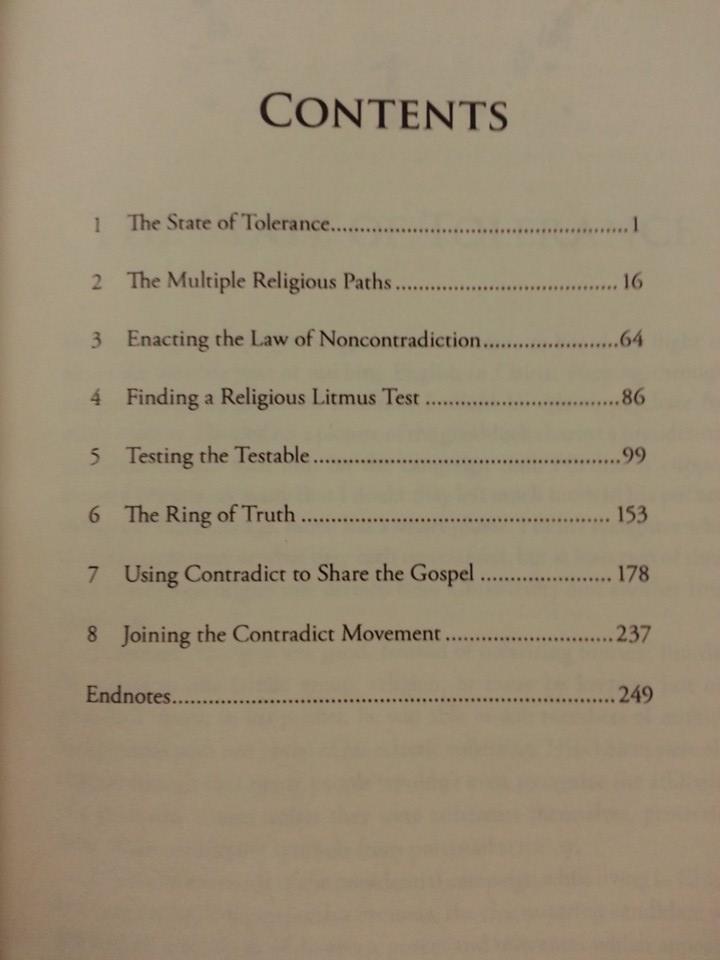
table of contents2My first published book is entitled, Contradict – They Can’t All Be True.  In case you have been wondering what’s inside the book before taking the plunge to order your copy, I have provided a brief overview of the book in this blog post:


Ch. 1 – The State of Pluralism

America’s state of religious pluralism stems from Hindu influence that crept in via the transcendental movement and came full force in the 60s counter-culture movement. The New Age Movement has direct parallels to Hindu beliefs, both of which lead to forms of religious pluralism. I share that the heart behind the movement is love, but that truth and love is lost in pluralism.

Ch. 2 – The Multiple Religious Paths

Many believe religious pluralism is true because Americans are religiously ignorant. Many of us don’t even know Christianity. So I give a 20 word glossary for Hinduism, Buddhism, Judaism, Christianity, and Islam.   If you know these 20 terms for each, you will know the basic history, teachings, and practices of the world’s five major religions.

Ch. 3 – Enacting the Law of Non-Contradiction

I then take direct quotes from the authoritative texts of each of those 5 religions and other minor religions and cults and put them under various doctrinal topics such as who God is, who man is, what mankind’s ultimate problem is, what the solution is to that problem to show the contradictions.

Ch. 4 – Finding a Religious Litmus Test

I present the historiographical tests for evaluating claims of the past and that Christianity offers a historical claim to prove or disprove the Christian faith – the resurrection.

Ch. 5 – Testing the Testable

I apply those tests to the Gospels. I present it in a way that I haven’t seen done yet in another book – so I think I’m contributing something new to the vast works that are already out there.

Ch. 6 – The Ring of Truth

I share what I call the ring of truth. The ring of truth can be found in the Bible’s details, its one unified message, its accuracy in predicting future events, and its uniqueness amongst the world’s religions.  I close this chapter by quoting Peter from Acts 2 and Jesus from Mark 16, “Repent and be baptized for the forgiveness of your sins.”

All of the book so far was in a non-Christian voice. I want anyone reading to not know where I am coming from – what I actually believe. I have not identified myself as Christian until the end of this chapter. It’s all fact based presentations. It turns me off reading most books of this nature because I don’t think my non-Christian friend would get past the first few pages in most cases the way they are written. The bias comes through too strongly in most of the books I have read making a case for the Christian faith.

Ch. 7 – Using Contradict to Share the Gospel

The Christian voice is out. This chapter focuses on sharing the Gospel using Contradict. It explains how I have used Contradict as a witnessing tool on college campuses and I explain the whole process if someone else wants to use it. I then give the 20 most asked questions after the initial conversational starter sharing that all religions can’t be true because they contradict each other, but that I believe Christianity is true and that Jesus is the son of God who died for the sins of all of mankind. Every question has several types of responses that should be utilized in the response. Validation responses show why it’s a good question and how you understand why it is being asked. Socratic method responses are questions that lead the person to the answer based on what they already know. Answer responses give multiple ways to respond to answer the question directly. Scripture responses show the verses that support the answer from God’s Word. Back the Gospel responses must always be used at the end of every answer. The Gospel saves, not our apologetics, so the answers must always be used to get back to the Gospel and often times the Gospel answers the question!

Ch. 8 – Join the Movement.

Why did I call Contradict a movement? The Holy Spirit moves each of us to action as he desires. There isn’t only one way, or method, to present the exclusive claims of Christ to be our only all-sufficient Savior. The Spirit might move some to share the Gospel exactly as I have using Contradict, but others might get other ideas on how to initiate the conversation. We might not all be led to success by the Spirit either. We might be led to persecution. Our role is simply to resign ourselves to will of God as the Spirit moves us to make disciples of all nations.

You can order my book here!

Norman Geisler – Science and Scripture? Nooooooooooooo!!!!

Norman Geisler – this bright, strong advocate for the Christian faith.  One of the greatest apologists, defenders of Scripture, in our age.  I just saw an article posted on his website… entitled, “Does Believing in Inerrancy Require One to Believe in Young Earth Creationism.”

In this article, he claims numerous times that it is possible to have gaps between the days of the Genesis accounts of creation (Alternating Day-Age Theory).  He claims it is possible to have a HUGE gap between Genesis 1:1 and Genesis 1:2 (Gap-Theory).  He claims it is possible that each day is lengthy epochs of time (Day Age Theory).  All of this is true.  Anything is possible.  He then rips all the arguments of a 24-Hour Day interpretation of Genesis 1.  He then provides arguments for all of the other theories.  He concludes by saying that the age of the earth doesn’t matter – it’s not important to salvation – it’s never been an essential doctrine or creed in church history – UNTIL NOW, of course.

What Geisler doesn’t do a great job of mentioning is that all of the views besides the “Young Earth” view have death reigning in the world before the fall of man into sin!  He also fails to mention that these other views (as of today) are arising not from Scripture Alone, but from the process of inserting prior beliefs into the reading of Scripture and performing interpretative gymnastics to pull out of Scripture the beliefs that were inserted into the text.

Please, read the article linked above, and then read my response.

I think we should note his hermeneutic – his formal principle. Norman Geisler writes near the end of this article, “If the Young Earth view is true, then so be it. Let the biblical and scientific evidence be mustered to demonstrate it.” This is not Reformation sola scriptura at work! That is my biggest complaint against the Old Earth crew. Members of this growing elite, such as Hugh Ross, claim that God has given us two books! Ross actually says “two books.” By this he means natural knowledge (general revelation) and revealed knowledge (special revelation). Since when does God’s revelation of himself through what he has created become on par with Scripture? I think that the Old Earth Creationists are starting with their conclusion that the world is very old based on their interpretation of what they see in the physical world and then interpreting Scripture in light of that presupposition.

From strictly reading the Bible, why would we suspect that there are gaps between the days in Genesis or that there is a gap between Genesis 1:1 and 1:2? From strictly reading the Bible, why would I suspect that there were millions of years of death in the animal kingdom with entire species being wiped off the face of the planet before the creation of Adam and Eve and before their fall into sin?

I agree with Geisler that one does not have to believe the earth is a certain age to be a follower of Christ – to trust in the salvation that comes through Christ’s work alone, but using “science” to interpret scripture is a bad hermeneutic and teaching death before the fall does not sit well with a very good world created by God. Many of the leading Christian apologists today are making claims that death in the animal kingdom was in the world before the fall of man and that there is where the huge problem lies! Death without sin is not Scriptural. God did not create a world of death. Teaching this as the Old Earth Creationists teach can very easily lead people away from Scripture and therefore away from God.

Go to www.contradictmovement.org to find links to my book, other merchandise, my Facebook page, and my Youtube Channel.

Discerning Law and Gospel when Interpretting Scripture

How do you interpret the Bible?  Most people ask questions such as:

1. Who wrote this text?
2. Who was first receiving this text?
3. What was the intent and goal of the author in writing to his audience?

These two questions can make a big difference in understanding the text.  Matthew for instance was writing to a Jewish audience trying to to show them how Jesus was the Messiah.  That’s why Matthew, of all the Gospels, quotes from the Old Testament Scriptures the most – showing how Jesus fulfilled them!

4.  What is the historical context?
5.  What is the cultural context?

These things do matter!  A whole other post is needed to address these.

6.  What is the context within the book?
7. What is the context within the rest of Scripture?

Context matters.  Have you ever been quoted out of context?  Did it completely change the meaning of what you said?  Yea.  Sound-bites kill context and meaning.  We should do our best to keep verses in their proper context.

8.  Greek and Hebrew?
9. Grammar?  Active vs. Passive verbs?  Singular vs. Plural nouns?  Who is the subject or object?  Etc.
10.  How else are these words used in Scripture?

You’ve heard that things are lost in translation.  Sometimes, going to the Greek and Hebrew can help.  A common example is that the word Love in English is only Love and can mean almost anything.  In Greek there are three words for love (agape, phileo, and eros – bet you can guess the meaning of the last one) and they all three have a different meanings, yet all three are translated into the same English word, love.

Answering all of these types of questions can help you understand the text as the original audience would have received and understood its meaning – it’s actually meaning.  The meaning doesn’t change.  The application, however, might change as the meaning is passed on to different cultures and historical settings.  Agree or disagree?  Leave a comment.

Now – to the topic of this post.  When you interpret a Scriptural passage do you ask yourself:

11. What is the Law in this passage?
12. What is the Gospel in this passage?

Law is what God tells you to do, what God expects of you.  Law shows you your sin and the consequences of those sins.

Gospel shows you your savior.  It is the work and actions of God alone to save you from your sins.  It is Good News!  Don’t take that to mean the Law is Bad News.  The Law is good too!  It just shows us our sin and our need of a savior.

Law statements might be implied or directly stated in a text.  The same for Gospel statements – implied or directly stated.

As we see these Law and Gospel statements we want to then apply them to our current culture, historical setting, and life.  When we are finished, we should be able to make an application of the Scripture to ourselves knowing what God wants us to do after hearing his Word and what he is doing for us to save us and bring us through this life to the finish line – i.e. Christ and eternal life with him in heaven.

I should probably write many blogs on this process and will likely do so.  For now, watch this video!  It gives examples of looking at verses and showing Law and Gospel statements that can be drawn from them.  Granted, I just look at one verse and show the Law and Gospel in it alone, not the full context of the passage that contains the verse – sort of breaking my interpretation rules – huh?

Drop me a line and let me know what you think.

Christ’s States of Humiliation and Exaltation!

I heard a message at my school’s chapel this week that covered the great Philippians 2 creed, the one that says, “Christ, who being in very nature God, did not consider equality with God something to be grasped, but made himself NOTHING, taking on the nature of a servant, being made in human likeness, in which he was obedient to the Father, unto death, DEATH ON A CROSS, and on account of his obedience, the Father had him raised and exalted him to the highest place, that at the name of Jesus EVERY knee shall bow and EVERY tongue confess that JESUS IS LORD!”  My paraphrase off the top of my head.  An awesome passage.  It details what is doctrinally called Christ’s states of humiliation and exaltation.  His state of humiliation commenced from the moment he assumed a human nature (his conception) until his death, at which point he entered into his state of exaltation.  Want more info…. watch this video!  Peace in Christ, Andy.