I saw Guardians of the Galaxy, yet this image’s text describing how an autistic boy received and responded to the movie is heartwarming.


Author of Contradict – They Can't All Be True.
I saw Guardians of the Galaxy, yet this image’s text describing how an autistic boy received and responded to the movie is heartwarming.
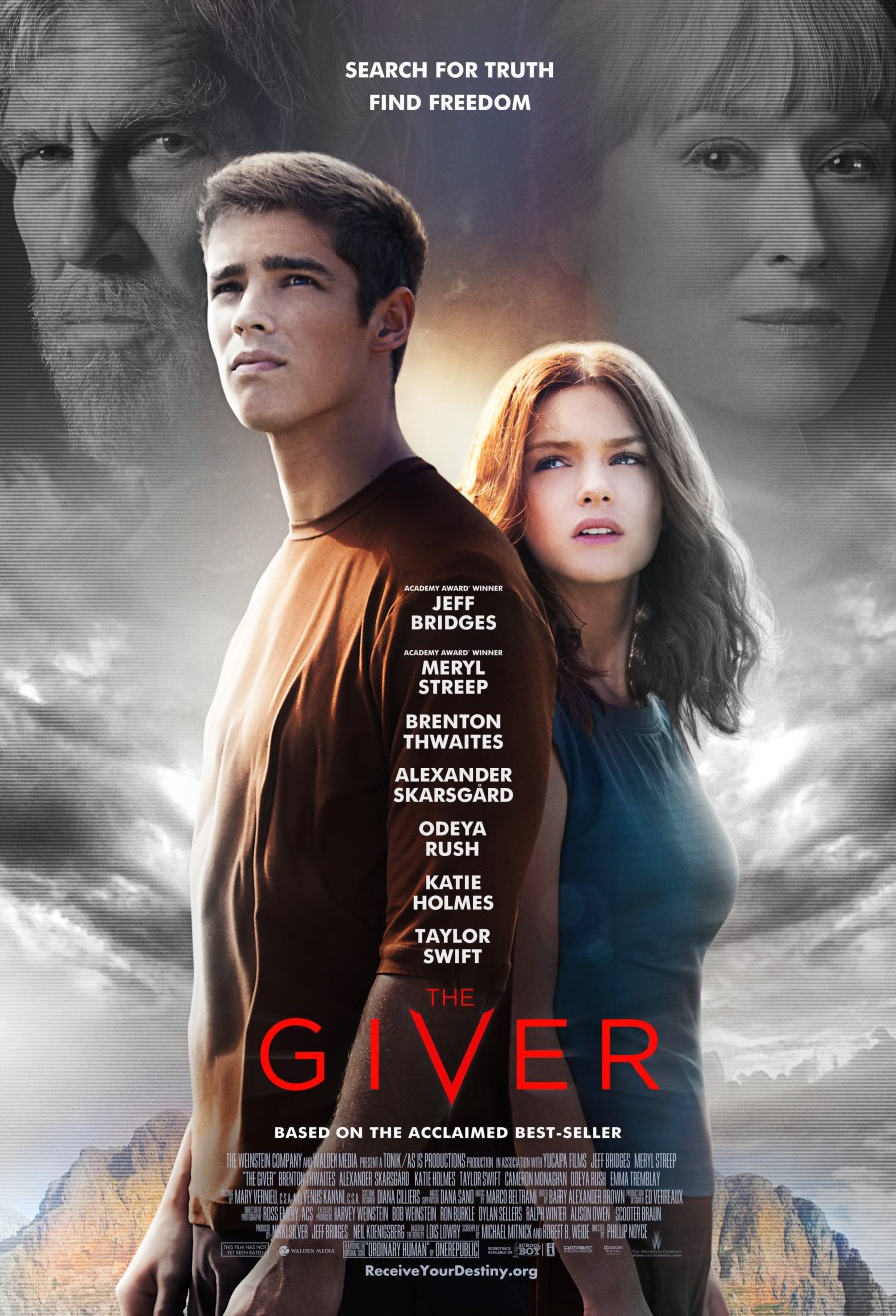
The Giver is a movie that has been completely off my radar. I have no knowledge of the book, and I didn’t even really know it was a movie, besides that fact that I tuned out as soon as I heard it had Meryl Streep in it. She has completely lost me as a viewer after her Oscar attempting stunts with that horrible movie she did with Tommy Lee Jones and her old, crazy lady performance in The Iron Lady, oh, and that other old, crazy lady performance in Osage County. But then… a post on Facebook caught my attention. It was a link to an article entitled, “Three Reasons Why The Giver is the best Christian Movie Since “Narnia”‘ The same day I read that article, Nolan J Matter sent me a review of a the article! So yes, The Giver, has caught my attention, but I’m not sure yet if I will see it.
I know Nolan from campus evangelism at Saddleback Community College. He’s a student there and I met him when he approached me about my Contradict Evangelism table. He initially thought I was an atheist and that he was going to have to share the Gospel with me. To his surprise, I was a fellow follower of Christ and he began to meet me every week for 2-3 months to sit at the table with me. I sense that Nolan will be a future, household name as a Christian known for proclaiming the Gospel and defending it vigorously. In his World Religions class at Saddleback Community College, he essentially pulled a God is Not Dead and asked his atheist professor if he could present Christianity to the class. Amazing young man and follower of Christ. With his permission, I asked him if I could publish his movie review, because I liked the Christian connection he made and the built in apologetic for Christianity within his review. Without further intro, here is Nolan J Matter’s The Giver review:
Last night I went to the cinema and sat through the production of The Giver. Now it is important to note that I had recently read an article entitled “Three Reasons Why The Giver is the Best Christian Movie Since ‘Narnia.’” After skimming the article, which I found quite interesting, I put it down…perhaps dismissing its relevance. But after watching the movie its relevance was all I could think of.
You see, during the last few years in my education, I have come across more than one professor who has outlined the atrocities committed by America; highlighting the bad, but some how forgetting the good. It seems that in the class room I hear daily of all the evil in the world; specifically all the evil America has committed. For my most recent assignment I had to read an article on the interment of Japanese Americans by the American Government. The article is titled “Then Came War” by Yuri Kochiyama, if you are interested in researching it. This article like many others from my classes seems to be outlining all the terrible things that America has done. The professors only want to discuss these types of articles; the type that talk about society’s mistakes. The premise of The Giver is that society has done away with evil; by creating a neutral society there is no evil—but there is also no good. In order to make life meaningful the Giver has to find a way to go against the society and bring back the memories of the past. The Elders in The Giver are against bringing back any past memories because they do not want evil and pain to be a part of their society.
At one point in the article “Then Came War” the author talks about an experience she had while she was on her way to the internment camp. Her train was stopped at the station when an older gentleman asked her to write letters to him. This act of kindness form a passerby, someone who she thinks could have viewed her as less than American, speaks volumes to the great good that humans can have—and give.
Of course there is great evil in the world, but would we as a society trade in love to get rid of hate? To be neutral so everyone can be normal? The Giver recognizes society’s flaws, he sees the evil of the world—he is the only one who sees it, and yet he is willing to unleash it on society? Why? Because he perceives the good—greater than any evil.
Most people have looked at America and said you have always been putting people behind walls, but shouldn’t our mindset be like the Giver and his rationale for wanting to eradicate the neutral society. Yes America has put people behind walls but America has also set people free. I will let you decide what has a greeter impact.
We cannot highlight the bad and leave out the good! We as Christian are called to share the good news not the bad news. Yes I understand that there is bad news, but if we are standing on a street corner condemneding people we are letting the evil have power over the good—are job is not to condemn, but to redeem. We as Christians need to emphasis the fact that all the evil in the world will be eradicated by the strongest good—Jesus Christ.
[End of Nolan’s review]
There will come an end to evil for all of those that are found in Christ Jesus. Amen, Nolan.

The following is an excerpt from my book, Contradict – They Can’t All Be True (FYI – the spacing doesn’t always transfer correctly from my PDF file to the blog):

A popular analogy that depicts an “all religions lead to God” form of pluralism is the story of several blind men touching various parts of an elephant and being unable to agree on a single description of the creature they’re touching. This story has connections to Jainism, Buddhism, Hinduism, and even Sufi Islam, a mystical branch of Islam. The story is found in the teachings of the Buddha within the Pali canon of Theravada Buddhism. One of the most popular versions comes from a nineteenth-century poet, John Godfrey Saxe, who rewrote the story in rhyme.
Though there are minor discrepancies among the versions, they all present the same basic scenario: since each blind man is touching a different part of the elephant, they disagree on what the elephant actually is. The one touching the tail might think the elephant is a broom; the one touching the side of the elephant might think the elephant is a wall; the one touching
the elephant’s trunk might think the elephant is a snake. Individually, they each know a part of the elephant accurately, but not the sum total of the animal. They fail to grasp what the elephant actually is because of their blindness. Their dispute is futile since they are all mistaken.
It is pretty clear how this story can be used within the framework of pluralistic relativism. Christians, Jews, Muslims, Hindus, Buddhists, and the like are all touching the same sacred elephant, God. But because all of humanity is spiritually blind, we are incapable of knowing God as he actually is. Any fighting among religious faiths is thus futile.
On the flip side, the good news within pluralism is that every religion is true based on what its adherents have experienced of the sacred reality. Since all religions have touched the sacred elephant, all religions lead to the same divine truth. Religious pluralists argue that if humanity could only come to “see” this predicament, all religious fighting could stop. We could recognize what each religion has learned about God and, by compiling the parts of the whole, come to a better understanding of who or what the nature and personhood of the sacred reality is.
The view of the divine expressed by the sacred elephant analogy is plausible and worth considering. Before considering the accuracy of its assertions, I want to stress the pluralistic uses of the story. Far from saying all religions are true, the story of the blind men and the elephant takes all religions and throws them under the bus, where they are left broken in their false perceptions of ultimate truth. As hopeful as this story can appear, in reality it just drops the bomb on absolute truth, at least absolute truth concerning God. The blind men show us that truth concerning God is unobtainable due to our limited faculties.
Skepticism toward God doesn’t invalidate this brand of pluralism. The problem lies within itself. Nestled within the story of the blind men and the elephant is a self-contradiction that makes the entire claim crumble in on itself. The pluralists claim that God is unknowable; every religion is wrong about its perceived understanding of the divine. However, in making this claim, the pluralists also implicitly declare they have an inside track on who God is. If no one is capable of knowing God due to our lack of sight in the realm of the divine, then what prescription glasses have enabled the pluralists to know the nature of God with such certainty? Pluralists are rejecting all exclusive truths concerning God, but making one themselves.
End of excerpt from Contradict – They Can’t All Be True.
In my book, I intentionally wrote with a non-Christian voice for the first six chapters. I first present what religious pluralism is and why its so dominant in our culture and society right now. I then demonstrate how religious pluralism doesn’t actually work logically. Responding to the elephant analogy was near the end of that section of the discussion before moving into presenting an evaluation of religious truth-claims and ultimately landing on the trustworthy nature of the person and work of Jesus of Nazareth to save us from sin and death and reconcile us into a right relationship with God! Since I wasn’t ready to let it out of the bag that I was a Christian yet in that stage of the book writing process, I didn’t respond to the elephant analogy the way I typically would. The following is a more complete Christian response to this popular analogy:
A critique of this parable would contain the following points:
Conclusion: Declare truth where truth is found!
It seems clear that all religions cannot be fully and equally true. There are direct contradictions within the teachings of the world’s religions, such as Jesus is God (Christianity) and Jesus is not God (Islam), which eliminate the possibility that all religions are true.
This however doesn’t mean that aspects of the truth cannot be found within various religions. Christians would do good to point these truths out from time to time. If Christ’s claim is true that he is the way, the truth, and the life (John 14:6), then all truth would be God’s truth, no matter where it is found. Where truth is found, declare it, use it, put it in its full context of which it is fully and directly revealed from God in the Bible. The Apostle Paul did when he quoted the philosophers of the Athenians (Acts 17). We can do it too!

I received an email question tonight that asked what the R represented in Contradict. The following was my reply:
The R contains an upside down Pentagram wrapped in a circle. It commonly represents Satanism. There is often an image of a Goat drawn into the star with the two up points forming the goat’s horns. This might be in reference to Matthew 25 where Jesus says that sheep go to heaven, and goats go to hell.
I have heard that the five point star facing upward has been used to represent the wounds of Christ: his head, hands, and feet. It would then make sense for the Satanist to flip it upside down; I know they have down that with the cross, they flip the cross upside down. Whatever God does they do the opposite of, or the backwards of. Although the upside down cross has also been shown as a good thing in some Church history and tradition as representing the cross of Peter, who according to tradition was crucified upside down by his own request because he didn’t want to to die in the same manner as his Lord; he was unworthy of such a death. So, don’t always think the upside down cross MUST be Satanic. Though in our day and age, it almost always represents an antiChrist position, or attitude.
But… the five pointed star has also been used to represent the five elements, common in many forms of paganism: earth, air, fire, wood, and spirit (I believe are the five elements). The pentagram facing upwards in a circle represents Wicca. Downwards is Satanism.
To know what all the symbols are in Contradict, I have made a video that says what they all are: http://youtu.be/gKXwkBQcXso?list=PLS-hGmUdPsUlNexQIjHflubJ6CSmfPbqL
I also made a video specifically for Satanism: https://www.youtube.com/watch?v=mQldtvPNEDY&index=5&list=PLS-hGmUdPsUlY3usoyKY0_DYA3PZKOsIC
As of right now, I have videos I have made for the first six symbols and here is a playlist for all of them: http://www.youtube.com/playlist?list=PLS-hGmUdPsUlY3usoyKY0_DYA3PZKOsIC
Finally, here is a playlist I have made for religions that goes into more detail on some of the religions than the Contradict videos: http://www.youtube.com/playlist?list=PLS-hGmUdPsUlnOvl4LM_rY0-eltl1IP6A
Dig around my Youtube channel and you’ll find more videos that are Contradict themed that focus more on supporting the Christian message of salvation through faith in Christ alone!
Thanks for getting a sticker and joining the movement. If you like the videos, you’ll love the book I wrote, Contradict – They Can’t All Be True. You can find links on the Contradict Movement page, and it’s on Amazon and Barnes’ websites.
Eventually, I’ll have group discussion guides for all the symbols in addition to the videos, and then we’ll be rolling! For now, a few of the complete discussion guides are on the CM website at the bottom of the home page.
Peace in Christ,
Andy Wrasman
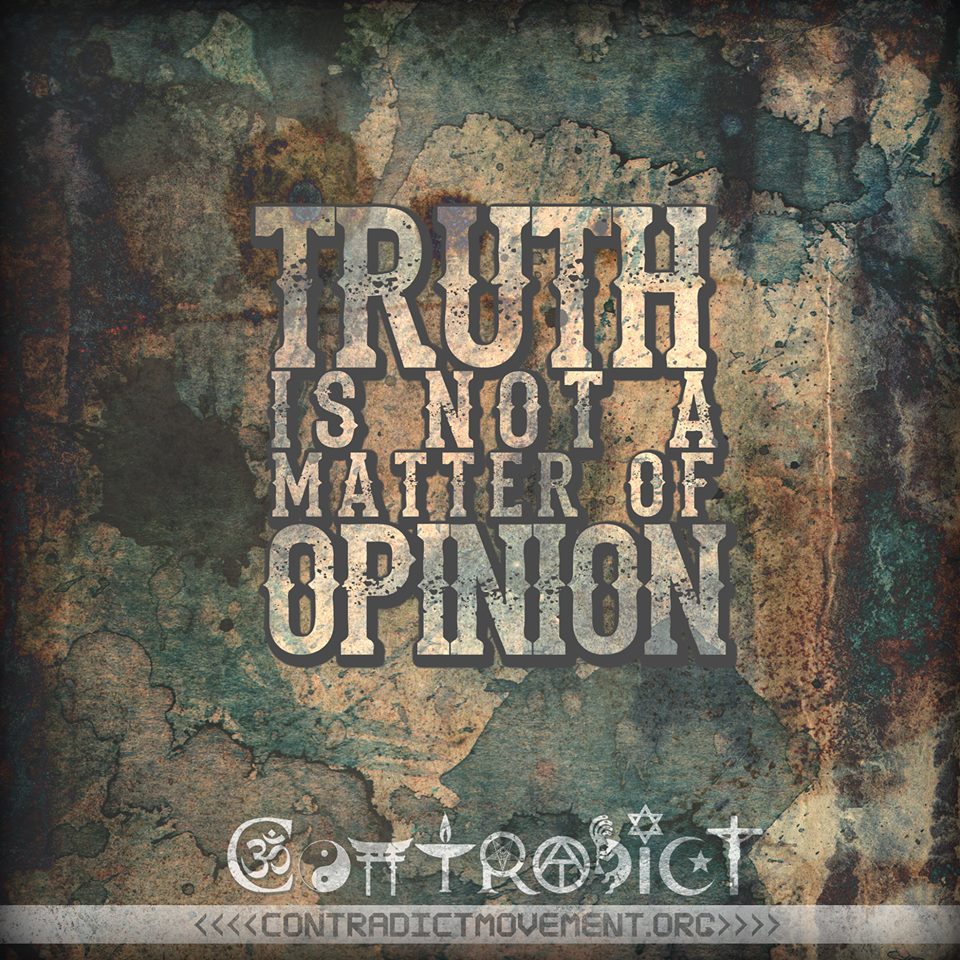
When speaking with famous atheist, Richard Dawkins, on his Fox News program, The O’Reilley Factor, Bill O’Reilley told Dawkins, “I can’t prove to you that Jesus is God, so that truth is mine and mine alone. But you can’t prove to me that Jesus is not God, so you have to stay in your little belief system.” O’Reilley’s statement fits into a view of truth called relativism. It is common to hear relativistic expressions within and without the Christian community. Relativism holds that truth is relative to each person’s experiences, culture, and needs. Since such guideposts for truth are not universal, truth is subjected to individual determination. Approaching all truth claims from a relativistic approach fails in three specific ways: failure to distinguish between subjective and objective claims, denies basic laws of logic, and is an inherently self-contradictory worldview.
First, relativism fails to distinguish between objective and subjective truth claims. Subjective truth claims are relative to each individual, because these claims deal in preference and personal opinion, often based on experience and feelings. For example, the best seats at a movie theater are the front rows. There are less people there to bother you, you don’t have anyone sitting in front of you to block your view, you always have a middle seat, and the screen encompasses the totality of your vision. I think the majority of the population would disagree with my claim, judging from my experiences of sitting by my lonesome in the front few rows of movie theaters. Others claim that the middle rows are the best. Others assert the back rows are superior. “The front rows are the best” is a true statement for me, but it might not be true for you, because determining the best row in a movie theater is based on subjective values.
Objective claims on the other hand lie outside of one’s individual partiality and experience for determining their truthfulness. They are unbiased claims that are determined to be true based on external realities that can be verified or tested. Objective claims pertain to facts, not opinions. Sticking with movie examples, the Best Picture of 2013 according to the Academy Awards was 12 Years a Slave. That is an objective claim. It can be factually verified to be true or false. If it were simply stated that 12 Years a Slave was the best movie of 2013, it would be a subjective claim, because everyone has a different opinion on the matter, but the specific Oscar winner of the 2013 Best Picture award is not a matter of opinion. A movie either won or did not win the Oscars for Best Picture. Relativism fails to realize this distinction by handling objective claims as if they were subjective, which is what Bill O’Reilly failed to do, when saying that “Jesus is God” is his truth, but not Richard Dawkins’ truth.
A second failure of relativism is its denial of basic laws of logic. When relativists state that all religions are true, they reject the Law of Non-Contradiction. The Law of Non-Contradiction states that “A” cannot equal “Non-A”. This means a statement cannot be true and not true at the same time in the same respect. Plugging statements into this equation, “Jesus is God” (Christianity) cannot equal “Jesus is not God” (Judaism and Islam). Already, the Law of Non-Contradiction has disproven the notion that all religions can be true, however the Law of Excluded Middle and the Law of Identity further demonstrate relativism’s denial of reason. The Law of Excluded Middle states that “A” is either “A” or “Non-A”. This means an objective claim is either true or not true. Jesus is either God or he is Not-God. Finally, the Law of Identity dictates that “A” is “A”; a thing is what it is. Therefore, if “Jesus is God” is a true statement, Jesus must be God.
A third failure of relativism is that it is a self-contradictory worldview. Relativists declare, “All truth is relative.” Yet, in their rejection of the existence of absolute truth, relativists are making an absolute truth claim themselves. If a relativist says, “There are no absolutes,” ask him, “Are you absolutely certain?” If a relativist says, “All truth is relative,” ask him, “Is that relative?” Such simple questions in response to relativism reveal the self-contradictions within such a worldview.
To answer this question directly, objective truth is not a matter of opinion. Jesus is God or Jesus is not God. We cannot have it both ways. The truthfulness of these two positions is not contingent upon our subjective experiences. This means that it is intolerant to claim that all religions are true, because it would require the erasure, or change, of all exclusive teachings within all of the world’s diverse religious faiths to make them one. If relativism is not intolerance in action, then it must be ignorance that fails to distinguish between subjective and objective claims, denies basic laws of logic, and embraces an inherently self-contradicting worldview.
Consider ordering my book Contradict – They Can’t All Be True!
 Andy Wrasman