Why are Some Books in the Bible and Others are Not #2

The Word Grows!

Dr. Franzmann in his book The Word of the Lord Grows explains that the Bible did not spontaneously appear, but that it grew over time through a gradual process.  He explains this by saying, “The canon is not being made; it is growing and being recognized.  This remains the case in the fourth century also, when the canon assumed the form it was destined to retain ever after in the Western church.”

This process of growth is easily seen when looking at the Old Testament.  As prophets wrote and the words of the prophets were confirmed by the work God did in their lives and through the fulfillment of their prophesies, their writings were seen to be God’s word.  Brad Alles notes in Life’s Big Questions, God’s Big Answers that Daniel 9:2 gives an example of the Bible’s growth.  This verse shows that Daniel was reading the Word of the Lord to Jeremiah the prophet and that he was counting the number of years prophesied for the Babylonian captivity.  God spoke to Jeremiah, Jeremiah wrote it down, it was collected, copied, and preserved, and later used by Daniel, who saw the fulfillment of that Word!

By the life of the apostles, the Old Testament canon had been set.  The books had been recognized by God’s people.  Jesus confirmed these scriptures, studied them, and taught from them.  Because of the evidence of Christ’s resurrection, we can trust that Christ is who he said he was – the Son of God, the Savior of the World.  This means that we can trust that God approves the Old Testament scriptures.  Jesus also put his stamp of approval on the apostle’s teachings when he told them in John 14:26, “But the Counselor, the Holy Spirit, whom the Father will send in my name, will teach you all things and will remind you of everything I have said to you.”

 

Contradictory Views of Mankind’s Ultimate Problem

Views of Mankind’s Ultimate Problem

The root words for religion, re (again) and lig (connect), indicate that religions are about reconnecting with something that has been lost. But what has been lost? What is causing the separation? What are the ultimate effects of this separation? How can the separation be overcome? The answers vary and they can’t all be harmonized to all be true.
  • Judaism – Adam and Eve disobeyed God and thus, their rebellion has brought mankind under a curse that involves struggle between the sexes, painful labor (both in child-bearing and work), and ultimately death.  The prophet Isaiah recognizes that such lawlessness has cut mankind off from God as he warns Israel, “Your iniquities have separated you from your God;
    your sins have hidden his face from you, so that he will not hear” (Isaiah 59:2).
  • Christianity – Romans 3:23 states that “all have sinned and fallen short of the glory of God.”  Romans 6:23 teaches that the penalty of that shortcoming by stating, “the wages of sin is death.”
  • Islam – Allah knows all and sees all, nothing is hidden from him and a day is coming when Allah shall bring judgment to everyone. (Surah 69:18).  At that time, “neither one shall avail another, nor any ransom (compensation) shall be accepted from anyone, nor intercession shall benefit anyone, nor any help will be given” (Surah2:123).  Humanity’s problem is facing Allah’s judgment on the actions of their life and ensuring that the good of an individual’s life outweighs the evil, of which Allah can be the only judge.
  • Hinduism – “Who sees the many and not the ONE, wanders on from death to death.  Even by the mind this truth is to be learned: there are not many but only ONE.  Who sees variety and not the unity wanders on from death to death” (Katha Upanishad Part 4).Our minds are deceived by the illusion called Maya that keeps us from all seeing the oneness of all things, and this deception on our part causes us to live within a cycle of death and rebirth.  We must find the one path that leads to immortality and escape Samsara, the cycle of reincarnation, and of the paths there are many with karma dictating the position of one’s next life.
  • Buddhism – The reality of this life is found in the mind’s perception of what is real and what is lasting.  The world is always changing, always in flux, and our minds and bodies with their desires and cravings resist change.  If our minds can’t acknowledge and accept this constant impermanence, pain and suffering are the natural byproduct.  The origin, or cause, of this suffering is our desires for gratification and success.  The Buddha taught, “The mind is fickle and flighty, it flies after fancies wherever it likes: it is difficult indeed to restrain” (The Dhammapada 35).
  • Christian Science – Mankind’s ultimate problem is being deceived by the illusion of sin, suffering, and death.  To the question, “Is there sin,” the answer provided within Mary Baker Eddy’s Health and Science is, “All reality is in God and His creation, harmonious and eternal. That which He creates is good, and He makes all that is made. Therefore the only reality of sin, sickness, or death is the awful fact that unrealities seem real to human, erring belief, until God strips off their disguise. They are not true, because they are not of God. We learn in Christian Science that all inharmony of mortal mind or body is illusion, possessing neither reality nor identity though seeming to be real and identical” (Chapter 14:472-473).
  • Atheism – If you are reading this text, you are alive, but the greatest problem you, and everyone else who is alive, is always facing in the atheistic worldview is death.  At death, you no longer exist, and that is mankind’s ultimate problem, our mortality.  Rocker, writer, and speaker, Henry Rollins expresses the atheistic view as such, “I don’t believe in an afterlife; you step on a bug, it dies; I shoot you in the face, you die, and you don’t come back.  That’s my belief.  OK?  There are no ghosts; there’s no afterlife; I’m not a spiritual person; I’m kind of a cash and carry type of guy, wash and wear.”

Henry Rollins – Joe Cole Part 1
Henry Rollins – Joe Cole Part 2

Contradictory Views of the Universe

the universe
How did the universe begin? Did it even have a beginning? What is the nature of the universe? Is the universe eternal? Or was it created? Does it have an end? Does the universe go through cycles?

Nature of the Universe

  •  Judaism – Genesis 1:1, the first verse of the Tanakh clearly states, “In the beginning God created the heavens and the earth.”  The universe and everything in it was created by God.  Except for humanity, who was uniquely created, the first man from the dust of the ground, and the first woman from the side of man, and except for God who is eternal, everything has come into existence out of nothing from the spoken word of God.  It is taught in the Genesis account that the Lord created all in six days and rested on the seventh and is from this structure of creation that the command for humanity to work six days and rest on the seventh is derived (Exodus 20:8-11).  Nature is objective and distinct and separate from a personal, transcendent God.
  • Christianity – The Christian Bible incorporates the teachings of the Tanakh concerning creation, and adds more details to them.  The first verses for the Gospel of John state, “In the beginning was the Word, and the Word was with God, and the Word was God.  He was with God in the beginning.  Through him all things were made; without him nothing was made that has been made.”  Christianity also shows that God is the sustainer of the universe as Colossians 1:17 states, “in him [Jesus] all things hold together.”  Nature is objective and distinct and separate from a personal, transcendent God.
  • Islam – The Qur’an doesn’t have the detailed narrative and specifics of creation as that of Judaism and Christianity, namely it lacks the order of creation that the Genesis account gives, but it is not mute on the subject and retains that Allah created the heavens and the earth in six days (Surah 7:54).  Nature is objective and distinct and separate from a personal, transcendent God.
  • Hinduism – The Rig Veda states that no one knows the origin of the universe, because none one observed it, but it also gives an explanation that the universe came into existence through the cosmic sacrifice of the God, Purusha, with everything being made from his body parts.  The Purusha explanation gives explanation to Hinduism’s teaching that all of creation is one, and that all is eternally divine.  However, this monistic reality is masked by an illusion.  As souls are subject to reincarnation, the universe is subject to cycles of death and regeneration.
  • Buddhism – Buddhism doesn’t have a specific teaching on the origin of the universe.  What is certain concerning the universe is that all things are constantly changing, and in this sense there is a new universe created every moment.  Linked to this permanent shifting is a complete lack of personal identity.  If you are never you, and I am never me, and everything is only classified for convenience’s sake, then what is the universe but nothingness?
  • Jainism – The universe is eternal, neither created nor made by a Creator God.
  • Sikhism – The universe is created by the one and only true God. According to Guru Granth Sahib page 1399, “He established the earth, the air and the sky, the water and the oceans, fire and food.   He created the moon, the stars and the sun, night and day and mountain; he blessed the trees with flowers and fruits.”24

These contradictory views of the universe are some of the contradictory teachings found in the world’s religions that this Contradict bumper sticker is attempting to bring to light.  www.contradictmovement.orgContradict Sticker


Don’t All Religions Lead to God? – #2

What do the different paths say about the problem of man and the offered solution?

Graveside Burial
10 out of 10 of us will die.

A pretty undeniable statistic is that ten out of ten humans die.  Humanity is mortal.  With this in mind the various religions have different answers to the problem of man, man’s inevitable death, and the solution to this inescapable end.  If the paths all lead to the same destination, these views on man’s ultimate problem, death, and the solution to that death should be very similar, if not identical.  A comparison of these teachings should be done in order to accurately answer the question of all paths leading to God.

Hinduism teaches samsara, a repeated cycle of birth and death from one body to another.

samsara
Samsara – AKA Reincarnation

This is commonly known as reincarnation.  The Bhagavad Gita explains this cycle in the following verse, “For the soul there is neither birth nor death at any time. He has not come into being, does not come into being, and will not come into being. He is unborn, eternal, ever-existing and primeval. He is not slain when the body is slain.” (Bhagavad Gita 2.20) How a person lived his or her life (karma) will then affect the position of life that person will have in the next one.  This cycle can be broken through various means which lead to self-realization, coming to the acknowledgment with the divine within one’s self.

8-fold path
Following the 8-Fold Path Leads to No Suffering.

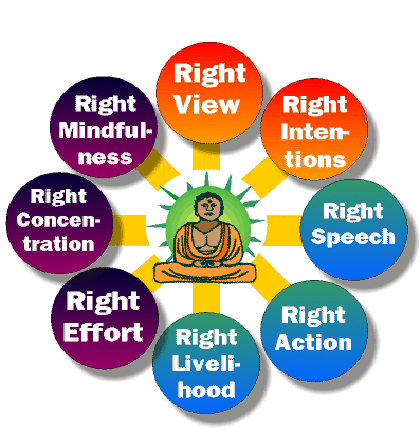
Buddhism is similar to Hinduism.  It started from a Hindu prince who broke from the teachings of Hinduism.  The Hindu teaching of Brahman, monism, that all is divine, was denied.  Samsara, or reincarnation, and Karma, to a degree, were both retained.  The focus was on answering the question of how to end suffering and how to find inner-peace.  Through seeking to answer these questions, Gautama Siddhartha, the Buddha, came to discover four noble truths.  The first noble trust is that to live is to suffer, and this is ultimately the problem of mankind.  The second noble truth is that suffering comes from desire.  To end suffering, one must put an end to desire is the third.  The fourth noble truth is that to end desire a person must follow the eight-fold path, which consists of right understanding, right intention, right speech, right action, right work, right effort, right meditation, and right contemplation.

Judaism has a God who has specifically revealed himself to one nation, Israel, and has made a covenant with these people.  This covenant contains the requirement to observe certain ceremonial laws to remain clean before God, as well as moral laws.  The penalty for breaking any of God’s law is death, following these laws while trusting in God’s grace and mercy should bring salvation and new life with God after death.  There are ways for people outside of Israel to be engrafted into the nation.  Judaism also contains the promise of a coming Messiah, a Savior of God’s people who will deliver them from their enemies and rule and reign with them for eternity.

Christianity teaches that Jesus was the Christ, the promised Messiah to the nation of Israel.  In fact, Christianity teaches that the Messiah came not just for the Israelites, but to bring salvation to all mankind.  Just as there were always non-Israelites engrafted into the nation of Israel, so the Messiah came for all people and nations.  Jesus being God in the flesh fulfilled all of the ceremonial and moral laws which mankind cold not.  The penalty of death as a result of falling short of God’s glory (sin) was also taken by Jesus as he died on the cross with the sins of the world upon him.  Man’s ultimate problem in Christianity thus is sin which results in death, and this problem is resolved in a great exchange in which Jesus, who is the second person of the Trinity, took on human flesh and fulfilled the law on man’s behalf and at the same time took mankind’s sins and the resultant penalty upon himself.  Christianity teaches that to receive this transaction of mankind’s sin to Jesus and Jesus’ righteousness to us, faith in Jesus is required.

Islam teaches that Allah is God and that he is coming to judge, the living and those

5 Pillars of Islam
The five pillars of Islam uphold the Islamic faith.

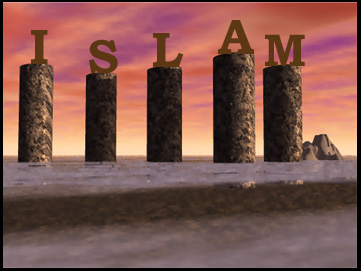
who previously had died.  Allah will pass judgment based upon a person’s good deeds and bad deeds.  If a person’s good deeds outweigh a person’s bad deeds, then he or she will be granted to enter paradise.  Muslims have no way of knowing if their good deeds outweigh their bad deeds or by how much Allah will require that their good deeds outweigh their bad to not be cast into hell.  The most certain way, which isn’t even certain, to be end up approved as good in Allah’s sight on the day of judgment is to follow the five pillars of Islam.  The five pillars of Islam are having faith in the creed that “There is no God, but Allah, and Muhammad is his prophet,” praying towards Mecca five times a day, giving 2.5 % of one’s income to charity, fasting during the month of Ramadan, and traveling to Mecca once in a person’s life.  The ultimate problem in Islam therefore is to be judged good at Allah’s coming and the best solution to this problem is to be submissive to Allah and to follow the five pillars of Islam.

So do all religions lead to God?

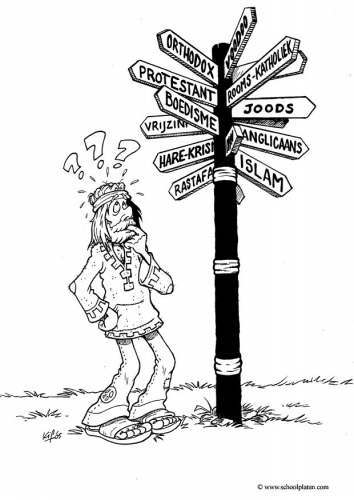
The statement that all religions lead to God is a statement that can only be made without having understood or studied the teachings of each religion.  Most religions contain similar aspects, such as morals and ethics, a sense of the divine, prayer, justice, and salvation, but even then these common aspects differ or may not be found in every religion.  To say that all religions lead to God would ultimately be taking the stance that all religions are false, since the views of God in the different religions are drastically different that they in fact contradict each either.

Desiring that all religions lead to God might derive from a heart that genuinely wants peace and tolerance amongst all the religions of the world, but unfortunately such a position is actually intolerant at the greatest measure possible.  To make all the religions lead to the same God or final destination for mankind would require all the unique teachings of each religion to be taken away, as if hacking them with a machete.  True tolerance of the varied and unique religions of the world would be to recognize their differences in teaching and maintain the individual’s right to belief.

Finally, homogenizing all the religions only leads to a denial of absolute truth.  Statements of contradiction cannot both be true.  They can both be false, but not both equally true.  The loss of seeking, finding, and valuing truth is at stake if someone were to legitimately profess that all religions lead to God.

Don’t All Religions Lead To God?

Don’t All Paths Lead to God?

Considering that people who suggest this ideology expect a God who is loving and completely good, and that these people honestly don’t want anyone to suffer for eternity, then sentiments like this one, that all religions lead to God, are easily understood.  Who wouldn’t want everyone to be spared from an eternity in hell?  If Hell is worse than the most painful, brutal suffering of this life extended for eternity, kind and compassionate people probably would have some grace to spare, even for Hitler.  The thought goes that so would an all-loving, good God.

If the question being asked revolves more around Hell and the love of God, then please look for other blog posts and articles. This post will focus more on the plausibility that all paths are equally true and valid paths to the divine or ultimate reality, whatever that may be.

What do the different paths say about the nature of God?

Hinduism essentially teaches that everything in the universe is divine.  Everything consists of the same divine, imperishable source, or energy, known as Brahmin.  This source is essentially impersonal, yet it is the make-up of all things in this life – water, air, earth, flesh, and etc.

Buddhism according to the traditional teaching of the Buddha is considered an atheistic religion with no divine being or source.  Everything, just, is, yet is always undergoing change.

Judaism teaches that the Lord revealed in the Tanakh (the Christian Old Testament) is the one true God.

Christianity teaches that the Lord revealed in the Old Testament is Lord, yet the New Testament reveals God through the person of Jesus Christ.  The Old Testament reveals God to be one in essence but three in person, yet this teaching isn’t fully revealed until the incarnation (the taking on of flesh) of the second person of the Trinity, Jesus Christ.

Islam accepts the teachings of both the Old and New Testament according the Quran, however, most Muslims will say that these written words from Allah have been distorted and changed.  Muslims claim that Jesus was not divine, that he was not the Son of God, that Jesus was a prophet and only a prophet.  At the same time, Muslims reject the doctrine of the Trinity.

religious paths
Do they all lead to the same mountain peak?

These are just a brief look at five of the world’s major religions’ teachings on the nature of God.  Based on the law of logic known as the law of non-contradiction, two statements that directly contradict each other cannot both equally be true.  They both can be false, but both statements cannot be true.  To put this into an equation, A cannot equal Non-A.  To plug in two of the teachings just mentioned into this equation, we see that, Jesus is God incarnate (Christianity) cannot equal Jesus Christ is not God incarnate (Islam).  From this example it must be concluded that both of these statements cannot be true statements.  However, both statements could be false.