Praying for God’s Healing

The Bible is full of miraculous healing.  Are we to pray for such miracles today?  Should we expect those prayers to be answered?  If they are not answered, were our prayers not heard?  Were our prayers not in line with God’s will, were they spoken out of doubt and thus not positively answered? In no particular, systematic order, the following are verses that I think aid in answering these questions:

James 5:13-16 – If I am ever really sick, I will follow this protocol.  I’ll call all the elders of my congregation together and other members of the congregation, as well as my close Christian friends, and I’ll have them pray for me.  I’ll also confess my sins.  This passage says that the prayers of a righteous person are answered.  I think this shows us that that God does not just care about our physical healing.  He also cares about our spiritual healing.  After all, it is our spiritual condition that brings all manners of illness and bodily breakdowns into our lives that lead us to death.  That condition is being a sinner. (Romans 6).  This passage from James also shows me that we are to pray for one another, sharing each others’ burdens, lifting them up to the Lord, who alone is the giver and sustainer of physical life. In this passage, there is mention of praying over a person, or as some translations word it, the laying on of hands.  This is one passage that church’s derive the practice of laying hands on a person for whom they are praying.  However is physical proximity a requirement for healing or answered prayers?

Luke 7:1-10 – This passage shows us how Jesus healed a man’s servant from a far distance.  The man who made the request was nowhere near his servant when he asked Jesus to heal him.  He was however close to Jesus, which I think harkens back to being in a righteous (in a right standing before God) when making our prayer request.  Obviously, though being in close proximity to the person who is sick when praying for him or her certainly helps comfort the ill in a way prayer from afar that is also unheard by the sick would not do, if the person is not healed.

Luke 18:9-14 – This passage is a parable that Jesus gave.  I am connecting this passage to James 5:13-16.  James says that the prayers of a righteous man are answered, but who is righteous?  In this parable, Jesus tells of a Pharisee who appears to be very righteous and he boasts publicly in his prayers about all that he has done right for the Lord over and above other men.  However, there is a tax collector nearby who simply beats his breast and confesses to the Lord that he is a sinner and asks for forgiveness.  Jesus says that the tax collector is the one whose prayer is heard, who is justified before the Lord.  The Pharisee was not in touch with his own sinfulness.  I really think this is key for physical healing, first confessing our sins and receiving the grace of God that comes through Christ, because a person offering a prayer under those conditions, certainly has faith in Christ.  A person with that heart position offering the prayer also has God’s kingdom first.  You see, God cares first for our heart (our spiritual condition) because if we are not cleaned by Christ of our sins, no matter what healing we receive in our physical bodies, we are still destined to die for the sins we have committed, and we are still facing eternal damnation, which God desires of no one (2 Peter 3:9).

James 4:2-3 – This passage connects to what I just shared with the last passage.  The heart behind the prayer matters to the Lord.  James says we don’t have because we haven’t asked.  If we don’t ask the Lord for physical healing, he might give it to us anyways, but if we never ask, then maybe that’s why we don’t receive the miraculous healing.  This passage also says that we don’t have if we ask from the wrong motivation; that is from a sinful motivation.  Again, confessing sins is connected to prayer, asking that God sets our hearts in alignment with his will, that our requests will be pleasing to him because they don’t stem from our worldly passions and desires.

John 14:13-14 – I imagine that this verse is one that raises questions for many people who ask for healing in the name of Jesus, yet healing isn’t experienced, and maybe worse, the person who was prayed for dies.  This verse says that if we ask anything in Jesus’ name, he will give it.  If the prayer is in his name, it will be inline with his will and it won’t spring from our sinful desires.  I’m connecting that statement back to the previous passage from James.  However, when it comes to healing, I think it’s safe to say that God doesn’t desire for us to die.  I already cited 2 Peter 3:9 to support this teaching.  Yet we also know that suffering can benefit believers, as shared by Paul in Romans 5:3-5.  Yet, if we ask in his name we should receive what we ask for according to this passage.. so how do we explain this?  Not all prayers are answered immediately, or the answer is immediate but we don’t receive it immediately.

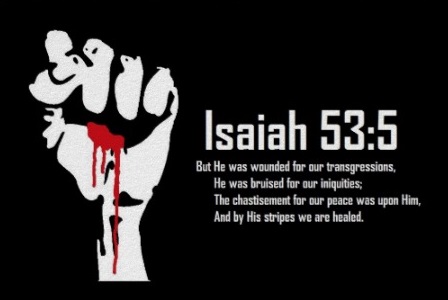
Isaiah 53:5 – We are healed by Christ’s stripes.  By his wounds we are healed.  First this isaiah 53is spiritually.  We are born again and reconciled to God.  The complete and total physical healing, doesn’t come until Christ’s return and we are raised to life with new, imperishable bodies as spoken of by Paul in 1 Corinthians 15. This means that if the person is a believer, even if he or she is not healed in this temporary life, that Christian will be healed in the life to come, and therefore Jesus has kept his promise.
Romans 8:28 – This verse is certainly a promise from the Lord!  It’s important to note that the Lord works for good through all things for those who love him.  Those who love him, know him, and are saved.  For those who die apart from Christ, we can’t find a good for that individual through their death; they have been cut off from the land of the living and from the Lord of life.

Mark 6:5-6 – In Jesus’ hometown, he could not perform many miracles, because the people lacked faith.  They didn’t believe.  Again and again, when someone is healed by Jesus, he tells them that their faith has healed them.  This indicated that it is not just the faith of the person praying involved with miraculous healing, but the faith of the person receiving prayer is also a component to miraculous healing.

Daniel 10 – This chapter is fascinating to me.  Daniel prays for three weeks straight with fasting.  On the twenty-fourth day, he receives a vision.  The angel in the vision says that Daniel’s prayer was answered the first day he prayed, but that a demon kept him from getting to Daniel to deliver the message of the Lord.  I wonder, if this still occurs.  Are our prayers answered immediately, but for some reason, in some way, the works of the devil and the other demons, keep them from arriving to us the moment they are answered?  How often has this occurred for us, but we haven’t been persistent in prayer, and thus when the answer comes, we don’t even make the connection that the answer is to prayer?  I don’t know about you, but in my sinfulness, I am not always persistent in prayer until I receive the answer.  I can’t tell you what I prayed for twenty-four days ago.

Mark 8:22-26 – Not all of Jesus’ miracles were immediately complete.  This is an example of a partial healing.

1 Corinthians 12:4-11 – Some argue that all of these gifts are not for today.  I am not one of those people.  In this list of spiritual gifts, we see the gift of healing listed.  All of these gifts are from the Spirit and given in proportion to each individual as he sees fit.  Because of this, some people might see more healing in response to their prayers than others.

Luke 11:5-12 – Fascinating.  Jesus says we can be given more of the Spirit when we ask for more of the Spirit.  If prayer for healing is a gift of the Spirit… I’ll let you finish that sentence as you pray and think about these verses.

These verses of course are not all encompassing of everything revealed in Scripture concerning prayer, and in particular prayer for healing.  But they are a start if you are finding this from an Internet search.  Please leave some comments if you have more verses to share, or other applications and information about the verses listed here.  And feel free to leave questions too.  You can contact me personally at andy@contradictmovement.org.

Reconnect Episode 8: Three Things Christians Say to Hurt Their Credibility

Left click here to listen now! Right click to download episode.

Listen in iTunes.

George and Andy, discuss a series of articles from Credo House entitled: 21 Things Christians Say to Hurt Their Credibility.  In this episode they have time to discuss three of these statements:

1. “You can’t use the Bible to prove the Bible.”

2.  “Good question.  I’ll find the answer and get back to you.”

3.  “One white lie will send you to hell for all eternity.”

We want to be credible witnesses of Christ.

Andy and George agree that some of these statements really do hurt the credibility of our Christian witness and should be avoided, but they come to disagree with at least one of these articles, because they think the statement is in fact Scriptural, thus should be spoken, but maybe there is a better way of presenting the truth to a nonbeliever.

Other questions and topics emerge as they discuss these articles, such as: how do we know the Bible is the Word of God, how should we respond to questions we don’t know the answers, is it possible for Christians to have all the answers to life’s questions, what exactly is revealed to us in Scripture and why, how should we approach preparing answers to difficult questions raised against or about the Christian faith, why should churches teach apologetics, and the very controversial topic of varying degrees of punishment in hell!

If you want to chime in on any of these topics or give a short review of any episode of Reconnect, record a short 30 second to one minute long audio clip, stating your name and the episode number you are addressing, and send it to Andy at andy@contradictmovement.org as an mp3 file.  If you have any questions you want addressed on the show, send them there via email as well.  Thanks.  Reconnect us, Oh Lord. 

Ashes to Ashes and Dust to Dust. From Whence We Came We Shall Return.

Why do we put ashes on our foreheads on Ash Wednesday?

Ash Wednesday is the first day of Lent.

Lent is a season of the church year. It is a season of penitence. Penitence means remorse for wrongdoings, in this case our sin.   Lent is a preparatory season, which means we are preparing for Jesus’ death and resurrection.

ash-wednesday

The question then is, “why the ashes for repentance?”

This comes from the ancient biblical tradition of covering one’s head with ashes, wearing sackcloth, and fasting.

Let’s see this tradition made visible in scripture.

Daniel 9:1-6, 17-19

Jonah 3:1-10

Other parts of scripture also show this practice for penitence and mourning.

On Ash Wednesday the church carries on this ancient tradition of using ashes.

On Ash Wednesday churchgoers are marked on the forehead with a cross of ashes.

Symbolism of the ashes:

The ashes remind us that . .

– Death comes to everyone

– We should be sorry for our sins.

Where does this symbolism come from in Scripture?

Genesis 2:7

Genesis 3:1-5, 19

God made the first human being by breathing life into dust, and without God, human beings are nothing more than dust and ashes.

Genesis 18:27

In Conclusion, putting on ashes is a symbol of the death that we so rightly deserve because of our sin. The ashes are in the form of the cross because it reminds us that God in his mercy gave us his Son, Jesus, to take our sin and death and die in our place.

The people of Colossians 4:7-18

At the close of Paul’s letters he will often times send greetings to and from certain people and updates about others.  It’s easy to just skip these sections, but these farewell blessings and news bits are still considered Scripture, and thus are important.  Paul’s letter to the church in Colossae is one such epistle with a litany of names, places, and greetings.  Here’s a rundown of who these people are:

(First read Colossians 4:7-18)

Colossians 4:7 – Tychicus

His name comes from the Greek word, tygchanō, which means, “to hit the mark” or “to meet one”.  The word sin comes from the Greek, hamartanō, which means “to miss the mark”.  When we sin we are missing the mark of Christ’s righteous standard, his law. In Christ, God sees us as having “hit the mark” because Christ’s righteousness is our righteousness.

Paul describes Tychicus as a “beloved brother and faithful minister and fellow servant of the Lord.”  The word for minister in Greek is diakonos.  This word desribes “one who executes the commands of another, esp. of a master, a servant, attendant, minister”.  This word often times was used to describe the servant of a king.  For Paul and Tychicus, this servitude was under the kingship of Jesus Christ.  With this understanding of minister Tychicus was executing the commands of King Jesus as he delivered Paul’s letter to the church in Colossae.

Ephesians 6:21 -Tychicus was also the one who delivered Paul’s letter to Ephesus.

Acts 20:4 lets us us know that Tychicus was from Asia.

Colossians 4:9 – Onesimus

Onesimus accompanied Tychichus to Colossae.  He is called a “beloved brother” but he is not called a co-worker in Christ as Tychichus is because at the time Onesimus is a slave!

Philemon 8-11 – We learn that Onesimus is a slave from Paul’s letter to Philemon.  Philemon is a letter Paul wrote on behalf of Onesimus to his master, Philemon.  From this letter we learn that Onesimus was a runaway slave of Philemon, a believer.  After running away from Philemon, Onesimus becomes a Christian himself.  Onesimus means “useless” and Paul writes to Philemon saying that formerly he was literally useless!  Maybe he was useless because he ran away, or maybe he was a very poor slave.  Now Paul says that Onesimus is useful.

Colossians 4:10 – Aristarchus

Paul calls Aristarchus his “fellow prisoner”.  The etymology of the word for prisoner that is used in this verse comes from the Greek word, aichme, which means “spear”.  This indicates that Paul is viewing Aristarchus and himself as “prisoners of war”.  They are ones that have been taken!  Not just imprisoned.

Going back to the minister understanding mentioned with Tychicus, Paul and Aristarchus are servants charged with executing the commands of their king, Jesus Christ!  To capture a king’s ministers is an act of war.  This really is Paul’s mentality throughout his ministry.  The war language and theme run throughout his works.  I think it will serve us a great interest to approach everyday life in God’s Kingdom as being at war.  We are not at ease in this life.  Recognizing the constant state of war we find ourselves, we will be spurred on to follow Paul’s plea to put on the full armor of God as Paul commands us in Ephesians 6.

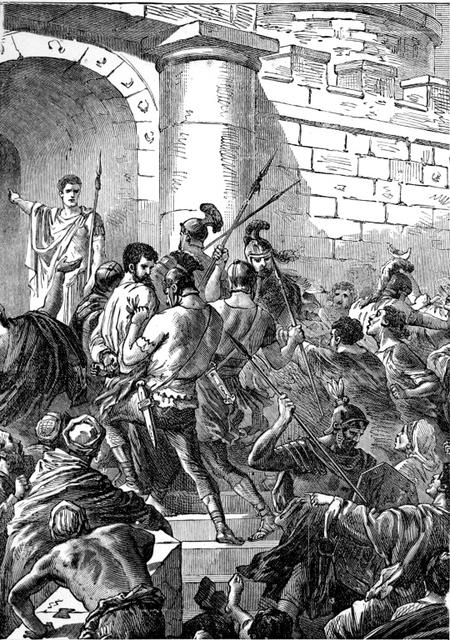
Acts 19:29 – Aristarchus was present at the riot at Ephesus and was dragged away by the mob.  Read the full account in Acts 19:21-41.

Aristarchus grabbed in the riot at Ephesus - Acts 19.
Aristarchus grabbed in the riot at Ephesus – Acts 19.

Colossians 4:11 – Jesus also called Justus

This verse is the only time that Justus is mentioned in the Bible.  We see from this verse that he was Jewish, as well as Aristarchus.

Colossians 4:12 – Epaphras

He’s mentioned in Colossians 1:7.  Since Paul says the church in Colossae learned the Gospel from Epaphras, he is most likely the church’s founder.

He is called one of them, so he is Colossian.

Paul says that Epaphras is always struggling on in his prayers on behalf of the Colossians.  This language still harkens to that of war.  His prayers are a struggle.  From such descriptions we can draw the often time used description, “Prayer Warrior”.

Colossians 4:14 – Luke and Demas

We read that Luke is a physician.  This Luke is the author of the Gospel of Luke.

Demas sends his greetings along with Luke, but in 2 Timothy 4:10, we learn that Demas deserted Paul.  Maybe he left the Christian faith, or maybe he just was afraid of sticking with Paul, afraid of imprisonment and death.

Colossians 4:15 – Nympha

This is a male or female name.  Some manuscripts say that the church at Laodicea met at “her house” and others say “his house.”

Colossians 4:17 – Archippus

He is mentioned in Philemon vs. 2.  There he is called a “fellow soldier” (again war language) and we learn that a church congregation met in his house.

From this study of the names at the end of Colossians, we can be encouraged to know that God has blessed and equipped the Body of Christ with a wide assortment of gifts, roles, and personalities.  We span different nations and language, yet we are united in Christ.  Some of us will own property that is useful for the church, as we will be generous enough to offer it.  Some of us will be in vocations like Luke, a physician, whose skills will be very useful within the Church and for our neighbors in the world.  Some of us will be like Justus, called to a people not our own.  Some of us might appear to be useless like Onesimus, but through Christ, we will be reworked into instruments for the Kingdom of God we will be useful, minsters and supporters to the leaders God has appointed within his Church.  Some of us will be prayer warriors.  We may not be on the front lines preaching the Gospel, but we might be constant anguish, praying for those who are.  Some of us might be prisoners of war, and all of us are co-workers and soldiers for Christ.  And thanks be to God, that through the person and work of Jesus Christ, we all are seen to have hit the mark, just like Tychicus’ name implies.  And may we be able “to meet others” as that name also implies and join them into Christ through the sharing of the Gospel of our risen King Jesus.   

Where is Jesus in Song of Songs 7:7-9?

I recently made the statement that virtually any topic or aspect of life can be connected to Christ and his saving work.  In reply I was challenged to show Christ in Song of Songs 7:7-9.  I do think adding imagery of Song of Songs 7:7-9 to this blog post would be a misstep, so I won’t add an image, but those two verses read:”Your stature is like a palm tree, and your breasts are like its clusters.  I say I will climb the palm tree and lay hold of its fruit.  Oh may your breasts be like clusters of the vine, and the scent of your breath like apples, and your mouth like the best wine.”

I accept the challenge.

The institution of marriage points to the marriage of Christ with his Church.  The deep passion and love and longing to be with his bride that Solomon expressed points to the deep passion and love that Christ has for his bride, us.  Though we are apart he longs to embrace us.  Sexually?  No.  But as an object lesson, the sexual longing between a betrothed man and woman serves to show the deep desire we have, and likewise Christ has, to be reunited with us.  Israel is called the Bride of God in the OT and the Church is called the Bride of Christ in the NT.  That’s the route I would go to show Christ in Song of Songs 7:7-9.

Song of Songs 8:6 says, “Set me as a seal upon your heart, as a seal upon your arm, for love is strong as death, jealousy is fierce as the grave.  Its flashes are flashes of fire, the very flames of fire, the very flame of the Lord.”  Are we not beautiful to the Lord?  Has he not placed his seal upon us, put his name upon us?  Is he not a jealous God?  And does not his love defeat the grave?  And does his flame not destroy all that separates his Bride from him?

Song of Songs 8:7 says, “Many waters cannot quench love, neither can floods drown it.  If a man offered for love all the wealth of his house, he would be utterly despised.”  Christ is our ark!  The floods of baptism will not drown us.  They drown the sinful man, but not the new creation.  In Christ, we are wrapped up and protected, as a groom wraps up and protects his Bride.  The two are one and if it be true love, all the money in the world could not buy it.  So death cannot separate true love, and neither can money buy it.  All the riches in the world that Satan laid before Christ’s feet did not take him away from us, and the death he died did not take him away from us, instead it united us to him and the union possible, for he bought us, not with money, but with his very  life, his shed blood on the cross.  Solomon of all people, with all the riches and lovers a man could ever have in this world, should know better than all people that the stairway to heaven cannot be bought.  That store is closed.

Song of Songs demonstrates proper marital love, from which new physical life is born.  Interpreting this book as a depiction of Christ and the Church, we see how new spiritual life is born.

christ-and-his-bride