It’s the Prince of Peace, Man!

I went to http://www.peacemonger.com.  It’s the website that spearheads the “Co-exist” bumper sticker and t-shirt campaign.  If you visit their site you will see that they sell numerous stickers that advocate for Hinduism or “religious pluralism.”  When they have “Jesus” stickers they are usually condescending, or simply cut-off any aspects of the Gospel narratives that pertain to Jesus being divine, a miracle worker, the Savior of the World, and a harsh judge (which he did quite a lot).

I bought a sticker from their site that says, “It’s the Prince of Peace.”  It has an image of Jesus flashing a “peace sign.”  What exactly does this mean?  Was Jesus a hippie who dropped acid and listened to Hebrew jam bands (I know a stereotype of the 60s counter-culture, so I am committing the same error that this sticker is, but I am trying to figure out what the sticker means.)?  In the context of “Co-exist” and other pluralistic messages from Peace Monger, I think the sticker is trying to say that Jesus is the Prince of Peace, so he wouldn’t be judging other religions as right or wrong, he’d just be loving, accepting, and tolerant of everyone.  Notice what I just did, I moved tolerance and acceptance into a realm of making no judgment calls on what is true and what is not true, which leads to one of two routes, everything is true or everything is false.

Anyways, here’s a video I shot addressing this sticker’s message (whatever it actually is).  I thought it’d be best to start by sharing where the title for Prince of Peace in relationship to Jesus originates and how Jesus was and is the Prince of Peace from a Christian Biblical worldview.

Note: the video is completely ad-lib.  I went in knowing I would share Isaiah 9 and Matthew 10:34-36.  We shot this like 5-6 times and every time different points and verses were shared and none of the shots had a strong conclusion and usually ended awkwardly.  This was one of the better versions, although there is another one that I really like that I might be able to edit to have a conclusion. That’s why this video ends a little sudden without a strong finish…

I’d love to hear feedback and I hope this is helpful to you.
Contradict Movement – First Animation!

I saw a Go Animate video put together by a student for a class project.  It got me thinking, maybe I can make a Go Animate video for the Contradict Movement.  I managed to make a Jesus character and a Buddha character.  I wanted to share a lot of verses from Jesus’ own mouth, so this was a great way to do it.  About 95% of everything the Jesus character says in this video is all “words in red!”  That’s what I like so much from this video.

If the verses I have quoted in this video are all true, and I firmly believe they are, they are the best news anyone can hear!  There is life after death, death has been swallowed up in victory.  Jesus is our all sufficient Savior and he loves us all, so much, that he innocently died in our place, like a an exchange on death row!

The downside, the side that brings me tears, is that if the verses quoted in this video are all true, and I firmly believe they are and that there is historical proof that they are, then all must repent and call upon the name of the Lord to be saved.  Apart from Christ there is no salvation is what these verses claim, so it’s great that our savior is revealed, but they also reveal the depth of our sinfulness, we must be in Christ to be a new creation, to have eternal life.  Many are not.  Many actually believe that it doesn’t matter what we believe as long as we do good.  But all of us have fallen short of God’s standards and we aren’t good in his sight, no matter how much we serve the poor.  The only way to be seen as good in the eyes of the Lord is to have the righteousness of His Son, which only comes from faith in Christ.  Don’t fool yourself – yoga leads to death, the eight-fold path leads to death, the five pillars lead to death, observing the Laws of Moses leads to death, and so on and so on.  For it is by grace we have been saved, through faith, and this not of ourselves, for it is a gift, so that no man may boast.

Rip Van Winkle Fell Asleep

I heard a song called, “Rip Van Winkle” and a line in the song says, “He went to sleep” and “When he woke he had grown old, he had grown old.” Here are some of the thoughts that came from hearing that song:

A barren, rock valley is filled with a sea of monsters.  Blood-thirsty vampires share company with werewolves and various undead beings of the night.  Ogres, goblins, and demonic figures of various sizes, shapes, and colors wield swords, clubs, spears, axes, and maces.  Some of them sit upon ferocious, dragon-like creatures.  They all gazed up the slopes of the valley.  Deep, angry growls filled the air.  Yellow-stained fangs gnashed.  In rage, they even tore at their flesh with razor-sharp claws.  Their hatred was channeled upon a band of humanity on top of the valley wall.  A great battle is about to erupt, except none of the men are ready for battle.  They stand empty-handed in their daily clothing: doctors, lawyers, farmers, construction workers, truck drivers, students, clerks, baristas, and others.  Fear grips them all.  Their enemies below are thirsty for blood.

From nowhere, a man atop a majestic white horse appears in the midst of the hopeless resistance, if they should even be called that.  He is clothed in a white robe with a breastplate of sparkling stones, twelve stones, just like the breastplate worn by the high priests of ancient Israel.  The evil army’s confidence vanishes at his entrance.  Smiles came to the men; they knew this man, and so does the demonic horde below.  The rider is Jesus.  At once, the rag tag battalion atop of the valley is adorned in white robes and similar breastplates, each now with a sword in hand. With Jesus, their fear is gone.  The white horse sprang up onto its hind legs to fall into a gallop down the valley walls.  The Christians surge down with him to greet the army of darkness in battle.  That’s when my friend awoke.

This dream, which my friend Danny had during the summer of 2010, is reminiscent of the famous Battle at Helm’s Deep in J.R.R. Tolkein’s Lord of the Rings.  The men of Rohan were greatly outnumbered against the dark forces of the Wizard Saruman.  It likely would be the last battle for the Rohirrim, but at the break of dawn, the Wizard Gandalf appeared mounted on a white horse with reinforcements, only a thousand strong, but with the light of the rising sun they charged to meet the darkness of evil.  Darkness chose to flee into the forest where they were slaughtered.  For J.R.R. Tolkein, who was a Christian, this scene must have symbolized the Light of the World, Jesus, breaking into the darkness of Satan’s kingdom.

Dreams as vivid as Danny’s, which serve as alarm clocks to arouse the dreamer to the spiritual war of this life, aren’t given to all dreamers.  The mythologies and fantasies of men throughout the ages serve as additional wake up calls to the supernatural battle between good and evil.  Too many people hit the snooze button and choose to sleep like Rip Van Winkle.  In case you aren’t familiar with Washington Irving’s story, Rip was quite a lazy fellow who avoided profitable work.  When America was still under British rule, he went into the Catskill Mountains with his dog and rifle.  Intending to only take a short nap in the woods, Rip fell asleep for twenty years.  When he awoke, he discovered that he had slept through all of the American Revolution.  Life had passed him by.  Are we going to be like Rip?  Will we be disinterested in the important chores of life? Will we sleep through the war over the souls of men? Or will we choose to fight like the heroes of Seventy-Six, the men of Rip’s days who joined the revolution?

If the conjectures that can be drawn from these images are correct, there is a battle of epic proportions occurring in this present life.  Embracing such imagery and applying it to my life is simple for me.  My favorite movies involve bloodshed, and as a rather competitive man, who loves contact sports, I live life with an aggressive mindset and attitude.  The application of this battle imagery isn’t as easily digested for everyone.  Society as a whole is stepping away from engaging conflict and controversy.  Ignoring contradictions in various worldviews and seeking pluralism at the cost of the exclusive truth-claims is becoming normative.  Political diplomacy, harmony, tolerance, compromise, and assimilation are far more accepted and approved when conflicts arise, not just in international matters, but within all facets of life.  The code of the Wild Wild West is dead.  Keeping up with the Kardashians and other stars of reality shows is of higher importance than following conflicts in the Middle-East.    The image of the Church being an army and Christians being at war isn’t a popular message for the masses.   However, when dealing with teachings of the church, revelation trumps feelings, popularity, and the spirit of the age.

It should go without saying that pizza-inspired dreams and fictional fantasies shouldn’t be the driving force behind Church teachings on the battle between God’s light and Satan’s darkness, but if such widely accepted myths are actually symbols of a real struggle, then what parts should be taken literally, and which images are only metaphorical?  Personal tastes need to be set aside and God’s Word must become the source and norm of Christian theology.

Or here is another call to “Wake Up!”

Hinduism – Connecting Hindu Beliefs to the Gospel of Jesus #1

It is good for Christians to spend time studying other religions.  Christians are commanded by Jesus to go and make disciples.  If Christians are to expect other people to listen to the message of Christ because we hold it to be true and the only way to salvation, it would greatly show other people that we truly care about them, by first knowing what they believe.   I will attempt to start with Hindus, their beliefs and practices, and try to make connections to the Gospel of Jesus Christ from their beliefs, as Paul did with the men of Athens in Acts 17.  
Hinduism originated in India.  Its roots go back over 4000 years ago.  The Harappa culture was an ancient civilization in the Indus River Valley before 2000 BC.  They were very advanced in some ways.  Many symbols from this culture exist in Hinduism, so it is suspected that aspects of Hinduism arose from this culture.  Around 2000 BC there was an immigration of a group of people called the Aryans from modern day Russia.  It is here during this time that a melting pot effect took place.  The gods of the Harrapa culture and the Aryan culture began to blend and mix.  They had many, many gods, some of them are still worshiped today, but many of them are not.  Worship of these gods took place at fire altars where sacrifices of grains, milk, and animals were made, as well as the use of sacred chants.
The sacred chants of this time were later written down, forming what is now called the Vedas.  The Vedas are the only revealed scriptures of Hinduism, meaning that the authors did not create them, but they only heard them and passed them down to later generations.  The good questions to ask here is, who exactly revealed these and who exactly first received them?  These answers when compared to the Gospels do not have historical reliability.  The Vedas consists of four collections of writings – the oldest of which is the Rig Veda.  If you go to Barnes and Noble or Borders and check the Hindu section you will certainly find this book.
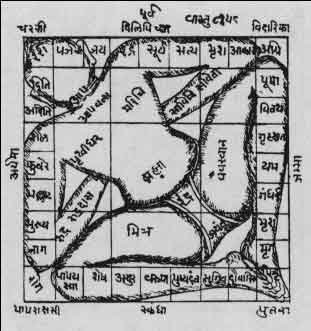
The Rig Veda contains an account of the formation of the world, claiming that the universe, as we know it, was formed from the sacrifice of the God Purusha.  This means that the universe itself was made from a divine substance, thus in Hinduism, all things are at their deepest level divine.  The universe consisting of Purusha’s body is therefore eternal.  From this sacrifice, the other gods were then formed, or evolved.  It’s all very unclear in Hinduism how all of this unfolded.  In fact, the account of Purusha’s sacrifice of himself as the formation of the universe is even questioned by the Vedas themselves, because the Rig also recognizes that no one was there to witness and confirm its genesis.
Still none of this initial information about Hinduism has touched on the core teachings of the religion, simply its formation and its explanation of the universe’s existence, but connections to Jesus can still be made in conversation with a Hindu from these teachings alone.  It can be noted that Christians also believe in the special nature of the universe, that Genesis teaches that all things was created by God and that their original state was “very good.”  However, it was not formed from God’s divine nature.  Instead, it was created by God out of nothing through his spoken Word.  Although, Christians don’t believe that God sacrificed himself in the formation of the world, we do believe that there was a sacrifice made before the creation of the world.  Revelation 13:8 refers to Jesus as “the Lamb that was slain from the creation of the world.”  Instead of saying that God sacrificed himself to create the world, Christianity teaches that God in the person of Jesus Christ sacrificed himself to save the world before the world was even created.  This of course is possible because God is outside of linear history, unrestrained by the fourth dimension, time.
Christians certainly agree with Hindus that the divine was involved in the creation of the universe and that a sacrifice on the part of God was made from the beginning.  Christians however believe that this God has revealed Himself clearly through his Word delivered through the prophets and apostles of the Bible, and through the person of Jesus Christ, so that there isn’t any doubt about who God is, who we are, and what God has done for us.
Rig Veda - The universe was created from the cosmic sacrifice of Purusha.
Rig Veda – The universe was created from the cosmic sacrifice of Purusha.
Christianity – Before the foundations of the world, Christ was slain.