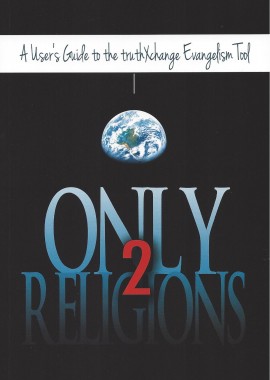
TruthXchange – Only 2 Religions

only 2 religions
Click the image to be taken to the truthXchange website to order this book.

A wonderful lady, Mary, who works at truthXchange was cut off driving on the freeway over a year ago.  The person had one of those Coexist stickers on the back of his car… but then she noticed that it said something different – Contradict. She found my website and shared her ministry with me.  TruthXchange was new to me.  I had never heard of its founder, Dr. Jones before either.  Mary sent me a copy of Only Two Religions.  It’s a user’s guide to the truthXchange Evangelism Tool.  She asked if I could read it and give some feedback.  I finally finished reading it in Dec. 2013, long after receiving it, and I’m just now getting to write something about it.

The premise is simple.  There are only two religions – One and Two, termed as One-ism or Two-ism.  The truthXchange, pocket-sized evangelism tool, explains it very simply:

One-ism, all is one. We worship and serve creation as divine.  All distinctions must be eliminated.  Through enlightenment, we discover that we also are divine.

Two-ism, all is two.  We worship and serve the eternal personal Creator of all things.  God alone is divine and is distinct from His creation, yet through His Son, Jesus, He is in loving communion with it.

The book addresses the topics of humanity, religions, our problem as humans, and the solution to that problem from both a one-ist view of the world and a two-ist view of the world.  Each section is designed to be read as a group with assignments to do during the week – pretty cool stuff, like looking for one-ist articles and movies to share with the group at the next meeting.

This framework comes from Romans 1:18-25.  This section of scripture states very plainly that all of creation knows there is a God from what has been created, yet men, have exchanged the truth of God for a lie, and have instead worshiped and served created things, rather than the Creator – who is forever praised.  When the Creator God is denied, men still worship.  The Created becomes the object of worship – creation, nature, is now One, not Two.  When the Creator is not exchanged for a lie, there are Two – Creator and His creation.  This means there are only two religions – worshiping the Creator or worshiping creation.

Dr. Peter Jones explains that “One-ism can be either atheistic (God is nothing and nowhere), or pantheistic (God is everything and everywhere)” (page 9).  From either form of One-ism, mankind’s ultimate problem is that we don’t recognize this all pervasive oneness.  One-ism says that our solution is to turn inward to ourselves – to become enlightened, that together, not separate, we can solve all of our problems.  Either way – atheistic or pantheistic, this is humanism, mankind is now divine.

This is a good starting point for discussing the uniqueness of the Christian truth-claims amongst the world’s religions. Christianity after all is the turning from one’s self (one-ism) and turning to Christ for salvation (two-ism).

I personally struggle with labeling this one-ism and two-ism distinction as justifying that there are only two religions, because I think that Jews and Muslims would be Two-ist in the sense that they recognize that there is a Creator, that God is transcendent and separate from what he has created.  I must not be the only one to have raised this objection or had this question because Appendix 2 in Only 2 Religions is entitled, “Are Judaism and Islam Two-ist?”  The answer seems to lie in the “personal” nature of the Two-ist Creator God.  According to Dr. Jones:

Is the Jewish God personal?  Well, yes it would seem so.  The Old Testament speaks often of God’s love, His compassion and His grace.  Such attributes are indeed personal.  And yet, the same Old Testament Scriptures give hints that God is triune.  The first verses of the Old Testament include the hovering of the Spirit, the power of the Word, and the intentions of God the Creator.  (See also Genesis 1:26 and other plural references for God, Psalms 110 and other passages that clearly speak of the coming Messiah).  We also see that the Messiah must be God himself.  (Isaiah 58).

Essentially, I understand Dr. Jones to be staying that sense the Jews have rejected the God revealed in the Tanakh (the Old Testament) they have rejected the Creator and are now “functioning as One-ist (page 58).  The same explanation also applies to Muslims with their view of Allah, who though He is viewed as transcendent and the Creator of all, “is made out to be so transcendent that no one can actually know anything about him” (page 59).

In conclusion on this question of framing Christianity as the only Two-ist religion, Dr. Jones writes:

Traditional Judaism and Islam claim to be Two-ist, yet both are functionally One-ist and the god they worship lacks both true transcendence and true immanence.  If God is remote, untouchable, impersonal, impotent and silent, there is no hope for any of us!  If He has not come down Himself to rescue us and to restore communion with us, we would have no way of knowing and loving Him. (Page 59)

two religions
This is the inside of the unfolded truthXchange “Only 2 Religions” evangelism tool. Note, they don’t call it a tract.

Because of this hiccup on Judaism and Islam essentially claiming to be Two-ist, I personally don’t like this One-ist and Two-ist framework to say that there are only two religions.  That doesn’t mean I don’t like this framework though.  I was able to use this framework to explain patterns of religions with a man on plane a ride this past winter.  I pulled out the truthXchange “Only 2 Religions” evangelism tool to show the difference between religious pluralism/pantheism/New Age/Hindu thought and practice compared to Christianity.  We went through each of the topics listed in the tool from the “All is One” perspective and the “All is Two” perspective. Having the tool in my pocket was very useful and gave a good visual to our discussion. I then was able to share Romans 1:18-25 to clarify that we all know there is a God from what he has made and that we all worship, we just don’t all worship the one true and living God.  I stressed that we all know there is a God even if we have exchanged that truth for a lie, and that it is through the person of Jesus Christ that the one true God has been personally revealed to us, that Jesus is the invisible image of God made visible to us!

I then explained the way I like to classify religions – There are only 2 religions, either “paid” or “not paid.”  I then quoted Romans 4:4-5 to the man, which in paraphrase says that when we work our wages are due to us, but when we don’t work, but trust God who justifies the wicked, we have salvation.  Essentially, all religions besides Christianity require men to work to attain some end goal.  We have been given a bill, a debt if you will, and we must either do yoga as in Hinduism, meditate as in Buddhism, adhere to the Law as in Judaism, follow the Five Pillars as in Islam, or adhere to other practices and rules according to other religions to pay this debt, to earn our way to the highest goal of mankind.  And in the end, no one from any of these religions has any certainty that they have paid the bill in full.  They are left to die in despair.  Or we can turn to Jesus who has paid the bill for us!   Through his life, death, and resurrection, he has paid all of our debts!  In the Christian worldview, our works our worthless.  If we want to trust in them and demand to be paid what we are due, we get and deserve eternal death.  When we turn from our sins, our unrighteous works, and turn to Christ and his righteousness for our hope and glory, we receive an inheritance that comes from the Lord. Death becomes sweet.  To live is Christ, and to die is gain.  Christanity alone stands apart as the only saved by grace, saved by divine redemption, religion.  In this sense there are only two religions “paid” and “not paid.”

I also like to classify religions as either, “from man” or “from God.”  All religions besides Christianity were founded by men, who claimed to be men.  They were either heroes, sages, prophets, or the like, but only in Christianity do we get a religion that is founded by a man who claimed to be God in the flesh.  This is why it should be no surprise that Christianity is the only religion that is “paid” for us by God.

So please, whatever way you want to share it – “One-ism vs. Two-ism” or “Paid vs. Not Paid” or “From Man vs. From God” or through none of these categorical tools- proclaim the Good News that salvation has come to us through the person and work of Jesus Christ.  Do not be ashamed – Romans 1:16.

In conclusion on Dr. Jones’ helpful Only 2 Religions evangelism tool and user’s guide, I think this framework does a great job of explaining why so many in our day and age are turning to homosexuality, religious pluralism, and humanism.  The explanation for the rise of homosexuality in our culture was most helpful to me – and a brand new idea that I hadn’t read from anyone else.  I’ll close by quoting that section:

A One-ist believes that God is no different than creation… which means that he is the one who decides what to worship and usually ends up worshiping himself!  A One-ist will naturally seek to suppress the distinctions God has placed in the world and may be tempted to embody his One-ist tendencies in a One-ist sexuality, such as homosexuality, transgenderism or lesbianism. … A Two-ist recognizes the distinctions God put in the world as a reflection of the distinction between the Creator and the creation.  Sexuality is one of those distinctions, as so a Two-ist rejoices in the sexual differences between men and women and enjoys normal, created sexual relations within the marriage and family structure ordered by the Creator.  … If you believe in a God who is “other,” then you will worship something “other” and will be in human sexual relationship with someone who is “other” (male or female). (pages 33-34)

Watch this following video to get the One-ism vs. Two-ism distinctions directly from truthXchange:

Click here for Only 2 Religions.

Click here to get my book, Contradict – They Can’t All Be True.
Christ’s States of Humiliation and Exaltation!

I heard a message at my school’s chapel this week that covered the great Philippians 2 creed, the one that says, “Christ, who being in very nature God, did not consider equality with God something to be grasped, but made himself NOTHING, taking on the nature of a servant, being made in human likeness, in which he was obedient to the Father, unto death, DEATH ON A CROSS, and on account of his obedience, the Father had him raised and exalted him to the highest place, that at the name of Jesus EVERY knee shall bow and EVERY tongue confess that JESUS IS LORD!”  My paraphrase off the top of my head.  An awesome passage.  It details what is doctrinally called Christ’s states of humiliation and exaltation.  His state of humiliation commenced from the moment he assumed a human nature (his conception) until his death, at which point he entered into his state of exaltation.  Want more info…. watch this video!  Peace in Christ, Andy.

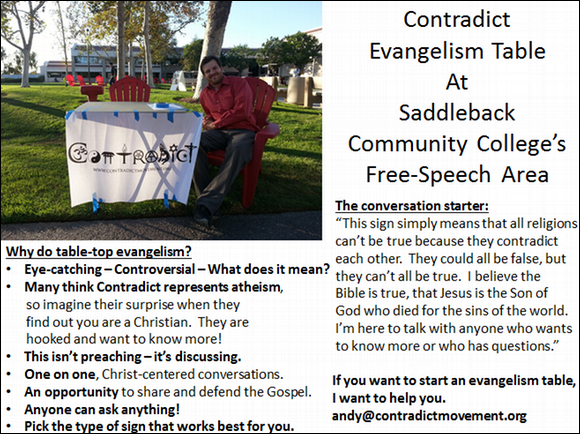
Contradict Evangelism Table

table evangelismAs many of you know if you have followed my blog, the Contradict logo was birthed from evangelism at University of California Irvine.  From many trial and error attempts at initiating Christ-centered conversations on the campus, I found that the best method for my personality is to set-up a table and draw people in to talk with a catchy poster on a table.  My first attempt was a Led Zeppelin poster with a sign saying free bootleg CDs.  I actually had purchased some bootleg CDs and was raffling them off, but, to enter the raffle the person had to take my “Stairway to Heaven” Gospel tract that I had written.  They also got an invitation to a Bible study on UCI’s campus.  I got a few emails this way so I could keep in contact – spamming people, if you will, about events I was hosting on campus.  I never got anyone to show to those events – :(.

Then I met a lady that was a full-time missionary at University California Los Angeles.  She told me what worked best for her was hosting a “Blessing of the Brains” night every mid-term and finals week.  She said students were up late studying and that she would offer them coffee and the opportunity to have their brains blessed with prayer!  She would pray for them right then and there if they wanted, or just collect prayer requests in a prayer box.  I did that method twice!  Both times – very successful.

All of these attempts were when I was as an undergraduate student at Concordia University Irvine during the 2004-2005 and 2005-2006 school years.  After a Masters degree and three years teaching in China, I was back in Orange County in the summer of 2009 and asked if I would kickstart evangelism for a congregation at UCI.  I wanted to set-up another table with a poster that would draw people in to talk and I wanted to also offer coffee.  Sort of a combination of the two best options I had done before.  I had many other attempts along the way that I won’t mention.  From UCLA pastor, Mark Jasa, I learned of a cool sign approach to evangelism. He set-up a table with a poster that read, “Religion is for the Weak.”  His approach was that people would see this and not know what he believed!  People usually think he is an atheist, and then get caught off guard and are intrigued to hear more when they find out he is actually a Christian.  He presents that everyone is going to die and religion offers a solution to the problem, yet there are really only two religions – Free and Not Free.  Christianity is the only Free religion – saved by grace through faith in Christ.  Then the discussion begins!

Adam Stetson also saw a presentation from Pastor Jasa on his “Religion is for the Weak” method of starting an evangelism conversation. Together we bought a table and went to UCI’s Freedom of Speech Area.  We started with small print-out pages that said “Religion is for the Weak” and other slogans we came up with. The only one I still remember is the one that I made up which was “Christianity is not a way of life.”  If someone asked what it meant I’d share, “Christianity is life given to you for free by the work of Jesus.  It’s not a list of rules you must obey to be saved.  Therefore it is not a way of life, it is life.”  We also had a big poster board that said, “Got Prayer?”  We did a lot of stuff like that.  It was a smorgasbord of little flyers taped to everything on the table.  People would get coffee and as they shook their sugar into their cup, they’d ask what the message meant on the sugar container.  It was quite comical.

One week, Adam said, he wanted to make a Contradict sign to counter Co-exist.  I thought it was great!  I found a few designs already made online and we started to use them on the table too.  It became my go to every time someone asked why were out there giving out free coffee.  Adam and the others with us began to always gravitate towards it too.  Eventually Adam had a Contradict poster made!  And then we ditched everything else and just used a Contradict poster exclusively, taped to the front of the table.  “Religion is for the Weak” didn’t work so great for me for some reason.  Before launching the site http://www.contradictmovement.org, I designed my own Contradict logo with my friend Danny Martinez.

I love the Contradict conversation starter.  It’s simple.  Someone asks what does this mean and I get to simply say, “It means that all religions contradict each other and they can’t all be true.  They could all be false, but they can’t all be true.  I personally believe Christianity is true, that Jesus is God and died for your sins and I am here to share that good news and answer any of your questions about what I believe from the Bible.”  I have presented the central truth-claim of Christianity, and now the ball is in that person’s court!  Often times, they might be shocked that I am Christian. For example, I once let an atheist talk a long time about his views on religion.  He thought I was an atheist too, so he was just laying it really thick against all religions and religious people, and when I told him what I believed he was stunned.  And his mouth was open, and he asked, “Wait, you’re a Christian?”  He thought by Contradict, I somehow meant they were all wrong!  No.  It means they can’t all be true, not that they’re all wrong – which is what many people first think the sign means.

Anyways, it’s a great conversation starter!  I encourage you to give it a try somewhere, at a park, a campus, a store front, a fair, a street corner with a lot of foot traffic.  There are handouts at http://www.contradictmovement.org that you can download and print for free.

If you are really into this idea, I encourage you to check out my book, Contradict – They Can’t All Be True.  It details the entire message I’d share with someone if they gave me 3-4 hours of their time.  And believe it or not, sometimes, people actually give that much time!  Many people I have talked to are very intrigued.  They are craving God (although they don’t know that’s what they’re missing and needing as they are lost in their sins) and few Christians have given them the straight up truth from Scripture.  And few Christians have sat there to listen to their questions and answer them.  A big portion of my book is to help equip you to know what questions are most often asked from the Contradict conversation starter.

Here’s a video for more info on how to get started. God bless you.

Please, let me know if you give this a try.  And you might find that something else besides Contradict works best for you.

Daoism – What is it, who believes it, who practices it, and how does it compare to Christianity?

My goal is to create group discussion guides for each religious symbol within the Contradict logo.  So far, I have one made for Hinduism and one made for Daoism.  I create a leader’s guide that gives suggested answers and Bible verses to be read for each question.  My goal however is to have participant’s be able to provide great answers on their own because all the questions are compare and contrast questions between Daoism and Christianity.  All the questions are very open ended and could go anywhere.  I hope that after such a small group discussion all the participants will be able to recognize Daoism’s influence in Western culture and to be able to share the Gospel and the truth of God’s Word in connection to themes and practices of Daoism whenever they arise in day to day life.

Here are the links to the Daoism guides:

Leader’s Guide

Participant’s Guide

I’d love to hear feedback on these guides, especially if you use them to guide a small group discussion.

To close here is a Daoism video that can be used to introduce the discussion:

Did Jesus Die on the Cross?

I met a student at Saddleback Community College yesterday who asked, “How can we be sure that Jesus died?”  I shared the following information with her, but I didn’t have the quotes at the time.  I gave her the website address http://www.contradictmovement.org and told her that there were links to a blog and Facebook and that I would post this for her.  I pray that she finds this and that others who need this information will find it too.  The important part is not just that he died, but that he was buried, and then raised!

Did Jesus die on a cross?

The Gospel accounts record that darkness fell over all the land for a three hour time span as Jesus hung on the cross.  (Matthew 27:45, Mark 15:33, and Luke 23:44,45)  This darkness covering the land is confirmed by the words of Thallus, a Samaratin historian who wrote about twenty years after Jesus’ death, as well as by the Greek historian Phlegon.  Their accounts of the darkness are preserved by the 2nd and 3rd century historian, Julius Africanus, who records both Thallus and Phlegon to confirm the same year and time of the darkness as the Gospels.  Julius records that Thallus tried to explain the darkness as an eclipse of the sun, yet Julius doesn’t buy this argument because:

The Jews celebrate their Passover on the 14th day according to the moon, and the death of our Savior falls on the day before the Passover. But an eclipse of the sun can only take place when the moon comes under the sun, how then could an eclipse have occurred when the moon is directly opposite the sun?1

Concerning Phlegon’s account, Julius records, “It is evident that he did not know of any such events in previous years.”2 This darkness is even recorded in Chinese history:

Summer, fourth month, on the day of Ren Wu, the imperial edict reads, “Yen and Yang have mistakenly switched, and the sun and moon were eclipsed.  The sins of all the people are now on one man.  [The emperor] proclaims pardon to all under heaven.3

The time of this eclipse recorded during the Han Dynasty is placed at 31 A.D., and if the darkening of the sun occurred from noon to three P.M. in Jerusalem that would correspond to be from five to eight P.M. at the current capital of China at the time, Luo Yang, explaining why the Chinese records claim not just a darkening of the sun, but also the moon!4

darkness

                With such internal and external evidence connecting an unprecedented and unexplainable extinguishing of the sun to the time of Jesus’ crucifixion, coupled with accounts of subsequent bodily resurrection; it’s likely that such news reached even the ears of the Roman emperor, who could have sent an investigator who would have had the authority to access all pertinent parties to verify if Jesus was in fact crucified.  Many other investigators of lesser political or wealthy status could have made inquiries about his death.  It wasn’t as if Pontius Pilate was completely inaccessible.  The Jewish Sanhedrin clearly had no problem bringing Jesus before Pilate and Herod to be tried for insurrection.  (Luke 23:1-25) Without a doubt, many Jews and Romans in the region would have wanted to investigate Jesus’ death and would have had the means of verifying if Jesus did die by crucifixion under Pontius Pilate.  Even if they couldn’t speak with Pilate in person, there were plenty of witnesses who saw him sentenced to death, since a riotous crowd shouting for Jesus to be crucified forced Pilate to condemn Jesus to the cross.  (Matthew 27:15-24, Mark 15:9-15, Luke 23:20-25)  Surely, an eyewitness from this scene could be found rather easily in the months to years following Jesus’ sentence. 

Both Matthew and Mark record that after Jesus’ death sentence, that he was taken to the Praetorium, the governor’s residence, where the entire company of soldiers stationed there stripped him, put a scarlet robe on him, gave him a crown of thorns, mocked him, spit on him, beat him, and had him flogged!  (Matthew 27:27-31 and Mark 15:16-20)  After this treatment, the Gospels record that the soldiers led Jesus away to his crucifixion.  Many of these men would be able to serve as witnesses to Jesus’ death, or if they didn’t see execution through until the end, they would be able to point you to centurion and his soldiers who oversaw his final hours. 

simon of cyreneAnother witness that could likely be found was a man from Cyrene, named Simon.  The Synoptic Gospels record that the soldiers forced him to carry Jesus’ cross.  Mark records that this man was the father of Alexander and Rufus.  (Mark 15:21)  He writes these names as if his audience would have known who they were.  Surely, a man named Simon, from Cyrene, who has two sons named Alexander and Rufus, could have been found and interrogated in the early first century.  He should be able to answer the following questions with ease: Were you forced to carry a cross at the time of the Passover?  Was the man whose cross you carried, Jesus of Nazareth?  Did he say anything to you?  What was his condition like when you carried his cross?  Was he crucified at Golgotha, The Place of the Skull, as Jesus’ disciples claim?  Is it true that a sign was placed over his head that said, “THIS IS JESUS, THE KING OF THE JEWS.”?  Did you see Jesus nailed to the cross?  What about his death?  Did you stay to witness it?  Could you tell if any of his followers or family was there for his execution?  What did you think about the sky going dark at his crucifixion?  Or the earthquake at his death?  Do you think they are linked? 

The Gospels make mention that many women followers of Jesus were watching his crucifixion: Mary Magdalene, Mary the mother of James and Joses, the mother of Zebedee’s sons, Salome, Mary the wife of Clopas, and Jesus’ mother and her sister.  Any of these women could have been interrogated to confirm the death of Jesus, as well as the apostle John, who claims in his Gospel to have witnessed the crucifixion, even receiving instructions from Jesus to take care of his mother, Mary, while his rabbi hung on the cross.  Already, a large list of supposed witnesses could be located and examined to verify the Gospel accounts that Jesus did in fact die.  The greatest witness of them all though, would be the centurion who oversaw the crucifixion, and the soldier who stuck Jesus in the side with a spear (possibly the centurion).  The following is what John records of the death that he witnessed:

Now it was the day of Preparation, and the next day was to be a special Sabbath.  Because the Jews did not want the bodies left on the crosses during the Sabbath, they asked Pilate to have the legs broken and the bodies taken down.  The soldiers therefore came and broke the legs of the first man who had been crucified with Jesus, and then those of the other.  But when they came to Jesus and found that he was already dead, they did not break his legs.  Instead, one of the soldiers pierced Jesus’ side with a spear, bringing a sudden flow of blood and water.  (John 19:31-35)

soldier spear

                If Jesus was not sentenced to death by Pontius Pilate, surely Pontius would publically squelch that rumor, or Herod or the Sanhedrin.  If someone other than Jesus was nailed to the cross, the mob who demanded his crucifixion, the women disciples who stayed to his final breaths, his closest disciple, John, should have been able to confirm that Jesus did not die on a cross.  If anyone questioned if Jesus could have survived the crucifixion as a possible explanation for how his tomb was empty and people saw him alive post-mortem, the executioners would certainly be able to affirm if he was dead or not.  The man who thrust the spear into Jesus’ breathless body would be able to confirm if Jesus died on the cross.  The Gospels record that the centurion in charge of Jesus’ execution, after seeing how Jesus died, said, “Surely this man was the Son of God” (Mark 15:39).   The first century inquirer would seek the centurion for confirmation of Jesus’ death and would learn if he truly did believe Jesus was the Son of God based on the way he died.  If any of the Gospel accounts were false on how Jesus died, these witnesses would deny them.  Living in the 21st century we have no record that they ever did. 

1. “Historical Evidence for Crucifixion Darkness” retrieved from http://www.biblehistory.net/newsletter/crucifixion_darkness.htm on March 21st, 2013

2. Ibd.

3. Chan, Kei Thong.  Faith of Our Fathers: God in Ancient China. Shanghai, China, 345 Xianxialu, 2006. p. 318.

4. Ibd. p. 318.

Click here to order my book, Contradict – They Can’t All Be True.