God’s Answer to the Problem of Evil

The following is a sermon based on the Old Testament text: Habakkuk 1:1-4; 2:1-4.

Habakkuk is crying out to God with the complaint that God’s people have struggled with through every age – and this is a struggle that won’t go away until Jesus returns and makes all things new – and that complaint is the problem of evil.  Why, oh why, does an all-loving, all-powerful, and all-knowing God allow evil?  Why does he let his people suffer?
habakkuk 2

In our day and age, even those who reject the existence of God – ask this question.  In fact, many people who do not believe in God reject his existence, because of this very problem of evil.  They think if God is all-powerful and all-good and all-loving, he’d stop evil.  Since evil still exists, they conclude that an all-powerful God must not exist; he must be impotent.  Or, maybe he’s all-powerful, but he isn’t all good, maybe he is actually evil.  They conclude that an all-powerful, all-loving God does not exist.

The text does not tell us what the exact sins are that Habakkuk is witnessing.  We are told that there is violence.  That there is destruction.  That there is constant strife and contention.  We are told that the law can’t do anything to stop this evil – that there is no justice for the righteous who are surrounded by the wicked.

Not knowing the exact details of the evil deeds in Judah at the time of Habakkuk works to make the text more relatable to us today, because we all can turn on the news, or read our social media feeds, and witness the evil and injustices that occur daily in our society.

Many of us have experienced evil and injustice against us and against our family, friends, and neighbors.

Many of us have also experienced suffering and pain that can’t be directly linked to specific sinful acts– such as a loved one dying of cancer or suffering from mental depression that can’t simply be stopped.

Do we usually get the answer we want from God when we ask why such evil and suffering is happening to us, to our people, and in our nation?  Probably not.

Habakkuk didn’t get the answer he wanted either.  In chapter 1 verses 5-11, he is told that the evil in Judah that he wanted the Lord to stop would be stopped, but that it would happen through God raising up the Chaldeans, a fierce, strong nation that marched through nations taking whatever they desired – their strength was their god.

Habakkuk can’t believe this answer – not at all.  Is God really going to stop the evil in Judah by having a more evil nation conquer his people?

In verse 13 of Chapter 1, Habakkuk wants to know why God sits around and looks at the traitors and remains silent when the wicked swallow up the man more righteous than he.  So he raises a second complaint to God – Habakkuk asks if God plans to just let nations continue to eat each other up forever?

He then takes his stand at the watchtower, and he waits for the Lord to answer this second complaint.

The answer, again, is likely not what Habakkuk wanted to hear, but he is told to write down the answer and to make it easy to read on tablets.  He was to make it so big that a person running could read it.  Habakkuk might have even written the answer he received from the Lord on something very big like a giant billboard – that the person running by couldn’t miss even if he wanted to not see.

The answer God gives is simple, and it is two-fold – First, God says, “Be patient.”  God’s word is true – the world as it is now is not as God intended it to be; God is setting everything right, though his coming salvation and end to all evil seems very, very slow to us.

We struggle in understanding why he is delaying his salvation.  But… the second part of the answer is given to Habakkuk – “The righteous shall live by his faith.”

The person who lives by his faith in God and God’s Word is righteous before God.  The righteous are those who trust in God and his promises, patiently waiting for the Lord to bring about his salvation – in his chosen time and in his chosen way.

Unlike Habakkuk who lived before the coming of God’s promised savior, the Christ, we living in the New Testament era of the Church know our promised savior, Jesus of Nazareth.  We know how Jesus came to save us from evil – how he saved each and every one of us from evil.  He saved us from our own evil.

He saved us from our own sins.  Our sins deserve God’s eternal punishment.  Jesus saved us from the punishment we so rightly deserved by taking our sins upon himself, paying the penalty that we deserve through his death on the cross.

Jesus brought us from being enemies of God into being the children of God.

And through his resurrection from the dead, he has given us the assurance that our sins truly are forgiven and that he has all power over sin, death, and the devil, that at his promised return, he will put a final end to all evil in this world, in our lives – forever.  The wicked will no longer devour the righteous.  Nations will no longer continually eat each other up over and over and over again.

Jesus will restore all of creation and he will make all things new again.  He will make all things as he intended them to be.

So we ask, like Habakkuk, when are you going to do this oh Lord?  When will Jesus return to do as he promised?

And the answer we get from the Lord is the same that Habakkuk received – “If it seems slow, wait for it; it will surely come; it will not delay.”

Peter at the end of his second letter tells us a very similar message to what Habakkuk received from the Lord.  In 2 Peter 3:9, Peter writes, “The Lord is not slow to fulfill his promise as some count slowness, but is patient toward you, not wishing that any should perish, but that all should reach repentance.”

He continues in verses 10 to 13, “But the day of the Lord will come like a thief, and then the heavens will pass away with a roar, and the heavenly bodies will be burned up and dissolved, and the earth and the works that are done on it will be exposed.  Since all these things are thus to be dissolved, what sort of people ought you to be in lives of holiness and godliness, waiting for and hastening the coming of the day of God, because of which the heavens will be set on fire and dissolved, and the heavenly bodies will melt as they burn! But according to his promise we are waiting for new heavens and a new earth in which righteousness dwells.”

God is not slow in keeping his promises to free us from all evil and suffering.  He is patient with us.  He desires for all to come to repentance.

Let me ask you, what would happen if Christ were to return today?  To return right now?

All who are not repentant, all who are not living by faith in Christ, will be lost to death forever along with everything else of this world that is destined for fire.

Who do you know that would be lost forever?  Do you really want God to put an end to all evil, right now, when you think of the ones you love who are not yet repentant of their sins?  Even those who have caused you evil would you really want that to be their fate?

What we perceive to be God’s lack of action in the problem of evil is actually patience that comes from his love for us – for you – for all people who are still outside of faith in Christ.  He does not want them to perish, though it is what they deserve, and that is what you deserve.

As he is patient with the wicked, he calls us, we who are righteous, not by any righteousness of our own, but by the righteousness we receive from Christ, through the faith by which we live, to be patient too.

So the problem of evil there is an answer – the answer is Jesus.

What is the greatest act of evil in the history of the world?  Many people typically will point to the acts of Hitler, or Stalin, or Mao Zedeng that led to the deaths of millions upon millions of people.

I’d point people however to the cross of Jesus.  The greatest act of evil that ever occurred in history has to be when Jesus, God in the flesh, innocent of any wrongdoing, was viciously beaten, whipped, and crucified at the hands of his sinful creation. Can anything more evil possibly happen than man killing God?

But what we see from the greatest act of evil is that the greatest good was produced: the forgiveness of all of our sins, the salvation of mankind. When Jesus allowed the greatest evil to be done to him and when God the Father offered his one and only son for us that we see the greatest love ever – God’s love.  And we see that God loves us.

When you face evil, remember Jesus and his love for you.

When you face evil, be patient and trust in the promises of God.  Pray and stand watch like Habakkuk.  Look for the return of Christ as Peter tells you to do.

Depending on what evil you have experienced or are experiencing, depending on what suffering you are enduring, such an answer may fail to cut the mustard.  If you attend the Sunday English Bible Study for Light of Christ, you’ll recognize that phrase “cut the mustard” from a couple of weeks ago.  It means that to be told to wait and trust in God when you are under attack by evil or when you are suffering in sorrow or pain will probably fail to satisfy your troubled heart and mind.

But nevertheless, when you stare evil in the face, remember the righteous shall live by his faith.  And it is through this faith that we live in holiness and godliness – as we wait for and speed the coming of the Day of the Lord.

And it is in that promised day of Christ’s return that Jesus will destroy sin, death, and the devil forever.

Amen.
“Should You Believe in the Trinity?” – A Tract of the Jehovah’s Witnesses

Jehovah's Witnesses - TrinityI recently received the Watchtower Bible and Tract Society’s tract, “Should You Believe in the Trinity?” from a sister in Christ who was convinced that that the tract contains a strong Scriptural argument that Jesus is not the Almighty God and she asked me what Scriptural evidence there is for Jesus’ divinity.[1]  The tract attacked the Trinity with a few key arguments: 1.) The Old Testament presents a strict monotheism that leaves no room for God to exist in a plurality of persons, 2.) The New Testament presents Jesus as having been created by God and as such is in a secondary position in time, power, and knowledge, 3.) Jesus is not God, but is a perfected man only, and 4.) Nobody in the first century ever thought of him as being God the Son.  I will address these arguments one by one to demonstrate that there is no good Scriptural ground to hold these positions.

The Old Testament presents a strict monotheism that leaves no room for God to exist in a plurality of persons.


The Watchtower Bible and Tract Society (WBTS) is correct in stating that the Old Testament held to a strict monotheism.  The tract’s citations of the verses Exodus 20:2-3, Deuteronomy 6:4, Psalm 83:18, Isaiah 42:8, and Isaiah 45:5 are all great Old Testament verses to use to demonstrate the Scriptural principle of God’s exclusive oneness in which there is nothing in his creation that is equal to him.  Throughout the Old Testament it is clear that God is the Creator and that he is the sovereign Ruler of all things – there is none beside him, none his equal.  Reading through the Old Testament one does not see a clear presentation or description of the Creator and Ruler existing beyond a singular personal being, in other words, the doctrine of the Trinity is not explicitly found in the Old Testament.

There are of course examples that one can point to in the Old Testament that could allude to a plurality of persons in this singular being, such as the chosen use of the plural form of god, Elohim, to refer to God, and God choosing to refer to himself in the plural form in Genesis 1 when he said, “Let us make man in our image.”  The WBTS does a good job of acknowledging these allusions to a Trinity in the Old Testament, but I agree with their position that these examples are just allusions and that they do not explicitly affirm God existing in a Trinity of persons as Christian doctrine holds.

Contrary to the WBTS position, and likely the position of the majority of Jews in the Second Temple era of Judaism, the strict monotheism of the Old Testament that draws an absolute Creator/creation distinction does not explicitly limit God’s existence to one person, though this would seem to be a more natural and plain conclusion of the Old Testament Scriptures presentation of God’s personhood.  We however do not only have the Old Testament, but we have Jesus who in the New Testament has revealed the Trinity to us.  In the New Testament Jesus is named as the Son of God and he is identified in the same way Yahweh is in the Old Testament, as the Creator and Ruler of all things (see John 1:1-3, 14; Colossians 1:15-20; and Hebrews 1:1-3 for examples).  Of course, Jesus, the second person of the Trinity would not be equal to his Father in divinity if he was created by his Father at some point in time, which is the position the WBTS finds in the New Testament.

The New Testament presents Jesus as having been created by God and as such is in a secondary position in time, power, and knowledge.


“Should You Believe in the Trinity?” does not reveal the WBTS’s particular doctrine concerning the identity and nature of Jesus, however, the Jehovah’s Witnesses do believe that Jesus was a created being, the archangel Michael to precise, an angel who is sparsely mentioned in the Bible, only in Daniel, Jude, and Revelation.

Michael the Archangel

They teach that Michael descended from heaven and became purely human as Jesus at the moment of Mary’s conception.  When he returned to heaven, he returned as the archangel Michael, not as the human, Jesus.  Since he returned as an angel and not a human, his resurrection was not a bodily resurrection.[2]  They justify Jesus’ archangel identity by pointing out that Jude 9 calls Michael an “archangel” and that 1 Thessalonians 4:16 says that Jesus will return “with a commanding call, with an archangel’s voice.”  They also point to Revelation 12:7’s description of Michael as being the leader of an army of angels, while they also recognize Scripture to describe Jesus as a leader of an army of angels (Matthew 13:41; 16:27; 24:31; 1 Peter 3:22; 2 Thessalonians 1:7; and Revelation 19:14-16).[3]  Since the WBTS sees from the Scriptures cited above that Michael and Jesus are both identified as an archangel (chief angel) and as an army leader, and since there can be only one archangel, and since Scripture only mentions one angel army and not two, the Jehovah’s Witnesses think “​it is logical to conclude that Michael is none other than Jesus Christ in his heavenly role.”[4]

Such a conclusion however has never been arrived in the history of Christianity, until the Jehovah’s Witnesses began to teach that Jesus is the archangel Michael.[5]  Instead the Church has historically recognized that Jesus has been identified in the New Testament as being the Creator and Ruler of all things (again, see John 1:1-3, 14; Colossians 1:15-20; and Hebrews 1:1-3 for examples) – identity markers that were exclusively attributed to Yahweh in the Old Testament.[6]  The New Testament on multiple occasions reveals that when Christ returns he will be coming with his angels to judge the world (Matthew 24:31; 1 Corinthians 15:52; 1 Thessalonians 4:16; and Revelation 19:13-16), but one does not have to run to the conclusion that Jesus is Michael because both Jesus and Michael are leading the army of heavenly angels.  Both of them leading the army of angels is easily harmonized when considering Christ’s preeminence above all things (Colossians 1:18).  We can relate this language of dual-leadership to the structure of the United States of America’s army – the President is the Commander and Chief of the army (and so the army is his), yet during wartime there is also a General of War who leads the army (and so they are his men and he is leading them – though he is still under his Commander and Chief, the President, who is the one who is truly over all of the army, including the General of War).

I have already listed on two occasions verses to demonstrate that the New Testament places Jesus on equal footing as Yahweh.  To these, the Jehovah’s Witnesses have prepared responses, and in this paper I will not refute all of their rebuttals, but I will address two of their objections to the clear pronouncements in Scripture that Jesus is the Creator and Ruler of all things.

First, in John 1:1, it is revealed that “In the beginning was the Word, and the Word was with God, and the Word was God.”  In John 1:14, we see that this Word became flesh and in the Gospel of John we see that the Word became flesh in the person of Jesus of Nazareth.  This opening passage from John indicates a personal being that sits in an equal state of divinity with God.  John 1:3 states that “all things were made through him, and without him was not anything made that was made,” and John 1:14 says that he is “the only Son from the Father, full of grace and truth.”   The Jehovah’s Witnesses get around this very clear pronouncement that the Word is both God and Creator, along with the Father, by using the WBTS’s translation of the Bible, the New World Translation (NWT), which translates verse 1 as, “In the beginning was the Word, and the Word was with God, and the Word was a god.”  A strict reading of this would lead to polytheism, but the Jehovah’s Witnesses don’t hold to a strict reading of their translation, instead they use their translation to justify that Jesus is a created being who was appointed to the position of “a god” by God through whom all things were then created.  The problem is that this translation is woefully inaccurate, because Koine Greek in which John was written does not possess the indefinite article “a” or “an,” nor did it in its original time of writing have lower-case letters to make a distinction between a hierarchy of divinity between “God” and “god.”  To further complicate their translation problem, Kyle R. Beshears points out in his book, Robot Jesus, that the WBTS “refuses to officially release any names of the NWT translation team, committee, or leadership board.”[7]  Beshears also shares that the one name that has been discovered is Fred Franz and that he is far from a qualified Bible translator having had only two undergraduate courses in Greek from the University of Cincinnati with no formal training in Hebrew.[8]

Second, and this is an argument that is found in “Should You Believe in the Trinity?,” the Jehovah’s Witnesses take the preeminence of Christ passage from Colossians 1 and pull out the phrase, “the firstborn of all creation” to indicate that Jesus was created.  This too is a translation error, or more specifically a misunderstanding of the meaning of “firstborn” in this context linguistic and cultural context.   The word used is πρωτότοκος and it can mean first born in a chronological order sense, but here it should be understood to refer “to having special status associated with a firstborn.”[9]  According to Jehovah’s Witnesses theology, Jesus was the first created angel – not the first born, because angels are not conceived and birthed into existence – so even in their theological framework, the phrase “firstborn of all creation” shouldn’t be interpreted to mean being born before any other creature, since again, angels are not born.  And within the sphere of humanity, the “firstborn” in chronology would go to Cain in Genesis 4:1, clearly not Jesus.  Such an understanding of “firstborn” as legal status and not chronology can be found in the Old Testament between Jacob and Esau.  Jacob was born second in time, yet he received the legal status of being the “firstborn” and inheritor of all that was of his father’s by that legal standing – though he was the younger son.  Calling Jesus, the “firstborn of all creation” in no way demands that he is a created being, and it goes against the clearness of the rest of the passage that presents him as being the Creator and Ruler of all things in whom the “fullness of God was pleased to dwell” (Colossians 1:19), and it goes against the Hebrews passage I have cited but not yet quoted that says, “He is the radiance of the glory of God and the exact imprint of his nature” (Hebrews 1:3).

Jesus is not God, but is a perfected man only.


The third argument laid out in the tract doesn’t understand how Jesus could be tempted if he’s God, pointing to his temptation by Satan in the wilderness after his baptism by John the Baptist.  God cannot be tempted the WTBS exclaims.  They could just as easily have also said that God is not born, God does not have flesh and blood[10], God does not get tired or hungry, God does not bleed, and he certainly does not die!  Here they fail to understand the union of the two natures of Jesus of Nazareth who is presented in the New Testament to be fully God and fully man.  Jesus just as easily does things that only God can do too.  From the moment of the Incarnation, when the 2nd person of the Trinity assumed a human nature, the divine and human natures became united so as to not be separated from his personhood – ever.  If the humanity of Christ is put to physical death, then so too is his divinity.  Since Jesus is fully God, we can say God was tired, hungry, thirsty, tempted, and killed in the person of Christ (the 2nd person of the Trinity). These feelings and experiences were experienced by Jesus in accordance to his human nature, yet due to the union of the natures the divine nature experienced them too.  Such experiences in no way reduces his divinity.  The attributes of humanity that Christ experienced of which the Father and the Holy Spirit cannot partake occurred because Jesus allowed them to occur, because he did not consider equality with God something to be grasped, but instead he humbled himself and chose not to make use of his divine attributes or retain the glory due to him because of his divinity. (Philippians 2:5-11)

The tract also presents an idea that if Jesus was God his death on the cross would supersede the ransom that is required under the law.  The WTBS argues that “it was only a perfect human, Adam, who sinned in Eden, not God. So the ransom, to be truly in line with God’s justice, had to be strictly an equivalent—a perfect human, “the last Adam.”  This line of thinking however misses the point that a perfect human could serve as a ransom for only one sinful human, but Christ’s death on the cross was not an exchange for the sins of one person – no – Christ’s death was an atoning sacrifice for the sins of all of mankind, and as such, the death of the God-Man, the death of the life source of all men would be suffice to atone for the sins of all of mankind – not just the sins of Adam.

Nobody in the first century ever thought of him as being God the Son. 


The final argument of the tract is that “WHILE Jesus is often called the Son of God in the Bible, nobody in the first century ever thought of him as being God the Son.” This is where my response is most important and where I would above everything else I have written point the sister in Christ who came to me with this heretical tract of the Jehovah’s Witnesses – Jesus thought of himself as God in the flesh – co-equal to his Father in divinity.  It is here that there is a mountain of Scriptural evidence to indicate that Jesus is fully God, and the WBTS doesn’t address hardly any of them in their tract.

One could ask, well, why didn’t Jesus make it more obvious in his statements to being God.  Why didn’t he directly use the words, “I am God?”  I speculate that Jesus never said those three direct words because, when he said “God” and when the apostles wrote “God” in their letters, they were almost always referring to the Father, not the Trinity. If Jesus had said that he was God, it might have been construed to mean that he and the Father were the same person, that he was the Father, which he is not. Within Christ’s theology and the theology of his apostles, God exists in three distinct persons, the Father, the Son, and the Holy Spirit, all of whom share in the same divine essence.

An aspect of Jesus’ role as Savior of the world was to reveal the Father to us, and I think his use of Trinitarian language does just that. In John 10:30–33, Jesus says that He and the Father are one. The Greek language used indicates that he and the Father are one, not in person, but in deity. The translation might be read in English as “I and the Father, we are one.”

The word used for “one,” hen, is neuter in gender. In the Greek language, most words have gender. Using the neuter, asexual “one” instead of the masculine “one” indicates that Jesus is saying that he and the Father are one in nature, not personhood. This statement in John 10 was again a public statement in front of the Jews in the temple area, in response to the Jews pressing him to declare plainly whether he is the Messiah. When he said, “I and the Father are one,” they responded by picking up stones to stone him, because they knew that he had just claimed to be God (John 10:22–33).

The following is an abridged and slightly rearranged list of verses taken from Kenneth Samples’ book, Without a Doubt, that show various ways that Jesus and others claimed and attributed divinity to Jesus through titles, actions, and words:[11]

Divine titles proclaimed by or attributed to Jesus Christ:

God (John 1:1; John 20:28; Romans 9:5; Titus 2:13; Hebrews 1:8; 2 Peter 1:1)

Lord (Mark 12:35–37; John 20:28; Romans 10:9–13; 1 Corinthians 8:5– 6; 12:3; Philippians 2:11)

Messiah (Matthew 16:16; Mark 14:61; John 20:31)

Son of God (Matthew 11:27; Mark 15:39; John 1:18; Romans 1:4; Galatians 4:4; Hebrews 1:2)

Son of Man (Matthew 16:28, 24:30; Mark 8:38; 14:62–64; Acts 7:56; Daniel 7:13–14)

Divine names, actions, or roles proclaimed by or attributed to Jesus Christ:

Creator (John 1:3; Colossians 1:16; Hebrews 1:2,10–12)

Sustainer (1 Corinthians 8:6; Colossians 1:17; Hebrews 1:3)

Forgiver of sins (Mark 2:5–7; Luke 24:47; Acts 5:31; Colossians 3:13)

Object of prayer (John 14:14; Acts 1:24; 1 Corinthians 1:2)

Object of worship (Matthew 28:16–17; Philippians 2:10–11; Hebrews 1:6)

Object of saving faith (John 14:1; Acts 10:43; Romans 10:8–13)

Divine attributes proclaimed by or attributed to Jesus Christ:

Eternal existence (John 1:1; John 8:58; John 17:5; Hebrews 13:8)

Self-existence (John 1:3; John 5:26; Colossians 1:16)

Omnipresence (Matthew 18:20; Ephesians 1:23, 4:10; Colossians 3:11)

Omniscience (Mark 2:8; Luke 9:47; John 2:25, 4:18; Colossians 2:3)

Omnipotence (John 2:19; Colossians 1:16–17)

Jesus made direct claims that many Jewish religious leaders considered to blasphemous:

“My Father is always at his work to this very day, and I, too, am working.” (John 5:17)

“I tell you the truth, before Abraham was born, I am!” (John 8:58)

“I and the Father are one.” (John 10:30)

“I am. And you will see the Son of Man sitting on the right hand of the Mighty One and coming on the clouds of heaven.” (Mark 14:62)

These words mean nothing however, unless Jesus could justify them to be true, which he most certainly did, through his death and resurrection.  He predicted that he would be put to death and he predicted that he would rise to life again on the third day.  This he most certainly did, leaving behind an empty tomb, appearing physically to his disciples over a forty-day period with convincing signs that he was alive again.  Through their witness of such things, even to their persecution and deaths, we can have assurance that their testimonies were true: Jesus is the God-Man, that he did die on the cross for our sins, that he was buried, and that he did have a physical bodily resurrection to new life for our salvation and future bodily resurrection to eternal life at his imminent return.


[1] This scenario is not true; it’s a prompt that I was given in a class.  The prompt contained other points that directed my response which are not revealed directly in this paper.

[2] “After Jesus’ Resurrection Was His Body Flesh or Spirit?” (https://www.jw.org/en/bible-teachings/questions/jesus-body/)

[3] “Who Is Michael the Archangel?” (https://www.jw.org/en/publications/books/bible-teach/who-is-michael-the-archangel-jesus/)

[4] Ibd.

[5] It’s also very unlikely that the founder of Jehovah’s Witnesses, Charles Taze Russell, even taught that the archangel Michael became the human Jesus for his earthly ministry, though Russell did teach that Jesus was a created being.  The first clear written teaching from the WBTS that Michael is Jesus is usually cited as being in the February 17th, 1979 issue of The Watchtower, p. 31.

[6] Bauckham, Richard. God Crucified: Monotheism and Christology in the New Testament (Grand Rapids, MI: Wm. B. Eermands Publishing Co. 1999) p. 6-42.

[7] Beshears, Kyle R. Robot Jesus: And Three Other Jesuses You Never Knew (USA, self-published, 2012) p 133.

[8] Ibd. p 133-134.

[9] Arndt, W., Danker, F. W., & Bauer, W. (2000). A Greek-English lexicon of the New Testament and other early Christian literature (3rd ed., p. 894). Chicago: University of Chicago Press.

[10] The Mormons (LDS) do make this claim of Elohim however.

[11] Kenneth Richard Samples, Without a Doubt: Answering the 20 Toughest Faith Questions (Grand Rapids, Mich.: Baker Books, 2004), 105–108, 125–126.


Contradict Movement (Stickers, Tract, and Books): www.contradictmovement.org
Andy Wrasman’s Youtube Channel: https://www.youtube.com/user/razwrasman
Reconnect Podcast: https://andywrasman.com/category/reconnect-podcast/

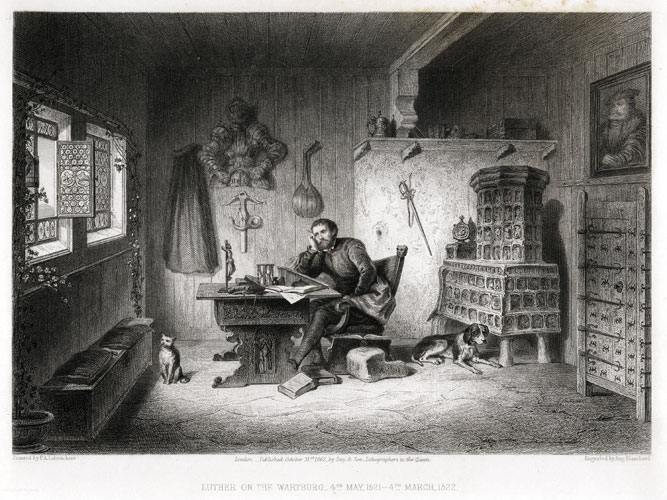
Luther’s “A Brief Instruction on what to Look for and Expect in the Gospels”

There is, besides, the still worse practice of regarding the gospels and epistles as law books that teach us what we are to do, and the works of Christ are pictured as nothing but examples to us.  Where these two erroneous notions remain in people’s hearts, neither the gospels nor the epistles may be read in a profitable or Christian manner; they remain as pagan as ever. – Martin Luther

Luther Reading               The above quote serves as Luther’s closer to the opening paragraph of “A Brief Instruction on what to Look for and Expect in the Gospels,” which he wrote in 1522.  Luther was on the move to reforming the reading of the Scriptures.  After coming to no agreement with Rome over the indulgence controversy and finding himself excommunicated by Pope Leo X in 1521, it was now time for him to solidify the Reformation movement he had begun which involved teaching his followers (both laity and pastors) how to read the Bible and to proclaim the Gospel.  The proper reading and use of the Scriptures were paramount to freeing the Church from her “Babylonian Captivity.”  In this brief, yet instruction-packed unterricht, Luther explains how there is only one gospel, how we should see Christ coming to us in that gospel, and how all of the Scriptures are properly read and understood through the gospel!

Central to Christianity, central to the Reformation, is the message of salvation in Christ alone, that is the gospel, and as such, for Christians to know how to read and use the Scripture, Luther must first make it clear what the gospel is: “a discourse about Christ, that he is the Son of God and became a human being for us, that he died and was raised, that he has been established as a Lord over all things.”  In other words, the gospel is a story of Christ and all of who he is and what he has done for us sinful men.  With this definition Luther is letting us know that when we refer to Matthew, Mark, Luke, and John as gospels, we are not saying that there are four gospels, for there is one and only one message of salvation.  Even though the four biography writers give different details of the life of the Messiah, and in fact none of them give all of his words and miracles for us to read, there is still just one gospel.  From this definition of the gospel Luther stresses that the evangelion is not bound within or wholly formed from a compilation of these four canonical biographies of Christ – the good news is found in the epistles too!

When we see this message of Christ and his saving work for us men, Luther says that we should not see this work of Jesus of Nazareth as an example by which we are to live – to emulate – to work our ourselves!  No, we should primarily see the work of Christ as being for us.  You should see Christ for you.   This means that whenever you see Christ going somewhere, anywhere, speaking, teaching, healing, walking on water, raising Lazarus from the dead, whatever miracle or work of Christ you might see from any Biblical text, you should see yourself in that text – see Christ coming to you, to heal you, to teach you, to save you from sin, death, and the devil, to be your all-sufficient savior.

Next, Luther points the Church to the whole counsel of God’s Word, id est to the woefully neglected Old Testament scriptures.  All of Scripture testifies to Christ, and since Christ’s person and work is the gospel, Luther explains that the gospel as found in the four gospel biographies and the epistles serves as the guide to reading and understanding the Old Testament.  Here too, the prophets, in particular “Moses the law-giver,” are not examples of how one should live.  Their words should not be taken as a handbook on how to live your life; their words primarily reveal the gospel – reveal Christ, though it is not so clearly realized in most cases, until Christ was incarnate and revealed himself personally by stepping into history, before then sending the Holy Spirit to illuminate our understanding of the Scriptures after his ascension.  This means we should not forsake the diligent reading of the Old Testament, which so often we do in our day as the Church also did in Luther’s.  To emphasize the consequence of this error, Luther ends his instruction with the following statement: “What punishment ought God to inflict upon such stupid and perverse people! Since we abandoned his Scriptures [referring to the Old Testament], it is not surprising that he has abandoned us to the teaching of the pope and to human lies.”

In summary, Luther taught that when we read Scripture, we should expect to see the gospel in our reading, we should see the gospel as Christ working for us in all that we need, and that we should expect to see this work of God for us in all of the Scriptures that we read.

107. Godparents – What Are They For?

>> Click here to listen to the episode <<
(Right click and “save as” to download the episode.)

Or listen in iTunes!

Godparents 2


In this specially requested episode, Andy returns from a long hiatus with a Reconnect episode on the role of godparents in baptism and in the life of their godchildren. 


Show Links

Episode 70: Does Baptism Save You?

Episode 99: Lutheran Theology Part 4

“Does Baptism Save You?” by Andy Wrasman

“Means of Grace Questions” by Andy Wrasman

“What is Baptism?” by Andy Wrasman

Contradict Movement Video Production Donation

Martin Luther’s Reformation on Spirituality

martin-luther-stained-glass_SIFrom my experiences, when people speak of Luther’s reformation teachings in commemoration of his posting of the 95 theses on October 31st 1517, the focus is almost always on his rejection of the selling of indulgences for the forgiveness of sins.  Inevitably this leads to the “solas of the Reformation” – that one is justified by grace alone through faith alone in Christ alone[i] – being presented as the pistons that drove all of Luther’s reforming agenda.  This depiction of Luther’s reforming work that I have observed again and again in numerous Lutheran congregations every Reformation Sunday has led me to see Luther’s reformation work to be primarily focused on correcting false doctrine.  What I have just recently discovered however from reading Scott Hendrix’s article “Martin Luther’s Reformation of Spirituality” is that central to Luther’s reformation was not a mere correcting of false doctrine, but that the Reformation had an additional emphasis, if not primary emphasis, on reforming Christian spirituality.

Late medieval spirituality consisted of the selling of indulgences for the remission of sins.  In particular, a full indulgence gave the pardon of all of one’s temporal punishment for sins committed up until the issuance of the indulgence.  Partial indulgences could lessen, or shorten, the temporal punishments one would receive for his sins.  These indulgences were granted by the authority of the pope with the full indulgence coming solely through his auspices.  To acquire these indulgences a Christian would have to attend countless masses, take pilgrimages to relics and shrines of saints, give endless cycles of penance, dive full-length into all that monasticism had to offer, and of course fill the Church’s coffer with pecunias multas (lots of money).  Luther’s 95 Theses and the resultant doctrinal formations that followed his initial disputation for clarifying the power of indulgences[ii] led to a necessary forsaking of these false spiritual practices for an embrace of a true, authentic Christian life of spirituality.

At the heart of Luther’s reformation of spirituality was his spotlighting that the religiosity of the Church in the late medieval age was wholly of human creation and ordinance – thus not established by God in his revealed Word.  Such religious activities were, as such, adiaphora – neither commanded nor forbidden in Scripture – thus Luther would come to demonstrate that such self-elected works had no value whatsoever to contribute to one’s righteousness, one’s right-standing before and with Christ.  All the spiritual mumbo jumbo of man’s creation, no matter how Christianized it might be made to seem, will actually kill you physically and spiritually, and Luther knew and experienced this suicidal murdering of his body and soul first hand through his fervent devotion to the monastic lifestyle for twenty years.  Much in the same way that Paul claimed to be a Pharisee of Pharisees, Luther was a monk of monks!  Following the rules and edicts of men to attain eternal life, Luther discovered that they only lead to the ruin of his body and the unending torment of his conscious that knew he was still a sinner rightly deserving God’s righteous judgment.

The epiphany of the salvation in Christ that comes apart from the works of the believer that Luther found in Scripture and stood upon for his salvation didn’t eradicate all spirituality, all Christian living, it simply eradicated the false-spiritualties of the Church of his day, because Christ did give edicts of religious and spiritual activities to those who would follow him, and Luther was not rejecting these, namely, Christ’s commands to baptize, to proclaim the Gospel, to administer the sacrament[iii], to absolve the sins of the repentant and to retain sins and excommunicate the unrepentant, to suffer with Christ and for Christ, and to love and serve all people as Christ would have us to do.  Essentially, following Christ and not the pope was the new landscape of Christian living that Luther sought through his reformation work.  Christian living and spirituality is thus very much a Lutheran thing.

[i] Sometimes lists contain four or five solas instead of just the three I have provided with the additional two solas being Scripture alone and the glory of God alone.

[ii] Disputation for Clarifying the Power of Indulgences is the title given in the 1518 Basel reprint.

[iii] By sacrament, I am referring to communion.