Reconnect Episode 8: Three Things Christians Say to Hurt Their Credibility

Left click here to listen now! Right click to download episode.

Listen in iTunes.

George and Andy, discuss a series of articles from Credo House entitled: 21 Things Christians Say to Hurt Their Credibility.  In this episode they have time to discuss three of these statements:

1. “You can’t use the Bible to prove the Bible.”

2.  “Good question.  I’ll find the answer and get back to you.”

3.  “One white lie will send you to hell for all eternity.”

We want to be credible witnesses of Christ.

Andy and George agree that some of these statements really do hurt the credibility of our Christian witness and should be avoided, but they come to disagree with at least one of these articles, because they think the statement is in fact Scriptural, thus should be spoken, but maybe there is a better way of presenting the truth to a nonbeliever.

Other questions and topics emerge as they discuss these articles, such as: how do we know the Bible is the Word of God, how should we respond to questions we don’t know the answers, is it possible for Christians to have all the answers to life’s questions, what exactly is revealed to us in Scripture and why, how should we approach preparing answers to difficult questions raised against or about the Christian faith, why should churches teach apologetics, and the very controversial topic of varying degrees of punishment in hell!

If you want to chime in on any of these topics or give a short review of any episode of Reconnect, record a short 30 second to one minute long audio clip, stating your name and the episode number you are addressing, and send it to Andy at andy@contradictmovement.org as an mp3 file.  If you have any questions you want addressed on the show, send them there via email as well.  Thanks.  Reconnect us, Oh Lord. 

Reconnect Episode 7: Jews Claim that Jesus did not Fulfill Messianic Prophesy

Left Click to Listen.  Right Click to Save. 

Listen in iTunes!

Reconnect logo designed by Kyle Beshears, author of Robot Jesus.

Jews reject Jesus as the Messiah, because they claim he didn’t fulfill Messianic prophesy.  Andy received an email from someone arguing that there were four key prophesies Jesus did not fulfill.  The sender also listed other ways in which Jesus contradicted the Hebrew Bible.  Andy discusses this email with Crean Lutheran High School’s Old Testament teacher, Conni Schramm.  She provides a Biblical response to all of the man’s objections.  Her first response to the email is shocking, and it should serve as a reminder for all of us entering into such debates via online messaging!

How would you have responded to these objections?  The following is the email Andy received at andy@contradictmovement.org in its entirety (swear words are blanked out):

I am contacting you because one of your members noticed my Israeli Air Force shirt today and proceeded to launch into horribly misinformed evangelical nonsense.  I’ve had more enlightening conversations with Time Warner Cable technical support.  He shared his nonsensical worldview with me, and I felt I should contact you, giving you feedback on one of your flock.  Simply put, he was an idiot, but just barely intelligent enough to be _____________.

Let me speak frankly, then: Jesus of Nazareth was not the messiah.

What is the Messiah supposed to accomplish? One of the central themes of biblical prophecy is the promise of a future age of perfection characterized by universal peace and recognition of God. (Isaiah 2:1-4, 32:15-18, 60:15-18; Zephaniah 3:9; Hosea 2:20-22; Amos 9:13-15; Micah 4:1-4; Zechariah 8:23, 14:9; Jeremiah 31:33-34)

Specifically, the Bible says he will:

  1. Build the Third Temple (Ezekiel 37:26-28).
    Second one was already standing – he’s out!
  2. Gather all Jews back to the Land of Israel (Isaiah 43:5-6).
    There was an enormous population of Jews outside Israel that stayed outside – nope.
  3. Usher in an era of world peace, and end all hatred, oppression, suffering and disease. As it says: “Nation shall not lift up sword against nation, neither shall man learn war anymore.” (Isaiah 2:4)
    If anything, more people were killed in his name than any other reason.
  4. Spread universal knowledge of the God of Israel, which will unite humanity as one. As it says: “God will be King over all the world ― on that day, God will be One and His Name will be One” (Zechariah 14:9). – Nope.

If an individual fails to fulfill even one of these conditions, then he cannot be the Messiah.  Jesus failed at all four.

The Messiah must be descended on his father’s side from King David (see Genesis 49:10, Isaiah 11:1, Jeremiah 23:5, 33:17; Ezekiel 34:23-24). According to the Christian claim that Jesus was the product of a virgin birth, he had no father ― and thus could not have possibly fulfilled the messianic requirement of being descended on his father’s side from King David. (1)  – Yet the genealogies of the gospels CONTRADICT EACH OTHER

The Messiah will lead the Jewish people to full Torah observance. The Torah states that all mitzvot remain binding forever, and anyone coming to change the Torah is immediately identified as a false prophet. (Deut. 13:1-4)   So, he’s a dissident.
Throughout the New Testament, Jesus contradicts the Torah and states that its commandments are no longer applicable. For example, John 9:14 records that Jesus made a paste in violation of Shabbat, which caused the Pharisees to say (verse 16), “He does not observe Shabbat!”    And a blasphemer.
Quite Frankly, sir, your evangelical organization is a sham, and the word “Contradict” in your title only refers to contradicting yourself.  You can’t hold that all parts of the bible are true if Jesus BLATANTLY contradicts the Torah, though you hold that it is the binding word of God (written by people, by the way, even Torah) even though it is contradicted by a blasphemer and political dissident who accomplished exactly nothing.  Jesus contradicts Torah, yet you worship Leviticus 18:22. YOU ARE CONTRADICTING YOURSELF! Normally, I don’t get too upset about these things.  This person was hell-bent on converting me back to idiocy, and I am hell-bent on letting you know the following:
1. That your followers are ________.  You won’t win any hearts and minds with people like that.
2. That your followers are also idiots, they are incapable of thinking for themselves save the lies with which you fill their heads.
3. I shall make it my goal to contradict your insidious movement whenever the opportunity arises.

Ashes to Ashes and Dust to Dust. From Whence We Came We Shall Return.

Why do we put ashes on our foreheads on Ash Wednesday?

Ash Wednesday is the first day of Lent.

Lent is a season of the church year. It is a season of penitence. Penitence means remorse for wrongdoings, in this case our sin.   Lent is a preparatory season, which means we are preparing for Jesus’ death and resurrection.

ash-wednesday

The question then is, “why the ashes for repentance?”

This comes from the ancient biblical tradition of covering one’s head with ashes, wearing sackcloth, and fasting.

Let’s see this tradition made visible in scripture.

Daniel 9:1-6, 17-19

Jonah 3:1-10

Other parts of scripture also show this practice for penitence and mourning.

On Ash Wednesday the church carries on this ancient tradition of using ashes.

On Ash Wednesday churchgoers are marked on the forehead with a cross of ashes.

Symbolism of the ashes:

The ashes remind us that . .

– Death comes to everyone

– We should be sorry for our sins.

Where does this symbolism come from in Scripture?

Genesis 2:7

Genesis 3:1-5, 19

God made the first human being by breathing life into dust, and without God, human beings are nothing more than dust and ashes.

Genesis 18:27

In Conclusion, putting on ashes is a symbol of the death that we so rightly deserve because of our sin. The ashes are in the form of the cross because it reminds us that God in his mercy gave us his Son, Jesus, to take our sin and death and die in our place.

Jesus’ Home in Capernaum!

Mark 2:1-2 – “And when he returned to Capernaum after some days, it was reported that he was at home. And many were gathered together, so that there was no more room, not even at the door.  And he was preaching the word to them.”  (ESV)

I hope you know the rest of this account.  Four men bring their paralyzed friend to the house to be healed, and since they couldn’t get into the house because of the crowd, they tore a hole through the roof of the house and lowered their friend into the packed home, that was likely experiencing a standing room only affair if there wasn’t even room at the door!  Jesus of course heals the man.

Here’s what stood out to me the last time I read this account – Mark says that Jesus returned to Capernaum and that Jesus was reported to be at his home. I for some reason never caught on that Jesus had a home in Capernaum!  Flip over to Matthew chapter 9 and you’ll see that Jesus went from casting out demons from two men in the country of the Gadarenes to crossing back over the sea “to his own city.”  His own city” in this case wasn’t Nazareth; it was Capernaum.  Matthew doesn’t say that there were four men who brought the paralytic to Jesus to be healed, and he doesn’t mention that they had to tear a hole through a ceiling to lower their friend into the home to get healed by Jesus.  But what Matthew does say about Capernaum earlier in his Gospel in chapter 4 is entirely new to me.  Matthew 4:13 says, “And leaving Nazareth he went and lived in Capernaum by the sea, in the territory of Zebulun and Naphtali, who that what was spoken by the prophet Isaiah might be fulfilled: “The land of Zebulun and the land of Naphtali, the way of the sea, beyond the Jordan, Galilee of the Gentiles – the people dwelling in darkness have seen a great light, and for those dwelling in the region and shadow of death, on them a light has dawned.” 

Isaiah prophesied about Capernaum.   This land was occupied by two of Israel’s 12 tribes.  The Assyrian army had marched through this land, conquering it.  It certainly would have been a place scarred with war, a people dwelling in darkness with the shadow of death from the past laid upon its inhabitants. But as Isaiah foretold, a great light would shine upon it.  Jesus was that great light. This was the hometown of Peter (Matthew 8:14) and the town in which Matthew collected taxes (Matthew 9:9). And Jesus called them to be two of his apostles.  And by by making his base of operations in between missions trips Capernaum, the land of the Gentiles, he was showing his desire to save all people, to bring together the Jews and the Gentiles under one house in his kingdom.

Mark says that Jesus was in his home.  And Matthew says that Jesus was in his city.

So whose house did these four amigos tear a hole in to have their friend healed?  Jesus’ roof!  I never knew that.  This shows that these men had some mighty strong faith to tear a hole in the ceiling of the guy’s house they were hoping would heal their friend.  It also shows that they knew Jesus’ heart – he put people before his physical belongings.

This event is also when Jesus made it known that he was equal to the Father in divinity by forgiving the man’s sins.  The miracle of the man walking confirmed the authority that he had to absolve sins.

Matthew 9:8 records that when the crowds saw the miracle “they were afraid, and they glorified God, who had given such authority to men.”  This is the same response that Peter had when he witnessed the miraculous catch of fish in his boat.  He was afraid and calling Jesus Lord he asked him to get away from him, since Peter knew he was a sinful man.  Jesus however consoled him and told him that he would now be catching men instead of fish. When we encounter the hand of God, as sinful men, it brings us to tremble.  Here in Capernaum, the people glorified God in that fear.  The Gadarenes who witnessed Jesus cast out the demons into a herd of pigs, responded by begging Jesus to leave.

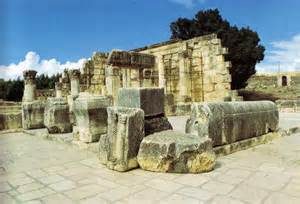
Capernaum is modern day Tel Hum.

Ruins at Capernaum (Modern Day Tel Hum)

Visit www.contradictmovement.org and get a sticker, tracts, or my book!  Thanks. 

You shall recognize them by their fruits – Judging fellow Christians.

“Every tree that does not bear fruit is cut down and thrown into the fire. Thus you will recognize them by their fruits.” – Matthew 7:19-20

I have seen this passage used a lot lately for the purpose of spotting “false converts,” or people who claim to be Christian, but they really are not. The reason we can know they are not Christians according to these posts, articles, and videos is that they are not doing things that TRUE Christians would do, or they are doing the unthinkable actions that TRUE Christians would NEVER do. Such examples of these actions that a TRUE Christian would never perform are those of a husband beating his wife habitually, living in a state of adultery, or denying the existence of God.

The numbers from XXX Church for Christian involvement in pornography consumption don’t look good for men, or women, who claim to be Christians, and they look just as bad for the pastors in the Church – if not worse than for the laity. Does this mean that the bulk of Christians in America are false converts, or think they are saved when they are not, because many are hooked on pornography?

Do you know someone who lives with their fiancé, or girlfriend or boyfriend, who is likely having sexual intercourse or other sexual behavior with their live-in roommate of the opposite sex, and yet, they profess Jesus as their Lord and Savior? Do you know anyone who isn’t living with their significant other, but they are openly having sexual intercourse together, while confessing that Jesus is Lord and Savior? Or… what about this… how many Christian couples do you think are having sex outside of marriage, yet no one knows about it, but God?

When you see these brothers and sisters in Christ in visible sin, do you look at them and think, there is NO WAY that person is a true believer? Do you approach them and say, “How can you call yourself a Christian when you (blank), (blank), and (blank)?” Do you approach them and say, “You are not truly repentant. If you were, you wouldn’t do these things. Therefore you must stop what you are doing and ask Jesus to forgive you, and turn from sin, and NEVER do it again.” Do you look at them and say, “Well they think they have repented, think they believe, think they have surrendered their all to God, but they haven’t. They claim to know Christ, but they are so far from him in his actions. They are just pretending to be a Christian.”

Let me ask you? How many people do you know who profess Jesus as their Lord and Savior, yet they regularly, daily, commit adultery, lie, sin in their anger, hold some sort of hatred in your heart, steal, slander their neighbor, have idols in their lives, covet, and what have you?

Now let me turn it to you. Do you do these things, daily? Do you ever put anything or anyone above Christ in your life? Do you struggle with road rage? Do you get extremely angry and start cursing liberals when you watch FOX News? Do you struggle with pride? Do you say little white lies? Do you go a whole day, a single hour, without a sinful thought, action, or word? Don’t forget, sins are not just acts of commission, but also omission – not doing the things that you should. James 2:10 says, “For whoever keeps the whole law but fails in one point has become accountable for all of it.”

This should really make us slow to judge someone who claims to be in Christ to be a person who is NOT in Christ. If we judge someone else to not be in Christ based on visible sin in their lives, then how are we different? If we have kept all of the Law of God but have stumbled in one aspect, we are guilty of breaking it ALL. So what then… would we not be saved? Scripture NEVER says, “Once you have committed X amount of sin, you are no longer a Christian, you are no longer saved.”

Yet, it says that we will recognize them by their fruits! So some in the Church tend to judge other believers and say that certain persons can’t be a TRUE Christian, because they have done (blank), (blank), or (blank). This is problematic because we must remember that we TOO have done (blank), (blank), or (blank), just maybe not to the same degree, but that still makes us breakers of God’s Law, which means we deserve his eternal wrath. This is also problematic because we cannot see into the person’s heart. Is the person resisting the sin? Is the person contrite? Is the person inwardly begging Christ to forgive them? Is the person crying out – Lord help I don’t want to do this, and he manages to abstain for a time, but fails once again to meet God’s standard or righteousness? That would be Paul’s dilemma in Romans 7:15-25. The person might be struggling in such away, which would be a sign that the Spirit is active and repentance is present! You don’t know it, and I don’t know it, unless we approach them in love with God’s Word and ask.

When we approach a fellow human being, who confesses Christ as his Lord and Savior, we should follow what Christ told us in Matthew 7, the chapter that tells us “thus we shall recognize them by their fruits.” In that chapter, Jesus tells us “first take the log out of your own eye, and then you will see clearly to take the speck out of your brother’s eye.” Jesus then tells us, “Do not give dogs what is holy and do not throw your pearls before pigs, lest they trample them underfoot and turn to attack you.” In other words, don’t hypocritically judge other precious believers, who are holy and seen as valuable as pearls, by throwing them out of the Christian assembly to the dogs and swine of the world.

So before calling someone who you see to have visible sin a “false convert” or unbeliever, you must examine yourself first, and approach your fellow believer (who you might think is a non-believer due to his actions) in humility, admitting your own sin, confessing your own sin, and gently showing them the error of their ways. This would be part of the process of “iron sharpening iron” as Proverbs 27:17 mentions, or being a Watchman and warning the wicked of their evil ways (Ezekiel 3:18-19). If you approach a person in this manner and he then denies what he is doing is sinful, and you show him in Scripture where it is sinful, and he still denies it as being sinful, it’s time to approach him with another brother, and if he still denies you and the Word of God that you bring that reveals his actions to be sinful, you then bring that person to the whole assembly of the Church, and if the person still denies God’s Word at that point, then we can count the person as LOST, NOT SAVED. I am getting that process of a solo approach, tag-team approach, and then congregant approach from Matthew 18:15-20. That process is for if someone sins against you personally, but I think it can be applied to anyone committing an openly visible sin, because it is harming the witness and image of the Church, and it is hurting his relationship with God. I do believe a person can fall away from the faith, and that would occur when they have rejected the gift of faith and chosen instead to deny Christ and his work to embrace the sin that they love without having to deal with the struggle against that sin any longer.

Now let’s look at King David! Was he a false convert?

David was a man after God’s own heart. (1 Samuel 13:14) Yet… after doing so many great things for the Lord and in the Lord’s name and for the glory of God, David has a string of horrid sin, that involves adultery with the wife of a devoted man of God and one of David’s soldiers. The wife of this other man gets pregnant by David while her husband is out on the battlefield. To cover up the adultery, David has the husband killed on the battlefield. Then he takes the man’s wife as his own to cover up the adultery. (2 Samuel 11) David, a man after God’s own heart, actually did ALL of these things. Was he a “false convert”? Was he not saved because of these things? Was he not fully surrendered and committed to God? Was he not truly repentant? And since he wasn’t fully, truly, actually (blank), (blank), and (blank) was he not a TRUE believer? This is how these “false convert” warnings are initiated against people who confess to be Christians and based on these “false convert” warnings; David wouldn’t be a TRUE believer!

When David is called out by Nathan (2 Samuel 12), Nathan does it by telling David about a very sinful man in the land. Not knowing who this man is David says that man deserves to die! And Nathan tells David, that man is YOU. David then simply says, “I have sinned against the Lord”. And the reply from Nathan is, “The Lord has put away your sin; you shall not die.” I think David was always in faith through it ALL! Have you not covered up sin? Tried to hide it? Got called out for it, and initially denied it, before finally, confessed your sin? When we have faith in Christ, our sins are forgiven! We do not have to completely turn from our sins so that we NEVER sin again. We do not have to name every one of our sins and confess them to have them forgiven? It’s not even possible to name all of our sins, because we sin, when we aren’t even aware we are sinning! That really is how wretched we are.

Back to Matthew 7:20

When you are read Matthew 7:15-20, you’ll see that Jesus is talking about recognizing false prophets. He says that false prophets come to us in sheep’s clothing, but that inwardly they are like ravenous wolves. Can you judge the inside of a man? Outwardly, these false prophets would appear as if they were TRUE believers in their actions. That’s why they look like sheep. So what fruit would you need or even be able to judge to know that they are false prophets? That would be their words, their teachings. Do their teachings align with God’s Word? Do their teachings point to Christ as Lord and Savior? 2 Peter 2:1 tells us that this is exactly what false prophets do: they “will secretly bring in destructive heresies, even denying the Master who bought them.”

When you look beyond Matthew 7:15-20, to the context of the entire Sermon on the Mount, you’ll clearly see that Jesus isn’t asking any of us to judge the salvation of anyone based on their external actions. He is calling out hypocrisy. He says, “Oh you don’t think you have committed adultery, you don’t think you have killed anyone? Guess what! You have – in your heart.” He actually throws all of the Jews who are trying to justify themselves by their “fruits” under the bus of the Law! He says, “For I tell you, unless your righteousness exceeds that of the scribes and Pharisees, you will never enter the kingdom of heaven.” (Matthew 5:20)

Please, don’t judge people as being TRUE Christians or not based on their external actions. God judges the heart. We can’t see into the heart. What we can do is have deep concern for our fellow brothers and sisters in Christ, especially when we see they are struggling with specific sins. Come alongside them. Share your own struggles with sin. Confess to one another. Pray for one another. Hold each other accountable. If the person denies his actions are sinful, and you show that person from God’s Word with the counsel of other believers present that it is sinful, then according to Matthew 18, it’s safe to consider them as LOST.

Recognize false prophets by their words and teachings. Don’t try to judge someone as Christian or not based on their external fruits, because we can’t see into the hearts of men to know the heart position behind the fruit we see to know if it is from faith or not. Do you know who the judge is of the fruit? God, the Father. Check out John 15. Jesus says that he is the vine, and that we are the branches. The good fruit we bear is because of him and being connected to him. He also says, “My Father is the vinedresser. Every branch in me that does not bear fruit he takes away, and every branch that does bear fruit he prunes, that it may bear more fruit” (John 15:1-2). So we aren’t the ones judging the fruit – God, the Father, is the one with that job. He cuts off and throws away the branches not bearing fruit. He prunes the branches that are bearing fruit, so they might bear more fruit.