What is a false conversion?

I have seen a recurring theme lately on social media sites… the false conversion!  These social media posts, videos, images, and websites are claiming that a false conversion is when people think they are Christians (or saved), but in reality, they are not.  Why wouldn’t they be saved?  It’s not because they don’t believe Jesus died for their sins, it’s because they aren’t doing the things Christians ought to do.  This means these false converts are somehow openly sinning in a way that  Christians should never do, they aren’t bearing the proper Christian fruit in their lives, or they think that a prayer that they said at some point means they are absolved of all their sins.  The other recurring theme I am seeing amongst these posts that talk about false converts is a question of “true repentance”.  They claim that a false convert hasn’t truly repented, or hasn’t really surrendered to God, or doesn’t actually desire a relationship with God, they’re just wanting “fire insurance”.

Here’s a recent example I saw:
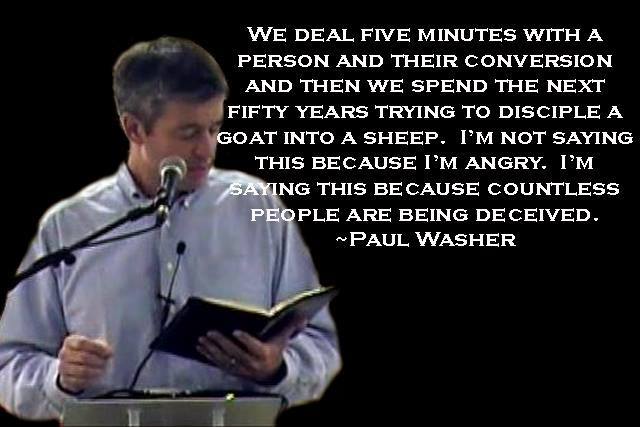
An example of this false conversion talk.

This quote by itself leaves a lot of questions of what exactly does Paul Washer mean, but a guy named Michael on Facebook explained the above Paul Washer quote by saying:

He’s speaking about how people are very quick to get someone saved that they basically never tell the the gospel but rather spend five minutes and make them mouth a sinner’s prayer. Then we end up spending the next 50 years trying to get them to actually follow Christ as part of God’s flock.

In other words, people are being deceived into believing they’re saved just because they said a simple prayer, without ever actually understanding what the Gospel is, and so they’re unfortunately never brought to the place of actual conversion to truly follow Christ. And unfortunately many will indeed do as Jesus says, “Many will say unto me, Lord, Lord,” and believe they’re saved, but they never actually gave their lives to Christ.”

Another commentator agreed with Michael, saying:

What Michael said is correct. Our current society [I think he means church congregations] tries to do whatever they can to get a “decision” for Christ, with a Gospel void of repentance and faith. Then this “convert” doesn’t act like a Christian, so we spend years and years trying to “disciple” a non-believer into acting right, without realizing they were never saved to begin with.

There are even websites dedicated to warning people that they might not be true converts to the Christian faith.  At one site, you’ll find numerous confessions from former “pretenders” and you’ll be greeted with a load of questions that are designed to lead you to the realization that you are not a true believer, such as the following question:

What if I have not honestly been broken over my sins against God and completely surrendered to the Lordship of Jesus Christ?

The measure of your salvation in all of these “false convert” warnings lies with YOU and YOUR work, not in Christ and HIS WORK.  The work lies upon your degree of commitment or involvement.   Do you really believe, have you completely turned from your sins, do you actually hate ALL of your sins, are you truly following Christ?

Based on these types of questions and warnings, a person is left to turn inward to himself, and not outward to the cross of Christ and his empty tomb.

Do I really believe?  What does that mean?  Do I ever have doubts?  Do I ever question God’s calling in my life? Is my entire theological system 100% correct, free of all errors?  Are there miracles accompanying all my prayers?  Have I been bitten by a poisonous snake and not harmed at all?

Have I completely turned from my sins (often worded as truly repented)?  What does that mean?  Does it mean I hate every single one of my acts of sin?  Can I even enumerate all of my acts of sin?  God forbid, but what if I fall into some sort of horrible cycle of sin, such as what King David and Samson did?  Were they not truly repentant because of those nasty spills of temptation and failure to resist?  Is it even possible to completely turn from my sin in this life?  Won’t I always have sin in this life?  And since I know I will always have sin this life, how many sinful acts are too many for me to have completely turned from my sin?

Am I truly following Jesus?  Let’s see… Am I holy as he is holy?  Do I always pray for and love my enemies?  Do I ever have hatred in my heart, or lust?  Do I ever covet my neighbor’s house, or my boss’ salary?  Do I have one too many coats?  Do I always do the things that Jesus would want me to do, just as he was always doing what his Father wanted him to do during his time here on earth?  Do I ever go astray like the dumb sheep of Psalm 23?

Do you get my point?!!?  Are any of us really, truly, completely (fill in the blank) so that we are deserving of salvation because we have (fill in the blank)?  Are any of us even capable of properly making these judgments about ourselves?  And I know for certain no other man can know my heart!  So please, don’t get sucked into justifying yourself, or trembling that you aren’t doing enough to prove yourself a true convert.

So how does conversion take place?  A person hears the Gospel and believes.  It’s that simple.  Conversion occurs instantaneously, as does our justification.  Sanctification however is a process, in which we will become more and more like Christ, likely sin less, and grow in faith and love more and more, etc.  But that process will never be complete in this life… NEVER.  When we die and are raised at Christ’s return, we will then receive heavenly bodies – that are sinless.  As for now, we will always struggle between our new nature in Christ and our sinful nature that we inherited at our conception (Romans 7).  And our justification is not dependent upon how we are progressing in sanctification!  Our justification always comes by grace through faith in Christ.

Here is Paul Washer (to use him again in this blog post) explaining how a person is converted:

I absolutely love that Paul Washer explanation of how a person is converted and how we should lead a person to Christ! I hope you watched it. His explanation shows that conversion is not saying a prayer or making a decision. It’s simply faith coming to a person through hearing the Gospel message proclaimed, just as Paul says it does in Romans 10. After we have faith, we do pray, we do decide to follow Christ, etc.  Perfectly?  No. Never, not in this sinful body.  Should the quality of my obedience dictate my salvation?  No. Never. The perfection of Christ’s obedience dictates my good standing before the Lord, and Jesus was obedient unto death – even death on a cross!

And to close… since the focus of these “true conversion” tests is for a person to discern his works and see if they are in line with the Lord’s will (“acting like a Christian”), I offer the following passage, Matthew 7:21-23:

“Not everyone who says to me, ‘Lord, Lord,’ will enter the kingdom of heaven, but only the one who does the will of my Father who is in heaven. Many will say to me on that day, ‘Lord, Lord, did we not prophesy in your name and in your name drive out demons and in your name perform many miracles?’ Then I will tell them plainly, ‘I never knew you. Away from me, you evildoers!’

Do you note what happened here?  Not everyone who prophesies in Christ’s name and drives out demons and performs miracles will be saved.  Why?  I think it is because they were justifying themselves.  If Jesus ever said to me, you can’t enter heaven, I won’t respond with, “But Lord, did I not (blank), (blank), and (blank) in your name?”  No!  I will say, “But Lord, did you not take on flesh and humble yourself to live amongst us in order to fulfill all righteousness for me?  Did you not die as an atoning sacrifice for my sins? Did you not rise from the dead, conquering sin, death, and the devil?”  Do you see the difference?  The ones who did not know Jesus, pointed to themselves and the work they did in Christ, not recognizing that they are evil-doers.  The one who knows the Lord will point to Christ alone for his salvation.  The point is that we are all evil-doers.  We don’t deserve salvation.  We deserve hell.  So let’s not make salvation (or our conversions) about how well we are following Christ, how committed we are to the one True Lord, how much we hate our sins, or how much fruit we are bearing.  Let’s always beat our breast and proclaim how wretched we are and that we need Christ to justify us!

The Blind Men and the Elephant – The Response!

The following is an excerpt from my book, Contradict – They Can’t All Be True (FYI – the spacing doesn’t always transfer correctly from my PDF file to the blog):

Drawing by my friend Danny Martinez.

A popular analogy that depicts an “all religions lead to God” form of pluralism is the story of several blind men touching various parts of an elephant and being unable to agree on a single description of the creature they’re touching. This story has connections to Jainism, Buddhism, Hinduism, and even Sufi Islam, a mystical branch of Islam. The story is found in the teachings of the Buddha within the Pali canon of Theravada Buddhism. One of the most popular versions comes from a nineteenth-century poet, John Godfrey Saxe, who rewrote the story in rhyme.

Though there are minor discrepancies among the versions, they all present the same basic scenario: since each blind man is touching a different part of the elephant, they disagree on what the elephant actually is. The one touching the tail might think the elephant is a broom; the one touching the side of the elephant might think the elephant is a wall; the one touching
the elephant’s trunk might think the elephant is a snake. Individually, they each know a part of the elephant accurately, but not the sum total of the animal. They fail to grasp what the elephant actually is because of their blindness. Their dispute is futile since they are all mistaken.

It is pretty clear how this story can be used within the framework of pluralistic relativism. Christians, Jews, Muslims, Hindus, Buddhists, and the like are all touching the same sacred elephant, God. But because all of humanity is spiritually blind, we are incapable of knowing God as he actually is. Any fighting among religious faiths is thus futile.

On the flip side, the good news within pluralism is that every religion is true based on what its adherents have experienced of the sacred reality. Since all religions have touched the sacred elephant, all religions lead to the same divine truth. Religious pluralists argue that if humanity could only come to “see” this predicament, all religious fighting could stop. We could recognize what each religion has learned about God and, by compiling the parts of the whole, come to a better understanding of who or what the nature and personhood of the sacred reality is.

The view of the divine expressed by the sacred elephant analogy is plausible and worth considering. Before considering the accuracy of its assertions, I want to stress the pluralistic uses of the story. Far from saying all religions are true, the story of the blind men and the elephant takes all religions and throws them under the bus, where they are left broken in their false perceptions of ultimate truth. As hopeful as this story can appear, in reality it just drops the bomb on absolute truth, at least absolute truth concerning God. The blind men show us that truth concerning God is unobtainable due to our limited faculties.

Skepticism toward God doesn’t invalidate this brand of pluralism. The problem lies within itself. Nestled within the story of the blind men and the elephant is a self-contradiction that makes the entire claim crumble in on itself. The pluralists claim that God is unknowable; every religion is wrong about its perceived understanding of the divine. However, in making this claim, the pluralists also implicitly declare they have an inside track on who God is. If no one is capable of knowing God due to our lack of sight in the realm of the divine, then what prescription glasses have enabled the pluralists to know the nature of God with such certainty? Pluralists are rejecting all exclusive truths concerning God, but making one themselves.

End of excerpt from Contradict – They Can’t All Be True.

In my book, I intentionally wrote with a non-Christian voice for the first six  chapters.  I first present what religious pluralism is and why its so dominant in our culture and society right now.  I then demonstrate how religious pluralism doesn’t actually work logically.  Responding to the elephant analogy was near the end of that section of the discussion before moving into presenting an evaluation of religious truth-claims and ultimately landing on the trustworthy nature of the person and work of Jesus of Nazareth to save us from sin and death and reconcile us into a right relationship with God!  Since I wasn’t ready to let it out of the bag that I was a Christian yet in that stage of the book writing process, I didn’t  respond to the elephant analogy the way I typically would.  The following is a more complete Christian response to this popular analogy:

A critique of this parable would contain the following points:

  1. This parable is actually claiming that all religions are false.
  2. This parable makes all aspects of life subjective.  There is no absolute, objective reality that we can be certain we are experiencing correctly.  If absolutes don’t exist in a way that we can comprehend them, morals and ethics also become subjective.  There would no longer be such a thing as right and wrong.
  3. Any exclusive religion, such as Christianity, Judaism, and Islam are forced to give up their claims to exclusivity to fit into the inclusive, pluralism which this parable projects.
  4. With Christianity’s exclusive claim that Jesus is the only way to salvation, all other religions would have to be false if Christianity is true, or Christianity could be false and other religions true.  This does not fit with the elephant analogy at all.
  5. The original telling of this legend has a king who sees the blind men groping at the elephant arguing about what they are touching.  The king reveals to them in laughter that they are all foolish men that they are all touching the same reality, the elephant!  This is very interesting that the original legend has a word from above revealing the truth to the blind men.  This indicates that the truth is actually discernible – we might just need some help from someone up above.
  6. The original ending of this parable lends itself very well to Christianity.  Christianity teaches that help did come from above.  That God has revealed himself to mankind through what he has created as well as through special revelation from the Scriptures and in particular through the second person of the Trinity, Jesus, taking on flesh and walking amongst us, revealing the truth to us, healing the blind and helping them see.  This revelatory claim of Christianity isn’t even considered or introduced in pluralistic uses of this parable.

Conclusion: Declare truth where truth is found!

It seems clear that all religions cannot be fully and equally true.  There are direct contradictions within the teachings of the world’s religions, such as Jesus is God (Christianity) and Jesus is not God (Islam), which eliminate the possibility that all religions are true.

This however doesn’t mean that aspects of the truth cannot be found within various religions.  Christians would do good to point these truths out from time to time.  If Christ’s claim is true that he is the way, the truth, and the life (John 14:6), then all truth would be God’s truth, no matter where it is found.  Where truth is found, declare it, use it, put it in its full context of which it is fully and directly revealed from God in the Bible.  The Apostle Paul did when he quoted the philosophers of the Athenians (Acts 17).  We can do it too!

Does Baptism Save you?

Spiritual Baptism Proponent: Do you believe baptism saves?

[Asking because I’m a Lutheran Christian and has heard another Lutheran say that baptism saves]

Me: Yes, 1 Peter 3:20-21 says that the waters of Noah’s day symbolize the waters of baptism that now save you, and they save you through the resurrection of Jesus Christ.

Spiritual Baptism Proponent:  I’m not familiar with that passage.

Me:  You should read it.  It’s in 1 Peter 3.  The only time the word symbolism is ever used in the same sentence as baptism is that passage and the waters of baptism are not symbolic; it’s the waters of Noah’s day that are symbolic.  Those waters symbolize the death and resurrection that we are connected to in baptism.  Baptism saves, and it saves because of Christ’s death and resurrection.  We are always saved by Christ’s death and resurrection.  So this isn’t taking away from Christ’s work.

Spiritual Baptism Proponent: I’m not familiar with that.  I’d have to read that verse.

Me:  Yea, please do.  It’s in 1 Peter 3, near the end of the chapter.  But, there are numerous times in Scripture, not just from Peter, but also Paul in which we see that baptism unites us with Christ.  For instance, wait I have a Bible, Romans 6:1-5 says, “What shall we say, Then? Shall we go on sinning so that grace may increase? By no means!  We died to sin; how can we live in it any longer?  Or don’t you know that all of us who were baptized into Christ Jesus were baptized into his death?  We were therefore buried with him through baptism into death in order that, just as Christ was raised from the dead through the glory of the Father, we too may live a new life.  If we have been united with him like this in his death, we will certainly also be united with him in his resurrection.”

Spiritual Baptism Propoenent: Yea, but that’s spiritual baptism.  We receive all of that when we receive the Holy Spirit and faith.

Me:  I would agree with you.  If a person hears the Gospel and receives the Gospel in faith, they are saved and have life and salvation.  We are always saved by grace through faith in Christ.  But how does that grace come to us?  And is there anywhere in Scripture were we see the term “spiritual baptism”?  I know we see “Baptism of the Holy Spirit” in Acts, which is something completely different.

baptism

The conversation spun off into addressing does everyone have to be baptized to be saved and if babies should be baptized, and etc.  I want to boil this all down to two questions:

#1 – Does baptism save?
#2 – Does everyone have to be baptized to be saved?

Let’s first define baptism – based on Matthew 28:19, baptism is washing in the name of the Father, and of the Son, and of the Holy Spirit.  Unless there is a clarifying word before or after baptism, such as “baptism by fire”, or “baptism of the Holy Spirit”, or “baptism of repentance”, or “John’s baptism”, we should interpret baptism to be referring to the baptism instituted by Christ, especially if we see the additional descriptors of, “Jesus’ baptism,” or “baptism into Jesus’ name”.

Now, that baptism is defined, I want to introduce a term that may not be too common in many Christian circles: MEANS OF GRACE.  Understanding MEANS OF GRACE will help answer both of these questions.

The MEANS OF GRACE are the ways in which God has promised to work salvation in our lives, to deliver the Grace that comes through Christ’s life, death, and resurrection to us. Let me explain this term the best I can and use Scripture to do it:

According to Romans 10 how does a person come to be able to declare with his mouth and believe in his his heart? Vs. 14 asks how can they call on the one who can save them if they have not heard of him? The concluding answer is that they can’t until they have heard the Gospel (vs. 17). It is through the hearing of the Gospel that faith COMESFaith COMES to us instead of us COMING to faith.  Here is Paul’s language on that point found in vs. 17, “Consequently, faith COMES from hearing the message, and the message is heard through the word of Christ.” Flip all the way back to the beginning of the letter to the Romans and you will see that this is how Paul starts the letter – The Gospel is the power of salvation for all who believe (Romans 1:16). The Gospel saves. We hear the Gospel and through the Gospel the Holy Spirit gives us faith (this is another point I’ll have to tackle in another post). This all fits into Ephesians 2:8 in which we are told that salvation is by grace through faith and this is not of ourselves but the gift of God. Grace is “God’s Riches At Christ’s Expense.” By his life, death, and resurrection we have been forgiven, but all people are not instantly saved. That Grace must come to us somehow. The Gospel is one MEANS OF GRACE by which Grace comes to us, though we only receive the benefits of it through faith in the Gospel promises of God.

I think all Christians would agree that Grace comes to us via the Gospel and that unless one has faith in the Gospel, there is no eternal life for that individual that has rejected the Gospel upon hearing it.

NOW… is that the only MEANS OF GRACE, is the Gospel the only way we may receive the forgiveness of sins?

To Question #1, I would say YES – Baptism saves! God has promised to work forgiveness of sins through baptism. That means that Grace comes to us in baptism (water applied to a person in the name of the Father, and of the Son, and of the Holy Spirit). To support that baptism saves, I point people to 1 Peter 3:20-21. Here the waters of Noah’s day are said to symbolize the waters of baptism that now SAVE YOU. How does it save? Look at verse 21 – “It saves you be the resurrection of Jesus Christ.” Baptism is not symbolic here, the waters of Noah’s day are symbolic. Baptism saves by the resurrection of Jesus Christ. Romans 6 clearly explains how in baptism we are buried and raised with Christ. It’s not just Peter that says this, but Paul too!

To Question #1, YES – Baptism saves! Baptism is not our work, but it is God’s work to save us! To illustrate this beyond the 1 Peter 3:20-21 example, I like to point people to Colossians 2:9-12. Again we see that in baptism we are buried with Christ and raised with Christ, but there is the additional detail that we aren’t doing ANYTHING in this process because Paul says that baptism is like circumcision. Instead of cutting of the flesh, it is cutting off the sinful nature (i.e washing us of our sins – oh, and so much more!). WE don’t cut off this sinful nature – JESUS DOES! Verse 11 – “not with circumcision done by the hands of men but with the circumcision done by CHRIST!

TO Question #2 – NO – We don’t have to baptized to be saved! Grace comes to us through the MEANS OF GRACE – the Gospel and Baptism (and communion, but that’s another topic). If a person hears the Gospel and believes, faith and salvation has COME to him. He is saved. If that person is never baptized, he still has received grace through faith. If a person is baptized and believes, faith and salvation has COME to him.

So is everyone saved who is baptized? NO! Just as the benefits of hearing the Gospel are received through faith, so TOO the benefits of the promises of baptism are received through faith alone.

Technically, everyone receives the forgiveness of sins in baptism, just as everyone receives the forgiveness of sins through hearing the Gospel, YET, the benefits of God’s Grace are only received through faith in his promises. Hence it is so crucial to stick to Paul’s phrase, “by grace through faith”. Just grace and no faith – NO salvation. Just faith – NO salvation. It is when we have faith in a trustworthy object of salvation we are saved. The object in this case is a person and his work that for his sake, we have an all sufficient Savior, Jesus Christ of Nazareth.

Get my book - Contradict - They Can't All Be True
Get my book – Contradict – They Can’t All Be True

Means of Grace Questions

Means of Grace – Ways in which God delivers grace to us.  Grace comes through the life, death, and resurrection of Jesus Christ (His blood shed on the cross).  But how does that blood come to us today?  Through the Gospel, through baptism, and through communion.

Sacrament – This Word is not in the Bible, so you can define it however you want or not use it at all.  Lutherans define it as a sacred act, instituted by God, that has the promise of forgiveness of sins attached to an external, visible element.  This means, from Scripture, that baptism and communion would be sacraments.  You would need to look at Scripture to see if these are just ordinary acts, or if they are sacred.  Were they instituted by God?  Do they have the forgiveness of sins attached to them?  Do they have a physical element within them?

Going through and answering these questions in class, everyone in my class seemed to be in agreement that baptism and communion met the criteria for being a sacrament under the Lutheran definition of sacrament.

Here were some questions that still lingered received in an online questionnaire:

1.  Why do Lutherans have a different definition of sacrament than other denominations? 
It’s not a Biblical word, so there is freedom to define it as you choose, or choose not to use it at all.  The important part is to focus on what Scripture teaches concerning baptism and communion.  Roman Catholics have more sacraments than Lutherans.  If they are using the same definition, then we should check to see if marriage ever has the promise of forgiveness of sins attached to it in Scripture, as well as their other sacraments.  We should see if they have external elements, etc.  We should check and see if the Roman Catholic definition of sacrament varies and if it does, we should check to see if what they label to be sacraments fit their definition in Scripture.

2. What do other religions believe to be the means of grace?
Other religions don’t have means of grace.  Their adherents must perform certain rituals or rites regularly and correctly as their means of attaining their religion’s highest goal.

3. Are the means of grace absolutely necessary to be saved or are they just helpful in that they help us remember that we are saved and welcomed into the kingdom of God?
Yes, and no.  From what God has revealed to us in his Word, hearing the Gospel is necessary for salvation!  Read Romans 10.  Could God save apart from the Gospel?  He is God and he is not limited by any means, but we should not speculate that he saves apart from the Good News of Christ’s saving work.  If a person has heard the Gospel, receives it in faith, they are saved.  If they are not baptized, they are saved.  If they never receive communion, they are saved.  Proof – the thief on the cross next to Jesus who was promised salvation for trusting that Jesus was the Messiah. The power for baptism and communion to save come from the Gospel!

Justification, Sanctification, and Conversion

I received the following question: “What are the main and general differences between justification, conversion, and sanctification?”

Sanctification may not always be such an upward slope.  I believe we will have dips in our walk with the Lord.
Sanctification may not always be such an upward slope. I believe we will have dips in our walk with the Lord.

Justification is being declared holy.
Sanctification is being made holy.

When we are declared holy it doesn’t mean that we actually are holy.  In god’s sight, through faith in Christ and his saving work, we are seen to be holy even though we still sin!  This is justification.

Justification is instaneous.  The moment a person has faith in Christ is the exact moment they are saved – seen to be holy in God’s sight.

At the exact same moment a person is justified he is converted.  He has gone from life to death, from a child of Satan to a child of God.  Just as justification is instantaneous, conversion is instaneous.

Through the life of the believer, he grows in holiness.  He becomes more like Christ.  Sin lessens and good works abound.  However, in this life, we will never become perfect. We will always still have sin.  So though we are becoming holy in sanctication, the process is never complete this side of heaven.

In summary:

Justification and conversion happen at the exact same moment and the effects are ongoing.
Justification and conversion are both instaneous.
Sanctiication is a process.