The Person of Jesus of Nazareth – From Scripture

The Person of Jesus of Nazareth

In this series, we have seen that God created all things in six days and at the end of those six days he called his creation “very good.”  We saw that mankind is the crown of his creation, being created in the image of God and being given the position of dominion and stewardship over God’s creation.  The first two humans, Adam and Eve, sinned, rebelled against God by breaking his command to not eat of the Tree of the Knowledge of Good and Evil.  The entrance of sin into the world brought evil and physical death into God’s creation.  God’s creation was no longer “very good”.  God’s creation was now Fallen and with the Fall mankind lost (while still retaining aspects of) God’s image. 

God did not leave Adam and Eve without hope.  Read Genesis 3:14-15. 

Jesus of Nazareth is the promised offspring of Eve that did defeat sin, death, and the Devil (the Serpent).  The Old Testament traces the history of God’s people, following the lineage of Adam and Eve that would give birth to the Savior of mankind. 

What do the following verses reveal about Jesus of Nazareth? 

1 Tim 2:5 –

Rom 9:5 –

Luke 2:40, 52 –

Matt 4:2 –

John 19:28 –

John 4:6 –

Luke 8:23 –

John 19:34 –

What do the following verses reveal about Jesus of Nazareth? 

1 John 5:20

John 1:1

Colossians 2:9

Matt 26:63-64

John 14:9

John 10:30

Do these two sets of verses seem to reveal contradictory truths?  How can we make sense of these revelations concerning the person of Jesus of Nazareth? 

Scripture reveals that Jesus, from the instant of his incarnation, is both fully God and fully man.

The Council of Chalcedon in 451 AD produced the Chalcedonian Creed to counter the false explanations of the union of the two natures of Christ and the down-right heretical teachings concerning the incarnation of Christ.  Four key statements can be drawn from this creed:

1.     Christ is fully (perfectly) God.
2.     Christ is fully (perfectly) human.
3.     The divine nature and human nature are united in the person of Jesus Christ.
4.     Jesus Christ is one person.

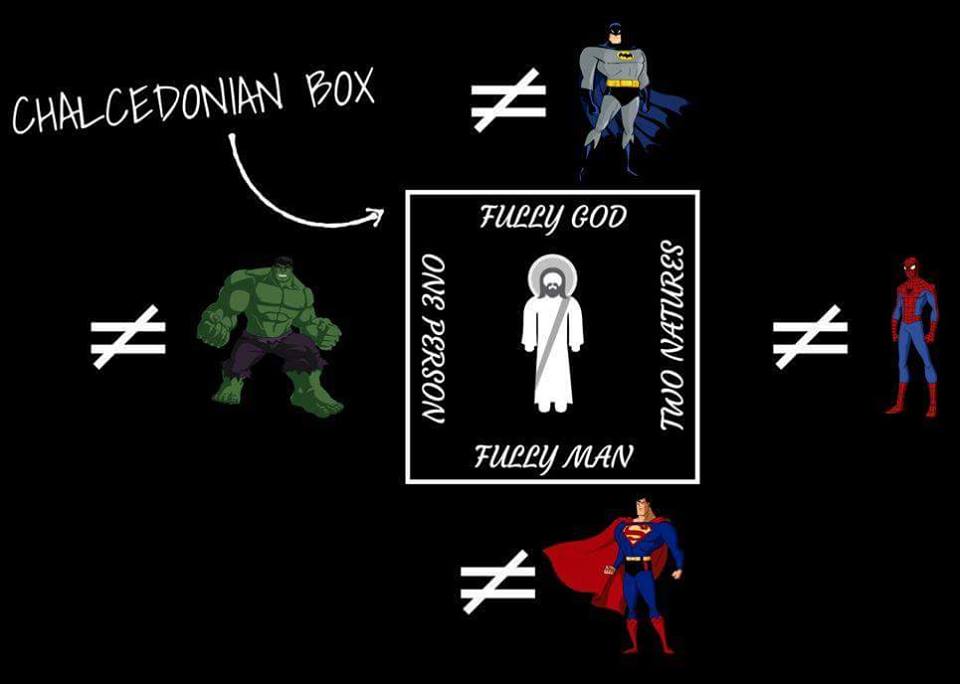
These four statements can be placed along each side of a box.  This box is the Chalcedonian Box. As long as any teaching, anecdote, or analogy of the person and work of Christ maintains that Jesus is fully God, fully man, one person, with two natures, it lands within this box.  When one of these doctrines is distorted, or worse, erased, the teaching lands outside of the box is appropriately labeled a heresy.

Alan Shlemon, a speaker, teacher, and writer, for Stand to Reason, created a slide for a presentation he gave on the incarnation of Christ.  At the center of the slide is the Chalcedonian Box with a clipart image of Jesus in the middle of the box.  Outside of the box lies DC’s Batman and Superman and Marvel’s the Hulk and Spider-Man.

How are Batman, Superman, the Hulk, and Spider-Man not good analogies to use to explain how Jesus can be one person with two natures?  Why does it matter if we are missing the mark of Scripture with these comic book analogies?  Also, more importantly, what Christological heresies align with these modern-day comic book superhero analogies to let us know that people have actually taught Christ in these throughout history, and in some cases still do!
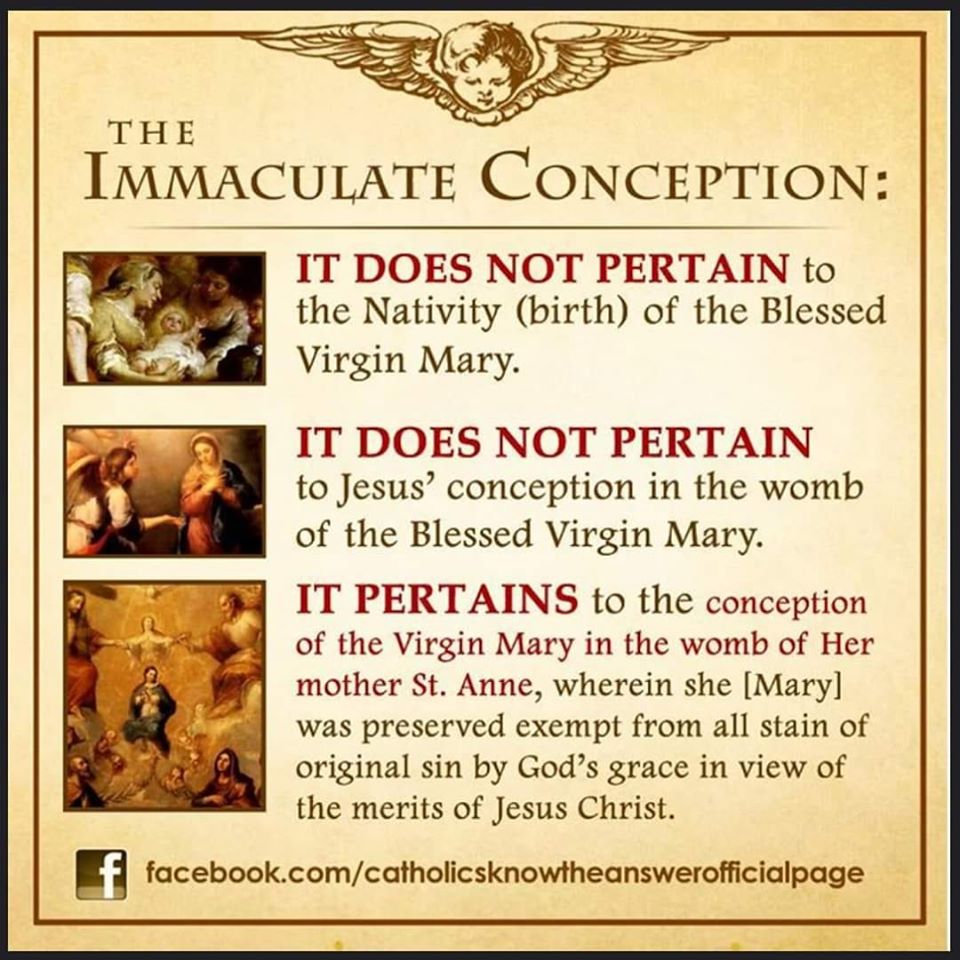
Do not confuse the Virgin Conception with the Immaculate Conception.  The Virgin Conception is taught in Scripture, whereas the Immaculate Conception is an invention of the Roman Catholic Church. 
The Sinlessness of Jesus of Nazareth

  1. Committed no sin – 1 Peter 2:22
  2. Endured Temptations, still no sin – Heb 4:15
  3. Yet what happened? 2 Cor 5:21

More verses for why Jesus is truly God

  1. Jesus existed before the world began = John 17:5
  1. Created all things = Colossians 1:16-17
  2. Jesus said “I Am” = John 18:58
  3. He is present forever = Matt 28:20
  4. Fills all things = Eph 1:23
  5. Forgives sins = Matt 9:2-8
  6. Raises people from the dead = John 11:17-44

What is the significance of Jesus’ humanity?

What is the significance of Jesus’ divinity?

Sin – From Scripture

This is largely a brief outline of Chapter 7 of Called to Believe: An Introduction to Christian Doctrine, edited by Steven P. Mueller.

Historical Origin of Sin

Was there evil in God’s creation as he completed his work of creating? 

Genesis 1:31

So what happened to God’s perfect creation? 

Revelation 12:7-9
2 Peter 2:4

So who first sinned? 

When did humanity first sin (The Fall)? 

Genesis 3:1-7

Who is to blame? 

Who shares responsibility?

Genesis 3:12-13

Does God share responsibility in the Fall?

Could we say God allow the Fall?  Could we say God caused the Fall? 

Was the Fall a Fall Up or a Fall Down? 

What did humanity lose in the Fall? 

Original Sin

What was the first sin?

Genesis 3:6 – “When the woman saw that the fruit of the tree was good for food and pleasing to the eye, and also desirable for gaining wisdom, she took some and ate it.”

Doubt = Unbelief

What was the result of that sin?

Romans 5:19 — “through the disobedience of the one man the many were made sinners.”

Psalm 14:3 — “there is no one who does good, not even one.”

John 3:6 – “flesh gives birth to flesh”

Sin was passed down from parent to child (Inherited Sin)

Sin is not simply an action; it is a condition!

Original Sin is the sinfulness inherited in our conception.

Genesis 8:21 – “every inclination of his heart is evil from childhood”

Psalm 51:5 – “Surely, I was sinful at birth, sinful from the time my mother conceived me.”

Romans 5:19 – “through the disobedience of the one man the many were made sinners.”

Psalm 14:3 – “there is no one who does good, not even one.”

Actual Sins

Original Sin – Objective. A sinful state.

Actual Sin – Subjective. Sinful acts.

Galatians 5:19-21 – “Now the works of the flesh are evident: sexual immorality, impurity, sensuality, 20 idolatry, sorcery, enmity, strife, jealousy, fits of anger, rivalries, dissensions, divisions, 21 envy, drunkenness, orgies, and things like these. I warn you, as I warned you before, that those who do such things will not inherit the kingdom of God.”

Actual sins are the product of original sin.

What is sin?

1 John 3:4 – “Everyone who sins breaks the law; in face, sin is lawlessness.”

2 Peter 2:8 – “lawless deeds”

               So, whose Law is being broken? 

Sins of Commission and Sins of Omission

Exodus 20:1-17 (Commission)

James 4:17 (Omission)

Sins of Thought, Word, and Deed

Matthew 5:22  (Thought, Emotion)

Matthew 12:36-37 (Words)

  1. John 3:15 (Deed)

The Causes of Sin

The Devil

Revelation 12:9

John 13:2

The World

Matt 18:7

1 John 2:16        

The Flesh (Sinful Human Nature)

Matt 15:19

James 1:14

Gal 5:19

Not God!!!

1 John 1:5 – “God is light; in him there is no darkness at all”

1 John 2:16

Consequences of Sin

Sin Separates

Man from Man

Man from God

Temporal Consequences

Divine Punishment (God hates sin)

Chastisement that leads to forgiveness

Consequences for the act itself

Eternal Consequences

Eternal Separation from God

The Ultimate Consequence of Sin – Death

Temporal, Physical Death

Romans 5:12 – “sin entered the world through one man, and death through sin, and in this way death came to all men, because all sinned”

Romans 6:23 – “the wages of sin is death”

Spiritual Death

Ephesians 2:1 – “you were dead in your transgressions and sins”

Eternal Death

Revelation 20:14 – “second death”

What does this mean for all of us?

Sin was like the opening of Pandora’s Box

Sin brought everything evil, bad, and sad into the world

Pain, Suffering, and ultimately Death

Humanity – From Scripture

Humanity – Who are you? 

Genesis 1:27 – “So God created man in his own image,
    in the image of God he created him;
    male and female he created them.”

What does the triple-parallelism in Genesis 1:27 emphasize?

What significance does “male and female he created them” have for us in our current social setting? 

The end of each day of creation ends with the work of God’s hand being labeled “good.” What is the created world finally called after the appearance of humanity? Genesis 1:31

The Crown of Creation

Humanity has been labeled the “crown of creation.”  How do the following verses justify this title for humanity: Genesis 1:26-28, Genesis 2:15?

How was the creation of mankind different than the rest of creation? Genesis 2:7-9, 22.

Is human life more valuable than that of the animals? 

The Image of God

What was humanity created in the image of that the rest of creation was not?

Where is the first mention of God’s image found?

Are the words “image” and “likeness” used synonymously? Genesis 1:16

Were both Adam and Eve created in God’s image, or only Adam?  Genesis 2:27, 5:1-2. 

What is the Image of God?

We can make some discernment about the image of God by looking at the unique traits of man when he was created. 

Man was created as an intelligent moral being.  He spoke, made decisions, and displayed an understanding of right and wrong.  (Genesis 2:17, 23) Man was also created to be relational, and even immortal, without death. (Genesis 2:17-18) Does humanity still possess all of these attributes?

God is not sinful and Adam was not created in sin.  In light of this it becomes increasingly apparent that the nature of the divine image is not simply morality, but faultless and sinless morality, pure holiness and righteousness.  Man’s relationship with God and his creation was perfect. 

If one were to conclude that man did not lose the image of God with the first sin, then what is not part of the divine image?

The Loss of God’s Image after the Fall into Sin

After the Fall, in whose image did Adam bear a son? Genesis 5:3.

What does Paul say about the loss of God’s image and its restoration? 1 Corinthians 15:49, Ephesians 4:24, and Colossians 3:10. 

So has God’s image been lost?  What does Genesis 9:6 and James 3:9 indicate? 


Scripture indicates that humanity has lost God’s image and yet at the same time retained God’s image To understand these two apparently contradictory conclusions a distinction must be made between the narrow sense and wide sense of God’s image. 

What is the image of God in the narrow sense?

What is the image of God in the wide sense?

Is being created in the image of God what makes us human? Why?

Human – An intelligent and moral being created in the image of God, consisting of a body and soul, which are united in one complete person. 


Body – Genesis 2:7, Daniel 12:2, Genesis 15:40. 

Soul (Spirit) – Scripture uses soul and spirit in parallel phrases (1 Samuel 1:15, Job 7:11, Isaiah 26:9, and Luke 1:46-47). 

Spirits do not have bodies. (Luke 24:39)

Human souls reside in human bodies.  (1 Corinthians 2:11)

At physical death, the human spirit returns to God and the body returns to the dirt.  (Ecclesiastes 12:7)  

Creation – From Scripture

The following is a Scriptural outline on Creation that largely follows the presentation found in Chapter 5 of Called to Believe: An Introduction to Christian Doctrine, edited by Steven P. Mueller.

All things were created by God out of nothing.

Genesis 1:1-2
– “In the beginning, God created the heavens and the earth. The earth was without form and void, and darkness was over the face of the deep. And the Spirit of God was hovering over the face of the waters.”

Colossians 1:16-17 – “For by him all things were created, in heaven and on earth, visible and invisible, whether thrones or dominions or rulers or authorities—all things were created through him and for him. 17 And he is before all things, and in him all things hold together.”

Hebrews 11:3 – “By faith we understand that the universe was created by the word of God, so that what is seen was not made out of things that are visible.”

Romans 4:17 – “As it is written, “I have made you the father of many nations”—in the presence of the God in whom he believed, who gives life to the dead and calls into existence the things that do not exist.”

God spoke creation into existence through his word.  

Read through Genesis 1.  How often do you find it written, “And God said”? 

John Chapter 1:1-3 – The Word, The Word, The Word, The Word. 

Hebrews 11:3 – “created by the word of God.” 

The Order of Creation

Order was given to that which had first been “without form and void” (Genesis 1:2)

Proverbs 8:22-31 – ““The Lord possessed me [Wisdom] at the beginning of his work,
    the first of his acts of old.
23 Ages ago I was set up,
    at the first, before the beginning of the earth.
24 When there were no depths I was brought forth,
    when there were no springs abounding with water.
25 Before the mountains had been shaped,
    before the hills, I was brought forth,
26 before he had made the earth with its fields,
    or the first of the dust of the world.
27 When he established the heavens, I was there;
    when he drew a circle on the face of the deep,
28 when he made firm the skies above,
    when he established the fountains of the deep,
29 when he assigned to the sea its limit,
    so that the waters might not transgress his command,
when he marked out the foundations of the earth,
30     then I was beside him, like a master workman,
and I was daily his delight,
    rejoicing before him always,
31 rejoicing in his inhabited world
    and delighting in the children of man.

Isaiah 29:16 – “You turn things upside down!
Shall the potter be regarded as the clay,
that the thing made should say of its maker,
    “He did not make me”;
or the thing formed say of him who formed it,
    “He has no understanding”?”

Genesis 2:7 – “Then the Lord God formed the man of dust from the ground and breathed into his nostrils the breath of life, and the man became a living creature.”


First Day Light and darkness separatedFourth Day Celestial bodies put in place Sun, moon, stars
Second Day Water and sky separatedFifth Day Fish and Birds created
Third Day Land and water separatedSixth Day Land Animals and Humanity created

The Nature and Condition of Creation at the end of Day 6

What does God see about his Creation in Days 1, 3, 4, and 5? 

What does God see about his Creation at the end of Day 6? 

The parallelism and repeated phrases within Genesis 1 have led some readers to say the Six-Day Creation Account should not be taken literally.  What does the rest of Scripture say?

Old Testament Passages that Affirm the Creation Account

Psalm 121:2 – “My help comes from the Lord,
    who made heaven and earth.”

Zechariah 12:1 – “The oracle of the word of the Lord concerning Israel: Thus declares the Lord, who stretched out the heavens and founded the earth and formed the spirit of man within him.”

2 Kings 19:5 – “And Hezekiah prayed before the Lord and said: “O Lord, the God of Israel, enthroned above the cherubim, you are the God, you alone, of all the kingdoms of the earth; you have made heaven and earth.”

Isaiah 44:24 – “Thus says the Lord, your Redeemer,
    who formed you from the womb:
“I am the Lord, who made all things,
    who alone stretched out the heavens,
    who spread out the earth by myself.”

Psalm 33:6 – “By the word of the Lord the heavens were made,
    and by the breath of his mouth all their host.”

Psalm 148:5 – “Let them praise the name of the Lord!
    For he commanded and they were created.”

Isaiah 45:18 – For thus says the Lord,
who created the heavens
    (he is God!),
who formed the earth and made it
    (he established it;
he did not create it empty,
    he formed it to be inhabited!):
“I am the Lord, and there is no other.”

Nehemiah 9:6
– ““You are the Lord, you alone. You have made heaven, the heaven of heavens, with all their host, the earth and all that is on it, the seas and all that is in them; and you preserve all of them; and the host of heaven worships you.”

Exodus 20:11 – “For in six days the Lord made heaven and earth, the sea, and all that is in them, and rested on the seventh day. Therefore the Lord blessed the Sabbath day and made it holy.”

Exodus 31:15-17 – “Six days shall work be done, but the seventh day is a Sabbath of solemn rest, holy to the Lord. Whoever does any work on the Sabbath day shall be put to death. 16 Therefore the people of Israel shall keep the Sabbath, observing the Sabbath throughout their generations, as a covenant forever. 17 It is a sign forever between me and the people of Israel that in six days the Lord made heaven and earth, and on the seventh day he rested and was refreshed.’”

New Testament Passages that Affirm the Creation Account

Acts 4:24 – “And when they heard it, they lifted their voices together to God and said, “Sovereign Lord, who made the heaven and the earth and the sea and everything in them.”

Acts 14:15 – ““Men, why are you doing these things? We also are men, of like nature with you, and we bring you good news, that you should turn from these vain things to a living God, who made the heaven and the earth and the sea and all that is in them.”

Acts 17:24-26 – “The God who made the world and everything in it, being Lord of heaven and earth, does not live in temples made by man, 25 nor is he served by human hands, as though he needed anything, since he himself gives to all mankind life and breath and everything. 26 And he made from one man every nation of mankind to live on all the face of the earth, having determined allotted periods and the boundaries of their dwelling place.”

Matthew 19:4 – “He answered, “Have you not read that he who created them from the beginning made them male and female.”

Did God Create in Six Literal Days?

Does day always refer to a 24-hour period in Scripture? 

Hebrews 3:8 – “Do not harden your hearts as in the rebellion,
    on the day of testing in the wilderness.” – Is this referring to a single 24-hour day? 

Compare Genesis 1:5 and 2:4. How many different ways is day is used in these two verses within the same book? 

Some say that the days of creation were lengthy ages or epochs.  Supporters of this position point to Genesis 1:14-19.  Why?  They also point to Genesis 2:4. How long is this day?  They also speak about God’s view of time by pointing to Psalm 90:4 and 2 Peter 3:8. 

There is strong compelling evidence for the 24-hour day in creation:

“God said… and it was…”  Does it seem like a long time?

There was morning and there was evening, the first day.  There was morning and there was evening, the second day.  There was morning, and there was evening, the third day… etc.  What else would Moses have known to be a morning and evening?  Throughout the whole of Scripture when a number is put with a day, the day is referring to a 24-hour period of time. 

Exodus 20:11 – “For in six days the Lord made heaven and earth, the sea, and all that is in them, and rested on the seventh day. Therefore the Lord blessed the Sabbath day and made it holy.”

Exodus 31:15-17 – “Six days shall work be done, but the seventh day is a Sabbath of solemn rest, holy to the Lord. Whoever does any work on the Sabbath day shall be put to death. 16 Therefore the people of Israel shall keep the Sabbath, observing the Sabbath throughout their generations, as a covenant forever. 17 It is a sign forever between me and the people of Israel that in six days the Lord made heaven and earth, and on the seventh day he rested and was refreshed.’”

What do these verses suggest?  Do they answer the question of why God created in six days? 

Important to Remember When Discussing Length of Yom in Genesis

  1. God created all things out of nothing
  1. He created all things through his spoken Word (except man)
  2. Adam was specially formed from dust and God breathed life into him
  3. Eve came from Adam’s side (one of his ribs)
  4. Man is distinct from the rest of creation and has been made in the image of God.

6. He created all things visible and invisible

7. Creation was “very good” at the end of Day 6

8. God did not create sin, author sin, or decree sin

9. Death of all men, spiritual, physical, and eternal is result of sin

10. God (F, S, and HS) is not created, nor is he made

What teachings of Scripture are impacted if the teachings of Creation are denied, especially through Darwinian models of evolution? 

What does it mean that God rested on the Seventh Day? He rested from ____________.  Yet…


Preserving (Nehemiah 9:6)

Upholding (Hebrews 1:3)

Directing (Jeremiah 10:23)

Working in you (Philippians 2:13)

God’s providence – He works to sustain the created order, working in, with, and through it.  This is ongoing from the start of creation until now and unto Christ’s return. 

The Triune Lord – From Scripture Alone

The Triune Lord

Natural Knowledge is the general revelation of God that is available to all through what God has created.  It reveals that God exists and demonstrates for us his divine attributes. 

Revealed Knowledge is the special revelation of God that reveals that reveals who God is, what he expects of us, and what he has done for us.   This revelation is found in the historical person of Jesus of Nazareth and the words of the Bible. 

From the words of the Bible and through the revelation of God through the person of Jesus of Nazareth, God is revealed to be Triune; in other words, the one true God is Father and Son and the Holy Spirit. 

The Doctrine of the Trinity teaches that there is only one God and he exists in three distinct persons.

There is only one God. 

Deuteronomy 6:4 – “Hear, O Israel: The Lord our God, the Lord is one.”

Isaiah 44:6-9 – “Thus says the Lord, the King of Israel and his Redeemer, the Lord of hosts: “I am the first and I am the last; besides me there is no god. Who is like me? Let him proclaim it. Let him declare and set it before me, since I appointed an ancient people. Let them declare what is to come, and what will happen.Fear not, nor be afraid; have I not told you from of old and declared it? And you are my witnesses! Is there a God besides me? There is no Rock; I know not any.”

1 Corinthians 8:4 – “There is no God but one.”

But doesn’t the Bible indicate that there are other gods? 

Exodus 20:3 – “You shall have no other gods before me.”

But what does the Bible say about these other gods? 

Jeremiah 2:11 – “Has a nation changed its gods, even though they are no gods?
But my people have changed their glory for that which does not profit.”

Jeremiah 10:5 – “Their idols are like scarecrows in a cucumber field, and they cannot speak;
they have to be carried, for they cannot walk. Do not be afraid of them, for they cannot do evil, neither is it in them to do good.”

1 Corinthians 8:4-6 – “Therefore, as to the eating of food offered to idols, we know that “an idol has no real existence,” and that “there is no God but one.” For although there may be so-called gods in heaven or on earth—as indeed there are many “gods” and many “lords”— yet for us there is one God, the Father, from whom are all things and for whom we exist, and one Lord, Jesus Christ, through whom are all things and through whom we exist.”

These so-called gods are no-gods! 

God is three persons: Father, Son, and Holy Spirit. 

All three persons of the Trinity were revealed in Jesus’ baptism. 

Matthew 3:16-17 – “And when Jesus was baptized, immediately he went up from the water, and behold, the heavens were opened to him, and he saw the Spirit of God descending like a dove and coming to rest on him; 17 and behold, a voice from heaven said, “This is my beloved Son, with whom I am well pleased.”

There are three persons, yet only one name in which disciples are baptized. 

Matthew 28:19 – “Go therefore and make disciples of all nations, baptizing them in the name of the Father and of the Son and of the Holy Spirit.”

The three persons of the Trinity are named together in Paul’s closing benediction to the Church of Corinth. 

2 Corinthians 13:14 – “The grace of the Lord Jesus Christ and the love of God and the fellowship of the Holy Spirit be with you all.”


The Father is called God in Scripture.

Ephesians 4:4-6 – “There is one body and one Spirit—just as you were called to the one hope that belongs to your call— one Lord, one faith, one baptism, one God and Father of all, who is over all and through all and in all.”

Romans 1:7 – “To all those in Rome who are loved by God and called to be saints: Grace to you and peace from God our Father and the Lord Jesus Christ.”

Jesus is called God in Scripture.

Romans 9:4-5 – “They are Israelites, and to them belong the adoption, the glory, the covenants, the giving of the law, the worship, and the promises. To them belong the patriarchs, and from their race, according to the flesh, is the Christ, who is God over all, blessed forever. Amen.”

John 1:1-3, 14 – “In the beginning was the Word, and the Word was with God, and the Word was God. He was in the beginning with God. All things were made through him, and without him was not any thing made that was made. 14 And the Word became flesh and dwelt among us, and we have seen his glory, glory as of the only Son from the Father, full of grace and truth.”

John 5:16-18 – “And this was why the Jews were persecuting Jesus, because he was doing these things on the Sabbath. 17 But Jesus answered them, “My Father is working until now, and I am working.18 This was why the Jews were seeking all the more to kill him, because not only was he breaking the Sabbath, but he was even calling God his own Father, making himself equal with God.”

Colossians 1:15-20 – “He is the image of the invisible God, the firstborn of all creation. 16 For by him all things were created, in heaven and on earth, visible and invisible, whether thrones or dominions or rulers or authorities—all things were created through him and for him. 17 And he is before all things, and in him all things hold together. 18 And he is the head of the body, the church. He is the beginning, the firstborn from the dead, that in everything he might be preeminent. 19 For in him all the fullness of God was pleased to dwell, 20 and through him to reconcile to himself all things, whether on earth or in heaven, making peace by the blood of his cross.”

The Holy Spirit is called God in Scripture.

1 Corinthians 3:16, 6:19 – “Do you not know that you are God’s temple and that God’s Spirit dwells in you?… Or do you not know that your body is a temple of the Holy Spirit within you, whom you have from God?”

Acts 5:3-4 – “But Peter said, “Ananias, why has Satan filled your heart to lie to the Holy Spirit and to keep back for yourself part of the proceeds of the land? While it remained unsold, did it not remain your own? And after it was sold, was it not at your disposal? Why is it that you have contrived this deed in your heart? You have not lied to man but to God.”

Summary of the Doctrine of the Trinity

Scripture reveals that there is one God, yet in Scripture we also see that the Father is God, the Son is God, and the Holy Spirit is God.  All three persons are equally and fully divine. This teaching is called the Doctrine of the Trinity (three in unity). 

To express the oneness of the Trinity the Church has adopted the language of substance, essence, or nature.  God is one in substance (deity or divinity).  All three persons share in this one divine substance.  Again, each person is equally and fully God. 

To express the threeness of the Trinity the Church has adopted the language of persons.  The Father, the Son, and the Holy Spirit are not different Gods.  Instead they are distinct and separately identifiable individuals each with their own conscious and relational personhood. 

There is one God (one divine substance/essence/nature) in three persons. 

The language can be confusing or complicated to discern at times because God can at times be used to refer to the Trinity and other times be used to refer to the Father. 

Why does this matter?

The one true God is the Triune Lord.  To worship any other God is to worship a false God. 

The one true God is the Triune Lord.  To confess any other God is to speak a lie. 

God has revealed himself as the Triune Lord. To know God is to know the Triune Lord. 

Salvation matters.  The Triune Lord saves people from sin, death, and the Devil.  All three persons of the Trinity work in our salvation.  The Father sent the Son into the World.  The human nature of the Son was conceived by the Holy Spirit and the Virgin Mary.  The Father told the Son what to speak and to do during the Son’s earthly ministry.  The Holy Spirit empowered the Son during his earthly ministry.  The Son died for the sins of mankind.  The Father accepted the Son’s sacrifice as an atoning sacrifice for the sins of all mankind.  All three persons were at work in the resurrection of Jesus.  The Holy Spirit works faith in the hearts of men so that they might believe and receive the benefits of the Son’s saving work. 

The Trinity is necessary in prayer, since we pray to the Father in the name of the Son by the power of the Holy Spirit.  Of course, prayers can also be addressed to each person or to all three persons at the same time. 

All three persons are Eternal.

Exodus 3:14 – “God said to Moses, “I am who I am.” And he said, “Say this to the people of Israel: ‘I am has sent me to you.’”

Psalm 90:2 – “Before the mountains were brought forth, or ever you had formed the earth and the world, from everlasting to everlasting you are God.”

Revelation 22:13 – “I am the Alpha and the Omega, the first and the last, the beginning and the end.”

All three persons are Omnipotent (All-Powerful).

Ephesians 3:20 – “Now to him who is able to do far more abundantly than all that we ask or think, according to the power at work within us.”

Luke 1:37 – “For nothing will be impossible with God.”

All three persons are Omnipresent (Ever-Present).

Jeremiah 23:24 – “Can anyone hide in secret places so that I cannot see him?”

Psalm 139:7-12 – “Where can I go from your Spirit? Where can I flee from your presence?”

All three persons are Omniscient (All-Knowing).

1 John 3:20 – “God is greater than our hearts, and he knows everything.”

All three persons are Love. 

1 John 4:8 – “Anyone who does not love does not know God, because God is love.”

All three persons are Good. 

Psalm 92:15 – ““The LORD is upright; He is my Rock, and in Him there is no unrighteousness.”

Mark 10:18 – “And Jesus said to him, “Why do you call me good? No one is good except God alone.”