
“God is too big to fit into one religion.” Ever hear this said before, or something similar to it? Here’s a rebuttal to the statement. I wrote a blog on this topic earlier in the year. Now here’s a video response. If you like the video, help me share it by posting it to your social media pages.
Matthew 4:19 – Come Follow Me!
The following is taken from a student’s notes on our classroom discussion on Matthew 4:19. Remember, these are just notes, a lot more was shared in class, but maybe you would want to add to the holes in the classroom discussion, or give additional information that maybe we didn’t even consider by commenting on this post. The students periodically check in on the blog to see the comments.
Matthew 4:18-22

Matthew 4:19 – “And he said to them, “Follow me, and I will make you fishers of men.”
- Jesus saw two brothers, Simon (who is called Peter) and Andrew.
- Jesus then said 4:19.
- They immediately followed him.
- He saw two more brothers, James and John.
- Immediately they followed him too.
It’s interesting how they immediately followed Jesus. How did they know this guy is legit?
Is it possible that the passage doesn’t record everything Jesus said? Did Jesus say more than just “Follow me…”?
Mark 1:14-20
Gives a little more detail than Matthew does. It suggests that Matthew doesn’t say all there is to know. According to Mark, the fishers might’ve known Jesus from his preaching.
Luke 5:1-11
Gives a much more detailed version; Simon and Peter witnessed an entire sermon from Jesus that he gave from within their boat, and they witnessed a miracle!
John 1:35-42
John the Baptist saw Jesus walking by and recognized him and proclaimed him to be the Lamb of God who takes away the sins of the world. Two of John’s disciples begin to follow him, one of them being Andrew.. Jesus asked what they wanted and they asked where he was staying, Jesus told them to follow him and see and they spent the entire day with Jesus. Then he calls them to follow him after they already recognized that he is the Messiah.
Timeline of Muhammad’s Life using Time Toast
For the first day in class studying Islam, after I gave a brief overview of Muhammad‘s life and how Islam originated in the Arabian Peninsula, I gave an assignment for students to make a timeline of Muhammad’s life that contained at least 8 major events in his life. His birth and death could be two of those events. They had several options for how to present the information: Xtimeline, TimeToast, Prezi, Pixton, or GoAnimate. All the students were familiar with Prezi, but most of them had never heard of the other electronic tools. The classes only had about 20-25 minutes to create an account on one of these sites, learn how to use it, research Muhammad’s life, create the outline, and post it to a class forum. If they didn’t finish in time, it was their homework, so of course; most of them finished in time. I only assigned 8 events in hopes that they would generate different outlines that can be shared and compared to learn more details, and this would also give them the opportunity to dig deeper into some of the events that interested them from my overview.
Here are a couple of the timelines that resulted from the students who chose to use Time Toast for this in-class assignment (sorry, they wouldn’t embed in Word Press):
As always on work generated from my World Religions class, feedback is much appreciated. Students check in on the comments periodically. For Apologetics, I’ll have them create their own blogs and I’ll share the best posts on Facebook to get traffic to their blog posts.
Islam and the Five Pillars
Christianity speaks of a foundation for our beliefs – Jesus Christ!
Islam has pillars.
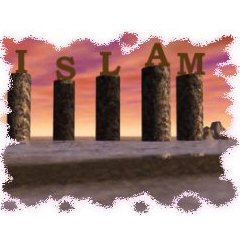 Pillars, of course, hold up the roof of a building. The pillars of Islam are then viewed as holding up the Islamic faith. Following these pillars are essential to all Muslims. Salvation comes through observing these pillars, yet, there is no guarantee to any Muslim that he or she has followed these well enough, as well as having other good works in their lives, enough to warrant salvation from Allah!
The Five Pillars of Islam
- Creed – The creed of Islam is “There is no God but Allah, and Muhammad is his messenger.” When this single sentence is spoken in faith it makes a person a Muslim.
- Prayer – Muslims must pray five times a day facing Mecca.
- Charity to the Poor – Muslims must give a percentage of their income to the poor. Generally, this is 2.5%.
- Fasting during Ramadan – Muslims must fast from food and water every day of the ninth month of the Muslim calendar. This fast is known as Ramadan. When the sun goes down, they can eat and drink.
- Pilgrimage to Mecca – This pilgrimage is called Hajj. Muslims must travel to Mecca once in their lifetime if they have the financial means to do so. Once in Mecca, there is is a series of numerous acts that must be performed, but the central task involves worship in the Kabbah.
So… how can a Christian present the Christian faith to a Muslim using these five pillars?
First, ask questions, even if you already know the answers. Show that you want to learn from them. Ask, “What are the five pillars to you?”
For the Creed, which for them is “There is no God but Allah, and Muhhammad is his messenger,” you can share that Christianity also has creeds. The Apostles’ Creed and the Nicene Creed. You could also share that you too believe in only one God. They’ll likely argue that… and say that you believe in three gods. But you can then share the Christian faith to them more.
For the daily prayers, you can ask questions about what are the prayers you say? Why do you have to say them in Arabic? You can can share that Christians pray too, and that God hears our prayers at all times, not just at certain moments, because he is all powerful and knows all things and wants to listen to what his children have to say.
Charity – you can share that it’s good that they give to the poor. You can share that Christians give too.
Fasting – you can share that Christians fast too, but that it’s optional for us, and that we can do it anytime we want, and that the purpose for the fasting for us is lead us to pray and to remind us to pray.
Hajj – you can share that to Christians this entire life is a pilgrimage! This is not our home. Our home is in heaven with God and we are just strangers passing through this world to our eternal home with God.
They may even ask you more questions about these similarities. If you have a Bible you can share verses from the Bible with them. Many Muslims have not read the Bible, yet they believe that the prophets of the Bible, and even Jesus, were prophets for Allah, so their words should be authoritative (although they believe the Bible has been corrupted).
It’s the Prince of Peace, Man!
I went to http://www.peacemonger.com. It’s the website that spearheads the “Co-exist” bumper sticker and t-shirt campaign. If you visit their site you will see that they sell numerous stickers that advocate for Hinduism or “religious pluralism.” When they have “Jesus” stickers they are usually condescending, or simply cut-off any aspects of the Gospel narratives that pertain to Jesus being divine, a miracle worker, the Savior of the World, and a harsh judge (which he did quite a lot).
I bought a sticker from their site that says, “It’s the Prince of Peace.” It has an image of Jesus flashing a “peace sign.” What exactly does this mean? Was Jesus a hippie who dropped acid and listened to Hebrew jam bands (I know a stereotype of the 60s counter-culture, so I am committing the same error that this sticker is, but I am trying to figure out what the sticker means.)? In the context of “Co-exist” and other pluralistic messages from Peace Monger, I think the sticker is trying to say that Jesus is the Prince of Peace, so he wouldn’t be judging other religions as right or wrong, he’d just be loving, accepting, and tolerant of everyone. Notice what I just did, I moved tolerance and acceptance into a realm of making no judgment calls on what is true and what is not true, which leads to one of two routes, everything is true or everything is false.
Anyways, here’s a video I shot addressing this sticker’s message (whatever it actually is). I thought it’d be best to start by sharing where the title for Prince of Peace in relationship to Jesus originates and how Jesus was and is the Prince of Peace from a Christian Biblical worldview.
Note: the video is completely ad-lib. I went in knowing I would share Isaiah 9 and Matthew 10:34-36. We shot this like 5-6 times and every time different points and verses were shared and none of the shots had a strong conclusion and usually ended awkwardly. This was one of the better versions, although there is another one that I really like that I might be able to edit to have a conclusion. That’s why this video ends a little sudden without a strong finish…
I’d love to hear feedback and I hope this is helpful to you.
 Andy Wrasman