How do we know who God is?

How do we know who God is?

The Bible reveals who God is to mankind.  It contains the history of God’s interaction with humanity from his creation of the first human beings to his direct entering into the world through the second person of the Trinity, Jesus Christ.

Two kinds of revelation

The Bible teaches that we do not have the ability to search and discover who God is.  It is not as if we can turn over a rock and find God!  If we are to have any knowledge of God at all, he must first reveal it to us.  This revealing work on God’s part is called revelation.  From the Bible we see that God has revealed himself to us in two different ways.  The first method of revelation which is available to all of mankind is called general revelation, or natural knowledge.  The other method of revelation is called special revelation, or revealed knowledge.   Both of these forms of revelation grant humanity information about God, however, only one of these can tell us who God is, what he requires of us, what he does and has done for us, and how to have a relationship with him.

General Revelation or Natural Knowledge

Through general revelation, also called natural knowledge, God has revealed himself to mankind through what he was created.  This means that through our knowledge and experiences within the world around us, we can glean information, or knowledge, about who God is.  The names given to this type of revelation can be useful to help remember what type of information we can gain from this type of revelation and where we can look to attain it.   Using the name natural knowledge, remember that this type of revelation is knowledge that mankind can obtain from nature.  Using the other name for this classification of God’s revealing work, general revelation, reminds us to what extent we can gain information about God from nature – it’s only general information, there’s a God, and he’s all-powerful!

From looking at the design, order, consistency, laws of nature, purpose, and aesthetics of nature and life, one should be able to come to the conclusion that there is in fact a designer, a creator of the universe and the cosmos, that there is a divine, eternal being – the cause of the effect we see in motion.  However, as the Bible explains, even though God’s existence is evident from what he has made, humanity regularly turns from this knowledge to worship and deify aspects of the created order or to worship idols made by the hands of men.

A passage of scripture commonly used to support general revelation is Romans 1:18-25.

“The wrath of God is being revealed from heaven against all the godlessness and wickedness of men who suppress the truth by their wickedness, since what may be known about God is plain to them, because God has made it plain to them. For since the creation of the world God’s invisible qualities—his eternal power and divine nature—have been clearly seen, being understood from what has been made, so that men are without excuse. For although they knew God, they neither glorified him as God nor gave thanks to him, but their thinking became futile and their foolish hearts were darkened.  Although they claimed to be wise, they became fools and exchanged the glory of the immortal God for images made to look like mortal man and birds and animals and reptiles. Therefore God gave them over in the sinful desires of their hearts to sexual impurity for the degrading of their bodies with one another. They exchanged the truth of God for a lie, and worshiped and served created things rather than the Creator—who is forever praised. Amen.” – Romans 1:18-25

Special Revelation, or Revealed Knowledge

Looking at a tree, the sunset, or rise, the human anatomy, or virtually any aspect of this world, one could easily come to the conclusion that there is a God. But who is that God?  What is his, or her, or its name?  Does this God love us, hate us, want to have us over for dinner, to get to know us, or does this God already know, he just wants a relationship with us?  Or maybe God is in all of us in such a manner that we are constructed with the divine essence itself, meaning we are God?  Does this God demand anything of us – throw a virgin into a volcano for instance!  None of the answers to these questions can be derived from general revelation alone.  All general revelation does is condemn us, leaving us with no excuse when we stand before our maker on the Day of Judgment as Paul wrote to the Romans.

This is why we must have special revelation, also known as revealed knowledge.  This type of revelation is God’s direct revelation of himself to mankind through his interaction with us in history recorded in the Bible and through the historical figure, Jesus Christ,

A commonly used verse from the Bible to support special revelation is Hebrews 1:1-2.

“In the past God spoke to our forefathers through the prophets at many times and in various ways, but in these last days he has spoken to us by his Son, whom he appointed heir of all things, and through whom he made the universe.” – Hebrews 1:1-2
Stereomud – Show Me

Back in 2001, maybe 2001, the band Stereomud was on heavy radio rotation in Nashville with their song, “Pain.”  I saw them play at the now closed rock club, 328, in downtown Music City.  They played with Saliva, Lifer, and Systematic.  Most of these bands and others coming out of the nu-metal, rap-rock genre didn’t go further than the small rock club scene, but I got a couple CDs from each of these bands.  Yesterday on my full library shuffle, I was taken back to early 2000 when Stereomud’s “Show Me” entered the cycle.

Check out a sampling of the lyrics to this song:

Please don’t forget me I’m out here trying to find you…

Show me some kind of light I can barely see it
Don’t want to think that it’s hopeless
Show me some kind of light I can barely see it
Don’t want to think I’m lost

Everytime I left It was so far away
No I never thought that it would be like this
Wish I could thank you for the patience that you gave me
It’s all I, I can do so don’t give up on me
Hope you know it’s your faith that’s guiding me

Please don’t forget me I’m out here trying to find you…

Show me some kind of light I can barely see it
Don’t want to think that it’s hopeless
Show me some kind of light I can barely see it
Don’t want to think I’m lost

Please don’t forget me

Show me some kind of light I can barely see it
Don’t want to think that it’s hopeless
Show me some kind of light I can barely see it
Don’t want to think I’m lost

I’m curious who do you think he is singing about?  Does the style of the music, the tone of singer, or the content of the lyrics fit a crying out for an ex-lover, distant parent, lost friend, or other human guidance, or does this seem more like a calling out for a divine hand, a divine light, a “word from above?”

It made me think of the lyrics of one of my favorite bands, Godsmack.  Many of their songs cry out to someone or something “to make me believe,” “to forgive me,” “to shine down to give me a chance to feel you,” “to give me a reason to pray,” “that I still believe in immortal love and I know that there is someone who is up above,” and the need to “re-align,” “change,” “speak the truth,” with an entire song centered on the question, “What if?”

I firmly believe that God has revealed himself through what he has created, as Romans 1:20 states, that from “the creation of the world God’s invisible qualities—his eternal power and divine nature—have been clearly seen, being understood from what has been made.”  In Christian doctrine this type of revelation is called Natural Knowledge or General Revelation.  I think songs like the ones from bands like Stereomud and Godsmack ask the questions that they ask and have themes transcend the natural because God has put his fingerprints all over his creation, though all men don’t acknowledge, they know there is more, which is why we all seek and have a god in our life, rather it is a God made in the image of man or creation, humanism, fame, money, or the true God of the universe as he has revealed himself directly through the person of Jesus Christ.

This isn’t for everyone, because for some Christians listening to certain songs might lead them to sin, but I do think that the spiritual themes that arise from the artists and poets of our society are good starting points for “religious” talk, for discussing God and the Gospel of Jesus Christ.  If you can take in the words and products of non-Christians without being led away from Christ or into sin, then by all means, listen, observe, but always filter through discernment using God’s Word, and pray for opportunities to share the Gospel.

Check out Christianity Today’s movie review section on-line.  They have great discussion questions at the end of all their reviews which can give some helpful examples of how we can engage secular culture and redeem it and point it towards Christ.  This is exactly what Paul did as he mingled in the marketplace of Athens in Acts 17.

Let me know what you find?  And if this proves helpful?


Hendrix Jam that Inspires Me to Think of the Power of Being a Child of God

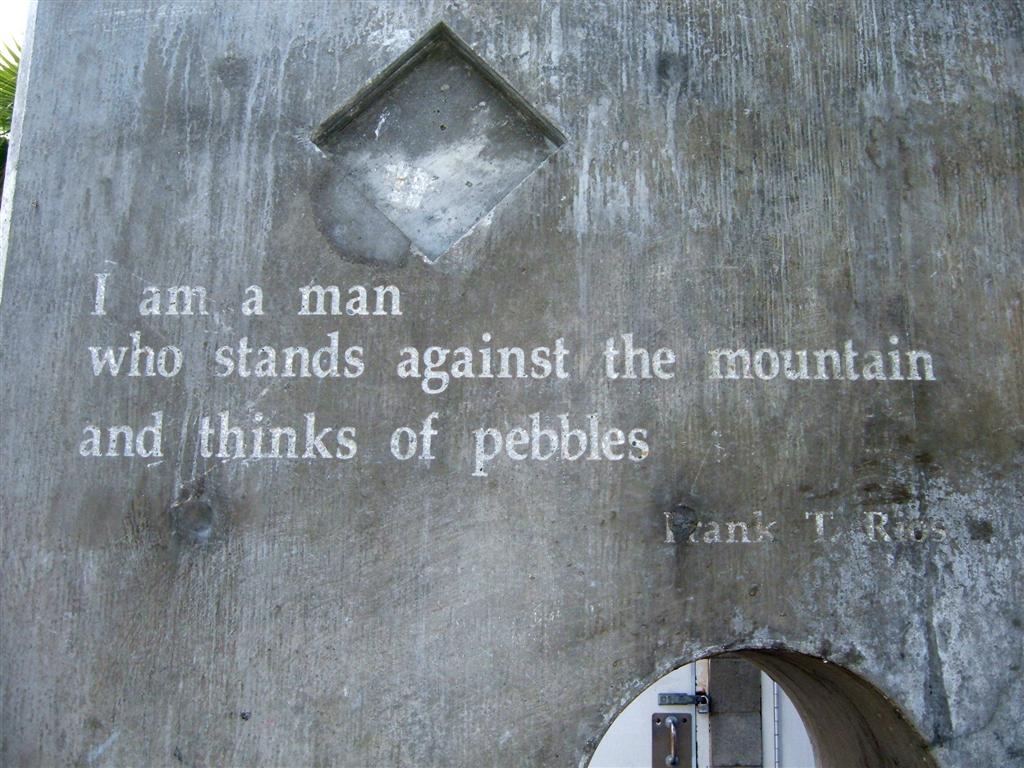
Good quote:  I am a man that stands against mountains and thinks of pebbles.

This quote is by the bathrooms along the walking strip of Venice Beach. I loved it so much the first time I saw it that I had to come back with a camera to take a picture of it. I quoted it once, and my friend Codie, knew exactly where the quote came from – Venice Beach Restroom. At least both of us caught the power of this quote.

I think this ties great to Jesus’ quote about “faith of a mustard seed, being able to move mountains.”  Maybe this isn’t’ a literal, physical, tree-covered mountain.  Maybe this is a mountain in a different manner, mountains such as going to China, where you face communism, a different language, poverty, imprisonment, cultural differences, or planting a new church in Orange County where you might be told that there are already too many churches for a new church to be needed, where you might face location problems, time problems, financial problems, and in a sense these are mountains.  Being a college student and having to juggle classes, work hours, play time, homework time, sleep time, eat time, God time all in 24 small hours can be a mountain.  With faith in Jesus though, these mountains can be moved because they are just pebbles.

Whenever I hear Jimi Hendrix’s song, “Voodoo Chile,” I am fascinated with the line that says, “I stand up next to a mountain, I chop it down with the edge of my hand, cuz I’m a Voodoo Chile baby, Lord knows, I’m a Voodoo Chile!”  I always think, that’s me, I have that power!  Not because of Voodoo, but because of Christ in me, my hope and glory.  I am a Child of God.

Half Empty or Half Full? – 1 Peter 4:7-11

Half Empty or Half Full?  How do you look at things?  What type of a view do you normally take on?  How does it affect those around you, your job performance, your relationships, and your witness to the love of Jesus Christ?

This is essentially a question of the mind and what you think about the situations in that arise in your life.   A person who always complains, always is afraid and doubtful, who sucks the energy out of other people, who always seems to focus on the negative aspects of people, work, school, and life – what type of mindset would that be?  A half empty or a half full mindset?

What does God’s word say about this matter and how our mindsets should be?  Half empty/Half full?

It’s a mug of hot green tea at sushi bar, honest.

1 Peter 4:7-11 says, “The end of all things is near. Therefore be clear minded and self-controlled so that you can pray. Above all, love each other deeply, because love covers over a multitude of sins. Offer hospitality to one another without grumbling. Each one should use whatever gift he has received to serve others, faithfullyadministering God’s grace in its various forms. If anyone speaks, he should do it as one speaking the very words of God. If anyone serves, he should do it with the strength God provides, so that in all things God may be praised through Jesus Christ. To him be the glory and the power for ever and ever. Amen.” 

Clear-minded.  Yoda, the great Jedi Knight would always tell Luke to clear his mind and it was so he could have self control.  In this state of mind, Luke could focus on the force.  This is very much like what Paul is telling us to be.  Be clear minded, so that our judgments are not clouded with our doubts, insecurities, and distractions.  We are to be self controlled, so that we can focus on prayer.  Instead of clearing our minds to focus on the force like Luke, we focus on God.  When we prayer to God we are admitting that we need God’s help, that our mission is bigger than what we can handle.  When facing a mission that is large, difficult, with many multifaceted challenges it could be very easy to start viewing our lives as half empty, to take our eyes of Jesus.  But we must remember that Jesus is the vine, and we are the branches.  If we remain in him, we can do many things, but apart from him we can do nothing.

It is Jesus who makes us righteous.  It his holiness that is our holiness, his strength, which is our strength.

1 Peter 4:7-11 also gives me encouragement, that the tasks I face in life are to be met using the gifts that God has given me and the through strength that he provides.  I should lean not upon my own abilities, but upon his, and to work to the best I can with the abilities he has given me.  When I start to look at life as a half full glass, this verse reminds me to be clear-minded, to be self-controlled, not to grumble, but instead let Jesus fill my cup as he desires.

Paul said in 2 Corinthians 12:8-10, “My grace is sufficient for you, for my power is made perfect in weakness.” Therefore I will boast all the more gladly about my weaknesses, so that Christ’s power may rest on me.That is why, for Christ’s sake, I delight in weaknesses, in insults, in hardships, in persecutions, in difficulties. For when I am weak, then I am strong.”  Delighting in my weakness, that would be a half full mentality.  I see that my weakness draws me to the cross, to his grace, to his strength.  Then I am strong.  When life’s blows hit, I could turn the other way, away from Christ, away from prayer, and then I am nothing, I am dry, I am empty.  But in reality, it’s when the waves come crashing that I run to Christ all the more, then that is when I am strong, when I am relying up God to carry me through.  In my life, I have found that when there is smooth sailing, I tend to become comfortable and lose sight of the fact that apart from Christ I can do nothing.  I pray that myself and all Christians may become more Cross-Focused and Christ-Centered when we face trails, that we won’t grumble.  That we won’t whine, but that we would shine.

Don’t All Religions Lead to God? – #2

What do the different paths say about the problem of man and the offered solution?

Graveside Burial
10 out of 10 of us will die.

A pretty undeniable statistic is that ten out of ten humans die.  Humanity is mortal.  With this in mind the various religions have different answers to the problem of man, man’s inevitable death, and the solution to this inescapable end.  If the paths all lead to the same destination, these views on man’s ultimate problem, death, and the solution to that death should be very similar, if not identical.  A comparison of these teachings should be done in order to accurately answer the question of all paths leading to God.

Hinduism teaches samsara, a repeated cycle of birth and death from one body to another.

samsara
Samsara – AKA Reincarnation

This is commonly known as reincarnation.  The Bhagavad Gita explains this cycle in the following verse, “For the soul there is neither birth nor death at any time. He has not come into being, does not come into being, and will not come into being. He is unborn, eternal, ever-existing and primeval. He is not slain when the body is slain.” (Bhagavad Gita 2.20) How a person lived his or her life (karma) will then affect the position of life that person will have in the next one.  This cycle can be broken through various means which lead to self-realization, coming to the acknowledgment with the divine within one’s self.

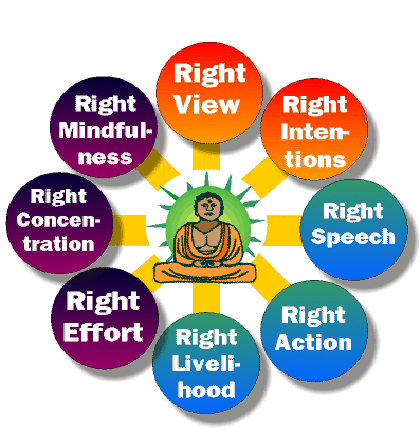
8-fold path
Following the 8-Fold Path Leads to No Suffering.

Buddhism is similar to Hinduism.  It started from a Hindu prince who broke from the teachings of Hinduism.  The Hindu teaching of Brahman, monism, that all is divine, was denied.  Samsara, or reincarnation, and Karma, to a degree, were both retained.  The focus was on answering the question of how to end suffering and how to find inner-peace.  Through seeking to answer these questions, Gautama Siddhartha, the Buddha, came to discover four noble truths.  The first noble trust is that to live is to suffer, and this is ultimately the problem of mankind.  The second noble truth is that suffering comes from desire.  To end suffering, one must put an end to desire is the third.  The fourth noble truth is that to end desire a person must follow the eight-fold path, which consists of right understanding, right intention, right speech, right action, right work, right effort, right meditation, and right contemplation.

Judaism has a God who has specifically revealed himself to one nation, Israel, and has made a covenant with these people.  This covenant contains the requirement to observe certain ceremonial laws to remain clean before God, as well as moral laws.  The penalty for breaking any of God’s law is death, following these laws while trusting in God’s grace and mercy should bring salvation and new life with God after death.  There are ways for people outside of Israel to be engrafted into the nation.  Judaism also contains the promise of a coming Messiah, a Savior of God’s people who will deliver them from their enemies and rule and reign with them for eternity.

Christianity teaches that Jesus was the Christ, the promised Messiah to the nation of Israel.  In fact, Christianity teaches that the Messiah came not just for the Israelites, but to bring salvation to all mankind.  Just as there were always non-Israelites engrafted into the nation of Israel, so the Messiah came for all people and nations.  Jesus being God in the flesh fulfilled all of the ceremonial and moral laws which mankind cold not.  The penalty of death as a result of falling short of God’s glory (sin) was also taken by Jesus as he died on the cross with the sins of the world upon him.  Man’s ultimate problem in Christianity thus is sin which results in death, and this problem is resolved in a great exchange in which Jesus, who is the second person of the Trinity, took on human flesh and fulfilled the law on man’s behalf and at the same time took mankind’s sins and the resultant penalty upon himself.  Christianity teaches that to receive this transaction of mankind’s sin to Jesus and Jesus’ righteousness to us, faith in Jesus is required.

Islam teaches that Allah is God and that he is coming to judge, the living and those

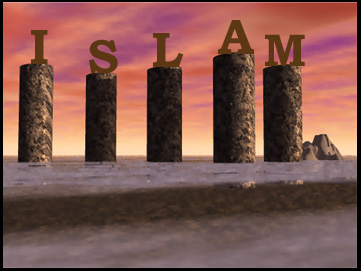
5 Pillars of Islam
The five pillars of Islam uphold the Islamic faith.

who previously had died.  Allah will pass judgment based upon a person’s good deeds and bad deeds.  If a person’s good deeds outweigh a person’s bad deeds, then he or she will be granted to enter paradise.  Muslims have no way of knowing if their good deeds outweigh their bad deeds or by how much Allah will require that their good deeds outweigh their bad to not be cast into hell.  The most certain way, which isn’t even certain, to be end up approved as good in Allah’s sight on the day of judgment is to follow the five pillars of Islam.  The five pillars of Islam are having faith in the creed that “There is no God, but Allah, and Muhammad is his prophet,” praying towards Mecca five times a day, giving 2.5 % of one’s income to charity, fasting during the month of Ramadan, and traveling to Mecca once in a person’s life.  The ultimate problem in Islam therefore is to be judged good at Allah’s coming and the best solution to this problem is to be submissive to Allah and to follow the five pillars of Islam.

So do all religions lead to God?

The statement that all religions lead to God is a statement that can only be made without having understood or studied the teachings of each religion.  Most religions contain similar aspects, such as morals and ethics, a sense of the divine, prayer, justice, and salvation, but even then these common aspects differ or may not be found in every religion.  To say that all religions lead to God would ultimately be taking the stance that all religions are false, since the views of God in the different religions are drastically different that they in fact contradict each either.

Desiring that all religions lead to God might derive from a heart that genuinely wants peace and tolerance amongst all the religions of the world, but unfortunately such a position is actually intolerant at the greatest measure possible.  To make all the religions lead to the same God or final destination for mankind would require all the unique teachings of each religion to be taken away, as if hacking them with a machete.  True tolerance of the varied and unique religions of the world would be to recognize their differences in teaching and maintain the individual’s right to belief.

Finally, homogenizing all the religions only leads to a denial of absolute truth.  Statements of contradiction cannot both be true.  They can both be false, but not both equally true.  The loss of seeking, finding, and valuing truth is at stake if someone were to legitimately profess that all religions lead to God.