Who is God #1

Some people don’t believe in God.  Some people believe in many gods.  Some people believe in only one God, but they disagree on whom that God is.  Others take the stance that there’s no way to know for sure if there is a God or not.

A broad definition of “god”

Martin Luther defined a god as whoever or whatever we fear, love, and trust above all things.  According to this definition even people who claim to believe in the God revealed in the Bible probably have other gods in their life.  It can become very easy for anyone to put trust in our own abilities and provision instead of the one true God.  If people believe in the Christian God and do this, they are not rejecting their belief in God; they are placing an idol alongside God, or above God.  It can become very easy to begin to pursue money, making decisions and living for the pursuit of financial gain, or to fear and seek the approval of men above God.   Luther’s definition is good for generically defining a “god.”  The goal at hand is to show how God has revealed himself to humanity in the Bible.

God revealed in the Bible      

The God in the Bible is clearly revealed to be one.  One of the most cited verses to support this doctrine comes from the Shema, an early creed of Israel, found in Deuteronomy 6:4, “Hear, O Israel: The LORD our God, the LORD is one.”  At the same time God is revealed to be three persons, the Father, the Son, and the Holy Spirit.  All three of these persons are called God in the Bible.  Malachi 2:10 says, “Have we not all one Father? Did not one God create us?”  Matthew 6:9, Luke 11:1-13, 2 Peter 1:17, and Colossians 1:2-3 all show that the Father is God.  Matthew 3:16-17 clearly shows the Father proclaiming Jesus to be his son, “As soon as Jesus was baptized, he went up out of the water. At that moment heaven was opened, and he saw the Spirit of God descending like a dove and lighting on him.  And a voice from heaven said, “This is my Son, whom I love; with him I am well pleased.”  In addition to numerous other verses that refer to Jesus as God, Titus 2:13 contains a clear statement by Paul that Jesus is God by saying, “while we wait for the blessed hope—the glorious appearing of our great God and Savior, Jesus Christ.”  The Holy Spirit is referred to as the Spirit of God or the Spirit of the Lord numerous times throughout Scripture and is referred to as a separate person with the Father and the Son such as in 2 Corinthians 13:14, “May the grace of the Lord Jesus Christ, and the love of God, and the fellowship of the Holy Spirit be with you all.”

From these verses and numerous others it can be concluded that there is only one God.  Yet the Father is God, Jesus is God, and the Holy Spirit is God.  Therefore, all three persons must be the one God.

Do Muslims and Jews worship the same God as Christians?

Christianity – One God, Three Persons

Judaism and Islam – One God, One Person

Christianity – Jesus is God.
Islam – Jesus is a prophet.
Judaism – Jesus is a false-prophet.

Could All Religions Contain Aspects of Truth

All religions could contain truth.  Christians should hopefully be willing to admit this point, and should go even further to help point out common points of belief with the various religions of the world.

However, if a person asks this question, he or she generally intends to say that if there are aspects of truth found within each religion, then every religion must then be accepted as being equally valid and true.  The problem with this line of thinking is that religions come not in isolated teachings or beliefs, but in systems of doctrines that form a complete faith.  For example, a recipe for a casserole might call for ten ingredients.  If three people use this recipe, but one cook only uses eight of the called for ingredients and replaces the other two with something of his liking, and the second cook only uses six ingredients total from the recipe, and the third chef uses all ten ingredients but doesn’t make a casserole, but instead makes a stir-fry, did any of them make the recipe’s casserole correctly?  No, none of the cooks made the casserole correctly based on the recipe, yet all of their meals contained ingredients from that recipe.

Similarly, if religions contain aspects of truth, it doesn’t mean that they are true in their entirety.  They each would just contain elements of truth, but as a complete system of doctrine would be false.  If one religion was true in its entirety, then it would be true, while all other religions would be false and only contain aspects of the truth.

What about the elephant parable?

elephant parableA common parable used in this discussion of religious truth is an Indian legend about six blind men touching an elephant.  All the blind men touch a different part of the elephant and come to a different conclusion about what they are all touching.  For example, one of them touches the tail and thinks the elephant is like a rope.  Another one touches his leg and thinks he is touching a tree.  The next blind man touches the elephant’s side and concludes that the elephant must be like a wall.  The story continues as the three other blind men come to different conclusions about the elephant based on their experience of what they have touched on the elephant.

This parable is used to illustrate that we as humans are like the blind men who do not have the proper sight required to comprehend ultimate reality; it’s just beyond our capabilities.  However, all of us have touched and experience reality and have come to accurate conclusions based on what we have experienced and known.  This would mean that all of the world’s religions are equally fair assessments of the truth and therefore are all equally valid paths to articulating the sacred.  It could even be taken to another step to say that by embracing all religions as true, then a person would have an even more accurate understanding of what ultimate reality is.

A critique of this parable would contain the following points:

  1. This parable is actually claiming that all religions are false.
  2. This parable makes all aspects of life subjective.  There is no absolute, objective reality that we can be certain we are experiencing correctly.  If absolutes don’t exist in a way that we can comprehend them, morals and ethics also become subjective.  There would no longer be such a thing as right and wrong.
  3. Any exclusive religion, such as Christianity, Judaism, and Islam are forced to give up their claims to exclusivity to fit into the inclusive, pluralism which this parable projects.
  4. With Christianity’s exclusive claim that Jesus is the only way to salvation, all other religions would have to be false if Christianity is true, or Christianity could be false and other religions true.  This does not fit with the elephant analogy at all.
  5. The original telling of this legend has a king who sees the blind men groping at the elephant arguing about what they are touching.  The king reveals to them in laughter that they are all foolish men that the same reality, the elephant!  This is very interesting that the original legend has a word from above revealing the truth to the blind men.  This indicates that the truth is actually discernible – we might just need some help from someone up above.
  6. The original ending of this parable lends itself very well to Christianity.  Christianity teaches that help did come from above.  That God has revealed himself to mankind through what he has created as well as through special revelation from the Scriptures and in particular through the second person of the Trinity, Jesus, taking on flesh and walking amongst us, revealing the truth to us, healing the blind and helping them see.  This revelatory claim of Christianity isn’t even considered or introduced in pluralistic uses of this parable.

Conclusion: Declare truth where truth is found!

It seems clear that all religions cannot be fully and equally true.  There are direct contradictions within the teachings of the world’s religions, such as Jesus is God (Christianity) and Jesus is not God (Islam), which eliminate the possibility that all religions are true.

This however doesn’t mean that aspects of the truth cannot be found within various religions.  Christians would do good to point these truths out from time to time.  If Christ’s claim is true that he is the way, the truth, and the life (John 14:6), then all truth would be God’s truth, no matter where it is found.  Where truth is found, declare it, use it, put it in its full context of which it is fully and directly revealed from God in the Bible.  The Apostle Paul did when he quoted the philosophers of the Athenians (Acts 17).  We can do it too!

The Heart Behind Pluralism

The 60s Counter-Culture movement that questioned absolute truth and morality and the objectivity for measuring such standards did so because they saw that people were being killed over differences that weren’t directly affecting them in their personal freedoms.  Different forms of government cause war, cultural clashes lead to hatred, racial differences bring oppression, the physically stronger sex suppresses the weaker sex, and religions… well, I think we know the problems that arise from the interaction of diverse faiths vying for the ultimate authority on the most important questions of life, death, and the after-life.

Crying amidst these clashes over politics, race, sex, and religion, the Youngbloods sang, “Come on people now smile on your brother.  Everybody get together. Try to love one another right now.”  The Beatles sang over and over, “All you need is love.  Love is all you need.”  And after the Beatles broke up, John Lennon sang against fussing over all the different “isms” in the world, when all we really need to do is “give peace a chance.”  The slogan that sums up the Counter-Culture movement was “Make love not war,” and this is the heart behind modern day pluralism, love.

Those who imply pluralism when they use the words tolerance and co-existence are doing so from a right heart position.  From their standpoint, the often times hateful reaction that intolerance offers in response to diversity is the root of our self inflicted pain and suffering upon each other.  If we could only love one another, we could heal the world.  If we could just get to that point that we recognize that we are all brothers and sisters; we could make the world a better place for you, and for me.

Love covers a multitude of sins.  Love trumps all ideologies, philosophies, and religions, and if some refuse to hop aboard the love (pluralism) train because they are still elevating their beliefs over and above love, then all we have to do is convince them that the world’s competing truth claims are actually at their core, the same.  If differences are only aesthetic, then all religions can all be boiled down to one common denominator.  That one common denominator is love thy neighbor as yourself; love is all we need, and that is the heart behind pluralism.

But is it true? Can religions really be reduced to a common denominator?

Led Zeppelin – Jesus is the Stairway to Heaven

Genesis Chapter 28- Jacob sees a vision from the Lord of a Stairway resting on the earth, with its top reaching to heaven, and angels were ascending and descending on it.

When I first read about Jacob’s vision of a “stairway to heaven,” I was stoked.  I was in high school at the time and my favorite band back then was Led Zeppelin.  I was excited to know that there is a stairway to heaven, but I wasn’t sure what exactly this stairway vision meant. Here is what I found:

Jesus himself is that stairway.

John 1:51 Jesus says that heaven will open and the angles of God will be ascending and descending upon the Son of Man.    Jesus is the Son of Man; he applied that messianic title to himself numerous times in his ministry.. 

What’s the significance of Jesus being a stairway?

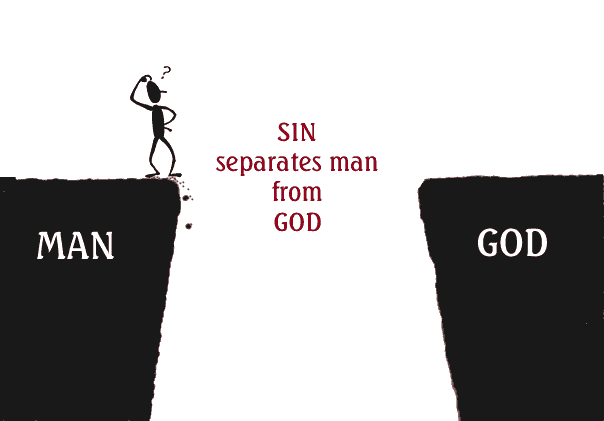
Isaiah 59:2  – “But your iniquities have separated you from God; your sins have hidden his face from you.”

sin sppartes
God is holy and man is sinful. Our sin causes a great separation between God and us.

John 14:6  “Jesus answered, “I am the way and the truth and the life.  No one comes to the Father except through me.”

1 Timothy 2:5  – “For there is one mediator between God and men, Jesus Christ, who gave himself as a ransom for all men.”

Romans 6:23 – “For the wages of sin is death, but the gift of God is eternal life in Christ Jesus our Lord.”

All of this means that Christ is the stairway that bridges the void between God and us.  The wages of sin is death and Christ took our sins upon himself and died in our place.  And unlike the Zeppelin song, you can not buy the stairway to heaven.  It is free.  It is a gift to you, received through faith.  Ephesians 2:5 – “For it is by grace you are saved, through faith- and this not from yourselves, it is the gift of God- not by works, so that no one can boast.”    John 3:16-17 – “For God so loved the world, he gave his one and only begotten son that whoever believes in Him shall not perish but have eternal life.  For God did not send his Son into the world to condemn the world but to save the world through him.”

Also, the Led Zeppelin song has a line that says, “Yes, there are two paths you can go by, but in the long run There’s still time to change the road you’re on.”  There are many religious paths that people can follow, but as the verses indicate, salvation comes only through faith in Jesus.  If you believe that Jesus is the Stairway to Heaven, then you have a calling, and a command from God, to share this message with others.  If you do not believe Jesus is the Stairway, I’d encourage you to study more about Jesus, his life, work, and claims, because there are multiple paths, and there is still time to change the one you are on.

Tolerance Quote – Erwin W. Lutzer

“Tolerance emerged as the one indisputable national value. This word, which at one time meant that people should be free to believe whatever they wished, now meant that they could do whatever they wished, and it was an improper to judge their conduct. Tolerance now demands an affirmation of virtually all behavior, no matter how immoral, unnatural, and bizarre.” – Erwin W. Lutzer