Why Are Some Books In The Bible And Others Are Not? #1

Stigmata Movie Poster
Stigmata was one such movie that envisioned books purposefully withheld from the Bible by the Church.

When Hollywood movies and popular fictional books revolve around the Bible, there’s a recurring theme that there are certain books which are not in the Bible that should be.  Usually the Vatican is hiding them all way in the Pope’s underground lairs!

Or in more legitimate cases, there are other Gospels, such as the Gospel of Thomas or the Gospel of Judas.  Should they be held up as the Word of God?  Did the church keep these books out of the Bible?  If the church kept these picks out, then doesn’t that mean the Bible is just a book put together and edited by men?
What’s the Standard for a Book to be in the Bible?
The word “canon” is often used when speaking of the books that are in the Bible.  “Canon” means “a standard or rule.”  For a book to be canonical it must have been written by an apostle or prophet, have been recognized by the early church, and has been in continuous use within the church for study and worship.  Certain lists for a book to be canonical vary, but they are all very similar.  Some of these variances are that the book must have been written in Greek or Hebrew (again this is connected to the book having been written by an apostle), the content of the book, and that the book had divine authority (again this is connected to the book having been written by an apostle or prophet), and that the texts were in use by the apostolic church (the church at the time the apostles were alive on earth).
It’s important to note that these standards were not imposed standards.  The church did not decide upon these criteria.  Instead the church merely recognized that these standards applied to the writings which authenticated themselves amongst the church.  In other words, the Scriptures were written and composed and gathered and accepted within the church as they were written, and later the church recognized the accepted books.

Did Jesus Claim to Be God?

Jesus either is God, or he is not God. 

It’s pretty simple logic.  A cannot equal Non-A. 

Since we have four biographies of Jesus’ life, two of which were written by eyewitnesses, Matthew and John, and the other two recorded by men who wrote based on the testimony of eyewitnesses, Mark and Luke, it makes sense that we should look to their accounts to see what they record of Jesus’ opinion of himself.  If Jesus said, “I’m not God,” then I think it’s safe to agree that he isn’t God.  If he said, “He is God,” then we should take a closer look at his claims.  So what did he say about himself?

Some will say that Jesus never said he was God (which Muslims and Jehovah Witnesses claim).  This technically is true, but only in the sense that the gospels never record Jesus  using the direct words, “I am God.”  There are however numerous verses in which Jesus says he is so close or similar to the Father that in fact he is saying, “I am God.”  Jesus also made statements which directly stated his divinity.  To such statement his audience responded with insults and shouts of “blasphemy.”  However, because we are not fully aware of the ins and outs of Jewish culture or even the teachings of the Bible, we might miss the meanings of such direct statements.  It also makes sense that Jesus never verbatim said, “I am God,” because He was sent to give glory to His Father in heaven.  This is why when Jesus usually stated His divinity, he also gave honor to His Father.

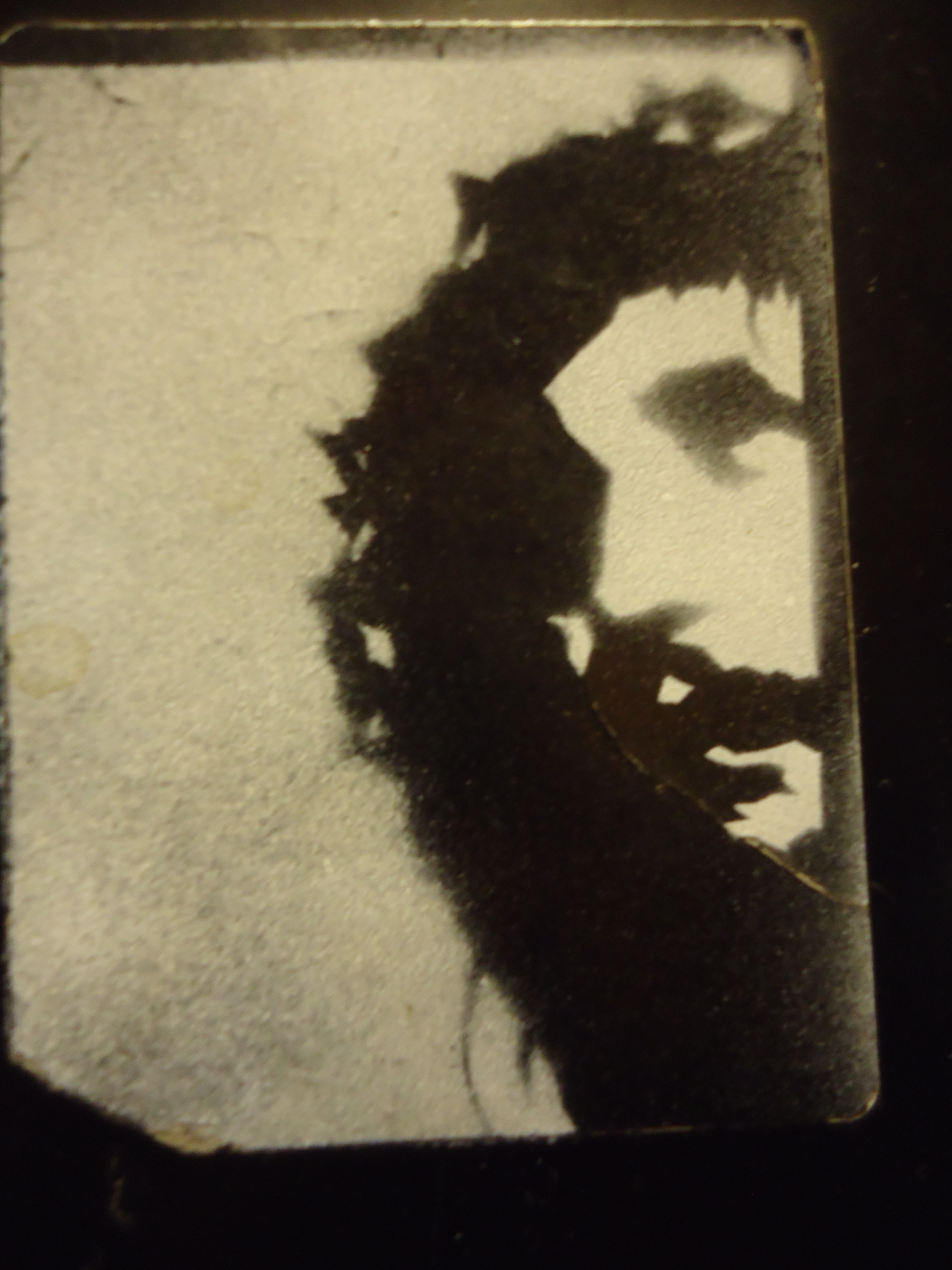
Jesus picture spray painted by Josh Conrad.
This is an image of Jesus that my friend, Josh Conrad, spray painted. He took a picture of his work and made stickers to share with his friends. This is a picture of his work on my laptop. Here’s the link to his blog: http://silentartistjc.blogspot.com/

Verses in which Jesus puts himself equal to the father:

John 14:23 “If anyone loves me, he will obey my teaching. My Father will love him, and we will come to him and make our home with him.”

Look up these other verses for more examples.

Mark 9:37
John 5:23
John 14:1
John 14:7
John 14:6
John 14:9
John 14:21
John 15:23
Statements in which Jesus directly claimed divinity upon himself (evidenced by the audience’s response):

John 10:30-33 “I and the Father are one.” Again the Jews picked up stones to stone him, but Jesus said to them, “I have shown you many great miracles from the Father. For which of these do you stone me?” “We are not stoning you for any of these,” replied the Jews, “but for blasphemy, because you, a mere man, claim to be God.”

John 5:17-18
John 8:58-59
Mark 14:61-64

Other Verses that show Jesus’ divinity though what Christ said or did or allowed others to do:

Mark 2:5-7
Matthew 28:16-17
John 5:21-27

“It’s the end of America as we know it.” – Nothing new. God is our resort.

I’ve heard numerous times lately from very conservative friends that it’s time to start stockpiling food and water as we face the end of America as we know it.  I’ve heard of FEMA concentration camps being built, drone bases being established to spy on and take out American citizens, the UN’s Agenda 21 and the plan to confiscate all citizen owned guns, censorship of the Internet, and numerous other government led preparations to crackdown against civil unrest.  I’ve been told that I need to stock up on guns; because it’s about to come the time to need them, and that anyone who stands for freedom will be labeled a terrorist in this new age of government control in the America to come.  Is it just paranoia, or is it real?

Today in church the sermon text came from Daniel 4.  King Nebuchadnezzar had a dream and the interpretation of the dream that the Lord gave to Daniel was the ruin of the king.  He was told by Daniel, “You will be driven away from people and will live with the wild animals; you will eat grass like cattle and be drenched with the dew of heaven.  Seven times will pass by for you until you acknowledge that the Most High is sovereign over the kingdoms of men and gives them to anyone he wishes”  (Daniel 4:25).  King Nebuchadnezzar was told that if he confessed his sins and repented unto the Lord that maybe his prosperity would continue.

Instead of confessing Nebuchadnezzar was boastful saying, “Is not this the great Babylon built as the royal residence, by my mighty power and for the glory of my majesty?”  Yep, that’s not a confession of sin, that is boast in self, and the prophesy of the interpretation of the dream was fulfilled.  Nebuchadnezzar was “driven away from people and ate grass like cattle.  His body was drenched with the dew of heaven until his hair grew like the feathers of an eagle and his nails like the claws of a bird” (Daniel 4:33).  He was brought to repentance and praised the Lord and he was restored.

King Nebuchadnezzar
An artist’s depiction of King Nebuchadnezzar facing the fulfillment of Daniel’s prophecy.

This story made me think about the “end of America as we know it” prophecies.  What if they are true?  What kingdom of man has ever stood the test of time?  Greek fell and Rome fell.  The Great British Empire fell to a ragtag bunch of hillbillies in the American colonies.  Who would have guessed that?  We must remember what Scripture teaches – God is the potter and we are the clay, at anytime if he wants to raise up a nation he can, and if a nation doesn’t stay in his hands he can bring it down as quickly as he brought it up!  That’s from Jeremiah 18!  Romans 13 teaches that God has placed all authority in place – that’s all rulers and all governors. Christians are called to submit to the authorities, since they are God’s servants.  Of course, Acts 5:29, Peter says, “We must obey God rather than men!”  If a government or authority figure orders us to disobey one of God’s moral laws, we must obey God rather than men, but we must also anticipate and expect the due penalty.

The points of the sermon were:

1.  God should not be our last resort.  He is our only resort.  I shouldn’t place my trust in the government, but in God.  The government will fail, even the best of them, but God is faithful.

2.  Speak the hard things and listen to the hard things.  Namely, speak the Gospel of Jesus Christ.  That’s hard to speak – it’s divisive after all.  It brings contradictions – either Christ is Lord of all, or He is nothing at all.  He is either to bowed to as Lord, or shut up as a fool or liar!  Knowing that a rejection of his message will bring persecution, or separation, even amongst family, makes it hard to proclaim.  It’s hard to also proclaim that someone is wrong, that repentance is needed.  Daniel made the proclamation though to the King.  He denied it at first, but he came to accept the need to confess. It was worth the proclamation.

3.  We should confess ourselves.  To build upon our own rock is silly.  To boast at our own works is futile.  What have we done apart from the Lord?  What can we do apart from him?  Nothing at all.  To avoid boasting and self-reliance, confession is needed to bring us into the refuge that is Christ Jesus our Lord.

Nebuchadnezzar in Pop Culture
In pop culture, the name Nebuchadnezzar was used in the movie the Matrix for the name of Morpheus’ ship.