Contradictory Views of the Divine

who is GodViews of the Divine:

  • Judaism – Monotheism.  One person, one nature. God is transcendent and he is called Yahweh.
  • Islam – Monotheism.  One person, one nature. God is transcendent and he is Allah.
  • Christianity – Monotheism. Three persons, one nature.  God is transcendent and exists in three persons, the Father, the Son, and the Holy Spirit.
  • Hinduism – Polytheism/Pantheism.  There is an extensive number of gods and goddesses that can be worshiped.  Yet those gods, as well as all things, are at their core existent of the same divine essence, called Brahman.
  • Buddhism – No God/Irrelevant.  The Buddha denied Brahman and the individual soul as he split from the teachings of Hinduism.  Irrelevance, or ambivalence, best describes the Buddha’s doctrine of God.  Belief and worship in God can actually be a hindrance to reaching nirvana because following a Supreme Power produces fear, as explained by the Buddha in the Dhammapada verse 188, “Men in their fear fly for refuge to mountains or forests, groves, sacred trees or shrines.” Instead of from a God of sorts, refuge comes from the Four Noble Truths.
  • Wicca – Pantheism and other views.  Everything is the manifestation of the divine, which is associated as being of the female sex, being called the Goddess.    Some descriptions of the Goddess give the impression of energy, like the Force in Star Wars that connects all things.  Although some Wiccans are monotheistic, and others say there is both a transcendent God and Goddess, and some say that both the God and Goddess are one, being of the same divine essence.
  • Scientology – There is a Supreme Being, but “the Church of Scientology has no set dogma concerning God that it imposes on its members.”  One’s view of God is contingent upon each individual’s “level of spiritual awareness.”  (Scientology.org)
  • Laveyan Satanism  – Each man is his own God.
  • Atheism – No God.

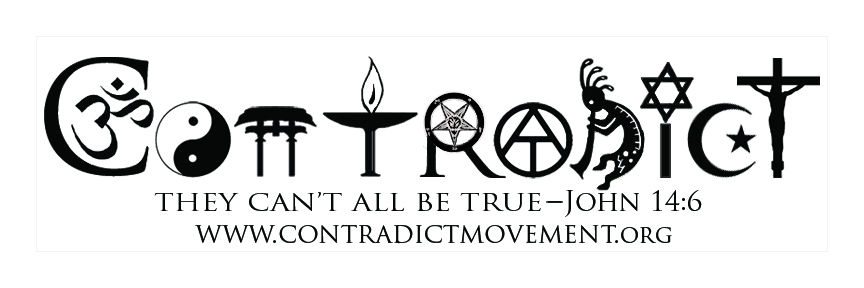
Contradict Bumper Sticker

Contradict Movement

“-We just recognize that the religions of the world contradict each other in their fundamental teachings. We are Christians who believe Jesus’ claim to be the way, the truth, and the life– the only way to the Father (John 14:6)”…

For two years I have been going once a week to the “Freedom of Speech Area” at the University of California Irvine and sharing the message in the video I have posted for this project.  There have been about ten different people who I have done this with and we have found this to be a very easy way to begin personal conversations with strangers about the Gospel message of Jesus Christ.

We set-up a table with a “Contradict” banner with various religious symbols spelling the word and we offer all the students passing by free Starbucks coffee.  Plenty of students stop for coffee and each night several of them stay for lengthy discussions about faith differences.  Sometimes, we are mistaken to be atheists, because many people interpret the sign to mean that we are against all religions, but that isn’t the case; we just recognize that the religions of the world contradict each other in their fundamental teachings.  We are Christians who believe Jesus’ claim to be the way, the truth, and the life– the only way to the Father (John 14:6) is true!  This usually creates an interested audience for further discussion, and why not, there is free coffee involved and it’s a personal conversation, not a bull-horn speech.

I have taught World Religions and Christian Apologetics for three years at a private Christian high school in Southern California.  I have found that before the class most of my students know very little about any religion besides Christianity, and I have found that the majority of the college students at UCI are also uninformed about many of the world’s most prominent religions, but that they are very interested to know more.

My goal is to write a book, Contradict -They Can’t All Be True, to equip Christians to share the teachings of various religions by evaluating their apparent contradictions as a catalyst in sharing the trustworthiness of the truth-claim found in John 14:6. The message can be shared in numerous ways as the Holy Spirit leads, but there is a desperate need at this present time to contradict the popular misconception that all religions are true and in fact, lead to the same end goal.

My hope is that there will be as many “Contradict” stickers backed with knowledge and Christ-like hearts as there currently are “Co-Exist” or “Tolerance” stickers. I hope and pray that Christians who have the sticker will be able to share the message that accompanies it.  The message of the love and truth of Christ in a hungry and thirsty world, desperate for unconditional love and grace.

The book is being self-published with WestBow Press, a Christian publishing company that is a division of Thomas Nelson.  Your pledges will contribute to  the vision and cost of self-publishing this first book. If the set goal is surpassed, additional funds will go towards producing more videos and creating artwork within the book.  Once the project is completed on Sept. 13th, I will be given the opportunity by Kickstarter to request mailing information from all backers so I can ensure you receive your reward.  Each person who pledges will receive a “Contradict” sticker to help spread the Word/word.

Update on this blog post: The Kickstarter pledge goal was met, but now you can still get Contradict stickers and endorse the movement at http://contradictmovement.org/t/stickers

Graphic Layout by Daniel Martinez.

The Heart Behind Pluralism

The 60s Counter-Culture movement that questioned absolute truth and morality and the objectivity for measuring such standards did so because they saw that people were being killed over differences that weren’t directly affecting them in their personal freedoms.  Different forms of government cause war, cultural clashes lead to hatred, racial differences bring oppression, the physically stronger sex suppresses the weaker sex, and religions… well, I think we know the problems that arise from the interaction of diverse faiths vying for the ultimate authority on the most important questions of life, death, and the after-life.

Crying amidst these clashes over politics, race, sex, and religion, the Youngbloods sang, “Come on people now smile on your brother.  Everybody get together. Try to love one another right now.”  The Beatles sang over and over, “All you need is love.  Love is all you need.”  And after the Beatles broke up, John Lennon sang against fussing over all the different “isms” in the world, when all we really need to do is “give peace a chance.”  The slogan that sums up the Counter-Culture movement was “Make love not war,” and this is the heart behind modern day pluralism, love.

Those who imply pluralism when they use the words tolerance and co-existence are doing so from a right heart position.  From their standpoint, the often times hateful reaction that intolerance offers in response to diversity is the root of our self inflicted pain and suffering upon each other.  If we could only love one another, we could heal the world.  If we could just get to that point that we recognize that we are all brothers and sisters; we could make the world a better place for you, and for me.

Love covers a multitude of sins.  Love trumps all ideologies, philosophies, and religions, and if some refuse to hop aboard the love (pluralism) train because they are still elevating their beliefs over and above love, then all we have to do is convince them that the world’s competing truth claims are actually at their core, the same.  If differences are only aesthetic, then all religions can all be boiled down to one common denominator.  That one common denominator is love thy neighbor as yourself; love is all we need, and that is the heart behind pluralism.

But is it true? Can religions really be reduced to a common denominator?