Reconnect Episode 10: Religions, Atheism, and Wars!

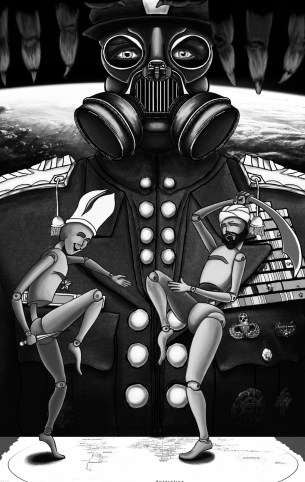
Drawing by Danny Martinez - an illustration from Andy Wrasman's book, Contradict - They Can't all Be True.
Drawing by Danny Martinez – an illustration from Andy Wrasman’s book, Contradict – They Can’t all Be True.

Click here to listen now!

Right Click to download.

Listen in iTunes!


All too often religions are said to cause evil and to cause wars. The Crusades are often times mentioned to support this claim.  Andy interviews Stephen Puls, a Lutheran high school history teacher, who explains what the Crusades were, why they were started, and what went wrong.

In the second segment, they turn towards looking at the role of Atheism in connection with wars!

By the end of this episode, you’ll have some great talking points whenever such an argument against religion arises.   And of course, the goal is to use these talking points to present the Gospel of Jesus Christ.  A few suggestions on making this connection are also shared in this episode.

Article discussed in show: “The Myth that Religion is the #1 Cause of War”.

Send comments, questions, and complaints to Andy Wrasman at andy@contradictmovement.org.  You may also record a short mp3 audio file to be shared on a future episode of Reconnect. 

Please share this episode on all of your social media sites and with all parties you think would benefit from listening to Reconnect.  Thank you in advance.

Reconnect Episode 8: Three Things Christians Say to Hurt Their Credibility

Left click here to listen now! Right click to download episode.

Listen in iTunes.

George and Andy, discuss a series of articles from Credo House entitled: 21 Things Christians Say to Hurt Their Credibility.  In this episode they have time to discuss three of these statements:

1. “You can’t use the Bible to prove the Bible.”

2.  “Good question.  I’ll find the answer and get back to you.”

3.  “One white lie will send you to hell for all eternity.”

We want to be credible witnesses of Christ.

Andy and George agree that some of these statements really do hurt the credibility of our Christian witness and should be avoided, but they come to disagree with at least one of these articles, because they think the statement is in fact Scriptural, thus should be spoken, but maybe there is a better way of presenting the truth to a nonbeliever.

Other questions and topics emerge as they discuss these articles, such as: how do we know the Bible is the Word of God, how should we respond to questions we don’t know the answers, is it possible for Christians to have all the answers to life’s questions, what exactly is revealed to us in Scripture and why, how should we approach preparing answers to difficult questions raised against or about the Christian faith, why should churches teach apologetics, and the very controversial topic of varying degrees of punishment in hell!

If you want to chime in on any of these topics or give a short review of any episode of Reconnect, record a short 30 second to one minute long audio clip, stating your name and the episode number you are addressing, and send it to Andy at andy@contradictmovement.org as an mp3 file.  If you have any questions you want addressed on the show, send them there via email as well.  Thanks.  Reconnect us, Oh Lord. 

Reconnect Episode 7: Jews Claim that Jesus did not Fulfill Messianic Prophesy

Left Click to Listen.  Right Click to Save. 

Listen in iTunes!

Reconnect logo designed by Kyle Beshears, author of Robot Jesus.

Jews reject Jesus as the Messiah, because they claim he didn’t fulfill Messianic prophesy.  Andy received an email from someone arguing that there were four key prophesies Jesus did not fulfill.  The sender also listed other ways in which Jesus contradicted the Hebrew Bible.  Andy discusses this email with Crean Lutheran High School’s Old Testament teacher, Conni Schramm.  She provides a Biblical response to all of the man’s objections.  Her first response to the email is shocking, and it should serve as a reminder for all of us entering into such debates via online messaging!

How would you have responded to these objections?  The following is the email Andy received at andy@contradictmovement.org in its entirety (swear words are blanked out):

I am contacting you because one of your members noticed my Israeli Air Force shirt today and proceeded to launch into horribly misinformed evangelical nonsense.  I’ve had more enlightening conversations with Time Warner Cable technical support.  He shared his nonsensical worldview with me, and I felt I should contact you, giving you feedback on one of your flock.  Simply put, he was an idiot, but just barely intelligent enough to be _____________.

Let me speak frankly, then: Jesus of Nazareth was not the messiah.

What is the Messiah supposed to accomplish? One of the central themes of biblical prophecy is the promise of a future age of perfection characterized by universal peace and recognition of God. (Isaiah 2:1-4, 32:15-18, 60:15-18; Zephaniah 3:9; Hosea 2:20-22; Amos 9:13-15; Micah 4:1-4; Zechariah 8:23, 14:9; Jeremiah 31:33-34)

Specifically, the Bible says he will:

  1. Build the Third Temple (Ezekiel 37:26-28).
    Second one was already standing – he’s out!
  2. Gather all Jews back to the Land of Israel (Isaiah 43:5-6).
    There was an enormous population of Jews outside Israel that stayed outside – nope.
  3. Usher in an era of world peace, and end all hatred, oppression, suffering and disease. As it says: “Nation shall not lift up sword against nation, neither shall man learn war anymore.” (Isaiah 2:4)
    If anything, more people were killed in his name than any other reason.
  4. Spread universal knowledge of the God of Israel, which will unite humanity as one. As it says: “God will be King over all the world ― on that day, God will be One and His Name will be One” (Zechariah 14:9). – Nope.

If an individual fails to fulfill even one of these conditions, then he cannot be the Messiah.  Jesus failed at all four.

The Messiah must be descended on his father’s side from King David (see Genesis 49:10, Isaiah 11:1, Jeremiah 23:5, 33:17; Ezekiel 34:23-24). According to the Christian claim that Jesus was the product of a virgin birth, he had no father ― and thus could not have possibly fulfilled the messianic requirement of being descended on his father’s side from King David. (1)  – Yet the genealogies of the gospels CONTRADICT EACH OTHER

The Messiah will lead the Jewish people to full Torah observance. The Torah states that all mitzvot remain binding forever, and anyone coming to change the Torah is immediately identified as a false prophet. (Deut. 13:1-4)   So, he’s a dissident.
Throughout the New Testament, Jesus contradicts the Torah and states that its commandments are no longer applicable. For example, John 9:14 records that Jesus made a paste in violation of Shabbat, which caused the Pharisees to say (verse 16), “He does not observe Shabbat!”    And a blasphemer.
Quite Frankly, sir, your evangelical organization is a sham, and the word “Contradict” in your title only refers to contradicting yourself.  You can’t hold that all parts of the bible are true if Jesus BLATANTLY contradicts the Torah, though you hold that it is the binding word of God (written by people, by the way, even Torah) even though it is contradicted by a blasphemer and political dissident who accomplished exactly nothing.  Jesus contradicts Torah, yet you worship Leviticus 18:22. YOU ARE CONTRADICTING YOURSELF! Normally, I don’t get too upset about these things.  This person was hell-bent on converting me back to idiocy, and I am hell-bent on letting you know the following:
1. That your followers are ________.  You won’t win any hearts and minds with people like that.
2. That your followers are also idiots, they are incapable of thinking for themselves save the lies with which you fill their heads.
3. I shall make it my goal to contradict your insidious movement whenever the opportunity arises.

Reconnect Episode 2: Top Ten Fallacies Used By Religion

In this episode I recruit a former roommate from Concordia University Irvine, Paul Kasaty, to assist me in understanding all the ins and outs of logical fallacies, in particular ten logical fallacies I found on a blog called, God Be Gone. The author listed ten logical fallacies that he claims are used the most by religious adherents, providing examples of what the religious say when committing these fallacies.  Paul explains what each fallacy is in this top ten list and if the blogger’s examples are fallacious arguments or not.  These are good points to know, because if we as Christians are committing these fallacies, we need to stop, and begin to make better arguments.

reconnect logo

Click here to listen to Episode 2: Top Ten Fallacies Used By Religion.

Click here to listen on iTunes.

Click here to read the God Be Gone article discussed in this episode. 

Please leave a review on iTunes and share this episode if you think others will benefit from hearing it.  Thanks so much!

Click to download the full song “Wouldn’t Dare” used  in this episode. 

Samson is NOT a Biblical Parallel to Suicide Bombers!

A colleague approached me yesterday and said, “I have a good one for you.  What’s a Biblical parallel to suicide bombers?” He answered, “Samson.”

Intentionally committing suicide to kill those who are your enemies in recent decades has been almost exclusively associated with Islam.  Many are arguing that all forms of terroism have no role or place in true Islam, thus those who claim to be killing themselves to kill others in the name of Allah are not true Muslims.  I don’t want to address that topic, right now.  I did find a very good article post from Middle East Forum entitled, “The Religious Foundations of Suicide Bombers”, that I believe has done a very fine job of citing early Islamic theologians, the Qur’an, and the Hadiths to demonstrate why we are witnessing suicide attacks in the name of Allah.  I want to take the time to find all the citations and then write a post afterwards to show if I agree with the article after reading the citations. Without looking up all of the citations first hand, I think the Middle East Forum presents authoritative Islamic texts that Muslims can use to support terrorism and violent acts against non-Muslims. But that’s not the intent of this blog post.  I want to address the point that Samson is a Biblical example that parallels Islamic suicide bombers.  Is it justifiable to kill yourself if it is to kill those who are enemies of God?  If the Christian says no, how could we respond if someone raises the objection of Samson?

If you are unfamiliar with Samson’s life and death, it can be found in Judges 13-16.

Samson was the product of a miraculous conception.  (Judges 13:3)  His mother was told that he should be a Nazarite from birth!  (Judges 13:5)  A Nazarite vow entailed no drinking of alcohol or cutting of your hair from the time the vow was taken, hence, Samson never had his hair cut.  Samson is known for his superman strength.  Samson attributes his great strength to having been a Nazarite from birth.  (Judges 16:17)  Once his hair is cut, he loses his strength and is captured by the Philistines.  They gouged out his eyes!  (Judges 16:21)  The Philistines then gathered to offer a sacrifice to their god, Dagon.  They had Samson shackled and were entertained by his failure and misery.  Samson requested to be able to rest against the pillars that held up the roof of the courtyard.  3,000 Philistines were gathered, men, women, and children.  (Judges 16:27) Samson then said, “O Lord God, please remember me and please strengthen me only this once, O God, that I may be avenged on the Philistines for my two eyes.”  He then tore down the building by pushing on the two pillars that held up the roof.  Scripture says that he died there with them and that he killed more Philistines in his death than during his life.  (Judges 16:30)

Samson brings down the house, killing about 3,000 Philistines.

This passage of Scripture can certainly be troubling.  It means that God empowered Samson to kill not only himself, but also women and children.  He wasn’t just killing the men who captured him and took his eyes. There are answers to this moral conflict that fit within the Biblical worldview that can ease the tension we sense over this horrible calamity, but outside of the Christian worldview they likely won’t satisfy, and even within the Christian worldview, we may not be satisfied.  There are also some very clear ways in which this event is far different from God giving his approval on such acts as suicide bombing!

1st – Samson was a judge over Israel, the people of God.  The position he had was appointed by God.  Justice needed to be served.  The false god and the temple of the Philistines should not prevail against the real God of the universe.  Samson prayed to the Lord and asked for vindication against the enemies of God, and he was willing to offer his own life in the process.  His death was not a self-righteous vindication either.  He was laying his life down for the good of God’s people, that they  might be spared from their enemies, even if it cost him his own life.

2nd – Samson’s strength always came from God.  He attributed it to his long hair and vow, but in his final prayer, he is acknowledging that his strength was from the Lord.  Scripture says that the Philistines were entertained by the spectacle of their enemy, Samson, captured and blinded.  How were they entertained, unless they were laughing and mocking him?  They likely were calling on him to save himself, to perform a great act of strength as he had done before, many times in his life.  Since he was a judge, a representative of God, the Philistines in the house of Dagon were thus mocking and challenging the one true God.  Foreshadowing and pointing to Jesus’ death, Samson gave his life to put an end to the enemies of God.  Jesus Christ, when he was mocked, delivered a death blow to sin, death, and the devil, and reconciled all of humanity back into a relight relationship with God through the shedding of his own blood. 

3rd – Samson’s death was far different from that of a suicide bomber.  Samson was captured, his eyes had been taken, he was shackled, and he was likely going to be put death.  The taking of his own life was clearly done through supernatural powers given by the Lord that he directly prayed to for help for vengeance against his enemies.  A suicide bomber on the other hand is not doing anything supernatural.  Bombs are not supernatural, thus cannot be confirmed to be approved by God.  Suicide bombers have not been captured, they have not been tortured, and they are not being held captive and mocked in an act of worship towards the god of their enemies. Suicide bombers are not God’s chosen representatives of his judgment amongst his people.

4th – From the Biblical worldview, all life comes from God and it is his to give or take.  All humans die as punishment for our sin (man, woman, or child).  When and how death shall come is a matter left to God.  When suicide bombers take their own lives and the lives of the innocent, it means that God has allowed the evil action to occur.  It does not mean that he ordains it to be good.  Samson’s sacrificial death brought glory to God and confirmed to all the remaining Philistines that the God of Israel is real and he is not to be mocked!  The death of the Philistines quite possibly led to others in their community to repent and be brought to saving faith in the one true Lord, turning from Dagon  The hope that we have from the Bible is that no matter what occurs, God will work through all situations for the good of his people who love him. (Romans 8:28)