What is a false conversion?

I have seen a recurring theme lately on social media sites… the false conversion!  These social media posts, videos, images, and websites are claiming that a false conversion is when people think they are Christians (or saved), but in reality, they are not.  Why wouldn’t they be saved?  It’s not because they don’t believe Jesus died for their sins, it’s because they aren’t doing the things Christians ought to do.  This means these false converts are somehow openly sinning in a way that  Christians should never do, they aren’t bearing the proper Christian fruit in their lives, or they think that a prayer that they said at some point means they are absolved of all their sins.  The other recurring theme I am seeing amongst these posts that talk about false converts is a question of “true repentance”.  They claim that a false convert hasn’t truly repented, or hasn’t really surrendered to God, or doesn’t actually desire a relationship with God, they’re just wanting “fire insurance”.

Here’s a recent example I saw:
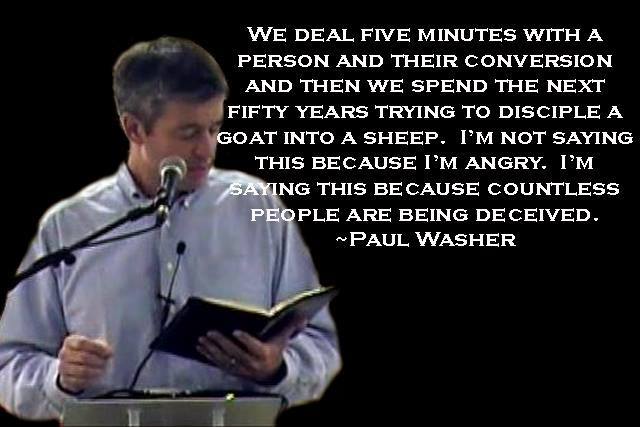
An example of this false conversion talk.

This quote by itself leaves a lot of questions of what exactly does Paul Washer mean, but a guy named Michael on Facebook explained the above Paul Washer quote by saying:

He’s speaking about how people are very quick to get someone saved that they basically never tell the the gospel but rather spend five minutes and make them mouth a sinner’s prayer. Then we end up spending the next 50 years trying to get them to actually follow Christ as part of God’s flock.

In other words, people are being deceived into believing they’re saved just because they said a simple prayer, without ever actually understanding what the Gospel is, and so they’re unfortunately never brought to the place of actual conversion to truly follow Christ. And unfortunately many will indeed do as Jesus says, “Many will say unto me, Lord, Lord,” and believe they’re saved, but they never actually gave their lives to Christ.”

Another commentator agreed with Michael, saying:

What Michael said is correct. Our current society [I think he means church congregations] tries to do whatever they can to get a “decision” for Christ, with a Gospel void of repentance and faith. Then this “convert” doesn’t act like a Christian, so we spend years and years trying to “disciple” a non-believer into acting right, without realizing they were never saved to begin with.

There are even websites dedicated to warning people that they might not be true converts to the Christian faith.  At one site, you’ll find numerous confessions from former “pretenders” and you’ll be greeted with a load of questions that are designed to lead you to the realization that you are not a true believer, such as the following question:

What if I have not honestly been broken over my sins against God and completely surrendered to the Lordship of Jesus Christ?

The measure of your salvation in all of these “false convert” warnings lies with YOU and YOUR work, not in Christ and HIS WORK.  The work lies upon your degree of commitment or involvement.   Do you really believe, have you completely turned from your sins, do you actually hate ALL of your sins, are you truly following Christ?

Based on these types of questions and warnings, a person is left to turn inward to himself, and not outward to the cross of Christ and his empty tomb.

Do I really believe?  What does that mean?  Do I ever have doubts?  Do I ever question God’s calling in my life? Is my entire theological system 100% correct, free of all errors?  Are there miracles accompanying all my prayers?  Have I been bitten by a poisonous snake and not harmed at all?

Have I completely turned from my sins (often worded as truly repented)?  What does that mean?  Does it mean I hate every single one of my acts of sin?  Can I even enumerate all of my acts of sin?  God forbid, but what if I fall into some sort of horrible cycle of sin, such as what King David and Samson did?  Were they not truly repentant because of those nasty spills of temptation and failure to resist?  Is it even possible to completely turn from my sin in this life?  Won’t I always have sin in this life?  And since I know I will always have sin this life, how many sinful acts are too many for me to have completely turned from my sin?

Am I truly following Jesus?  Let’s see… Am I holy as he is holy?  Do I always pray for and love my enemies?  Do I ever have hatred in my heart, or lust?  Do I ever covet my neighbor’s house, or my boss’ salary?  Do I have one too many coats?  Do I always do the things that Jesus would want me to do, just as he was always doing what his Father wanted him to do during his time here on earth?  Do I ever go astray like the dumb sheep of Psalm 23?

Do you get my point?!!?  Are any of us really, truly, completely (fill in the blank) so that we are deserving of salvation because we have (fill in the blank)?  Are any of us even capable of properly making these judgments about ourselves?  And I know for certain no other man can know my heart!  So please, don’t get sucked into justifying yourself, or trembling that you aren’t doing enough to prove yourself a true convert.

So how does conversion take place?  A person hears the Gospel and believes.  It’s that simple.  Conversion occurs instantaneously, as does our justification.  Sanctification however is a process, in which we will become more and more like Christ, likely sin less, and grow in faith and love more and more, etc.  But that process will never be complete in this life… NEVER.  When we die and are raised at Christ’s return, we will then receive heavenly bodies – that are sinless.  As for now, we will always struggle between our new nature in Christ and our sinful nature that we inherited at our conception (Romans 7).  And our justification is not dependent upon how we are progressing in sanctification!  Our justification always comes by grace through faith in Christ.

Here is Paul Washer (to use him again in this blog post) explaining how a person is converted:

I absolutely love that Paul Washer explanation of how a person is converted and how we should lead a person to Christ! I hope you watched it. His explanation shows that conversion is not saying a prayer or making a decision. It’s simply faith coming to a person through hearing the Gospel message proclaimed, just as Paul says it does in Romans 10. After we have faith, we do pray, we do decide to follow Christ, etc.  Perfectly?  No. Never, not in this sinful body.  Should the quality of my obedience dictate my salvation?  No. Never. The perfection of Christ’s obedience dictates my good standing before the Lord, and Jesus was obedient unto death – even death on a cross!

And to close… since the focus of these “true conversion” tests is for a person to discern his works and see if they are in line with the Lord’s will (“acting like a Christian”), I offer the following passage, Matthew 7:21-23:

“Not everyone who says to me, ‘Lord, Lord,’ will enter the kingdom of heaven, but only the one who does the will of my Father who is in heaven. Many will say to me on that day, ‘Lord, Lord, did we not prophesy in your name and in your name drive out demons and in your name perform many miracles?’ Then I will tell them plainly, ‘I never knew you. Away from me, you evildoers!’

Do you note what happened here?  Not everyone who prophesies in Christ’s name and drives out demons and performs miracles will be saved.  Why?  I think it is because they were justifying themselves.  If Jesus ever said to me, you can’t enter heaven, I won’t respond with, “But Lord, did I not (blank), (blank), and (blank) in your name?”  No!  I will say, “But Lord, did you not take on flesh and humble yourself to live amongst us in order to fulfill all righteousness for me?  Did you not die as an atoning sacrifice for my sins? Did you not rise from the dead, conquering sin, death, and the devil?”  Do you see the difference?  The ones who did not know Jesus, pointed to themselves and the work they did in Christ, not recognizing that they are evil-doers.  The one who knows the Lord will point to Christ alone for his salvation.  The point is that we are all evil-doers.  We don’t deserve salvation.  We deserve hell.  So let’s not make salvation (or our conversions) about how well we are following Christ, how committed we are to the one True Lord, how much we hate our sins, or how much fruit we are bearing.  Let’s always beat our breast and proclaim how wretched we are and that we need Christ to justify us!

The Blind Men and the Elephant – The Response!

The following is an excerpt from my book, Contradict – They Can’t All Be True (FYI – the spacing doesn’t always transfer correctly from my PDF file to the blog):

Drawing by my friend Danny Martinez.

A popular analogy that depicts an “all religions lead to God” form of pluralism is the story of several blind men touching various parts of an elephant and being unable to agree on a single description of the creature they’re touching. This story has connections to Jainism, Buddhism, Hinduism, and even Sufi Islam, a mystical branch of Islam. The story is found in the teachings of the Buddha within the Pali canon of Theravada Buddhism. One of the most popular versions comes from a nineteenth-century poet, John Godfrey Saxe, who rewrote the story in rhyme.

Though there are minor discrepancies among the versions, they all present the same basic scenario: since each blind man is touching a different part of the elephant, they disagree on what the elephant actually is. The one touching the tail might think the elephant is a broom; the one touching the side of the elephant might think the elephant is a wall; the one touching
the elephant’s trunk might think the elephant is a snake. Individually, they each know a part of the elephant accurately, but not the sum total of the animal. They fail to grasp what the elephant actually is because of their blindness. Their dispute is futile since they are all mistaken.

It is pretty clear how this story can be used within the framework of pluralistic relativism. Christians, Jews, Muslims, Hindus, Buddhists, and the like are all touching the same sacred elephant, God. But because all of humanity is spiritually blind, we are incapable of knowing God as he actually is. Any fighting among religious faiths is thus futile.

On the flip side, the good news within pluralism is that every religion is true based on what its adherents have experienced of the sacred reality. Since all religions have touched the sacred elephant, all religions lead to the same divine truth. Religious pluralists argue that if humanity could only come to “see” this predicament, all religious fighting could stop. We could recognize what each religion has learned about God and, by compiling the parts of the whole, come to a better understanding of who or what the nature and personhood of the sacred reality is.

The view of the divine expressed by the sacred elephant analogy is plausible and worth considering. Before considering the accuracy of its assertions, I want to stress the pluralistic uses of the story. Far from saying all religions are true, the story of the blind men and the elephant takes all religions and throws them under the bus, where they are left broken in their false perceptions of ultimate truth. As hopeful as this story can appear, in reality it just drops the bomb on absolute truth, at least absolute truth concerning God. The blind men show us that truth concerning God is unobtainable due to our limited faculties.

Skepticism toward God doesn’t invalidate this brand of pluralism. The problem lies within itself. Nestled within the story of the blind men and the elephant is a self-contradiction that makes the entire claim crumble in on itself. The pluralists claim that God is unknowable; every religion is wrong about its perceived understanding of the divine. However, in making this claim, the pluralists also implicitly declare they have an inside track on who God is. If no one is capable of knowing God due to our lack of sight in the realm of the divine, then what prescription glasses have enabled the pluralists to know the nature of God with such certainty? Pluralists are rejecting all exclusive truths concerning God, but making one themselves.

End of excerpt from Contradict – They Can’t All Be True.

In my book, I intentionally wrote with a non-Christian voice for the first six  chapters.  I first present what religious pluralism is and why its so dominant in our culture and society right now.  I then demonstrate how religious pluralism doesn’t actually work logically.  Responding to the elephant analogy was near the end of that section of the discussion before moving into presenting an evaluation of religious truth-claims and ultimately landing on the trustworthy nature of the person and work of Jesus of Nazareth to save us from sin and death and reconcile us into a right relationship with God!  Since I wasn’t ready to let it out of the bag that I was a Christian yet in that stage of the book writing process, I didn’t  respond to the elephant analogy the way I typically would.  The following is a more complete Christian response to this popular analogy:

A critique of this parable would contain the following points:

  1. This parable is actually claiming that all religions are false.
  2. This parable makes all aspects of life subjective.  There is no absolute, objective reality that we can be certain we are experiencing correctly.  If absolutes don’t exist in a way that we can comprehend them, morals and ethics also become subjective.  There would no longer be such a thing as right and wrong.
  3. Any exclusive religion, such as Christianity, Judaism, and Islam are forced to give up their claims to exclusivity to fit into the inclusive, pluralism which this parable projects.
  4. With Christianity’s exclusive claim that Jesus is the only way to salvation, all other religions would have to be false if Christianity is true, or Christianity could be false and other religions true.  This does not fit with the elephant analogy at all.
  5. The original telling of this legend has a king who sees the blind men groping at the elephant arguing about what they are touching.  The king reveals to them in laughter that they are all foolish men that they are all touching the same reality, the elephant!  This is very interesting that the original legend has a word from above revealing the truth to the blind men.  This indicates that the truth is actually discernible – we might just need some help from someone up above.
  6. The original ending of this parable lends itself very well to Christianity.  Christianity teaches that help did come from above.  That God has revealed himself to mankind through what he has created as well as through special revelation from the Scriptures and in particular through the second person of the Trinity, Jesus, taking on flesh and walking amongst us, revealing the truth to us, healing the blind and helping them see.  This revelatory claim of Christianity isn’t even considered or introduced in pluralistic uses of this parable.

Conclusion: Declare truth where truth is found!

It seems clear that all religions cannot be fully and equally true.  There are direct contradictions within the teachings of the world’s religions, such as Jesus is God (Christianity) and Jesus is not God (Islam), which eliminate the possibility that all religions are true.

This however doesn’t mean that aspects of the truth cannot be found within various religions.  Christians would do good to point these truths out from time to time.  If Christ’s claim is true that he is the way, the truth, and the life (John 14:6), then all truth would be God’s truth, no matter where it is found.  Where truth is found, declare it, use it, put it in its full context of which it is fully and directly revealed from God in the Bible.  The Apostle Paul did when he quoted the philosophers of the Athenians (Acts 17).  We can do it too!

Can Sci-Fi Fanboys Allow Co-existence?

Sci-Fi Coexist Bumper StickerCould this happen?

Of course, fans of the X-Files can love the Alien universe.  Plenty of Lord of the Rings fans also read the Star Wars books and follow all of the spin-offs.   Even the most treasonous act of loving Star Wars and Star Trek occurs all of the time.  And the most blasphemous act of all is already set in motion – JJ Abrams who directed the Star Trek remakes is directing the forthcoming Star Wars trilogy.  I know one fanboy who couldn’t sit still in-class when this news was released.  His world had ended.

Of course, this type of co-existence happens in the Sci-fi world.  Geeks, nerds, fanboys can unite over multiple Sci-fi universes and enjoy them at the same time.  But… can those universes actually co-exist with one another.  Could you imagine how it would play out if an alien from the Alien universe entered into the X-Files story arch?  Chris Carter would be strung up before filming even has a chance to begin.  What if some sort of time and dimension jump took place and all of a sudden the Star Trek Enterprise with Captain Kirk was teaming up with the Rebels to fight the Empire?  Fans would not allow this to happen.  Would they?  Could this co-existence really take place?  Could these story-archs all unite without sacrificing something special within each of their unique universes?

So why should we expect this to happen with religions?  Come on!

Could this be a good starting point for sharing the Gospel of Jesus Christ with someone?

Why do you have to evangelize?

I was on a radio show recently called Engaging Truth.  The episode I was on was hosted by Ken Chitwood.  There was an option for people to call in with questions or to text questions.  A few questions were received but not able to be addressed on the show.  Here is one of those questions:

Why do you have to ‘evangelize?’ Couldn’t you just help people appreciate religious differences, teach them about religion, and lead others into more peaceful co-existence… recognizing we aren’t all the same? Why do you have to shove your faith down someone else’s throat? 


My answer:

I agree with you that the Christian faith shouldn’t be forced upon someone. Jesus taught that we should make disciples through sharing his teachings, not at gunpoint with an ultimatum to convert or die. The example of Jesus and the early church is that the spreading of the gospel needs to be done through service to the community, coupled with dialogue, storytelling, Scripture proclamations, and reasoned arguments communicated in love. Submission holds with tap-out conversions aren’t part of God’s plan of proselytizing, and if you have experienced Christians sharing God’s Word in an unloving manner, I apologize.

When I share my Christian faith in public, I share my beliefs with anyone who wants to listen to them and engage in dialogue with me. I offer coffee and a chair to create a relaxed, enjoyable environment for religious conversation, usually on public campuses. If you don’t want to stay and discuss the person and work of Jesus Christ with me, and how he stands out among the other religious founders by being the only one to die for the sins of the world and rise from the grave, then I don’t want to force you to listen.  I wish you well and I say silent prayer for you as you move on down the line.

The reason I “evangelize” is because I am convinced that Jesus is God and that he died to take away the sins of the world.  “Evangelize” means to share good news. Gospel means “good news” and the good news is that God has demonstrated his love for us through his Son Jesus Christ, forgiving our sins through Jesus’ life, death, and resurrection. I’m sure that you have heard this message before, if you are living in America. I have strong convictions that the gospel is true, so much so that I take time to share the gospel of Jesus Christ at the risk of potentially offending someone and bringing harassment upon myself in the process. I hope you understand that because I believe the life, death, and resurrection of Jesus is good news for the entire world, I must tell people. If I were to keep silent and not share what I believe to be the best news anyone could ever receive, that would mean I really hate you. If you have any questions about the Christian faith or why I believe it to be true, it’d be my pleasure to answer them to the best of my ability.

Some questions I would ask back to you:

Can you think of any examples where it could be right to force your beliefs on others even if they don’t want any part of what you confess to be true? Would it be okay if you were convinced that sharing your beliefs was a matter of life and death, the type of truth that could save someone’s life or make society as a whole better?

What if your belief system involved a command to share your beliefs with others? Would you disobey the exhortation to share what you believe to be true?

Here is a well-known atheist who understands why Christian share their faith:


Where is the Gospel Application?

dailyhope-header-1920Rick Warren has a daily devotion that is free online!  The devotion is called Daily Hope with Rick Warren. I haven’t looked at it much, but every Rick Warren message I have heard has a lot of Bible passages used through out and they are always well structured and delivered in a way that is easy to receive and comprehend.  He’s a great communicator!

A recent devotion was entitled, “How Can I Overcome Discouragement?”  It was based on the verse Nehemiah 4:10.  You can find it on Rick’s Purpose Driven site, here.  Rick provides 4 action items that we can do or practice to overcome discouragement.  I was asked if I liked the devotion?  I said that I did like it and that I thought it was all good advice, but I was curious if most of the devotions were of this nature, and I was told that they were.  I said, yea, I think this devotion was good advice and very practical, but that if this was what I heard every day, or every week as a church sermon, it would drive me inward to myself.  I say this because it was all commands that I should follow.  Even the “Talk About It” section was questions to guide me towards what I should do.  None of the devotion talked about what God is doing in me and through me and for me during my times of discouragement.  I was told that every message doesn’t need to say, “Jesus died for you,” and that to do such would be only giving spiritual milk and not solid food!

I disagree.  I think God’s actions to save and help lead us through this life go way beyond Christ’s work of salvation.  The Trinity’s work to not only justify us (declare us holy) but sanctify us (make us holy) involve law proclamations and Gospel proclamations.  I think what Rick called us to do in the devotion was all good, sound advice and he was drawing the implications from Scripture!  So Amen.  But it was only commands and demands put upon myself. If that’s all I hear everyday from pastors and teachers preaching God’s Word, that would be all I’d be trained to hear in my personal studies of God’s Word.  This would lead to a state of despair when I constantly fall short of those commands, or it would lead to a state of self-righteousness in which I think I am DOING it, and doing it well without God, because nothing about God’s work in me was ever mentioned, not once.

To demonstrate what I would add to Rick’s devotion, I decided to keep his devotion exactly as it was given, but add Gospel proclamations (statements of God’s work in the situation to lead us through this life to him as he is transforming us into the image and likeness of his son, our Lord, Jesus Christ).

_________________________________________________________________________

Here is Rick’s devotion and I have put in bold all the times we are the subject and all the actions we are called to do in the devotion are put in bold with itallics:

“How Can I Overcome Discouragement?”
By Rick Warren (With emphasis added)

“Then the people of Judah said, ‘The work crews are worn out, and there is too much rubble. We can’t continue to rebuild the wall.’” (Nehemiah 4:10 GWT)

Discouragement is curable. Whenever I get discouraged, I head straight to Nehemiah. This great leader of ancient Israel understood there were four reasons for discouragement.

First, you get fatigued. You simply get tired as the laborers did in Nehemiah 4:10. We’re human beings, and we wear out. You cannot burn the candle at both ends. So if you’re discouraged, it may be you don’t have to change anything. You just need a vacation! Sometimes the most spiritual thing you can do is go to bed.

Second, you get frustrated. Nehemiah says there was rubble all around, so much that it was getting in the way of rebuilding the wall. Do you have rubble in your life? Have you noticed that anytime you start doing something new, the trash starts piling up?

If you don’t clean it out periodically, it’s going to stop your progress. You can’t avoid it, so you need to learn to recognize it and dispose of it quickly so you don’t lose focus on your original intention.

Third, you think you’ve failed. Nehemiah’s people were unable to finish their task as quickly as originally planned and, as a result, their confidence collapsed. They were thinking, “We were stupid to think we could ever rebuild this wall.”

But you know what I do when I don’t reach a goal on time? I just set a new goal. I don’t give up. Everybody fails. Everybody does foolish things. So the issue is not that you failed; it’s how you respond to your failure.

Do you give in to self-pity? Do you start blaming other people? Do you start complaining that it’s impossible? Or, do you refocus on God’s intentions and start moving again?

Finally, when you give in to fear, you get discouraged. Nehemiah 4 suggests the people most affected by fear are those who hang around negative people. If you’re going to control the negative thoughts in your life, you’ve got to get away from negative people as much as you can.

Maybe you’re discouraged because of fear. You’re dealing with fears like, “I can’t handle this. It’s too much responsibility.” Maybe it’s the fear that you don’t deserve it or the fear of criticism. Fear will destroy your life if you let it. But you can choose to resist the discouragement. Say, “God, help me get my eyes off the problem and the circumstance and keep my eyes on you.” [This statement is simply a law, telling you what you are supposed to SAY!]

Talk It Over

  • Rubble is the trivial things that waste your time and energy and prevent you from accomplishing what God has called you to do. What is the rubble in your life?
  • How can you reduce negativity in your life that is keeping you discouraged?
  • On what abandoned goal do you need to refocus so that you can accomplish something God has called you to do? 

When you look through this devotion, the only two times that God is the subject is when he is calling you to do something. Otherwise, all the action is inner focused!  It’s turned towards you and what you need to do.  However, God’s relationship is two ways.  Yes, God calls us to action, but Scripture shows that we always fall short of those actions and that brings condemnation upon us.  Therefore, God acts to save us and through our lives he works to make us more like him and he blesses us to be  a blessing to others.

___________________________________________________________________________

Here is Rick’s devotion with my additions.  I added God’s work in the situation, not just what God calls us to do, but how he acts in our lives.  I think by adding these additions, I am not watering down the message, and I am not somehow turning solid food into some sort of liquid mash that would be called giving spiritual milk.  What I have done from my understanding of Scripture is delivered the Gospel.  I have shown God’s actions to save us and sanctify us (bring us through this life into the next as he works in our lives to make us holy).  Therefore, I see what I have done is take a devotion that was all law and make it a proper balance of law and gospel.  Again, I haven’t changed any of Rick’s words.  They are all still present.  I have added emphasis on God’s actions this time, now that they are present.

“How Can I Overcome Discouragement [And How Does God Provide Encouragement in my Discouragement]?” By Rick Warren and Andy Wrasman

“Then the people of Judah said, ‘The work crews are worn out, and there is too much rubble. We can’t continue to rebuild the wall.’” (Nehemiah 4:10 GWT)

Discouragement is curable. Whenever I get discouraged, I head straight to Nehemiah. This great leader of ancient Israel understood there were four reasons for discouragement.

First, you get fatigued. You simply get tired as the laborers did in Nehemiah 4:10. We’re human beings, and we wear out. You cannot burn the candle at both ends. So if you’re discouraged, it may be you don’t have to change anything. You just need a vacation! Sometimes the most spiritual thing you can do is go to bed.

Sometimes you might feel guilty for taking a break when more work needs to be done, but it’s not God’s desire or plan for any of us to work ourselves to death.  This is seen most evidently through God’s design of creation, by taking six days to create all things, and a seventh day to rest.  We learn that God took six days to create to serve as a pattern of work for us.  Exodus 20:9-11 clearly shows this for us, “Six days you shall labor and do all your work,  but the seventh day is a sabbath of the LORD your God ; in it you shall not do any work, you or your son or your daughter, your male or your female servant or your cattle or your sojourner who stays with you. For in six days the LORD made the heavens and the earth, the sea and all that is in them, and rested on the seventh day ; therefore the LORD blessed the sabbath day and made it holy.”  God even built in special days of rest into each year as well as an entire year’s worth of rest every seventy years.  All of these times or rest given by God, served as signs of encouragement to the Israelites who were the only nation at the time to have days of rest to see that when they stopped working, God still provided and had everything under control.  [Rest is a gift!]

Second, you get frustrated. Nehemiah says there was rubble all around, so much that it was getting in the way of rebuilding the wall. Do you have rubble in your life? Have you noticed that anytime you start doing something new, the trash starts piling up?

If you don’t clean it out periodically, it’s going to stop your progress. You can’t avoid it, so you need to learn to recognize it and dispose of it quickly so you don’t lose focus on your original intention.

God as a loving Father helps in this process.  As Jesus said in John 15:1-2, “I am the true vine, and My Father is the vinedresser. “Every branch in Me that does not bear fruit, He takes away ; and every branch that bears fruit, He prunes it so that it may bear more fruit.”  As  good gardener, God is taking care of us and desires that we will bear much fruit, so he is actively cutting out the parts of our lives that restrict us from growing.  Will we be patient and work with God through this process?  Or will get frustrated and give up when we see all the rubble in our lives?  [Since this is sanctification and we work with God in this process, I tie in our role in this process]

Third, you think you’ve failed. Nehemiah’s people were unable to finish their task as quickly as originally planned and, as a result, their confidence collapsed. They were thinking, “We were stupid to think we could ever rebuild this wall.”

But you know what I do when I don’t reach a goal on time? I just set a new goal. I don’t give up. Everybody fails. Everybody does foolish things. So the issue is not that you failed; it’s how you respond to your failure.

Do you give in to self-pity? Do you start blaming other people? Do you start complaining that it’s impossible? Or, do you refocus on God’s intentions and start moving again?

To help you in this process, remember that this life is not a sprint, but a marathon that demands endurance and perseverance.  The author of the book of Hebrews reminds us of this when he calls us to remember the men and women of the faith who have gone before us, suffering and stumbling along the way.  Despite their failures chasing after God, they never tossed in the towel of faith and God was faithful, bringing them to heavenly glory.  By the witness of God’s faithfulness in the lives of the saints before us, we are told, “lay aside every encumbrance and the sin which so easily entangles us, and let us run with endurance the race that is set before us,  fixing our eyes on Jesus, the author and perfecter of faith, who for the joy set before Him endured the cross, despising the shame, and has sat down at the right hand of the throne of God.  For consider Him who has endured such hostility by sinners against Himself, so that you will not grow weary and lose heart.”  [I added this whole paragraph and you can see that there is plenty of Law I spoke here too]

Finally, when you give in to fear, you get discouraged. Nehemiah 4 suggests the people most affected by fear are those who hang around negative people. If you’re going to control the negative thoughts in your life, you’ve got to get away from negative people as much as you can.

Maybe you’re discouraged because of fear. You’re dealing with fears like, “I can’t handle this. It’s too much responsibility.” Maybe it’s the fear that you don’t deserve it or the fear of criticism. Fear will destroy your life if you let it. But you can choose to resist the discouragement. Say, “God, help me get my eyes off the problem and the circumstance and keep my eyes on you.”  But even when we do fear the things of this world and we stray from the path of God, Jesus as our good shepherd never leaves our side.  He is always calling to us and leading us through the valley of death that we keep walking ourselves into. 

Negativity drowns out our Savior’s words of comfort.  Clinging to the positivity of God’s promises points us to depths of which Christ humbled himself to bring us to himself through becoming human and suffering and dying though he is God and did not deserve any such pain or temptation, we are encouraged to know that there is no reason to fear that he won’t continue to work to bring his goals for us to completion [we are passive here].

Talk It Over

  • Rubble is the trivial things that waste your time and energy and prevent you from accomplishing what God has called you to do. What is the rubble in your life?  How is God helping you remove this rubble?
  • How can you reduce negativity in your life that is keeping you discouraged?  What has God given that is positively moving you closer to the goals he has for you?
  • On what abandoned goal do you need to refocus so that you can accomplish something God has called you to do?  How has God equipped you for meeting this goal, or how has God grown you and prepared you to meet this goal since the time you abandoned it?

________________________________________________________________________

So there you go.  Those were my additions.  You can see I added more law, but I add Gospel statements that were never present.  Compare Rick’s devotion to the one that I added Gospel statements too.  Rick’s devotion had no statements were God was acting besides to call us to do something.  The one with my additions shows God’s active involvement in our discouragement and how he empowers us to overcome the hurdles, equips us to accomplish what we are being called to, how it might take time, but God is faithful, how the fruit may not come instantly, as God is caring for us as a Father, and how God encourages us through the Gospel and example of the life of Christ.

Do you think I watered down the message?  Do you think I took away from the message by mentioning God’s works and actions?  Do you think mine provides encouragement that wasn’t in the first devotion?  Do you feel more able to meet the commands of the first devotion or less able?  Do you now feel as if you don’t have to do any work after reading mine?  Do you think I gave you spiritual milk by telling you what God has done for you and is still doing in your and through you in your times of discouragement?

I also want you to think about Joseph in the Bible?  When he was sold into slavery and then later imprisoned innocently, do you think he was discouraged?  Do you think he would need to be told – bro, just clean out the rubble?  Bro, what are you not doing that God has called you to?  Hey bro, how can you reduce the negativity in your life?   Hey bro, I think you are just being afraid and that ‘s why you are discouraged. Joseph needed to be encouraged by the promises of God!  If someone is in a situation like that, just being told a bunch of law wouldn’t help them get closer to God or know that he cared.  They would still feel trapped in slavery or their prison cell.  We have to proclaim both Law and Gospel.  We need both.  We need to be told what God desires of us, and the Gospel, the sweet news of salvation and God’s blessings that we don’t deserve, energizes us to do good works (God’s work).

Give me your feedback on this one. I’d love to hear it!  Thanks.  Peace in Christ, Andy Wrasman.