Greek Translations

1 Thess. 1:9-10

αὐτοὶ γὰρ περὶ ⸀ἡμῶν ἀπαγγέλλουσιν ὁποίαν εἴσοδον ἔσχομεν πρὸς ὑμᾶς, καὶ πῶς ἐπεστρέψατε πρὸς τὸν θεὸν ἀπὸ τῶν εἰδώλων δουλεύειν θεῷ ζῶντι καὶ ἀληθινῷ* 10 καὶ ⸀ἀναμένειν τὸν υἱὸν αὐτοῦ ἐκ τῶν οὐρανῶν, ὃν ἤγειρεν ἐκ °[τῶν] νεκρῶν, Ἰησοῦν τὸν ῥυόμενον ἡμᾶς ⸁ἐκ τῆς ὀργῆς τῆς ἐρχομένης.

My Translation

For they themselves concerning us report the sort of welcome we had toward you, and how you turned to the [one and only] God from [false] idols to serve the living and true God, and to wait for his son from heaven, whom he raised from the dead, Jesus who saves us from the coming wrath.

ESV

For they themselves report concerning us the kind of reception we had among you, and how you turned to God from idols to serve the living and true God, 10 and to wait for his Son from heaven, whom he raised from the dead, Jesus who delivers us from the wrath to come.

NIV

for they themselves report what kind of reception you gave us. They tell how you turned to God from idols to serve the living and true God, 10 and to wait for his Son from heaven, whom he raised from the dead—Jesus, who rescues us from the coming wrath.

My Commentary

The biggest difference in my translation with the ESV and the NIV comes from this portion of the text: “τὸν θεὸν ἀπὸ τῶν εἰδώλων δουλεύειν θεῷ ζῶντι καὶ ἀληθινῷ.” 

Both the ESV and NIV chose to drop the article in front of God and the article in front of idols.  I chose to keep both of these articles in my translation. I chose to keep the sense of having the article in front of God by adding “one and only” as modifiers.  I think this is fitting.  This is what putting an article in front of God would mean in English.  We just customarily never say “the God.”  We always had more descriptors if we are to put an article in front of God. I wanted to say, “the one true God,” but since Paul later clarifies who “the God” is by saying he is “living and true God,” I chose to not be redundant and repeat the word “true”, opting for “one and only.”  Taking this route, I also added the word “false” in front of idols which also had an article with no other modifying word, and sense Paul is contrasting these idols to the living and true God, I chose to add the modifying word, “false,” to keep the article with a proper description of what Paul is pointing out is the difference between the idols and the one, true God.


1 Cor. 1:18-19

Ὁ λόγος γὰρ °ὁ τοῦ σταυροῦ τοῖς μὲν ἀπολλυμένοις μωρία ἐστίν,* τοῖς δὲ σῳζομένοις °2ἡμῖν δύναμις θεοῦ ἐστιν. 19 γέγραπται γάρ·

ἀπολῶ τὴν σοφίαν τῶν σοφῶν*

καὶ τὴν σύνεσιν τῶν συνετῶν ἀθετήσω.*


My Translation  

For the word of the cross is foolishness to those who are perishing, but to us who are being saved it is the power of God.  For it is written, “I will destroy the wisdom of the wise, and the understanding of the intelligent I will reject.”

ESV

For the word of the cross is folly to those who are perishing, but to us who are being saved it is the power of God. 19 For it is written,

“I will destroy the wisdom of the wise,

and the discernment of the discerning I will thwart.”

NIV

For the message of the cross is foolishness to those who are perishing, but to us who are being saved it is the power of God. 19 For it is written:

“I will destroy the wisdom of the wise;

the intelligence of the intelligent I will frustrate.”

My Commentary

My translation matches almost identically with the ESV and the NIV translations.

The biggest distinction of difference came in the word choices made in the very last line.

I chose “the understanding of the intelligent I will reject.”
The ESV chose “the discernment of the discerning I will thwart.”

The NIV chose “the intelligence of the intelligent I will frustrate.”

At first, I chose to use the word choice of the NIV, but I think “understanding” is a better choice than “intelligence” in the context of this passage.  BDAG gives the definition of “the content of understanding or comprehension, insight, understandingas a possible meaning for σύνεσις, and I think in this context the word of the cross is much more against the “understanding of the intelligent” instead of the “intelligence [the faculty of comprehension] of the intelligent.

I stuck with translating λόγος as “word” instead of translating it to “message” as the NIV did, though I think “message” is a better rendering in English for our modern day use of English to express what Paul is stating.


Gal. 2:16

εἰδότες °[δὲ] ὅτι οὐ δικαιοῦται ἄνθρωπος ἐξ ἔργων νόμου ἐὰν μὴ διὰ πίστεως ⸉Ἰησοῦ Χριστοῦ⸊, καὶ ἡμεῖς εἰς ⸉1Χριστὸν Ἰησοῦν⸊ ἐπιστεύσαμεν, ἵνα δικαιωθῶμεν ἐκ πίστεως Χριστοῦ καὶ οὐκ ἐξ ἔργων νόμου, ⸀ὅτι ἐξ ἔργων νόμου οὐ δικαιωθήσεται πᾶσα σάρξ.

My Translation

And yet because we having known that a person is not declared righteous by works of the law except by faith in Jesus Christ, and we ourselves believed in Christ, in order that we might be declared righteous by faith in Christ and not by works of the law, because by works of the law all flesh will not be declared righteous (or no flesh will be declared righteous).

ESV

yet we know that a person is not justified by works of the law but through faith in Jesus Christ, so we also have believed in Christ Jesus, in order to be justified by faith in Christ and not by works of the law, because by works of the law no one will be justified.

NIV

know that a person is not justified by the works of the law, but by faith in Jesus Christ. So we, too, have put our faith in Christ Jesus that we may be justified by faith in Christ and not by the works of the law, because by the works of the law no one will be justified.

My Commentary

Both the ESV and NIV translations translate εἰδότες, a perfect active participle, as “to know” instead of “having known.”  I like to say, “having known” instead of “to know” because it demonstrates an on-going knowledge of experience. It emphasizes the personal knowledge of knowing that my works don’t cut it for justification.  I know this, and having known this, I’m not going to submit myself to a yoke of slavery again.

I notice that in Logos, the options of translate δικαιόω as “to justify” or “to declare righteous” are available.  In BDAG, the definition of “justify” is never even given as an option.  Instead there is an emphasis on a verdict being a cast that sets one free or vindicates someone.  I don’t even see the word “justify” or “justification” anywhere in the BDAG article.  Though justification is the central doctrine in Lutheran theology, I think it’s best to focus on the declaration of our righteousness in the translation.  It emphasizes the immediacy of our righteousness and focuses on our justification coming from the imputation of righteousness to us in the verdict by God in Christ, which strips away the thought of our works being involved in justification.

The ESV doesn’t show the subjunctive mood of δικαιωθῶμεν in its translation.  I think the subjunctive is helpful here, because as Lutherans we do confess the possibility of “losing one’s faith” or “falling away.”  As long as a person believes in Christ, they might be saved… turning to works of the law would be a turn from believing in Christ.  It’s possible for someone to make this turn, and many have, and the subjunctive translation I and the NIV provided allow for this teaching to be present in this verse. 


Romans 1:16-17

Οὐ γὰρ ἐπαισχύνομαι τὸ εὐαγγέλιον⸆, δύναμις γὰρ θεοῦ ἐστιν ⸋εἰς σωτηρίαν⸌ παντὶ τῷ πιστεύοντι, Ἰουδαίῳ τε °πρῶτον καὶ Ἕλληνι*. 17 δικαιοσύνη γὰρ θεοῦ ἐν αὐτῷ ἀποκαλύπτεται ἐκ πίστεως εἰς πίστιν, καθὼς γέγραπται·* ὁ δὲ δίκαιοςἐκ πίστεως ζήσεται*.

My Translation

For I am not ashamed of the good news, because it is the power of God for salvation for everyone who believes, to the Jew first and also to the Gentile.  For the righteousness of God in it is revealed from faith for faith, just as it is written, “But the righteous one by faith will live for his own benefit.”

ESV

For I am not ashamed of the gospel, for it is the power of God for salvation to everyone who believes, to the Jew first and also to the Greek.  For in it the righteousness of God is revealed from faith for faith, as it is written, “The righteous shall live by faith.”

NIV

For I am not ashamed of the gospel, because it is the power of God that brings salvation to everyone who believes: first to the Jew, then to the Gentile. For in the gospel the righteousness of God is revealed—a righteousness that is by faith from first to last, just as it is written: “The righteous will live by faith.”

My Commentary

My translation doesn’t vary much from the ESV.  The NIV translation seems to have taken a lot of liberties on translating these two verses, as many words are present in that translation that I simply do not see in the Greek language.  For instance, the NIV states that the Gospel “brings salvation to everyone who believes.”  I believe the Gospel as a means of grace brings salvation to everyone who hears it… though it’s power to save is only beneficial when received in faith.  The NIV translation with their additional wording muddies this doctrine up.

The NIV also takes liberty in translating “from faith for faith” into “by faith from first to last.”  Why add these additional words that are not in the Greek?  The ESV, KJV, NAS, and NSRV translations do not do this?

The ESV and NIV do not translate the middle voice of ζήσεταιDr. Gibbs taught that it was best to add “for your own benefit” to the verb translation of middle voice verbs to express the middle voice meaning.  Here I think it is helpful to do this.  It’s to my benefit as a righteous person to live by the faith that makes me righteous not by works of the law do not.  There’d be no benefit for me to live under the law instead of by faith in Christ.


Colossians 1:21-22

21 Καὶ ὑμᾶς ποτε ὄντας ἀπηλλοτριωμένους καὶ ἐχθροὺς τῇ διανοίᾳ ἐν τοῖς ἔργοις τοῖς πονηροῖς,* 22 νυνὶ δὲ ⸀ἀποκατήλλαξεν ἐν τῷ σώματι τῆς σαρκὸς αὐτοῦ διὰ τοῦ θανάτου ⸆ παραστῆσαι ὑμᾶς ἁγίους καὶ ἀμώμους καὶ ἀνεγκλήτους κατενώπιον αὐτοῦ,*

My Translation

And you (plural) who were once having been alienated and enemies in the mind because of evil works, but now he reconciled in the body of his flesh through his death to present you (plural) holy and blameless and above reproach before him.

ESV

And you, who once were alienated and hostile in mind, doing evil deeds, 22 he has now reconciled in his body of flesh by his death, in order to present you holy and blameless and above reproach before him

NIV

Once you were alienated from God and were enemies in your minds because of your evil behavior.  But now he has reconciled you by Christ’s physical body through death to present you holy in his sight, without blemish and free from accusation—

My Commentary

Again the NIV adds much language that is not present in the Greek text.  The Greek says that Jesus through his death present us “before him” as holy, but in the NIV the language of being presented “in his sight” is added.  Nothing in the Greek indicates how Jesus sees us.  It seems as if an interpretation or explanation is being added to the NIV translation.  It is very much the case that we are not literally holy before Jesus, but we are seen (or declared) holy before Jesus though we are in fact still sinners.

There are no possessive pronouns in the Greek to modify mind or evil works, but the NIV takes the liberty to add them.  Also in the Greek mind is singular, but the NIV matching makes it plural to match the possessive pronoun the translators chose to insert into the text.

The ESV adds the verb of doing to the evil deeds.  Paul however is painting a picture of a state of being that is alienated from God as evidenced by the evil deeds that come from that hostile mindset to God.  I think my translation demonstrates this more though it might sound awkward in English.

Also, neither the ESV or the NIV attempted to translate the perfect passive participle verb ἀπηλλοτριωμένους.


1 Timothy 3:16

καὶ ⸀ὁμολογουμένως μέγα ἐστὶν τὸ τῆς εὐσεβείας μυστήριον·*

⸁ὃς ἐφανερώθη ἐν σαρκί,*

ἐδικαιώθη ἐν πνεύματι,*

ὤφθη ἀγγέλοις,

ἐκηρύχθη ἐν ἔθνεσιν,*

ἐπιστεύθη ἐν κόσμῳ,

ἀνελήμφθη ἐν δόξῃ.*


My Translation

Beyond question, the mystery of godliness is great: he who was revealed in the flesh, was vindicated by the Spirit, was seen by angels, was proclaimed among the nations, was believed in in the world, [and] was taken up in glory.

ESV

Great indeed, we confess, is the mystery of godliness: He was manifested in the flesh, vindicated by the Spirit, seen by angels, proclaimed among the nations, believed on in the world, taken up in glory.

NIV

Beyond all question, the mystery from which true godliness springs is great: He appeared in the flesh, was vindicated by the Spirit, was seen by angels, was preached among the nations, was believed on in the world, was taken up in glory.

My Commentary

Both the ESV and NIV add words that are not in the opening statement of this verse.  The ESV adds the words, “we confess,” and the NIV adds, “from which true godliness springs.”  I’m not sure why either translation adds these words.  I don’t know why they are necessary.

Neither translation included the relative who, ὃς, in their translation.  I think it’s important to include this pronoun in the translation.  Including ὃς in the translation emphasizes what Paul is doing in this verse; he is describing Jesus who is the great mystery of godliness.

The NIV chose to interpret ἐφανερώθη with an active voice, instead of its passive voice.  The NIV then translates the other verbs in this descriptive sequence with their passive voice.  The ESV does translate ἐφανερώθη with the passive voice and then chooses to not write “was” in all of the other verbs.

It is interesting to me that his assumption of a human nature is spoken with the passive voice.  I would assume that this is something that he actively did as the NIV translates it, but I think it is best to keep the verb in the passive voice – this is after all a great mystery.


Contemporary Worship and the Divine Service – Adiaphora Issues!

Adiaphora is a term that refers to things that are neither commanded nor forbidden by God in Scripture.  In these things we are to have a position of indifference, meaning that we recognize that there is Christian freedom in these areas.  An area of great contention in the realm of adiaphora is that of what transpires in our church services – in our worship services.  Scripture does not mandate the following of a church calendar for instance, so the observance of church seasons and festivals such as Advent and Lent and Christmas and Easter are adiaphora issues.  The use of vestments and collars for pastors is also an adiaphora issue.  It is never commanded in Scripture what exactly must be worn by a pastor in his day to day work for the Church or in the church services; though there are commands such as dressing modestly in Scripture that are commanded, the details of what that might look like are not commanded.  Even the mode of baptism is adiaphora.  Scripture does not tell us how the water should be applied to a person in the sacramental washing nor how much is to be used or what type of water.  The same applies for the distribution of communion, as well as to the type of bread and the type of wine – these things aren’t commanded one way or the other.

This adiaphora issue comes to the head a lot in Lutheran circles debating if churches should use the Church’s traditional liturgy or partake in what is called contemporary worship.  I have heard it many times that to be Lutheran is to be liturgical, and I’ve heard it spoken that the Divine Service is not adiaphora, but in such cases Divine Service seems to be referring not just to the proclamation of the Gospel and the distribution of the sacraments in a church service, but at times is conflated to also refer to the particular traditional liturgy service named, the Divine Service.  It is here that I want to spend some time – is the Divine Service adiaphora and is contemporary worship adiaphora?  Can a congregation engage in either and still be considered Lutheran?  To answer this question, I’ll first define what the Divine Service is and what contemporary worship is (or could be).

The Divine Service is the liturgy of the Lutheran Church.  It is a Christocentric liturgy that emphasizes God coming to us, to serve us, offering us his presence and his grace through his Word and sacraments.  Using the liturgy every week is a great resource for consistency, teaching the Christian faith, and ensuring that the Gospel is proclaimed even if the pastor doesn’t properly distinguish between Law and Gospel in his sermon, or even fails to proclaim the Gospel in his sermon.  It consists of two services, first the service of the Word, and then the service of the Altar.  Each of these services have components to them that are typically repeated and present each week and work together to show God’s grace to his people and our response.  For example, the service will start with an invocation (in the name of the Father, and of the Son, and of the Holy Spirit), followed by an invitation to confession of sins, a confession of sins to God by the congregation, and then an absolution proclamation from the pastor to the congregation.  The service has elements such as a common confession of Christian faith before partaking in communion, usually by reciting the Apostles’ Creed or the Nicene Creed together.  Many more elements are present in the Divine Service and they all are derived from Scripture with the purpose of allowing God to come to his people and to serve them through the means by which he has promised to work faith and salvation in our lives.

Contemporary worship conjures different meanings and practices among those who use this term.  If by contemporary worship, we mean a complete stripping away of the Divine Service to have a gathering comprised of random praise songs from various theological backgrounds, unscripted prayers, and a sermon each gathering, we run a great risk of becoming anthropocentric in our worship with a shift to emphasizing OUR service to the Lord instead of HIS service to us through Word and Sacrament.  However, this wouldn’t mean that a contemporary service along this format would have to fall into such a pattern or error.  Contemporary worship services can also follow a church calendar and have lectionary readings, and even use the Divine Service as a framework – updating or changing language as needed to fit the current situation and context of the congregation.  Contemporary worship typically embraces such freedom.

Based on these definitions, contemporary worship absolutely falls under adiaphora, though Word and Sacrament ministry is not adiaphora for any service since the Great Commission demands it.  When it comes to an adiaphora issue of this magnitude, since it does directly correlate to the mode by which the Word is proclaimed and the setting in which the Sacraments are distributed, there are a couple of questions that must be considered: 1.) What is the heart position behind the decision? and 2.) Which action or tradition best serves the proclamation of the Gospel?  Answers to these questions will vary from location to congregation to context, and we must be OK with that… since these are adiaphora issues.  If we were to force an adiaphora issue to be a required rule of a worship setting, then we will have destroyed the Gospel.  Supporters of the Divine Service must be aware to not force the historic Church liturgy upon congregations as if it is a law that must be adhered to in order for Christian worship to occur.  Those who advocate for contemporary worship must be careful to not look down upon their brothers who use the Divine Service and follow its liturgical calendar as not being free in the Spirit or not being loving by refusing to change with the times to “connect” or “relate” to people.  Both camps are living in their convictions and should not judge their brothers in such matters as long as both are faithfully proclaiming the Gospel and delivering the Sacraments.

The Sacraments are Signs

One of your elders comes to you with a question about the Apology of the Augsburg Confession.  “It says in Apology 13 that the sacraments are ‘signs and testimonies of God’s will towards us’ (AP 13.1).  My Baptist friends say that the sacraments are symbols too.  How is this any different?”

Trigger Warning

Elder John, I am glad that you are reading the confessions and mulling over their meaning. This is a very good question.  I tend to forget the wording of that passage of the Apology of the Augsburg Confession.  When a Baptist calls the sacraments signs, he means that the Body of Christ and the Blood of Christ are not actually present in communion, and that baptism does not forgive one’s sins or unite one to Christ or gives one new life and an adoption into the Kingdom of God.

I’m actually surprised that you’ve encountered Baptist friends who would even call baptism and communion as sacraments.  They usually refer to the sacraments as ordinances, meaning that they are being obedient to Christ’s commands when they are baptized or take communion.  When you ask a Baptist what baptism is the typical answer is that baptism is “his public commitment to be a follower of Christ.”  When you ask a Baptist what communion is the typical answer is that communion is “a remembrance meal in which he remembers Christ’s suffering for him.”  You can notice by these short explanations of what baptism and communion are to the Baptist that he views them as acts that he does, and he does them because Christ tells him to – hence the Baptists call them ordinances.

Lutherans however view the sacraments quite differently.  We agree with the Baptists that they are instituted by Jesus.  However, we see that they also have the promises of forgiveness of sins attached to them in Scripture – hence we call baptism and communion means of grace.  They are ways in which God has promised to deliver grace to us.  They are the promises of the Gospel connected to or with a visible and external element – in baptism it is the Word with the water and in communion the Word with the bread and wine.  Because we have not striped the promises of God’s forgiveness and grace from the sacraments we trust that in baptism we are united with Christ in his death and resurrection and that in communion we are drinking not just bread and wine but also the very body and blood of Jesus Christ, literally tasting the forgiveness of sins as we eat and drink.

The confessions refer to the sacraments as signs, because of the promises God has given to us in the gracious gifts of baptism and communion.  The physical elements and the words that accompany them are signs and witnesses of God’s will towards us.  We know that is his will that no man perishes, but that all come to repentance and be saved.  We see that in the waters of baptism that wash away our sins and unite us in Christ’s death and resurrection.  We see that in the meal in which we eat his body broken for us and drink his blood shed for the forgiveness of all our sins.  We believe these gifts are actually present and active in the sacraments trusting that the Holy Spirit is working through them to strengthen and preserve our faith and give us the assurance that we are saved.

The assurance that we have of salvation in the sacraments comes from the promises of the Word of God that accompanies the water, bread, and wine.  Yet, the assurance also comes from the external and physical nature in which these promises come to us.  We are physical people.  Jesus came to save us physically. The Word became physical flesh. We are saved by the shedding of his physical blood. We are saved by his physical death and resurrection. God still comes to us today physically.  He comes to us through physical water with the Word.  He comes to us with physical bread and physical wine with the Word. It’s assuring to hear our sins are forgiven in the Gospel proclamation, but it’s also assuring to have our sins physically washed away and to be able to physically touch, taste, and smell the forgiveness of our sins.

We should feel sorrow for our Baptists brothers who have turned the gifts and gracious promises from Christ to his Church into works of the law and thus works of men.  We should feel sorrow for them that they have nothing external that is from God to look to and to touch and to feel to know that they are forgiven.  Because Baptists have denied monergism (that God alone works in salvation), they have involved their work in salvation – even if it is just the work of faith; it is a work that casts doubt on their assurance and certainty of salvation.  Since faith is the work of men in Baptist’s theology, Baptists can be plagued with the questions: “Have I believed enough?” and “Do I have too many doubts to be saved?”  To answer these internal questions, they have nowhere to look outside themselves for assurance of God’s “signs and testimonies of God’s will towards us.”  So typically, they look to their external works for that assurance of faith, since Scripture promises that we will bear fruit in Christ… but we’re still sinners and we cannot accurately make such judgments without falling into self-righteousness or despair.  Again, I say we should feel sorrow for our Baptist friends who have turned God’s gracious gifts in the sacraments into ordinances (commands that we must obey). 

Jesus is the Best Portion

Martha and MaryLuke provides a historical narrative of the time Jesus was the guest in the home of two sisters.  The lives of these two sisters are juxtaposed against one another in such a way as so as to lead the hearers to seek first the kingdom of God… by seeking rest in Jesus above all the immediate… and temporal… demands of each and every single day.
This is a short five verse historical narrative, meaning this story actually happened in history.  And it is a story that only Luke records for us among the four Gospel biographies.

This passage is also an objection passage, meaning it features a depiction of someone rejecting Jesus’ teachings – or his actions.

It’s Luke chapter 10, verses 38-42, which reads as follows:

“As Jesus and his disciples were on their way, he came to a village where a woman named Martha opened her home to him. She had a sister called Mary, who sat at the Lord’s feet listening to what he said. But Martha was distracted by all the preparations that had to be made. She came to him and asked, “Lord, don’t you care that my sister has left me to do the work by myself? Tell her to help me!”

“Martha, Martha,” the Lord answered, “you are worried and upset about many things, but few things are needed—or indeed only one. Mary has chosen what is better, and it will not be taken away from her.”

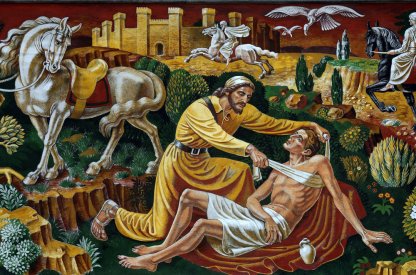
Now, look at what appears immediately before this account.  You’ll notice that Luke Good Samaritan.jpgplaces this historical narrative of Jesus’ visit at Mary and Martha’s house right after the famous “Good Samaritan Parable,” another passage given to us only by Luke.  You’ll likely recall that in the “Good Samaritan Parable,” Jesus teaches that we should do good works in service to our neighbors – and that our neighbor is in fact anyone who is in need – and that we are called to serve even when our service could be detrimental to our own physical well-being.  So the objection that Martha raises shouldn’t seem too startling if we had simply been reading straight through Luke’s Gospel, landing on this narrative immediately after reading the “Good Samaritan Parable.”  It appears as if Jesus is condoning the actions of Mary who is not serving and caring for her guests – not helping her sister.  It appears as if Martha’s objection to Jesus is valid… why isn’t Mary helping her sister serve their special guests?  But Jesus doesn’t rebuke and chastise Mary as Martha was expecting him to do… and why is that?

Trouble in the Text:

Let’s look at the text again and consider this in more detail – to see what the real trouble is in this text.

Jesus says, “One thing is necessary,” and indicates that Mary has chosen it – the “good portion.”  But doesn’t it seem that what Martha was doing was good and in fact it would appear to be necessary.  Jesus and his disciples just entered her village and they needed a place to rest…. and she invited them into her house.  They were likely hungry and needed something to eat.  I’m sure their sleeping arrangements would have had to be made somewhere in the village if not at Mary and Martha’s house.

It seems that Martha has a point!  Someone needs to cook.  Someone needs to get a seat for everyone.  Someone needs to clean everyone’s feet.  Someone needs to get everyone some water from their travels.  Someone needs to find a place for the guests to put their luggage – or to rest and feed their animals.  So if Martha didn’t do these things, when would they have been done?  Would they have been done at all, since Mary clearly had no movement towards helping her?

Should Martha have tested Jesus and put him in a position of snapping his miracle making fingers when it was time for such acts of service to necessarily be completed… so everyone… including Martha… could just chill and not do any of the hosting work – that is apparently not necessary?  [Long pause]

I don’t think Jesus ever snapped his fingers for a miracle to happen, but I think you get my point.  He’s the God-Man and he doesn’t need to be served by Martha at all.  She needs to be served by him.

What I’m pointing out here in this text is that what Martha did – serving Jesus and her other guests – wasn’t a bad thing to do.  As the host, she was fulfilling her calling – her vocation.  [Pause]

Martin Luther had a deep, worked out theology on vocations.  Here is a quote that is often attributed to him concerning our work:

What you do in your house is worth as much as if you did it up in heaven for our Lord God…”

According to Luther’s way of thinking, you might think that Martha was really outdoing everyone with her work.  She wasn’t simply doing work in her house that would be worth as much as if she were doing it up in heaven for our Lord, she really was doing work in her house – for the Lord – who was literally in her house! 

Luther’s quote continues though:

We should accustom ourselves to think of our position and work as sacred and well-pleasing to God, not on account of the position and work, but on account of the word and faith from which the obedience and the work flow.”

Here lies Martha’s trouble in choosing to do this good thing for Jesus.  Such service needs to flow from the Word of God and faith in the Word of God.   From this faith the work is to flow.  The text says that she was distracted from the serving.  What was she distracted from?  Jesus!  She was distracted from resting with Jesus by her serving.  And Jesus, being Jesus, knows her heart.  When she chastises him to spur him on to get her sister to work too – he knows that she is asking this because she is anxious and worried.  Here we see that even making a meal – even making a meal for Jesus – can be a life or death matter, if the work doesn’t flow from faith and if it keeps us from rest in Jesus.

Grace in the Text:

“So what does Jesus do when faced with someone who is doing the right things for the wrong reasons?”

He gives her grace.

God’s grace is in the rebuke Jesus gave to Martha.  It’s not often that we might consider a rebuke as containing God’s grace, but here you have to hear the heart position Jesus has towards Martha when he says these words.

Listen to this rebuke again and picture an empathetic Jesus:

“Martha, Martha, you are anxious and troubled about many things, but one thing is necessary. Mary has chosen the good portion, which will not be taken away from her.”

Did you hear the gentleness in Jesus’ voice?  Did you hear the concern he had for Martha’s well-being?

Jesus directly addresses Martha by name – twice!  This is a sign of his gentleness to her.

Mary and Martha 2.jpgThis should not be understood of as a harsh critique.  He does have compassion on her… she after all is working hard in service for him and others.  He is her guest.  She has opened her home to him.  And you can tell that Jesus sees her suffering.  He puts the words anxious and troubled to her work.   Even though her work is a good choice – it’s a good thing for her to be serving her guests, these important visitors to her village… but as a result of her heart position behind her work – one of anxiety, trouble, and even resentment against Mary for not helping and its seems against Jesus too for not correcting Mary –  Martha is missing out on what Jesus has to offer her.  This is far from a “get behind me Satan,” response that the Apostle Peter got when he had the gall to rebuke Jesus.  No… this is an invitation from Jesus to Martha to partake in the good portion with her sister Mary.

And what is this good portion?  In our text, when Jesus says, “One thing is necessary,” it might be better for us to understand it as Jesus saying, “There is need of one thing.”  That one thing we need is Jesus.  Jesus is the best portion of anything a person might have in this world.

Martha is making a meal, of which I’m sure she will have a portion, but Jesus is letting her know that Mary has chosen the better portion… him!  And with his compassion and his heart position to Mary, he expresses his understanding of her trouble, Jesus is welcoming her into the rest that Mary has received sitting at his feet that Martha has missed.

It is the type of rest that comes when we realize that Jesus’ heart is for us… his heart that so loved us that he set himself to Jerusalem to die on the cross for our sins, for our troubled and idolatrous hearts, that we might have forgiveness and that he might be with you.

This image of the Lord being the good portion is not a concept that is new in Jesus’ words to Martha.  To get a better grasp of Scripture’s explanation of the Lord being our portion, I’m going to read Psalm 16 to you.  It’s on page 546 of your pew Bible.

Keep me safe, my God,

    for in you I take refuge.

I say to the Lord, “You are my Lord;

    apart from you I have no good thing.”

I say of the holy people who are in the land,

    “They are the noble ones in whom is all my delight.”

Those who run after other gods will suffer more and more.

    I will not pour out libations of blood to such gods

    or take up their names on my lips.

Lord, you alone are my portion and my cup;

    you make my lot secure. 

The boundary lines have fallen for me in pleasant places;

    surely I have a delightful inheritance.

I will praise the Lord, who counsels me;

    even at night my heart instructs me.

I keep my eyes always on the Lord.

    With him at my right hand, I will not be shaken. 

Therefore, my heart is glad and my tongue rejoices;

    my body also will rest secure,

because you will not abandon me to the realm of the dead,

    nor will you let your faithful one see decay. 

You make known to me the path of life;

    you will fill me with joy in your presence,

    with eternal pleasures at your right hand.

In this Psalm, David calls the Lord his ONLY portion and his cup.  In the full context of this psalm, we see that this brings David security, gladness, and rest.

David says that apart from God he has no good thing, which indicates that every good thing he does have comes from the Lord!

This psalm features the juxtaposition between the person who seeks after other gods for refuge and himself as he seeks after the one true God.  Those who seek after other gods will suffer more and more, and the counsel from these false gods will lead those who listen to them and walk with them to ruin and decay.  Whereas, the counsel that comes from the Lord leads to life, a life that is even beyond the grave!

This rescue even from the grave is one that Martha will later experience firsthand through her brother Lazarus.  The Mary and Martha in Luke’s Gospel are the same sisters found in John chapter 11.  In John’s Gospel, their brother Lazarus has died, but they had sent for Jesus to heal him before his death.  Jesus waited to go to them and he arrived after Lazarus had been in the grave for four days.  And in that text, we hear Martha’s confession that Jesus is the Christ, the Son of God who has come into the world.  She says that with his words he can do anything.  And Jesus raises Martha’s brother back to life. He raises him even though he’s been dead for four days with his body reeking from decay.

Martha knew there was a resurrection of all the dead to come at the end of days, but she had no anticipation of experiencing a foretaste of this victory from the dead in her lifetime – through her brother’s death and resuscitation.

And Lazarus’ resuscitation was the foretaste of Jesus’ resurrection from the dead that was to come.  David was right!  God will not abandon his people to the realm of the dead.  He will not leave his people to decay.  He will not let his people face eternal death due to their sins – in Christ all sins are forgiven when Christ and his work are received in faith.

From John’s account of Martha’s interaction with Jesus, we see that she took his invitation to heart.  She is trusting in him to have the power over life and death – first to save Lazarus from death and later to raise Lazarus from death to life.  She has learned what Jesus meant when he said that there is one thing of need – it is him!  Jesus is the best portion of anything a person might have in this world.  A person might have a meal to support physical life, but no matter how many meals a person eats, another is always needed.  All such sustenance of this world will abandon us to the grave and to decay leaving us with the penalty of our sins, but Martha’s sin was forgiven at the cross and so is your sin.

Jesus is the “good portion” that will never be taken from us and he will not abandon us to the grave.

Trouble in the World:

In our day and age, the same temptation and struggle that weighed down on Martha presses against us too.  We have more things to do than what can be done in the hours of the day.  And all these important and even necessary things to get done vie against our time with Jesus and our rest in him.

This means that we need to have proper prioritization of our God-given vocations, which are really callings from God.  They are not just jobs that bring in a paycheck.  They are all the relational as well as job duties that God has called each and every one of us into. In all of these callings, the calling that Jesus gives us to abide in him and rest in him must be our first calling.  His presence is with us when we hear his Word… and when we are in fellowship with other believers centered on that Word… and when we walk in the waters of baptism in which we are buried and raised with Christ daily, as we turn from our sins and turn to Christ… and when we partake in the communal reception of his body and blood at the Lord’s Supper, in which we not only hear – but also taste the forgiveness of sins.  This invitation, this call to receive Jesus as the best portion above all things in this world… is above all other callings.

But this world presses in on us and distracts us from Jesus and his presence in our lives.  It might be easy to picture tragedies such as cancer, death, fires, natural disasters, divorce, loss of jobs, and such as the thorns that choke out the light of Christ, but these daily troubles and woes can be of the variety that Martha had and we all have when we are pressured to put other relational vocations above our calling to be in Christ so that we have no time in Christ’s presence at all.

We have many more distractions in the 21st century than the disciples from centuries before.  The many luxuries we have from technological advancement has only increased the number of hours that we work, because we are no longer limited to a small geographic work area or the hours of daylight of the sun.  Much of our work (well for many of us) is not as physically demanding as that of previous centuries, so our hours of work can increase too, which certainly takes a toll on our minds, emotions, and spirits, if not our bodies.  Our standard of living in America is very high… I imagine that most of us eat better than the kings from thousands of years ago… probably even better than the ones from centuries ago.  So our focus can easily fall to maintaining that high standard of living.  We can easily start to spin our wheels on material items that are solely of this temporal life.  I believe this is one reason why Jesus said it is very hard for a rich person to enter the kingdom of heaven.

In many families with children, both parents have full-time jobs, which means time with their kids is more limited due to household chores that must be met, such as laundry, grocery shopping, cleaning, and cooking.  As soon as the parents are off work, that work must start.  Their time with their kids and each other is more limited.  I’ve seen that for Millennials, though many have called this generation lazy and entitled, are people who have two to three part-time jobs or who have what they call a “side hustle” to make more income… and as a result of these factors our relationships and the vocational duties necessary within these relationships can easily take precedent over the one necessary relationship – which is with Jesus, our good portion.

For many kids in school today, the work load has increased drastically from how it was a couple of decades ago.  The curriculum in most schools keep expanding and the credential process for schools has become more extensive so more work is given to verify that the students are learning what they are supposed to learn.  Kids are now expected to have many extracurricular activities to stand out in college applications – many of which end up occurring on Sundays.  In addition to this, to keep up with the financial status of their peers, some teens are working part-time jobs to get the latest phone or the new pair of Jordans.

In all the hustle and bustle… we are like Martha, anxious and troubled and working towards good things in many instances but have missed the good portion of the Lord in our work, and often times we end up missing the loved ones in our lives. 

Grace in the World:

Jesus says don’t be worried or anxious about tomorrow.  Don’t worry about what you’re going to wear, or what you’re going to eat, or where you’re going to sleep.  Doesn’t God provide for the birds and the grass —- and how much more important and loved by God are you than birds and grass?

Jesus says that his yoke is easy and his burden is light.  He invites you to come to him – everyone who is heavy-burdened and that he will give you rest for your soul.

Jesus says I come not to be served, but to serve.

Jesus washes his disciples’ feet… not the other way around.

Jesus says abide in me, and you will bear fruit.  It’s a promise!  Abide in him, and you will bear fruit.

All of these sayings and actions of Christ are magnified and understood as reliable and true through his death on the cross for our sins and through his resurrection from the dead for our salvation.

This goes back to the Luther quote I previously shared.

We should accustom ourselves to think of our position and work as sacred and well-pleasing to God, not on account of the position and work, but on account of the word and faith from which the obedience and the work flow.”

Our good works should just flow from the faith that we have in Jesus.  When there is resentment, anxiety, and unnecessary stress present in our work – stop and ask… where is Jesus right now?  You are almost 100% likely to have been distracted from Jesus in these moments of labor.  It’s time to take a moment and refocus on Jesus and remember…

Jesus is the best portion of anything you have in this world, because it is in Jesus and Jesus alone that you will have eternal life.  It is in Jesus and Jesus alone that your works can have eternal merit. It is in Jesus and Jesus alone that your labors may be holy.

And knowing this… it’s imperative for us to find rest in Jesus daily.  We know that Jesus comes to us in his Word.  So daily, we need to find time to be in his Word, preferably throughout the day we will remain his Word.  I hope you don’t feel this invitation stop some of your vocational labors to be in God’s Word as an obligation that must be met for pleasing Jesus.  No.  This is for you.  Remember Jesus is the best portion of anything the world has to offer.

If you are not already resting with Jesus in his Word daily… it can be hard to conceive of how to even begin to put this into practice.  Putting aside earthly demands that seem all together necessary to be met for the day at hand can seem impossible.  If someone already doesn’t have time to watch TV due to their family and work demands, it can be hard to find what must be cut out of the schedule for simply resting in God’s Word and for quiet contemplative prayer.

A conversation I had in my last year of high school teaching before going to the seminary has helped me understand this conflict and it has forever changed the way I look at each day’s work.  I was running copies at the printer… and it wasn’t even jamming… but my principal stopped by me and just started preaching.  He said, “You know there is more than we can ever possibly do in a single day.  We can work every hour of the day and not get everything done that we need to get done.  So just don’t worry about doing it all. Just stop when you need to stop.  It’s OK.  You can’t do it all anyways.  It will be there for you tomorrow.”  I took that as my boss giving me permission to not respond to every email the day they come in – if it was going to take away from being with my family, if it was going to take away from being with Jesus.

Knowing that Jesus is the best portion of anything we can have in this world is a good start to having the right motivation to do this.  Just stop doing what you’re doing when you feel you need to stop… Because God never stops coming to you.  He promises to be with you in his word and speak his words to your needs.   When you feel you need rest.  Just stop something on your agenda. God is starting each day new with you.  Stop anything… if you’re missing Jesus in the things you’re doing.  We’ve already seen that it’s possible to miss Jesus when serving Jesus.

First, consider picking a verse with a promise from God within it that you can recite in a breath.  During the time it takes you to breathe in and then breathe out, you can recite that verse.  During those moments when you are stressed and feel anger or anxiety swelling up within you as you work… stop… breathe in and breathe out, saying that verse.

[Breathing in] God is my refuge

[Breathing out] and my strength.

That is just one example of a breath prayer.  That short breath focused on the Lord can reorient you to properly see your work in light of Christ so that your service might be holy… and that it might flow from faith in the Word.

A second idea to help set aside time to rest in Jesus is to carry a pocket Bible with you or having a Bible app on your phone can help you find the time to rest in the Lord.  When you are in the grocery store line to check out, instead of gawking at the tabloids, eyeing the candy, or swiping through your social media feed on your Smart phone, consider pulling out the Bible and reading a few verses and saying a prayer.  Such actions might even spark conversation in the line… or you might hear a word from the Lord that applies to your life and current situation and it might fill you with such joy and encouragement that not only will it change your mind from anger towards the idiot drivers in rush hour home… but it will give you a word from Jesus to share with your loved ones at the dinner table.  Bringing the eternal spiritual bread into your evening’s physical meal of bread.

When our vocational demands press against our time to worship on Sundays, we might have to get creative.

I’m reminded of the time I was placed in a teaching position in China that required me to work at nights and all day on Sundays, so that I could not attend any mid-week or Sunday church services.  At the time, getting out of this predicament wasn’t an option.  But a blessing is that I ended up reading my Bible more during this time of my life than ever before.  Since I didn’t have work in the mornings, I routinely took my Bible to a shop nearby my apartment and I read it Monday through Friday for an hour or longer while eating breakfast and drinking tea.  I would sometimes do this for lunch too.  When I saw people that I suspected were Christian, I always went out of my way to speak with them and I had many great encounters with fellow believers that year, and I believe I read the Bible more in that year than any other year of my life.

I’m reminded of the college student who worked every Sunday service and Sunday school time as a preschool supervisor.  She took great care of my daughter, Arabella, and the other young kids. I was worried for her, because I didn’t know if she was able to attend any services with this work schedule.  I knew that our church didn’t offer any other service times that she could attend.  So I asked her about this one day, and she told me that she still attended church, but she did so by finding a Saturday service.  Wonderful.

There are always moments to rest with Jesus, because he’s always there for us and he invites us to rest with him and partake in his love and compassion for us.  He truly is the best portion of anything a person can ever have in this world.  Amen.

Roman Catholicism on Justification by Grace Alone

A friend of yours who is a Roman Catholic asks you the following question: “When I hear descriptions of the Reformation, I usually hear that the distinctive feature of Lutheran theology is that we are justified by grace alone.  But my church also teaches that we are justified by grace alone.  So is there any real difference between us on this part?”

To be clear the Reformation distinction is more nuanced than just saying we are justified by grace alone.  The distinction is that we are justified by grace alone through faith alone in Christ alone and that we know all of this by Scripture alone.  The Calvinist reformers typically add that all of this is to the glory of God alone.  The word alone is spoken in all of these prepositional phrases to stress that our individual works, or merits, are completely void in our salvation.  Grace does not involve our works.  Faith is not our work.  Christ’s work alone is where our faith clings for salvation.

This is not what Rome means when Roman Catholics speak of being saved by grace alone.  For Rome, our works are still involved in our justification.

To demonstrate this point directly, one can look at the Council of Trent’s Cannons on Justification:

If any one saith, that by faith alone the impious is justified; in such wise as to mean, that nothing else is required to co-operate in order to the obtaining the grace of Justification, and that it is not in any way necessary, that he be prepared and disposed by the movement of his own will; let him be anathema” (Council of Trent, Canons on Justification, Canon 9).

And…

“If any one saith, that man is truly absolved from his sins and justified, because he assuredly believed himself absolved and justified; or, that no one is truly justified but he who believes himself justified; and that, by this faith alone, absolution and justification are effected; let him be anathema” (Canon 14).

Anathema is a very strong word.  It means accursed or eternally condemned.

Such statements reject the Reformation teaching that justification is completely void of our works.  A rewording of Canon 9 from the negative stance to the positive would state that “something else is required to co-operate in order to the obtaining the grace of Justification, and that this is in every way necessary.”  To my knowledge Rome never states directly that we are justified by grace and works, but such statements push one to such a conclusion.  To demonstrate in more detail how Rome teaches that our works are involved in justification, one only needs to look at the Catechism of the Catholic Church’s teaching on this doctrine:

Justification includes the remission of sins, sanctification, and the renewal of the inner man” (CCC, par. 2019).

“No one can merit the initial grace which is at the origin of conversion. Moved by the Holy Spirit, we can merit for ourselves and for others all the graces needed to attain eternal life, as well as necessary temporal goods” (CCC, par. 2027)

In the first quote from the CCC, it is plainly stated that justification includes not just the remission of sins, but also sanctification and the renewal of the inner man.  This definition of justification points us not to the work of Christ alone for our justification, but instead it turns us inward on ourselves.  How am I doing?  Am I progressing enough in sanctification?  Am I experiencing this inner renewal day by day?  When we are honest with ourselves and uphold the full instruction of God’s commands and demands for us, such an inner turn for our justification can only lead to despair.  Since in Rome’s definition of justification, the work of Christ alone and his righteousness are not the sole means by which we are justified, we lose all assurance, confidence, and certainty of salvation.  The second quote I provided from the CCC details this further with the clear words that “we can merit for ourselves and for others all the graces needed to attain eternal life.”  Merit by definition involves my works, and according to Rome, I am even capable of working to merit the graces necessary for the eternal life of others too!

These graces that I can merit are found in the seven Sacraments of the Roman Catholic Church: Baptism, Confirmation (or Chrismation), the Eucharist, Penance, the Anointing of the Sick, Holy Orders and Matrimony. Concerning the graces of these sacraments, the CCC states:

“The sacraments are efficacious signs of grace, instituted by Christ and entrusted to the Church, by which divine life is dispensed to us. The visible rites by which the sacraments are celebrated signify and make present the graces proper to each sacrament. They bear fruit in those who receive them with the required dispositions” (CCC, par. 1131).

Here the CCC stresses that to receive the graces proper to each sacrament one must receive them with the required dispositions – this again involves our merit, our work.

In Reformation theology, justification is the work of God alone.  Our work, or merit, or required disposition, is not a qualifier for our justification at all.  In Reformation theology, justification is instantaneous – at the moment of faith – a person is declared justified, declared righteous in God’s sight on account of Christ’s righteousness, though we are still sinful.  Sanctification in Reformation theology, unlike in Roman Catholic theology, is distinct from justification; in Reformation theology, it is not part of justification, but in Roman Catholic theology it is, as was previously quoted from the CCC.  Sanctification is a process, a life-long process of becoming less and less sinful, more and more like Christ and his image of perfect righteousness.  This process is not always a constant upward motion of increased holiness.  There are dips and valleys in this life-long process of sanctification, which is in Reformation theology is viewed as the process of becoming what we were already declared to be in justification.  This process is never complete this side of heaven.

This proper distinction of justification and sanctification in Reformation theology gives the person who has received God’s grace through faith the assurance and confidence that his or her sins are forgiven, because on account of Christ’s innocent, bitter suffering and death, that person is truly forgiven – instantly at the moment of faith.  In Roman Catholic theology, because there is no proper distinction between justification and sanctification, one cannot look to Christ’s saving work through his death and resurrection alone.  The person must look at their process of growing in holiness as the gauge of their justification.  Since the person will always have sin in his or her life and since God alone is the true judge of righteousness, the Roman Catholic who believes the doctrines of the papacy will have no assurance, no comfort, and no confidence of his or her eternal salvation.  This wreckage to our certainty of salvation is what inserting our work into justification always produces.