Luther’s “A Brief Instruction on what to Look for and Expect in the Gospels”

There is, besides, the still worse practice of regarding the gospels and epistles as law books that teach us what we are to do, and the works of Christ are pictured as nothing but examples to us.  Where these two erroneous notions remain in people’s hearts, neither the gospels nor the epistles may be read in a profitable or Christian manner; they remain as pagan as ever. – Martin Luther
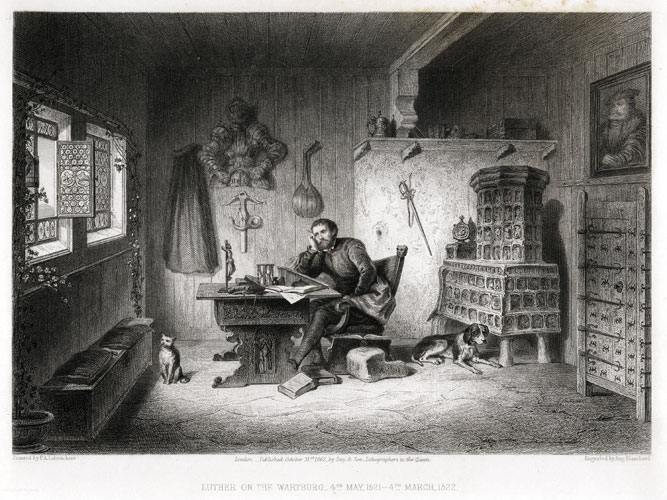
Luther Reading               The above quote serves as Luther’s closer to the opening paragraph of “A Brief Instruction on what to Look for and Expect in the Gospels,” which he wrote in 1522.  Luther was on the move to reforming the reading of the Scriptures.  After coming to no agreement with Rome over the indulgence controversy and finding himself excommunicated by Pope Leo X in 1521, it was now time for him to solidify the Reformation movement he had begun which involved teaching his followers (both laity and pastors) how to read the Bible and to proclaim the Gospel.  The proper reading and use of the Scriptures were paramount to freeing the Church from her “Babylonian Captivity.”  In this brief, yet instruction-packed unterricht, Luther explains how there is only one gospel, how we should see Christ coming to us in that gospel, and how all of the Scriptures are properly read and understood through the gospel!

Central to Christianity, central to the Reformation, is the message of salvation in Christ alone, that is the gospel, and as such, for Christians to know how to read and use the Scripture, Luther must first make it clear what the gospel is: “a discourse about Christ, that he is the Son of God and became a human being for us, that he died and was raised, that he has been established as a Lord over all things.”  In other words, the gospel is a story of Christ and all of who he is and what he has done for us sinful men.  With this definition Luther is letting us know that when we refer to Matthew, Mark, Luke, and John as gospels, we are not saying that there are four gospels, for there is one and only one message of salvation.  Even though the four biography writers give different details of the life of the Messiah, and in fact none of them give all of his words and miracles for us to read, there is still just one gospel.  From this definition of the gospel Luther stresses that the evangelion is not bound within or wholly formed from a compilation of these four canonical biographies of Christ – the good news is found in the epistles too!

When we see this message of Christ and his saving work for us men, Luther says that we should not see this work of Jesus of Nazareth as an example by which we are to live – to emulate – to work our ourselves!  No, we should primarily see the work of Christ as being for us.  You should see Christ for you.   This means that whenever you see Christ going somewhere, anywhere, speaking, teaching, healing, walking on water, raising Lazarus from the dead, whatever miracle or work of Christ you might see from any Biblical text, you should see yourself in that text – see Christ coming to you, to heal you, to teach you, to save you from sin, death, and the devil, to be your all-sufficient savior.

Next, Luther points the Church to the whole counsel of God’s Word, id est to the woefully neglected Old Testament scriptures.  All of Scripture testifies to Christ, and since Christ’s person and work is the gospel, Luther explains that the gospel as found in the four gospel biographies and the epistles serves as the guide to reading and understanding the Old Testament.  Here too, the prophets, in particular “Moses the law-giver,” are not examples of how one should live.  Their words should not be taken as a handbook on how to live your life; their words primarily reveal the gospel – reveal Christ, though it is not so clearly realized in most cases, until Christ was incarnate and revealed himself personally by stepping into history, before then sending the Holy Spirit to illuminate our understanding of the Scriptures after his ascension.  This means we should not forsake the diligent reading of the Old Testament, which so often we do in our day as the Church also did in Luther’s.  To emphasize the consequence of this error, Luther ends his instruction with the following statement: “What punishment ought God to inflict upon such stupid and perverse people! Since we abandoned his Scriptures [referring to the Old Testament], it is not surprising that he has abandoned us to the teaching of the pope and to human lies.”

In summary, Luther taught that when we read Scripture, we should expect to see the gospel in our reading, we should see the gospel as Christ working for us in all that we need, and that we should expect to see this work of God for us in all of the Scriptures that we read.

107. Godparents – What Are They For?

>> Click here to listen to the episode <<
(Right click and “save as” to download the episode.)

Or listen in iTunes!

Godparents 2


In this specially requested episode, Andy returns from a long hiatus with a Reconnect episode on the role of godparents in baptism and in the life of their godchildren. 


Show Links

Episode 70: Does Baptism Save You?

Episode 99: Lutheran Theology Part 4

“Does Baptism Save You?” by Andy Wrasman

“Means of Grace Questions” by Andy Wrasman

“What is Baptism?” by Andy Wrasman

Contradict Movement Video Production Donation

Martin Luther’s Reformation on Spirituality

martin-luther-stained-glass_SIFrom my experiences, when people speak of Luther’s reformation teachings in commemoration of his posting of the 95 theses on October 31st 1517, the focus is almost always on his rejection of the selling of indulgences for the forgiveness of sins.  Inevitably this leads to the “solas of the Reformation” – that one is justified by grace alone through faith alone in Christ alone[i] – being presented as the pistons that drove all of Luther’s reforming agenda.  This depiction of Luther’s reforming work that I have observed again and again in numerous Lutheran congregations every Reformation Sunday has led me to see Luther’s reformation work to be primarily focused on correcting false doctrine.  What I have just recently discovered however from reading Scott Hendrix’s article “Martin Luther’s Reformation of Spirituality” is that central to Luther’s reformation was not a mere correcting of false doctrine, but that the Reformation had an additional emphasis, if not primary emphasis, on reforming Christian spirituality.

Late medieval spirituality consisted of the selling of indulgences for the remission of sins.  In particular, a full indulgence gave the pardon of all of one’s temporal punishment for sins committed up until the issuance of the indulgence.  Partial indulgences could lessen, or shorten, the temporal punishments one would receive for his sins.  These indulgences were granted by the authority of the pope with the full indulgence coming solely through his auspices.  To acquire these indulgences a Christian would have to attend countless masses, take pilgrimages to relics and shrines of saints, give endless cycles of penance, dive full-length into all that monasticism had to offer, and of course fill the Church’s coffer with pecunias multas (lots of money).  Luther’s 95 Theses and the resultant doctrinal formations that followed his initial disputation for clarifying the power of indulgences[ii] led to a necessary forsaking of these false spiritual practices for an embrace of a true, authentic Christian life of spirituality.

At the heart of Luther’s reformation of spirituality was his spotlighting that the religiosity of the Church in the late medieval age was wholly of human creation and ordinance – thus not established by God in his revealed Word.  Such religious activities were, as such, adiaphora – neither commanded nor forbidden in Scripture – thus Luther would come to demonstrate that such self-elected works had no value whatsoever to contribute to one’s righteousness, one’s right-standing before and with Christ.  All the spiritual mumbo jumbo of man’s creation, no matter how Christianized it might be made to seem, will actually kill you physically and spiritually, and Luther knew and experienced this suicidal murdering of his body and soul first hand through his fervent devotion to the monastic lifestyle for twenty years.  Much in the same way that Paul claimed to be a Pharisee of Pharisees, Luther was a monk of monks!  Following the rules and edicts of men to attain eternal life, Luther discovered that they only lead to the ruin of his body and the unending torment of his conscious that knew he was still a sinner rightly deserving God’s righteous judgment.

The epiphany of the salvation in Christ that comes apart from the works of the believer that Luther found in Scripture and stood upon for his salvation didn’t eradicate all spirituality, all Christian living, it simply eradicated the false-spiritualties of the Church of his day, because Christ did give edicts of religious and spiritual activities to those who would follow him, and Luther was not rejecting these, namely, Christ’s commands to baptize, to proclaim the Gospel, to administer the sacrament[iii], to absolve the sins of the repentant and to retain sins and excommunicate the unrepentant, to suffer with Christ and for Christ, and to love and serve all people as Christ would have us to do.  Essentially, following Christ and not the pope was the new landscape of Christian living that Luther sought through his reformation work.  Christian living and spirituality is thus very much a Lutheran thing.

[i] Sometimes lists contain four or five solas instead of just the three I have provided with the additional two solas being Scripture alone and the glory of God alone.

[ii] Disputation for Clarifying the Power of Indulgences is the title given in the 1518 Basel reprint.

[iii] By sacrament, I am referring to communion.

How to Live as Creatures in God’s Creation

In the secular world of Hollywood and in the politics of the D.C. Beltway, environmental doom is not only very real, but very immanent.  Leonardo Dicaprio upon winning his first Oscar took the bulk of his speech time to virtue signal through lip service about the need to fight climate change – never mind his gas guzzling yacht exploits and private jet flights that astronomically raise his individual carbon footprint.[1] Alexandria Ocasio-Cortez, the freshman congregational starlet of the Democratic Party, boldly proclaimed that the world will end in 12 years from climate change if we don’t take drastic action now[2] – as proposed in her New Green Deal this state of emergency demands a rail system to be constructed in the next ten years that will make all plane flights unnecessary.[3]  Never mind that Al Gore made this same doomsday claim in 2006[4], while also personally raking in millions through his climate change politics, while at the same time, flying privately and using 20 times more electricity than the average American home.[5]  I could continue for days on the virtue signaling of the leaders from these two camps who cry that the world is ending while living in hypocritical opposition to their claims.  On the flipside, the Church has an entirely different response (from my experience) that is largely a complete disregard for creation, an approach that ignores the goodness of God’s creation in a poo-pooing of the physical material world in which we live and are a member (of which our Lord Christ became a member too through his Incarnation) to reduce Jesus’ saving work almost exclusively to the souls of men and not their entire personhood and the entirety of the creation that he loves.  In such respect… the Church in many ways has taken a “to hell with this world” approach to creation with the view of death as a final escape into goodness – regardless of the fact that we’d be missing our bodies!  Clearly these are two extremes, both of which tend to be hypocritical and inconsistent in their proclamations and living witness to those proclamations.

Into this fray, enter Norman Wirzba with his book, From Nature to Creation, and Jonathan R. Wilson with God’s Good World.  As Christians, their focus is on correcting the Church’s fall into a batch of Christian believers living as functional Gnostics, living as people who have lost our place in the proper Biblical perspective and appreciation of our creatureliness and our God-given role of participation in Christ’s work of redeeming all of creation.

Wirzba takes more of a philosophical and experiential approach to this end (goal) by recognizing that we have fallen into idolatry and have essentially deified ourselves or have deified creation, which he says has been able to happen wholesale in the Church through the Church’s embrace of modernity’s disconnecting impact between humanity with the rest of creation.  Such an impact has led even Christians to place their highest trust in the bedrocks of modernity, such as, “scientific reductionism, the autonomous self, instrumental reasoning, unencumbered individualism, technophilia, and the dis-embedding of communities from life-giving habitats.”[6]  To wake us up from this idolatry, Wirzba is advocating that we regain “an imagination for the world as created, sustained, and daily loved by God.”[7]  Essentially, his definition of imagination is getting to the point of being honest with ourselves that we are not the Lords of the universe that we pretend to be, but instead live as the lowly creatures we are.  As such, we need to be more patient and attentive to the world upon which we are dependently interconnected – which should lead us to see the world as a “gift” that we “need to “appreciate and affirm” and see it all as “a miracle that is itself an expression of divine love.”[8]  The process to regain this imagination is to recognize our idolization of nature, properly perceive nature as creation, not as nature, and then to practice the art of living a creaturely life, that finally leads to giving thanks to God, recognizing that “to be genuinely grateful is to experience the world as the place of God’s blessing and to participate in life’s fullness and abundance.”[9]

I like Wirzba’s approach.  Essentially, I’d sum up his main course of suggested action to be “get back to the dirt!”  From dirt we came, and dirt we still are, and form dirt all the animals created on Day Six came and still are too.  He words this connection as follows: “Respect for human bodies and respect for lands go together and are intimately tied to the understanding that soil and the many processes of life and death are sacred.”[10]  To do this, we need to all start gardens on some scale, any scale.  We need to get connected to our food sources – and if it’s not by some level of personal working involvement in that process – it’s getting connected to the local farmers who do the work for us.  Wirzba suggests that churches should use their land for “growing food and flowers for parishners and the community” and to use their kitchens for “teaching people the arts of preparing and preserving food grown with their own hands.”[11]  For the most part, Wirzba’s approach is operating under the assumption that we know the truth of creation and our place within it, but we’re not living it – we’re living the Satanic lie that we are each our own god.  We’ve all reduced creation down to nature, but if we can get into nature, get connected to it, we’ll begin to awaken to the awe of what nature really is – God’s creation.  This will point us to God and let us experience what we do confess but rarely live and practice – that we are creatures and that nature is really creation.

Wilson takes a different approach to the Church’s Gnosticism and idolatry problem.  Unlike Wirzba who points us to natural knowledge (what can be known about God and ourselves through what God has created), he makes us re-evaluate our doctrine of Creation derived from revealed knowledge – the knowledge directly handed us by God in his written word, the Bible, that tells us specifically who God is and who we are and what we are not – namely we not God.  He suggests that the solution to our current problem is to “emphasize the necessity of always keeping creation and redemption together in our thinking, teaching, and living.”[12]  He points out that one of our biggest errors in this respect is in our thinking that “we can address the many pressing issues of our times – the degradation of Earth, what it means to be human, the use of technology, and more – without a robust doctrine of creation grounded in witness to Christ.”[13]  When we do this it makes us more than what we are – it elevates us above the creatures that we are to put us in some sort of god-position – thinking we can fix the world and heal the world by our own devices.  But when our doctrine of creation is connected to Christ, we see that God became connected and one with his creation in Jesus of Nazareth, and in seeing this “coming together of God’s work of creation and redemption for life [in Jesus], our vision is directed forward to the new creation.”[14]  Without this proper doctrine of Christ redeeming and working to restore all of creation, our salvation narrative is diminished to looking forward to death and escaping the current world of ruin… how Gnostic of us!  Wilson does a good job of fighting the lies of Gnosticism and our idolatry with the truth of Scripture, honing in on the restoration and salvation of all things taught in Scripture with highlights of the creation narrative focusing on Revelation 21-22, Hebrews 1:1-3, Colossians 1:15-20, Romans 8, John 1:1-18, and a sprinkling of Scripture’s Wisdom literature.

I think Wirzba’s approach and Wilson’s approach go hand in hand.  Wilson’s approach of focusing on Scripture is focusing on the 2nd article and 3rd article work of God in the Apostles’ Creed of which we too play a role as the Church as the instruments by which God works to redeem creation.  Wirzba’s approach is to live in the 1st article gifts of the Creed – to embrace creation by being creatures.  Wilson’s approach is more “Right-Hand Kingdom,” Church work, preaching and distributing the sacraments.[15]  Wirzba’s focus is more “Left-Hand” Kingdom,” society and creation work, being a good neighbor, not just to our human neighbors, but all of our creaturely  neighbors as well, and to the land, the waters , and the vegetation that support the life of all living creatures of flesh and blood.

I think both of these books, working in tandem, have sparked in me an appreciation and thankfulness for the little things in life… the little things that I am interconnected with and dependent upon on in some way, some fashion.  For the first time, I rethought spiders… I didn’t kill the spider; I didn’t destroy his web.  The spider is one of my fellow creatures, and I thought, maybe it’s got a point in God’s design and care for me and all of creation for being right there, right on the guard railing of my steps.  I don’t know what exactly that might be – maybe a reduction in flies or mosquitoes, but for once, I let the spider live.  For once, I’m rethinking the gardening scheme.  It might cost me more financially and it might exhaust more of my labors to grow some herbs and vegetables, but it will bring about a better awareness of all the food I eat and the processes that went into getting each meal on my plate.  It might – I know it will – make me more appreciative.  With joy, I took a picture of a lovely leaf that my four-year-old daughter asked me to take – it looked like a butterfly, and in fact, every leaf on the tree looked like the shape of butterflies with open wings.  I wouldn’t have noticed it without her, and instead of being annoyed, I took pause, and enjoyed not just taking the photo, but looking at the leaves with her.  I took my one-year-old son to the zoo with a new intent – not just to entertain – but to love my fellow creatures and to be in awe of them and how God has created them.  I’ve looked closely at people… and I have marveled at the thought that out of the billions of people on this planet, God has made us all unique – even identical twins don’t have the same fingerprints.

To move forward with practical things that the Church can do for our bodies, for our houses and homes, for our gardens and yards, for our church buildings and schools, for our neighborhoods and communities, and for the whole of creation, the Commission on Theology and Church Relations of the Lutheran Church – Missouri Synod has prepared an excellent report called, Together with All Creatures: Caring for God’s Living Earth, with more than enough ideas to get us started in our local congregations on all of these fronts to do exactly what the title of the report says, “Care for all of God’s living earth.”

[1] https://www.forbes.com/sites/rrapier/2016/03/01/leonardo-dicaprios-carbon-footprint-is-much-higher-than-he-thinks/#599d71a82bd5

[2] https://thehill.com/policy/energy-environment/426353-ocasio-cortez-the-world-will-end-in-12-years-if-we-dont-address

[3] And recognizing the real danger, she knows we must stop cow fart emissions – https://www.npr.org/2019/02/07/691997301/rep-alexandria-ocasio-cortez-releases-green-new-deal-outline

[4] https://www.historyandheadlines.com/may-21-2011-10-times-people-predicted-the-end-of-the-world-and-were-wrong/

[5] Snopes claims it’s not as bad as the Tennessee Center for Policy Research reported.  Instead of 20 times the national average, Gore only used 12 times the national average.  However, Snopes has also been proven to be left-leaning.  https://www.snopes.com/fact-check/al-gores-energy-use/

[6] Wirzba, From Nature to Creation, p. 8.

[7] Ibd. p. 3.

[8] Ibd. p. 3-4.

[9] Ibd. p. 131.

[10] Ibd. p. 100.

[11] Ibd. p. 128.

[12] Wilson, God’s Good World, p. ix.

[13] Ibd. p. 50.

[14] Ibd. p. 53.

[15] He even ends Chapter 1, “Missing Creation in the Church”, with a call to recover the practice of baptism and the Eucharist.  Instead of referring to the sacraments as “the practice of” I’d rather say “the gifts of” and instead of “practicing them” I’d rather say “receiving them.”

3 Damaging Impacts of the Church’s Neglect of the Doctrine of Creation

The doctrine of creation is crucial for the Christian story in three ways: in the initial creation (God made everything that exists and it was very good), in the liberation of creation (Jesus came to redeem and save the world – that is all of creation that was utterly wrecked by the Fall of Man), and in the restoration/correction of creation at Christ’s return (God is making all things new! – Revelation 21:5).  Creation is a key component in the Christian story in the beginning, middle, and end. 

Revelation 21-5

I think this doctrine is neglected the most within the Church in our teachings concerning the final act of Christ’s full restoration of creation in which all things will be made new.  Having this doctrine intact radically changes the “salvation package.”  Often times because of the neglect of this doctrine in this key part of the Christian story of salvation, the presentation of the Christian message is relegated to the two-fold imputation of justification – the teaching so excellently explained in Bill Bright’s Four Spiritual Laws:

1.) God loves you and created you to know Him personally; 2.) Man is sinful and separated from God, so we cannot know Him personally or experience His love; 3.) Jesus Christ is God’s only provision for man’s sin. Through Him alone we can know God personally and experience God’s love; and 4.) We must individually receive Jesus Christ as Savior and Lord; then we can know God personally and experience His love.

As a Lutheran, I recognize that the individual reception of Christ is done through the work of the Holy Spirit (1 John 1:12-13), but other than that distinction, these “Four Spiritual Laws” pretty well summarize the way I have presented the Gospel to people – and as many other Lutherans I know have done as well – except that we, as well as many other Protestants, would add some little tidbit about when we die we’ll be with the Lord forever! End of story.  Yet the resurrection of the dead and the restoration of all creation at Christ’s return is the true end (or do I say beginning?) of the complete and final hope Christ has in-store for us! 

The neglect of not having a fully developed endgame of Christ’s return in view is damaging in three ways: it makes us think death is a good thing for the Christian, it leads Christians to function as Gnostics, and it diminishes the hope we have in Christ. 

First, it makes us think of death as our friend.  Even my four-year old daughter has picked up on this false-narrative.  She recently heard that someone’s grandmother died, and she immediately said, “Well death is good, because then we get to see Jesus.”  It’s true that we get to be with Christ when we die in faith, but that death is not good!  I’ve even emphasized the resurrection of the dead at Christ’s return with my young daughter, but she’s still picked up on this placating view of death.  Our spirit would be with Christ at death, but that’s not who we really are – we are body and spirit – and even at that moment of being with Christ though disembodied – much more is still wrong in the world that is not yet restored to its sinless glory.

Two – focusing almost exclusively on the salvation of the spirit, and not the full humanity of spirit and body, has in some ways led Christians to function as Gnostics – valuing the spiritual over and above the physical.  Obesity runs supreme in the Church (at least in some states or regions) and no one bats an eye about it – while we keep offering donuts as the “snack” at Church.  Online churches are now a thing – along with a special designated pastor who is called the Online Pastor.  We likely don’t think so much about the care of God’s creation either – one example – the number of chickens slammed into a shed with artificial light stacked on top of each other in in cages crapping on the ones below, getting vaccinated relentlessly against the new diseases that emerge from their environment, and if the chickens get to walk out on a concrete patio for some sparse minutes each day, they can be labeled as “free-range.”  Probably not the best stewardship of chickens and our source of eggs – in fact I know it is not, but I don’t really care, because I can get my eggs cheap!

Third, and finally, maybe most devastating is that we have lost sight of the greatness of the hope that we have in Christ, a full and total restoration of creation, a making of all things new again.  The good gifts of God in this life should be expected to be present in the world to come.  The things we love to do in this life that are good, we should expect to partake of them in some way in the life to come (most of them at least).  We’re going to be stewards of God’s re-creation – the new creation at Christ’s return that will be without sin, without curse, and with God visible and in direct relationship with us while we tend to what he has made.  What Jesus has in store for us at his return is so much more to live for than that cheap image of floating on a cloud with a harp or singing praise songs forever and a day in an eternal worships service that is so often pitched to us due to the woeful neglect of the doctrine of creation in our Christian story.


Be sure to visit Contradict Movement.