
One of your elders comes to you with a question about the Apology of the Augsburg Confession. “It says in Apology 13 that the sacraments are ‘signs and testimonies of God’s will towards us’ (AP 13.1). My Baptist friends say that the sacraments are symbols too. How is this any different?”

Elder John, I am glad that you are reading the confessions and mulling over their meaning. This is a very good question. I tend to forget the wording of that passage of the Apology of the Augsburg Confession. When a Baptist calls the sacraments signs, he means that the Body of Christ and the Blood of Christ are not actually present in communion, and that baptism does not forgive one’s sins or unite one to Christ or gives one new life and an adoption into the Kingdom of God.
I’m actually surprised that you’ve encountered Baptist friends who would even call baptism and communion as sacraments. They usually refer to the sacraments as ordinances, meaning that they are being obedient to Christ’s commands when they are baptized or take communion. When you ask a Baptist what baptism is the typical answer is that baptism is “his public commitment to be a follower of Christ.” When you ask a Baptist what communion is the typical answer is that communion is “a remembrance meal in which he remembers Christ’s suffering for him.” You can notice by these short explanations of what baptism and communion are to the Baptist that he views them as acts that he does, and he does them because Christ tells him to – hence the Baptists call them ordinances.
Lutherans however view the sacraments quite differently. We agree with the Baptists that they are instituted by Jesus. However, we see that they also have the promises of forgiveness of sins attached to them in Scripture – hence we call baptism and communion means of grace. They are ways in which God has promised to deliver grace to us. They are the promises of the Gospel connected to or with a visible and external element – in baptism it is the Word with the water and in communion the Word with the bread and wine. Because we have not striped the promises of God’s forgiveness and grace from the sacraments we trust that in baptism we are united with Christ in his death and resurrection and that in communion we are drinking not just bread and wine but also the very body and blood of Jesus Christ, literally tasting the forgiveness of sins as we eat and drink.
The confessions refer to the sacraments as signs, because of the promises God has given to us in the gracious gifts of baptism and communion. The physical elements and the words that accompany them are signs and witnesses of God’s will towards us. We know that is his will that no man perishes, but that all come to repentance and be saved. We see that in the waters of baptism that wash away our sins and unite us in Christ’s death and resurrection. We see that in the meal in which we eat his body broken for us and drink his blood shed for the forgiveness of all our sins. We believe these gifts are actually present and active in the sacraments trusting that the Holy Spirit is working through them to strengthen and preserve our faith and give us the assurance that we are saved.
The assurance that we have of salvation in the sacraments comes from the promises of the Word of God that accompanies the water, bread, and wine. Yet, the assurance also comes from the external and physical nature in which these promises come to us. We are physical people. Jesus came to save us physically. The Word became physical flesh. We are saved by the shedding of his physical blood. We are saved by his physical death and resurrection. God still comes to us today physically. He comes to us through physical water with the Word. He comes to us with physical bread and physical wine with the Word. It’s assuring to hear our sins are forgiven in the Gospel proclamation, but it’s also assuring to have our sins physically washed away and to be able to physically touch, taste, and smell the forgiveness of our sins.
We should feel sorrow for our Baptists brothers who have turned the gifts and gracious promises from Christ to his Church into works of the law and thus works of men. We should feel sorrow for them that they have nothing external that is from God to look to and to touch and to feel to know that they are forgiven. Because Baptists have denied monergism (that God alone works in salvation), they have involved their work in salvation – even if it is just the work of faith; it is a work that casts doubt on their assurance and certainty of salvation. Since faith is the work of men in Baptist’s theology, Baptists can be plagued with the questions: “Have I believed enough?” and “Do I have too many doubts to be saved?” To answer these internal questions, they have nowhere to look outside themselves for assurance of God’s “signs and testimonies of God’s will towards us.” So typically, they look to their external works for that assurance of faith, since Scripture promises that we will bear fruit in Christ… but we’re still sinners and we cannot accurately make such judgments without falling into self-righteousness or despair. Again, I say we should feel sorrow for our Baptist friends who have turned God’s gracious gifts in the sacraments into ordinances (commands that we must obey).
 Luke provides a historical narrative of the time Jesus was the guest in the home of two sisters. The lives of these two sisters are juxtaposed against one another in such a way as so as to lead the hearers to seek first the kingdom of God… by seeking rest in Jesus above all the immediate… and temporal… demands of each and every single day.
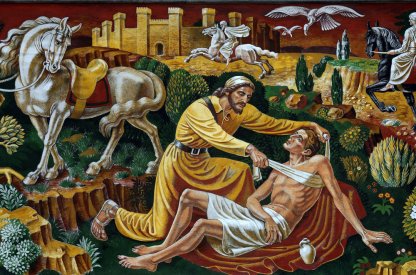 places this historical narrative of Jesus’ visit at Mary and Martha’s house right after the famous “Good Samaritan Parable,” another passage given to us only by Luke. You’ll likely recall that in the “Good Samaritan Parable,” Jesus teaches that we should do good works in service to our neighbors – and that our neighbor is in fact anyone who is in need – and that we are called to serve even when our service could be detrimental to our own physical well-being. So the objection that Martha raises shouldn’t seem too startling if we had simply been reading straight through Luke’s Gospel, landing on this narrative immediately after reading the “Good Samaritan Parable.” It appears as if Jesus is condoning the actions of Mary who is not serving and caring for her guests – not helping her sister. It appears as if Martha’s objection to Jesus is valid… why isn’t Mary helping her sister serve their special guests? But Jesus doesn’t rebuke and chastise Mary as Martha was expecting him to do… and why is that?
 This should not be understood of as a harsh critique. He does have compassion on her… she after all is working hard in service for him and others. He is her guest. She has opened her home to him. And you can tell that Jesus sees her suffering. He puts the words anxious and troubled to her work. Even though her work is a good choice – it’s a good thing for her to be serving her guests, these important visitors to her village… but as a result of her heart position behind her work – one of anxiety, trouble, and even resentment against Mary for not helping and its seems against Jesus too for not correcting Mary – Martha is missing out on what Jesus has to offer her. This is far from a “get behind me Satan,” response that the Apostle Peter got when he had the gall to rebuke Jesus. No… this is an invitation from Jesus to Martha to partake in the good portion with her sister Mary.
 Bill: Andy, I agree that Scripture teaches universal or general atonement, but I have a question about your statement that the Son of God died. Technically, the Son of God only died according to his human nature. Isn’t that right?
 Andy Wrasman