Reconnect Episode 1: Meet the Skeptic

Author of Meet the Skeptic: A Field Guide to Faith Conversations

I’m very grateful to Bill Foster for being the first guest on Reconnect.  When he agreed to be on the recorded interview, this was just a demo that I was recording for a radio show.  That radio show didn’t pan out, but I promised Bill that this recording would still be published.  Almost eight months later, this interview is finally being released.

I highly recommend Bill’s book, Meet the Skeptic.  It prepares Christians for faith conversations when speaking with skeptics.  The book covers four different types of skepticism as they will be encountered in conversation.  I can’t recommend it enough, and I hope that this interview will nudge you along to get Bill’s book, as well as get you geared up for kickstarting some faith conversations with your friends, co-workers, relatives, and neighbors.

Click here to listen to Episode 1: Meet the Skeptic. (Right click to save)

Listen on iTunes.
Please share this with all of your friends and family who will benefit from listening.  Also, please leave a review on iTunes, as well as subscribe to the channel there.  If I can get plenty of positive reviews and subscribers, it will help drive Reconnect into the new and noteworthy category on iTunes, which should generate more listeners for the show.  Thanks!

I’m also looking for a a fifteen to thirty second audio clip where you share what you learned from this episode, that I’ll add to a future episode.  Email such clips to andy@contradictmovement.org.  Again, thanks!

Subjective Morality – What is evil? What is good?

Dr. Evil memeIf morality is subjective, everyone would have their own opinion of what is good and what is evil.

The only possible absolute standard of morality is an eternal, good, and unchanging God. To have an absolute, objective standard of morality we must appeal to a standard above man. God is that standard and he has revealed that standard to us in Scripture. His Law is also written on our hearts.

Most atheists argue that there are objective standards that are derived from societal standards.  Societal standards however are not absolute. The consensus changes in each society and every society around the world won’t have the same consensus.  And technically, such a standard shouldn’t be considered objective, but subjective.

Ashes to Ashes and Dust to Dust. From Whence We Came We Shall Return.

Why do we put ashes on our foreheads on Ash Wednesday?

Ash Wednesday is the first day of Lent.

Lent is a season of the church year. It is a season of penitence. Penitence means remorse for wrongdoings, in this case our sin.   Lent is a preparatory season, which means we are preparing for Jesus’ death and resurrection.

ash-wednesday

The question then is, “why the ashes for repentance?”

This comes from the ancient biblical tradition of covering one’s head with ashes, wearing sackcloth, and fasting.

Let’s see this tradition made visible in scripture.

Daniel 9:1-6, 17-19

Jonah 3:1-10

Other parts of scripture also show this practice for penitence and mourning.

On Ash Wednesday the church carries on this ancient tradition of using ashes.

On Ash Wednesday churchgoers are marked on the forehead with a cross of ashes.

Symbolism of the ashes:

The ashes remind us that . .

– Death comes to everyone

– We should be sorry for our sins.

Where does this symbolism come from in Scripture?

Genesis 2:7

Genesis 3:1-5, 19

God made the first human being by breathing life into dust, and without God, human beings are nothing more than dust and ashes.

Genesis 18:27

In Conclusion, putting on ashes is a symbol of the death that we so rightly deserve because of our sin. The ashes are in the form of the cross because it reminds us that God in his mercy gave us his Son, Jesus, to take our sin and death and die in our place.

The people of Colossians 4:7-18

At the close of Paul’s letters he will often times send greetings to and from certain people and updates about others.  It’s easy to just skip these sections, but these farewell blessings and news bits are still considered Scripture, and thus are important.  Paul’s letter to the church in Colossae is one such epistle with a litany of names, places, and greetings.  Here’s a rundown of who these people are:

(First read Colossians 4:7-18)

Colossians 4:7 – Tychicus

His name comes from the Greek word, tygchanō, which means, “to hit the mark” or “to meet one”.  The word sin comes from the Greek, hamartanō, which means “to miss the mark”.  When we sin we are missing the mark of Christ’s righteous standard, his law. In Christ, God sees us as having “hit the mark” because Christ’s righteousness is our righteousness.

Paul describes Tychicus as a “beloved brother and faithful minister and fellow servant of the Lord.”  The word for minister in Greek is diakonos.  This word desribes “one who executes the commands of another, esp. of a master, a servant, attendant, minister”.  This word often times was used to describe the servant of a king.  For Paul and Tychicus, this servitude was under the kingship of Jesus Christ.  With this understanding of minister Tychicus was executing the commands of King Jesus as he delivered Paul’s letter to the church in Colossae.

Ephesians 6:21 -Tychicus was also the one who delivered Paul’s letter to Ephesus.

Acts 20:4 lets us us know that Tychicus was from Asia.

Colossians 4:9 – Onesimus

Onesimus accompanied Tychichus to Colossae.  He is called a “beloved brother” but he is not called a co-worker in Christ as Tychichus is because at the time Onesimus is a slave!

Philemon 8-11 – We learn that Onesimus is a slave from Paul’s letter to Philemon.  Philemon is a letter Paul wrote on behalf of Onesimus to his master, Philemon.  From this letter we learn that Onesimus was a runaway slave of Philemon, a believer.  After running away from Philemon, Onesimus becomes a Christian himself.  Onesimus means “useless” and Paul writes to Philemon saying that formerly he was literally useless!  Maybe he was useless because he ran away, or maybe he was a very poor slave.  Now Paul says that Onesimus is useful.

Colossians 4:10 – Aristarchus

Paul calls Aristarchus his “fellow prisoner”.  The etymology of the word for prisoner that is used in this verse comes from the Greek word, aichme, which means “spear”.  This indicates that Paul is viewing Aristarchus and himself as “prisoners of war”.  They are ones that have been taken!  Not just imprisoned.

Going back to the minister understanding mentioned with Tychicus, Paul and Aristarchus are servants charged with executing the commands of their king, Jesus Christ!  To capture a king’s ministers is an act of war.  This really is Paul’s mentality throughout his ministry.  The war language and theme run throughout his works.  I think it will serve us a great interest to approach everyday life in God’s Kingdom as being at war.  We are not at ease in this life.  Recognizing the constant state of war we find ourselves, we will be spurred on to follow Paul’s plea to put on the full armor of God as Paul commands us in Ephesians 6.

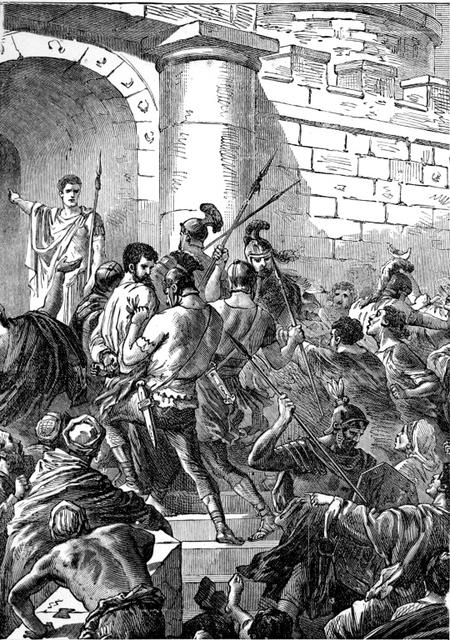
Acts 19:29 – Aristarchus was present at the riot at Ephesus and was dragged away by the mob.  Read the full account in Acts 19:21-41.

Aristarchus grabbed in the riot at Ephesus - Acts 19.
Aristarchus grabbed in the riot at Ephesus – Acts 19.

Colossians 4:11 – Jesus also called Justus

This verse is the only time that Justus is mentioned in the Bible.  We see from this verse that he was Jewish, as well as Aristarchus.

Colossians 4:12 – Epaphras

He’s mentioned in Colossians 1:7.  Since Paul says the church in Colossae learned the Gospel from Epaphras, he is most likely the church’s founder.

He is called one of them, so he is Colossian.

Paul says that Epaphras is always struggling on in his prayers on behalf of the Colossians.  This language still harkens to that of war.  His prayers are a struggle.  From such descriptions we can draw the often time used description, “Prayer Warrior”.

Colossians 4:14 – Luke and Demas

We read that Luke is a physician.  This Luke is the author of the Gospel of Luke.

Demas sends his greetings along with Luke, but in 2 Timothy 4:10, we learn that Demas deserted Paul.  Maybe he left the Christian faith, or maybe he just was afraid of sticking with Paul, afraid of imprisonment and death.

Colossians 4:15 – Nympha

This is a male or female name.  Some manuscripts say that the church at Laodicea met at “her house” and others say “his house.”

Colossians 4:17 – Archippus

He is mentioned in Philemon vs. 2.  There he is called a “fellow soldier” (again war language) and we learn that a church congregation met in his house.

From this study of the names at the end of Colossians, we can be encouraged to know that God has blessed and equipped the Body of Christ with a wide assortment of gifts, roles, and personalities.  We span different nations and language, yet we are united in Christ.  Some of us will own property that is useful for the church, as we will be generous enough to offer it.  Some of us will be in vocations like Luke, a physician, whose skills will be very useful within the Church and for our neighbors in the world.  Some of us will be like Justus, called to a people not our own.  Some of us might appear to be useless like Onesimus, but through Christ, we will be reworked into instruments for the Kingdom of God we will be useful, minsters and supporters to the leaders God has appointed within his Church.  Some of us will be prayer warriors.  We may not be on the front lines preaching the Gospel, but we might be constant anguish, praying for those who are.  Some of us might be prisoners of war, and all of us are co-workers and soldiers for Christ.  And thanks be to God, that through the person and work of Jesus Christ, we all are seen to have hit the mark, just like Tychicus’ name implies.  And may we be able “to meet others” as that name also implies and join them into Christ through the sharing of the Gospel of our risen King Jesus.   

Where is Jesus in Song of Songs 7:7-9?

I recently made the statement that virtually any topic or aspect of life can be connected to Christ and his saving work.  In reply I was challenged to show Christ in Song of Songs 7:7-9.  I do think adding imagery of Song of Songs 7:7-9 to this blog post would be a misstep, so I won’t add an image, but those two verses read:”Your stature is like a palm tree, and your breasts are like its clusters.  I say I will climb the palm tree and lay hold of its fruit.  Oh may your breasts be like clusters of the vine, and the scent of your breath like apples, and your mouth like the best wine.”

I accept the challenge.

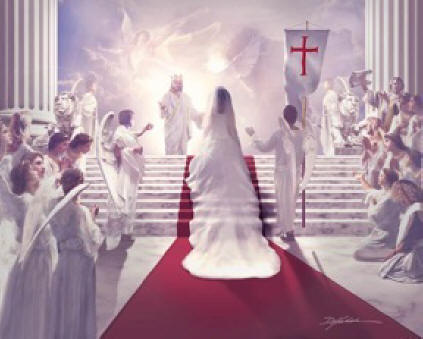
The institution of marriage points to the marriage of Christ with his Church.  The deep passion and love and longing to be with his bride that Solomon expressed points to the deep passion and love that Christ has for his bride, us.  Though we are apart he longs to embrace us.  Sexually?  No.  But as an object lesson, the sexual longing between a betrothed man and woman serves to show the deep desire we have, and likewise Christ has, to be reunited with us.  Israel is called the Bride of God in the OT and the Church is called the Bride of Christ in the NT.  That’s the route I would go to show Christ in Song of Songs 7:7-9.

Song of Songs 8:6 says, “Set me as a seal upon your heart, as a seal upon your arm, for love is strong as death, jealousy is fierce as the grave.  Its flashes are flashes of fire, the very flames of fire, the very flame of the Lord.”  Are we not beautiful to the Lord?  Has he not placed his seal upon us, put his name upon us?  Is he not a jealous God?  And does not his love defeat the grave?  And does his flame not destroy all that separates his Bride from him?

Song of Songs 8:7 says, “Many waters cannot quench love, neither can floods drown it.  If a man offered for love all the wealth of his house, he would be utterly despised.”  Christ is our ark!  The floods of baptism will not drown us.  They drown the sinful man, but not the new creation.  In Christ, we are wrapped up and protected, as a groom wraps up and protects his Bride.  The two are one and if it be true love, all the money in the world could not buy it.  So death cannot separate true love, and neither can money buy it.  All the riches in the world that Satan laid before Christ’s feet did not take him away from us, and the death he died did not take him away from us, instead it united us to him and the union possible, for he bought us, not with money, but with his very  life, his shed blood on the cross.  Solomon of all people, with all the riches and lovers a man could ever have in this world, should know better than all people that the stairway to heaven cannot be bought.  That store is closed.

Song of Songs demonstrates proper marital love, from which new physical life is born.  Interpreting this book as a depiction of Christ and the Church, we see how new spiritual life is born.

christ-and-his-bride