Samson is NOT a Biblical Parallel to Suicide Bombers!

A colleague approached me yesterday and said, “I have a good one for you.  What’s a Biblical parallel to suicide bombers?” He answered, “Samson.”

Intentionally committing suicide to kill those who are your enemies in recent decades has been almost exclusively associated with Islam.  Many are arguing that all forms of terroism have no role or place in true Islam, thus those who claim to be killing themselves to kill others in the name of Allah are not true Muslims.  I don’t want to address that topic, right now.  I did find a very good article post from Middle East Forum entitled, “The Religious Foundations of Suicide Bombers”, that I believe has done a very fine job of citing early Islamic theologians, the Qur’an, and the Hadiths to demonstrate why we are witnessing suicide attacks in the name of Allah.  I want to take the time to find all the citations and then write a post afterwards to show if I agree with the article after reading the citations. Without looking up all of the citations first hand, I think the Middle East Forum presents authoritative Islamic texts that Muslims can use to support terrorism and violent acts against non-Muslims. But that’s not the intent of this blog post.  I want to address the point that Samson is a Biblical example that parallels Islamic suicide bombers.  Is it justifiable to kill yourself if it is to kill those who are enemies of God?  If the Christian says no, how could we respond if someone raises the objection of Samson?

If you are unfamiliar with Samson’s life and death, it can be found in Judges 13-16.

Samson was the product of a miraculous conception.  (Judges 13:3)  His mother was told that he should be a Nazarite from birth!  (Judges 13:5)  A Nazarite vow entailed no drinking of alcohol or cutting of your hair from the time the vow was taken, hence, Samson never had his hair cut.  Samson is known for his superman strength.  Samson attributes his great strength to having been a Nazarite from birth.  (Judges 16:17)  Once his hair is cut, he loses his strength and is captured by the Philistines.  They gouged out his eyes!  (Judges 16:21)  The Philistines then gathered to offer a sacrifice to their god, Dagon.  They had Samson shackled and were entertained by his failure and misery.  Samson requested to be able to rest against the pillars that held up the roof of the courtyard.  3,000 Philistines were gathered, men, women, and children.  (Judges 16:27) Samson then said, “O Lord God, please remember me and please strengthen me only this once, O God, that I may be avenged on the Philistines for my two eyes.”  He then tore down the building by pushing on the two pillars that held up the roof.  Scripture says that he died there with them and that he killed more Philistines in his death than during his life.  (Judges 16:30)

Samson brings down the house, killing about 3,000 Philistines.

This passage of Scripture can certainly be troubling.  It means that God empowered Samson to kill not only himself, but also women and children.  He wasn’t just killing the men who captured him and took his eyes. There are answers to this moral conflict that fit within the Biblical worldview that can ease the tension we sense over this horrible calamity, but outside of the Christian worldview they likely won’t satisfy, and even within the Christian worldview, we may not be satisfied.  There are also some very clear ways in which this event is far different from God giving his approval on such acts as suicide bombing!

1st – Samson was a judge over Israel, the people of God.  The position he had was appointed by God.  Justice needed to be served.  The false god and the temple of the Philistines should not prevail against the real God of the universe.  Samson prayed to the Lord and asked for vindication against the enemies of God, and he was willing to offer his own life in the process.  His death was not a self-righteous vindication either.  He was laying his life down for the good of God’s people, that they  might be spared from their enemies, even if it cost him his own life.

2nd – Samson’s strength always came from God.  He attributed it to his long hair and vow, but in his final prayer, he is acknowledging that his strength was from the Lord.  Scripture says that the Philistines were entertained by the spectacle of their enemy, Samson, captured and blinded.  How were they entertained, unless they were laughing and mocking him?  They likely were calling on him to save himself, to perform a great act of strength as he had done before, many times in his life.  Since he was a judge, a representative of God, the Philistines in the house of Dagon were thus mocking and challenging the one true God.  Foreshadowing and pointing to Jesus’ death, Samson gave his life to put an end to the enemies of God.  Jesus Christ, when he was mocked, delivered a death blow to sin, death, and the devil, and reconciled all of humanity back into a relight relationship with God through the shedding of his own blood. 

3rd – Samson’s death was far different from that of a suicide bomber.  Samson was captured, his eyes had been taken, he was shackled, and he was likely going to be put death.  The taking of his own life was clearly done through supernatural powers given by the Lord that he directly prayed to for help for vengeance against his enemies.  A suicide bomber on the other hand is not doing anything supernatural.  Bombs are not supernatural, thus cannot be confirmed to be approved by God.  Suicide bombers have not been captured, they have not been tortured, and they are not being held captive and mocked in an act of worship towards the god of their enemies. Suicide bombers are not God’s chosen representatives of his judgment amongst his people.

4th – From the Biblical worldview, all life comes from God and it is his to give or take.  All humans die as punishment for our sin (man, woman, or child).  When and how death shall come is a matter left to God.  When suicide bombers take their own lives and the lives of the innocent, it means that God has allowed the evil action to occur.  It does not mean that he ordains it to be good.  Samson’s sacrificial death brought glory to God and confirmed to all the remaining Philistines that the God of Israel is real and he is not to be mocked!  The death of the Philistines quite possibly led to others in their community to repent and be brought to saving faith in the one true Lord, turning from Dagon  The hope that we have from the Bible is that no matter what occurs, God will work through all situations for the good of his people who love him. (Romans 8:28)

Many Different Contradict Stickers – Which is the best?

Contradict Movement was born through weekly evangelism outings at University California Irvine (UCI).  Our method of engaging in conversation was to setup a folding table with a few camping chairs at UCI’s Freedom of Speech Zone. We’d have some Starbuck coffee in a “traveler” with creams, sugar, cups, and stir sticks.  We would then use various signs and posters laying on the table or taped to the front of the table that were designed to spark conversation that would allow us to introduce the Gospel.  One night, Adam Stetson, suggested creating a poster that spelled Contradict using religious symbols.  That idea profoundly struck me as the best idea I had ever heard.  It’s a perfect conversation starter: “All religions can’t be true because they contradict each other in their teachings.  Logically, they could all be false, but how would we know that?”  We then could spring into why we believe Christianity to be true!

Upon returning home, I instantly searched for Contradict bumper sticker online.  The following are the two images that I found online:

Image #1: This Contradict image doesn’t strictly use religious symbols and it has no tagline of explanation.

Contradict Bumper Sticker
This was the first Contradict image that I found. And if my memory serves me correctly, this was the image that I used to print off a little sign to use on our coffee table evangelism outings at UCI.

Image #2: This Contradict image was also online at the time and being sold by someone who clearly wasn’t Christian.  The tagline really makes no sense!  I think the sticker is calling for us to go against all religions because all religions are just forms of social slavery.

Contradict Sticker
The other Contradict image that I found online around 2009-10 for use in evangelism. I believe I did print this one for evangelism, but I had to cut out the tagline.

After using these two as small printed pages on the top of the table, Adam had a friend paint an original Contradict design on a poster to tape to the front of the table.  Once we had that poster, Contradict became are constant (only) go to sign for kickstarting evangelism conversations.

After a couple of year at UCI, I wanted to write a book laying out the Contradict message I would share with someone from start to finish, if they gave me five hours of their time.  I also I wanted the book to serve as a tool to help spur others onto college campus and public spaces with a similar approach to evangelism.  To help raise awareness for the book, I wanted to create bumper stickers and a website.  If I was to sell bumper stickers and sell a Contradict design on the front cover a book, I’d need to own the copyright of the image, those I sat down and made a list of religious symbols I would use to spell Contradict and I hired a friend, Danny Martinez, to put it together for me.  I own the copyright and now I also own the trademark to the Contradict Movement logo:

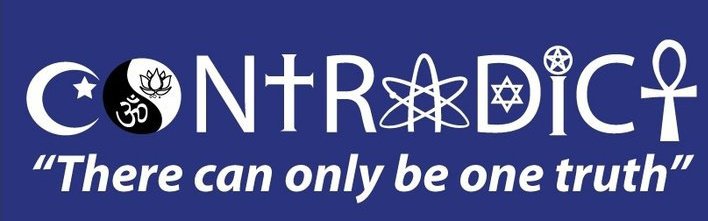
Image #3: The Contradict Movement version of Contradict!

Contradict Sticker
You can order these stickers with a black background or a white background at http://www.contradictmovement.org. I also offer tracts and my book, Contradict – They Can’t All Be True, at the website.  Click the image to go to Contradict Movement.

At the time I launched Contradict Movement as a website, I saw that another Contradict image had emerged:

Image #4: That I could tell the person who made this image was Christian and had a Facebook page named Contradict, but no stickers of this image were being sold.  Later, Cross Examined, started to sell this image with the same tagline with their website url on it.  I don’t think Cross Examined sells this image anymore.

I don't like this tagline as well as mine, but I do really like the design.  I still prefer my design though, because all the letters in this one are not religious symbols.
I don’t like this tagline as well as mine, but I do really like the design. I still prefer my design though, because all the letters in this one are not religious symbols.

Recently, I checked online and I have seen that numerous other Contradict designs have been created and they are now being sold online as bumper stickers!   Here they are:

Image # 5: This was the first obviously Christian Contradict image I saw being sold online (besides the Cross Examined one I mentioned above that is now no longer being sold at the Cross Examined store, Impact Apologetics).  This one is being sold on Zazzle.

I really like this design!  The tagline is good too. It's a shout out to John 14:6, the same verse that I simply cited.
I really like this design! The tagline is good too. It’s a shout out to John 14:6, the same verse that I simply cited.

Image # 6: Here’s a variation of the one above that is also being sold on Zazzle.

I prefer the one with the bubble letters behind the symbols.

Image #7: This is the current Cross Examined Contradict image being sold through their Impact Apologetics online store.

I really like this design.  I think the R with Kokopelli is very creative.
I really like this design. I think the R with Kokopelli is very creative.

I suspect that the clearly Christian Contradict images created after I launched Contradict Movement were working off my Contradict image.  I suggest this because the common theme is the Shinto torri gate for the letter N, but I could be wrong!  They might not have seen my image first.

Two questions:

1.  Which Contradict tagline do you think is the best? 

“They Can’t All Be True – John 14:6”
“Only 1 is Truth, Life eternal, and the Way”
“Don’t be a Contradiction.  There can only be ONE Truth.” 

2.  Which sticker do you think would be the one best suited to go platinum, “Coexist status”, and why? 

If you think it should be mine, please, share http://www.contradictmovement.org with all your friends and family.  Order extra stickers and help distribute them.

Here’s why I think my sticker is best situated for sharing the Gospel!  It has the url to my website, big and clear for people to visit.  The home page has a video that details the message of Contradict by sharing the importance of Coexistence and Tolerance, while also sharing that Tolerance can’t be taken to mean that all religions are true.  I then share examples of religious contradictions and close by sharing the Gospel and why we can trust that Jesus is the Way, the Truth, and the Life.  From a stand alone point of view, the one with the tagline, “Only 1 is Truth, Life Eternal, and the Way” clearly shows a Christian message.  The Cross Examined tagline, “Don’t be a Contradiction, There can only be ONE Truth”, does not clearly demonstrate that it is a Christian bumper sticker, however, the name of their website’s url does indicate this.  When visiting their website though, you are not instantly greeted with the message of their Contradict sticker.  With my tagline, “They Can’t All Be True – John 14:6”, interested parties could be forced to go to a Bible and look up John 14:6 to know why all religions can’t be true.  If interested parties go to Contradict Movement, they will only find links to my blog, the Contradict Facebook page, my Youtube channel, and my book.  All of these sites are very much Contradict themed!

Every sticker I sell comes with a Contradict folding tract as well as a printed page of explanation.  The goal is that if anyone is interested in knowing more about the message of Contradict when seeing a person’s sticker, the Christian has something to hand interested parties on the spot.  It has been my experience that when people are caught starting at your Contradict sticker, they usually don’t want to talk long in the parking lot.

If you do appreciate my work with Contradict Movement, help share my image online and through print.  Right now, images to my page do not always display as prominently as these others, so people may not find my page.  Cross Examined is way more known and popular than Contradict Movement, my blog, or my book.  If their sticker takes off and becomes the one everyone sees and knows, that’s great, because they certainly proclaim the Gospel and do a great job defending it, but if you think the Contradict Movement platform is better due to more specialized focus, again, share Contradict Movement with everyone you know by selecting some key blog articles, Youtube videos, or Facebook posts that you find helpful for sharing the Good News of Jesus Christ.

Thanks so much!

Peace in Christ,
Andy Wrasman

Seeing Christ in Your Christmas

There are many simple ways to see Christ in Christmas. One way to accomplish this goal is by drawing Biblical parallels with the traditional Christmas tree décor.   As long as Christians are not glorifying pagan beliefs and practices, or bowing at the altar of gluttonous consumerism through our American Christmas tree traditions, then there is freedom in Christ to take what has become a hallmark of the secular world at the time we celebrate the birth of our Lord, and point it all back to Jesus being the reason for the season. With no plea to reject Black Friday shopping as the day to get your Christmas season started off on the right foot, and with no “Bah Humbug” towards the secular spirit of Christmas, here’s a list to check twice to see Christ this Christmas.

The Christmas tree is an evergreen tree, because it doesn’t lose its needles through the winter. Using this type of tree points to the eternal life that Jesus Christ offers to the world. Jesus is the one who was, and is, and is to come! (Revelation 4:8). The Christmas tree also harkens us back to the tree upon which Christ was slain, the tree by which eternal life has been given to the world. (Galatians 3:13)
Christmas treeThe traditional tree toppers – a bow, an angel, or a star – all point to the Christmas tree representing Jesus. Bows adorn gifts, and the coming of Christ into the world is a reminder that the Father gave Jesus as a gift out of his great love for us. (John 3:16) At Jesus’ birth, Luke records a great multitude of angels proclaiming the Good News of his arrival to shepherds who watched over their flock at night. (Luke 2:8-18) Matthew tells of wise men travelling from the east, following a star to the birth place of the awaited Messiah (Hebrew for Christ). (Micah 5:2, Matthew 2:1-12)

The wise men from the east, who followed the star of Christ, brought gifts of gold, frankincense, and myrrh, valuable gifts that were common to give to a king. If the Christmas tree is seen to represent Christ, the gifts at the foot of the tree draw us back to the gifts the wise men laid before baby Jesus as they worshipped him. (Matthew 2:11) Our gift giving at Christmas should serve to remind us that as we give to others who are in need, we are giving to Jesus. (Matthew 25:34-40) And if the gifts at the tree are seen to have come from Santa Claus, an all-knowing, all-loving, apparently all-powerful, and never dying father-figure who cares for children, it should point us to the true gift-giver, God our heavenly Father. (James 1:17)

The lights that are held up by being draped across the Christmas tree’s branches are a final touch that point back to Christians, the Church. John begins his Gospel biography of Christ by saying that in Jesus “was life, and the life was the light of men” (John 1:4, ESV). The light of Jesus shines in the darkness of this sin cursed world. (John 1:5) The light of Jesus enlightens men as to who God is. (John 1:9) Later in his Gospel, John directly quotes Jesus as having said, “I am the light of the world. Whoever follows me will not walk in darkness, but will have the light of life” (John 8:12). As Christians know the Lord through Jesus, and possess eternal life and the light of Christ, we become just what Jesus calls us in his Sermon on the Mount, “the light of the world” (Matthew 5:14).

When we look at the Christmas tree, we are reminded that Jesus became flesh and dwelt among us. The Light of the World has revealed himself, lighting the path to eternal life. As Christians are connected to Christ, we shine the light of Christ into a fallen world. The Church that is spread out across the world, and is still growing, shines as many dispersed beacons of hope in a fallen and depraved world. Jesus came, died for our sins, rose for our salvation, and is patiently waiting for more to come to know of his love and grace.

This Christmas, remember that Jesus came once with angels and with a star as the ultimate gift of God to this world, and Jesus will come again; this time with the entire heavenly host with the falling of all the stars as he returns for his chosen and holy people. Let’s help the world see Christ this December, as we hold out the Good News of Jesus Christ in all that we say and all that we do in our Christmas celebration.

Flood Narratives Around the World

This post is really just for me for future reference:

I have been searching a bit this morning on the flood stories that are found around the world from ancient days, and I found the following page that contained numerous of these stories: http://www.talkorigins.org/faqs/flood-myths.html  I have only focused on the Chinese ones so far.  One of them mentions a rainbow!

The following site is really neat, and it certainly appears to be from a  Christian source: http://www.nwcreation.net/noahlegends.html  It mentions the Chinese flood story that I was trying to find that I had heard once before that has a strong parallel to the Noah flood of the Bible, but the Talk Origins site I cited earlier claims that it’s not from China, but America: http://www.talkorigins.org/indexcc/CG/CG202_2.html  I wonder if it’s an example of Christians making connections to prove Christianity that are not actually there, in the similar way that atheists take Horus and other pagan gods and try to make them fit the Christian narrative in an attempt to disprove Christianity.

The rabbit trails certainly can run deep on all the many topics we can find in God’s Word.  I am certain we will never be able to plumb the depths of what God has revealed to us in this life time, but for those of us who are in Christ, we will get to look forward to trying to do so in the eternity we will get to share with Him.

Jesus’ Home in Capernaum!

Mark 2:1-2 – “And when he returned to Capernaum after some days, it was reported that he was at home. And many were gathered together, so that there was no more room, not even at the door.  And he was preaching the word to them.”  (ESV)

I hope you know the rest of this account.  Four men bring their paralyzed friend to the house to be healed, and since they couldn’t get into the house because of the crowd, they tore a hole through the roof of the house and lowered their friend into the packed home, that was likely experiencing a standing room only affair if there wasn’t even room at the door!  Jesus of course heals the man.

Here’s what stood out to me the last time I read this account – Mark says that Jesus returned to Capernaum and that Jesus was reported to be at his home. I for some reason never caught on that Jesus had a home in Capernaum!  Flip over to Matthew chapter 9 and you’ll see that Jesus went from casting out demons from two men in the country of the Gadarenes to crossing back over the sea “to his own city.”  His own city” in this case wasn’t Nazareth; it was Capernaum.  Matthew doesn’t say that there were four men who brought the paralytic to Jesus to be healed, and he doesn’t mention that they had to tear a hole through a ceiling to lower their friend into the home to get healed by Jesus.  But what Matthew does say about Capernaum earlier in his Gospel in chapter 4 is entirely new to me.  Matthew 4:13 says, “And leaving Nazareth he went and lived in Capernaum by the sea, in the territory of Zebulun and Naphtali, who that what was spoken by the prophet Isaiah might be fulfilled: “The land of Zebulun and the land of Naphtali, the way of the sea, beyond the Jordan, Galilee of the Gentiles – the people dwelling in darkness have seen a great light, and for those dwelling in the region and shadow of death, on them a light has dawned.” 

Isaiah prophesied about Capernaum.   This land was occupied by two of Israel’s 12 tribes.  The Assyrian army had marched through this land, conquering it.  It certainly would have been a place scarred with war, a people dwelling in darkness with the shadow of death from the past laid upon its inhabitants. But as Isaiah foretold, a great light would shine upon it.  Jesus was that great light. This was the hometown of Peter (Matthew 8:14) and the town in which Matthew collected taxes (Matthew 9:9). And Jesus called them to be two of his apostles.  And by by making his base of operations in between missions trips Capernaum, the land of the Gentiles, he was showing his desire to save all people, to bring together the Jews and the Gentiles under one house in his kingdom.

Mark says that Jesus was in his home.  And Matthew says that Jesus was in his city.

So whose house did these four amigos tear a hole in to have their friend healed?  Jesus’ roof!  I never knew that.  This shows that these men had some mighty strong faith to tear a hole in the ceiling of the guy’s house they were hoping would heal their friend.  It also shows that they knew Jesus’ heart – he put people before his physical belongings.

This event is also when Jesus made it known that he was equal to the Father in divinity by forgiving the man’s sins.  The miracle of the man walking confirmed the authority that he had to absolve sins.

Matthew 9:8 records that when the crowds saw the miracle “they were afraid, and they glorified God, who had given such authority to men.”  This is the same response that Peter had when he witnessed the miraculous catch of fish in his boat.  He was afraid and calling Jesus Lord he asked him to get away from him, since Peter knew he was a sinful man.  Jesus however consoled him and told him that he would now be catching men instead of fish. When we encounter the hand of God, as sinful men, it brings us to tremble.  Here in Capernaum, the people glorified God in that fear.  The Gadarenes who witnessed Jesus cast out the demons into a herd of pigs, responded by begging Jesus to leave.

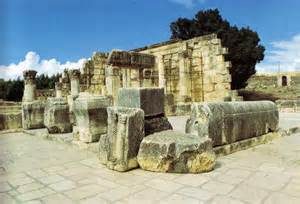
Capernaum is modern day Tel Hum.

Ruins at Capernaum (Modern Day Tel Hum)

Visit www.contradictmovement.org and get a sticker, tracts, or my book!  Thanks.