Why is Contradict a movement?

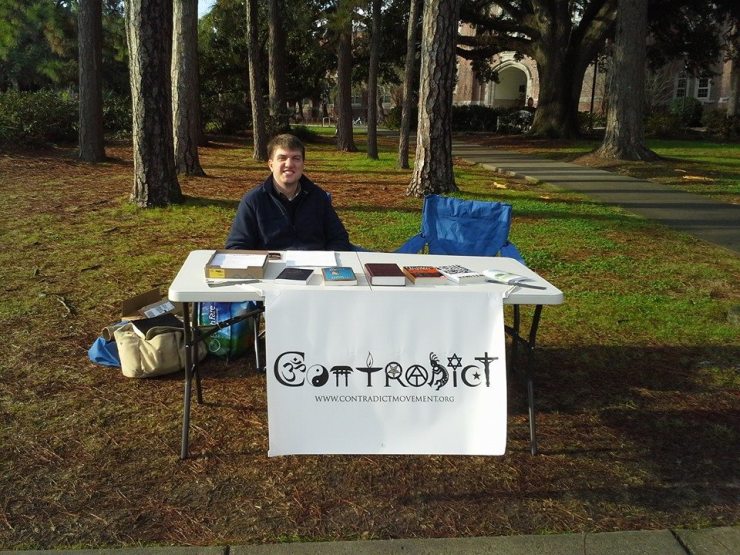
Dan Palmere at FSU
Dan Palmere at Florida State University, sharing the Gospel using a Contradict poster. He is a member of the campus’ Ratio Christi club.

When I decided to begin sharing Contradict with a broader audience than tabletop evangelism, I chose to start a Web site with the name Contradict Movement. Calling trends, fads, and new tendencies “movements” seems to be a popular development of its own lately. I think that what I’d like to see happen is for Contradict to spread, classifying as a movement in the tradition sense of organizing and rallying the troops behind a cause of action or expression. In a way I was jumping on the movement-branding bandwagon, but I have a dual meaning in mind.

I intend the term Contradict Movement to refer to the movement of the Holy Spirit as he leads Christians to share the good news of Jesus Christ. Jesus indicates this unpredictable movement of the Holy Spirit in his often-quoted discourse to Nicodemus in John chapter 3, saying, “The wind blows wherever it pleases. You hear its sound, but you cannot tell where it comes from or where it is going. So it is with everyone born of the Spirit” (verse 8).

With this in mind, each Christian reading this book will likely be prompted to share the gospel with others in ways that I haven’t yet perceived. Maybe some readers will be moved to step directly into the manner in which I have shared Contradict, using a poster at a college campus. The objective of the Contradict Movement is to counter the spirit of this age that all religions are equally valid and true, that all roads and paths lead to God.

It is more specific than this, however. A conservative Muslim could easily stand alongside a conservative Christian and boldly proclaim, “We worship a different God.” Grounded in the Christian worldview, my goal is to move people not only to see that all religions can’t be true, but to point them to Jesus Christ as mankind’s one and only, all-sufficient Savior. Then I want to prayerfully and winsomely reason with them in the various marketplaces of life to which God has called each Christian to serve and be his witnesses.

To participate in this movement, a person is not required to use the Contradict logo I have made. Many people are likely participating in this movement already without having seen Contradict; in fact I think this movement goes all the way back to the beginning of humanity. God’s people have always stood in opposition to the patterns of this world which lure us to exchange the truth of God for a lie, enticing us to bow down to the things of God’s creation rather than worship and praise the Creator.

It is not surprising that the lies of pluralism have infiltrated the ranks of the visible church. Jesus indicated that this would happen with his parable of the wheat and the weeds (Matthew 13:24–30). Lies, the Enemy, and people who claim to be followers of Christ but are not will spring up within Christ’s church (Matthew 13:36–43).

You can see Satan’s sowing of lies within the church in the way that a large percentage of Christians in America have embraced certain New Age elements within their Christian beliefs and practices. With the lie swallowed and craved by society and even within the church, taking a stance in our pluralistic age will receive harsh criticism. This is what Jesus promised would happen. He said, “Brother will betray brother to death, and a father his child. Children will rebel against their parents and have them put to death. All men will hate you because of me, but he who stands firm to the end will be saved” (Mark 13:13).

Everyone in the church won’t stand firm. Jesus promised this too. He said that when persecution comes, “many will turn away from the faith and will betray many people” (Matthew 24:10). This is why those of us who are standing upon Christ, pointing to Jesus as the only way to salvation, must band together, meet with one another, and encourage each other as we see the signs of the day of the Lord approaching (Hebrews 10:25).

Click this image to get 25% of my book, Contradict - They Can't All Be True, for Free!
Click this image to get 25% of my book, Contradict – They Can’t All Be True, for Free!

Jay Smith – Comparing the Bible and the Qur’an

I recently attended the Vertias Evangelical Seminary National Apologetics Conference 2014 at Calvary Chapel, Costa Mesa (technically Santa Ana), CA.

Jay Smith

One, Jay Smith spoke, comparing the Qur’an to the Bible.  Here are some notes that I pulled from the Veritas conference page:

The Qur’an is not narrative. There is no beginning, no end. It is not a book for Muslims to study, but to memorize. This is the book they do not question; it is above criticism. It’s a capital offense to criticism it in certain countries; penalty is seven years imprisonment.

The radicals have read the Qur’an, they trust it. Don’t we Christians do the same thing? We read our Bible, we trust it? Don’t we start from the same paradigm? We are uniquely positioned to reach Muslims.

Radical Muslims force Christians to convert, pay the tax or die. This is based on the Qur’an.

We are the only ones that can confront their ideology. The government cannot do this. In order to confront violence, we have to confront the Qur’an. When you compare, there is simply no comparison with the Bible.

Muslims always say the Bible has been corrupted. I always ask 2 questions: where and when? But Qur’an says to come to the Christians for answers and don’t even argue with Christians.

Portions of the Qur’an were copied from Jewish commentaries and apocryphal  works. This is a problem for the Qur’an. If it were from God why would it borrow from embellished stories and misrepresentations of the biblical stories that the Qur’an actually says to reject?  [I wasn’t taking notes on this, but the details shared were fascinating, so this is all I can provide easily from the notes the conference was posting live during the speech]

We have had a real problem with Muslims confronting our manuscripts. We have more than 5000 Greek and when you add the copies into other languages it’s more than 24000 copies. But it is true we do not have the originals.

What manuscript evidence is there for the Qur’an. Muslims claim to have the original manuscripts. It was supposedly given by way of divine revelation to Muhammad who couldn’t read or write, and then passed through a few people. Four copies was made and sent to different cities. Those four copies exist today.

They claim that there is no comparison to any of their Suras but just open Psalm 23 and compare to any Sura.

5 questions to ask:

  1. Is the Qur’an ETERNAL? (Sura 85:2 says so)
  2. Was it SENT DOWN to Muhammad via the angel Jibril? (Gabriel)
  3. Was it compiled COMPLETE at the time of Ithman in 650AD?
  4. Is the Qur’an UNCHANGED since 650 AD? Every letter, word, sentence, chapter?
  5. PROVE IT! Provide a complete manuscript

Where are those Uthmanic copies from 650 AD? The claim is that the original copies still exist. Topkapi Mushaf, Sammarqand Mushaf, Shabir Ally and a few more. The challenge is that it’s difficult to get access to these. But in 2002 study was done and released in 2009 concluding: we have none of Uthman’s Mushafs (manuscripts); they date from the early to mid 8th century and are not the originals.

They find over 2000 differences from the cannonical version, is full of grammatical deviations (errors), with spelling mistakes. The Sammarqand Manuscript is the same; only goes up to chapter 43 and the author didn’t use very good Arabic. Ma’ll Qur’an is only 53% and dated late 8th century. Petropolitanus is early 9th century, full of corrections, have obvious corrections and only 26% of the Qur’an. Husseini is early 8th century, full of vairants. Sana manuscript couldn’t be read at first; Sura 20,21 show two different styles of writing from two different time periods showing the Qur’an has evolved; also contains manuscript variants (1000 just in this Quran); they could actually see another version underneath.

Jay Smith sources all of this from Islamic Answers, a Muslim website. He challenged the founder of this website to reveal one original, complete manuscript and the founder walked away.

Jay then projects unpublished research which revealed over 800 textual variants. Since this has not yet been published yet, notes will not be provided here.

It seem to be that THERE WAS NO QUR’AN until somewhere in or after the 8th century, long after Muhammad. He debated the best Muslim debater and he had no refutation.

[All of these notes were taken from the following site on Nov. 9th, 2014: http://defendinginerrancy.com/nac2014/]

Jay Smith closed with the following but the notes weren’t on the Veritas site, so here is a type up of the final comments Jay gave:

Finally!  Let’s show what Christians know about the Word of God, that is Jesus Christ, the Word of God who made himself known in the flesh according to John chapter 1.

Jesus, the Word of God is Eternal.

Jesus the Word of God has come down to us.

Jesus the Word of God is the complete revelation of God to us.

Jesus Christ remains unchanged.

Prove it – Jesus lived, died, and rose from the grave for the forgiveness of your sins!

OH, and he shared some amazing stuff that is yet to be published and asked not to be shared yet, but he actually projected the manuscript copies for us to see of this new research.

“Haunted by the Dead” – The Walking Dead

walking deadI know that some Christians are highly opposed to watching any movie related to zombies, vampires, witches, ghosts, and demons.  I typically avoid these types of shows and movies as well.  Most of the time they seem to be filmed for shock value and have what I consider to be excessive and unnecessary sex, gore, and violence with little to none redeeming value.

However, I have found a lot that I enjoy about AMC’s The Walking Dead, which is based on the Image Comics series with the same name.

Here’s what I enjoy about the show – the moral dilemmas.

If one of us must die to save the rest, who should it be and why?

When is it appropriate to kill someone else?  If you know letting the person live will likely lead to many more deaths, murders in fact, murders within your own family, do you let the person go!  An entire episode dealt with essentially a debate about this topic with arguments from both sides.

The show raises questions about government authority. If our entire governmental system were to crash, who makes the laws, who enforces those laws, what laws from before still apply and which ones no longer do?

All of this is connected to the value of humanity.  The one character in the show who has consistently fought for the intrinsic value of all humans as being equal has been the Christian pastor, because he of course knows that we are all created in the image of God.  He again and again calls people to look to the good that God is working out through the zombie apocalypse.

As fictional as a zombie apocalypse might be, the scenarios come down to what we all face in our day to day lives on much smaller levels – provision and safety for our families – are we selfless or selfish – do we seek to love God and love our neighbor – or do we seek to save our own lives?

Spoiler [this paragraph break only] Once the Christian pastor is removed from the show, the group quickly begins to dissolve into us first, and kill everyone else mode.  Maybe rightfully so in the scenarios presented thus far, but there is no hesitation any longer!

Walking Dead2

And there are of course some really good quotes one can pull from the show.  Here’s one that stuck out to me:

“That’s the fear, right?  People who are living are haunted by the dead.  We are who we are; we do what we do, because they’re still here – in our heads, in the forests, the world is haunted now, and there’s no getting out of that.  Not until we’re dead.”

Isn’t this true for us, here, in this world, our very real world not overrun by zombies.  We are who we are and we do what we do because of those who went before us – the dead if you will.  Why do we sin?  Because Adam sinned and his sin has been passed on to all of us (Romans 5).  Why do I do the things I do, why am I the way I am?  Largely, it’s a result of my ancestors (the dead).  I am in very much the same way as my father and mother, and I’m sure they are very much who they are because of their father and mother, and it can keep going back down the line.  Genesis shows this from the very beginning – just look at the patterns that flowed from Cain to his descendents compared to those that flowed from Seth down to his.  The apple doesn’t fall far from the tree – if you will.

Also, aren’t we haunted by the dead?  It’s always in front of us, death.  Those who have died that we have known, are always in our heads, in our thoughts.  They remind us of our own mortality.

This world is truly haunted!  Is it not?  At least, as it is now, in its fallen state due to sin!  And there is no escaping it.  Not until we die.  At which point there is an escape, but that escape only comes to those who have died in Jesus Christ our Lord.

CONTRADICT01

Bad Theology in Gospel Tracts

I saw a post on Facebook a couple of months ago that asked what would prompt a person to choose not to buy specific Gospel tracts, and I responded with “bad theology” and ‘mixing Law and Gospel”.  This post will just address bad theology.

Walking through a dark Wal-Mart parking lot with my wife, a lady pops out between two SUVs approaching us quickly pleading for our attention for some reason or another.  I was just concerned about getting in between the crazy lady and my wife.  The lady thrusts out a pamphlet and says, “Jesus loves you.”  I told her simply, “Thanks for sharing that message with us.”

My wife thinks the lady is what is completely wrong with Christians – popping out on people at night in middle of a parking lot, looking like a homeless lady and acting like you are on speed –  guess really excited by the Holy Spirit.  Even though approach was a little offsetting, I hoped to find a good read from the pamphlet.

NOPE!

Here’s an excerpt from the lady’s tract:

“Please here this. People don’t go to hell for their sins.”

WHAT??? Our sins do not deserve eternal damnation?

The tract continues:

“They go to hell for rejecting Jesus Christ as their Sin Bearer, their Substitute, and the One who died in their place for their sins.”

That’s true!  But they also go to hell for all their other sins too.  Apparently, there is a good number of people on line who argue that sins don’t send people to hell, just their rejection of Jesus.  Do a search for it, more people think this than I had previously thought.  Romans 5 comes to mind to say that people die because we all have sinned.  Galatians 5 ends with a long list of all the works of the flesh, which are all damnable works, that are sin.  Wages of sin- death – Gift of eternal life comes through Jesus.  I think it’s pretty clear that all sin is damnable.  James 2:10 for instance gives this implication.  If we break one command, we are guilty of breaking them all.  What’s this talk of not going to hell because of the sins we commit?  Where does this originate and why?

Bad theology – Bad Gospel Tract.

Not to mention, it closes by asking a person to “pray with all your heart” a prayer that presumably makes you a Christian.  What if you don’t pray with all your heart?  It’s not a prayer that saves?  Oh wait… is it my full dedication that makes me saved, my full heart in participation, or is it solely the work of Christ in me, my hope and glory upon which I am saved?  See what I mean… bad theology.  And this last example is mixing Law and Gospel, inserting your works into your salvation.  So maybe I did hit on both topics with this one post.

Visit www.contradictmovement.org to find links to my Youtube page, Facebook page, and my book and evangelism conversation starting products.  Peace in Christ. – Andy W.

3 Types of Biblical Law Distinguished in Scripture in Response to Same Sex Love

I recently received the following comment on a Facebook post:

If we aren’t stoning women for being married when they are not virgins and we aren’t burning animals then why the hate on gays?

I actually receive variations of this question a lot!  I have found that the best reply is to share the three types of Law found in the Bible: Civil-political Law, Ceremonial Law, and Moral Law. 

Civil-political Laws found in the Bible are those that were given to ancient Israel under the theocracy of God.  The command to stone witches and men who lie with men as men lie with women, would fit into this category.  Since we no longer live under that government, it would be breaking the law of the government we are currently under if we were to drag out the palm readers from their shops and stone them to death, or to hurl rocks at the gay men on the floats at the gay pride rallies. 

Ceremonial Laws dealt with purity and ritual cleansing, the Jews being set apart from all other peoples on earth.  These involved dietary restrictions, circumcision, hygiene, specific dress, and of course animal and grain sacrifices and the many Jewish festivals.  These laws point to Christ, and in light of Christ and his fulfillment of these, we do not have to observe them any longer.  In certain situations it would be sinful for us to do so, such as with the animal sacrifices, that if we made would be a denial of the work of Christ’s sacrifice that was once for all.

Moral Laws are the laws that apply to all people throughout all time – laws of morality – what God desires of us to do and not to do.  All sexual sin, including homosexual activity, would fall into this category of sin found in the Bible, therefore, it would still be sinful for two men to have sexual relations as a man and a woman would have, just as it would be for a man and a woman to have sexual relations if they are not married to one another.  But, we don’t stone them anymore, just as we don’t stone the Wiccans or other fornicators!

[Check out my website: www.contradictmovement.org]

These arguments usually get a well received response, because the people hearing it are usually not Christians and this is all new information that they have never heard explained to them before.  In the case of this Facebook discussion, I received a unique reply because it was from a Christian who had heard who wasn’t foreign to this information:

“I feel like the Cival/Moral/Ceremonial distinction is pretty ad hoc. Rabbis recognize no such distinction in the law they are experts in.  Jesus made it pretty clear to the religious leaders of the time that the distinctions they imagines were in the text were in no way apparent. He then went on to make no such distinction between Moral/Cival/Ceremonial laws in the Torah, do you know who did? Other religious leaders, from a much later time, who had done much less study in the Hebrew bible than either the pharisees to whom Jesus was talking or the Talmudic rabbis upon whom modern Jewish scholarship is based. Is that supposed to be better? If it was really an obvious key to unlocking the OT why did it take until Augustine for anybody to figure it out?

Augustine who by the way was wrong about pretty much every other theological subject about which he spoke.

Don’t get me wrong, I think it’s a better answer than any other answer I know of, and probably has some use in helping us to understand the OT. But that doesn’t change how unsatisfying ad hoc it is. We had a problem, scripture did not have an answer, so we made up this answer after the fact in order to make our problem go away. There is no reason to believe it is true except that it solves the problem and that’s what we think should truly happen…”

I really appreciate this question because it is asking for Scripture!  If there really are such distinctions of types of Law in the Bible, then Scripture should indicate it.

But based on the fact that Ceremonial Laws were fulfilled by Christ and no longer necessary to be observed, and in some cases would be sinful, and the fact that Jesus was pretty clear that his kingdom was not of this world so we wouldn’t be striving to set up a nation that follows the governmental laws of the Old Testament, I see no reason why Jewish Rabbis would be the experts in the Law on this matter as this Christian seems to propose.

I recognize that these divisions are tough to piece together in Scripture, especially since the words Civil-Political Law, Ceremonial Law, and Moral Law are not used in Scripture.  Despite the absence of these categorical labels in Scripture, it doesn’t mean the teaching of these divisions isn’t present, because many accepted words in Christian Systematic Theology are not in Scripture, such as the Bible, the Trinity, and Sacraments.  The following is my best shot to put together Scriptural support for the three types of Law distinguished in the Bible:

Acts 15 – The first Church council distinguished Ceremonial Law!

The need for the distinction is established in verses 1 and 5:

Vs 1 – “But some men came down from Judea and were teaching the brothers, “Unless you are circumcised according to the custom of Moses, you cannot be saved'”

Vs 5 – “But some believers who belonged to the party of the Pharisees rose up and said, “It is necessary to circumcise them and to order them to keep the law of Moses.'”

James comes to the conclusion that circumcision isn’t necessary (vs. 19).  But he does command them to abstain from things polluted by idols, from sexual immorality, from meat that came from animals that had died by strangulation, and from blood.  The things that he commanded of them not to do were things that fell into the realm of weak and strong brother issues (except that of sexual immorality) which can be seen to be explained in Romans 14.  James essentially said, “Don’t be circumcised; you don’t have to observe that Law, but with these other ceremonial issues, please avoid them so as to not offend or cause problems with your fellow brothers and sisters in Christ who are Jewish and still find such practices to be unclean!” At which point, I’d point you to Romans 14 for more clarity.

Paul and James on observance of the WHOLE Law. 

In his letter to the Galatians Paul addresses circumcision and how it is unnecessary:

5:3 – If you accept circumcision, then you must keep the whole law.

5:4 – Are you justified by law, or by grace?

5:6 – Neither circumcision nor uncircumcision counts for anything, but only faith through love.

5:11 – If I still preach circumcision, why am I being persecuted?

Through this chapter we see that Paul is placing circumcision into a different type of law, because clearly Paul still taught the law, just not certain parts of the law to be observed any longer.  He still commanded us to seek holiness and do the things of Christ (the Moral Law).  A good way to establish what is Moral Law vs. Ceremonial Law would be to ask what laws would fall in line with loving God and loving your neighbor.  Ceremonial Laws pertain to keeping one’s self and community ritually clean, where as Moral Laws focus on one’s relationship with God and neighbors through love.  The Moral Laws would be the Laws that Paul still preached!  He didn’t preach the need for circumcision, dietary laws, or any of the Jewish sacrifices, festivals, or days of observance.  He concludes chapter 5 in his letter to the Galatians by listing the works of the flesh that we SHOULD abstain: “sexual immorality, impurity, sensuality, idolatry, sorcery, enmity, strife, jealousy, fits of anger, rivalries, dissensions, divisions, envy, drunkenness, orgies, and things like these” (vs. 19).  The things that we SHOULD have present in our lives in accordance to the works of the Spirit of God are “love, joy, peace, patience, kindness, goodness, faithfulness, gentleness, and self-control.”  Moral Law stuff – these things still apply to all people as things to do and pursue and things not do and pursue.

James takes a similar approach as Paul to the observance of the whole of the Law of God.  Whereas Paul says if you accept circumcision you are obligated to keep the whole Law, James flips it and says if you have kept the whole of the law, but have stumbled in just one part of it, you are guilty of breaking all of it, for you are a lawbreaker (James 2:10)

The Book of Hebrews Demonstrates the Unnecessary Observance of Ceremonial Law

When I was first asked, where are the distinctions of types of the law in Scripture, I thought – THE WHOLE BOOK OF HEBREWS!  But here is a sprinkling of verses from the Book of Hebrews to demonstrate the distinction:

7:27 – We have no need for the high priests of the order of Aaron or for their sacrifices.

8:5 – What should we make of the Ceremonial Laws? “They serve a copy and a shadow of the heavenly things.”

9:8-10 – “By this the Holy Spirit indicates that the way into the holy places is not yet opened as long as the first section is still standing (which is symbolic for the present age).  According to this arrangement, gifts and sacrifices are offered that cannot perfect the conscience of the worshiper, but deal only with food and drink and various washings, regulations for the body imposed until the time of reformation.

10:1 The Law [referring to all the ceremonial laws mentioned throughout the preceding chapters] is but a shadow of the good things to come!

10:28-29 – Don’t put away the blood of Christ by keeping the ceremonial, sacrificial system of the Law of Moses.

Civil-Political Recognized in Scripture

Romans 13 Paul provides instruction to submit to the governing authorities that were put in place by God, essentially to keep order in society by punishing the evildoer and rewarding the person of good works.  We must observe the laws of the land, essentially!  The theocracy of God that was established with certain laws for that nation in the Old Testament is no longer an established government, therefore we shouldn’t hold to them.

The Jews of Jesus’ day didn’t just go by those rules either.  This is evidenced by John 18:29-32.  The Jews wanted to kill Jesus, but they had to go to Pilate, because it was unlawful under Roman rule for them to execute anyone. This shows that the Jewish leaders were submitting to the law of the land, the law of Rome in this case.  This means the Civil-Political Laws of Israel in the Old Testament were essentially abolished at this point.  They were trying to observe them, but could only do so in as much as Rome allowed them to keep them.

In John 8, Jesus demonstrates this principle, or recognition of Civil-Political Law when handling the stoning of a woman caught in adultery.  I must note however that this passage of the Bible isn’t in our earliest manuscript copies however.  In this passage, Jesus says, “He who is without sin cast the first stone.”  They could have been sinning by stoning the lady caught in adultery, because they weren’t also stoning the man, who apparently they let off the hook.  Or… maybe Jesus was recognizing Civil-Political Law, knowing that they would be breaking Roman Law by executing her. 

Jesus further demonstrates this principle of Roman Law being the Law of the Land and not the Civil-Political Laws of the Old Testament by responding to a question about paying taxes by saying, “Give to Caesar what is Caesar’s and give to God what is God’s” (Luke 22:19-26).  

As to Civil-Political Law, we should submit to the Law of the Land as Paul exhorts in Romans 13, but we should not do so at the expense of God’s Moral Law.

Daniel and his amigos demonstrate this in the Book of Daniel.  They still kept the Ceremonial Laws, because Christ had not yet come, but they also kept the Moral Law, praying to God and not bowing to worship the Babylonian king.  They faced due penalty for it too, however, God spared them from that penalty through supernatural intervention.

Peter addresses how to handle Civil-Political Laws of the Land that go against God’s Moral Law by stating, “We must obey God rather than men” (Acts 5:29).

Distinction in the Old Testament

So far, the distinctions of these laws have been drawn from the New Testament, which I think is the correct place to draw them since the Ceremonial Laws foreshadowed Christ and until his arrival and fulfillment, we wouldn’t have been able to fully understand their proper role.

But… I found looking at CARM’s website an article on these distinctions:“Leviticus18:22, 20:13, homosexuality, shellfish, mixed fabrics, and not being under Old Testament Law”

In the article, the author Matt Slick, notes that certain laws were given to “the Sons of Israel” whereas other laws were given to “the nations”.  And when you look at the laws given specifically to Israel, we see that they were Ceremonial Laws, and when they were given to all people, they were Moral Laws.  Check out the linked article above for more details.

[Check out a review of my book, Contradict – They Can’t All Be True]

There is plenty more that can be shared and written on how these types of the law are distinguished in Scripture, but this is a good start I believe.  What do you think?  What verses would you add?  Or do you think the verses I have shared don’t support a distinction in types of the Law?