The Story of Job – Told by his friend Elihu

This storytelling of Job was given as a sermon at Oak Road Lutheran Church in Lilburn, GA, on Father’s Day, 2021. The Scripture reading for the sermon was Job 38:1-5. Some of the dialog quotes come from the English Standard Version translation of the Bible or The Kingstone Bible.

Are you by chance friends with someone who is really rich?  Are you friends with the richest person in Gwinnett for instance… a person who has everything they’d ever need or want in life… And he… or she… is actually a good friend of yours.  And this uber rich person who is a good friend of yours is also just… good.  He loves and worships the one true Lord – no can find any fault in him… and his kids are great too… the best kids you can imagine having.  You probably don’t have a friend like that… you probably don’t hear about too many people like that either… rich and righteous. 

Well, I have a friend like that.  His name is Job and we’re from the land of Uz… about 4,000 years ago.  We all lived around the same time as the patriarch, Father Abraham.  I’m sure you’ve heard of him.

Job… He was a righteous man.  He had 7 sons and 3 daughters.  He owned 7,000 sheep, 3,000 camels, 500 yoke of oxen, 500 female donkeys, and many, many servants.  Job was the greatest of all the people in the East. 

His sons used to go and hold big feasts in their homes on each of their birthdays, and their siblings would join in on the party.  Job, always woke up early and made a sacrifice, an animal for each of his ten kids, at the end of these feasts, just in case his kids had partied to hard and moved into sin or if they cursed God in their hearts during their celebration. 

After one of these offerings to the Lord… Job sees one of his servants from the field, bloody and bruised and coming to him on foot… the news was not good… it was horrible.  The Sabeans stole all the oxen and donkeys and all the servants killed with the sword… that servant alone escaped. 

While that servant was still speaking another servant came… a fire from heaven fell and burned up the sheep and the servants… they all were consumed except the one.

While that servant was still speaking yet another came… the Chaldeans formed three groups and raided the camel caravan… all the servants were killed and the camels stolen, except the one to return. 

While that servant was still speaking… there came another servant… “Master, something horrible has happened.”  “I know, all the servants are killed, all the livestock, killed or stolen.”  “No, master, it’s something worse. Your sons and daughters were all at your oldest son’s house celebrating….”  “I know, I know.  What did you come to tell us?” 

“A great wind came sir… it came and struck the house down… we looked through the rubble… we found everyone, but they were all…they were all…”  He didn’t have to finish the sentence… we all knew. 

After collapsing on the ground and wailing with his wife, Job rose… tore his rob and cut off his hair with a knife and he fell on the ground… and then he gave the greatest testimony of faith in God I’ve ever heard… after that whirlwind of devastating news, after the whirlwind of destruction that took everything but his wife and his life… Job laying on the ground said, “Naked I came from my mother’s womb, and naked shall I return.  The Lord gave, and the Lord has taken away; blessed by the name of the Lord.” 

In all of this, Job did not sin or charge God with wrong…. Amazing… All your business, all your income, all your employees, all your children… gone… and you don’t curse God???

Then while Job was in mourning, sitting in ashes he was struck with boils all over his body… he was in great pain and he grabbed a piece of broken pottery to scrape these sores.  His wife then told him to curse God and die.  He refused.   He said that was foolishness.  He said shall we receive good from God and shall we not receive evil?  In all this, Job did not sin with his lips. 

Job’s three friends, Eliphaz, Bildad, and Zophar, came to Job from their own territories when they heard of his suffering and they were good friends to him… they came to show him sympathy and to comfort him.  When they saw Job they couldn’t even recognize him… and they too wept and tore their robes and cast dust on their heads.  They sat with Job for seven days, day and night.  They did not speak a word to him for they saw that his suffering was very great. 


After these seven days… Job cursed himself… he didn’t listen to his wife who told him to curse God.  Instead, he cursed the day he was born and he wished for death.  This is understandable… most of us would do this if we had suffered only a fraction of Job, or we would sin unlike Job by cursing God! 

Eliphaz then spoke up… “When we went through hard times, Job, it was you who helped us out.  You encouraged us to put our hope in God. Now where is your hope?  Shouldn’t you have hope, if you are as sinless as you seem?” 

Job, so faithful, his answer, “If I have no hope, it’s because I just don’t have the strength to hope.” 

But Eliphaz didn’t take that word… he pushed Job.  “Job, God does not punish or cut off innocent people!  If you plow evil and sow trouble, what will you reap? Evil and trouble.  You’ve done something to deserve this! Seek God.  Be happy, for God has chosen to correct you!”

Happy?  Yeah, right?  Eliphaz was fortunate that Job didn’t punch him right in the nose or worse.  Could you imagine telling a Holocaust survivor or survivor of any of the genocides of human history, you must have committed a particular sin to have caused your suffering? But, Job was a much better man than me. 

Job… just shut Eliphaz down… “Be happy?  My children are all dead.  My body oozes with sores!  And I have never doubted God or denied his words.  Show me what I have done wrong!”

Eliphaz can’t point out his sin.

So Job turns to God, “What have I done?  Why have you made me your target?”  He then admitted his sinfulness, not a particular sin, but he did admit his sinfulness, and he asked that God would take away his iniquity! 

Bildad then speaks and pours on more of what Eliphaz said… “Job, you must have done something wrong.”  As does Zophar.  “Repent.  Repent.  Repent.”

But Job… in great sarcasm, “No doubt when you three die, wisdom will die with you.” 

Job corrects them – “Look at the world.  Sometimes good men go hungry and thieves and thugs get rich and richer.  No matter what God does, I will trust him.  Though he slay me, I will hope in him.”

Again and again they went in circles… “Job you are being punished, the only question is what have you done?  You know, but we don’t. God knows but we don’t.” 

Finally, Job broke… and he began to justify himself, saying everything good he has ever done, and it’s more than any of us could ever list.  And Job questions why this calamity has come upon him?  Isn’t such disaster for the wicked.  Why have you allowed this to happen to me, God? 

This is when I, Elihu, finally spoke!  I had had enough.  I was the youngest and so I let my elder friends speak first and I listened, but they all had erred and I was angry with them all.

I rebuked Eliphaz, Bildad, and Zophar.  All they did was argue with Job.  They never proved him wrong.  They just condemned him for some secret sin.  Who are they to do that?  They are not God.  How do they know why he is suffering the way he is?”

I then had to rebuke Job… for he said, “That it profits a man nothing that he should take delight in God.” And he asked, “What advantage have I?  How am I better off than if I had sinned?” 

He began to argue the same way as our other friends… saying that his good deeds should have brought him good from God!  Job finally broke and began to justify himself instead of simply trusting God. 

I told him, “But look at the heavens!  How high are they?  They are certainly higher than you, Job.  If you have sinned, what do you give to God?  If you are righteous, what do you give to him?  If you are righteous, what does he receive from you?”

“Job,” I said, “You complain against God for not answering you and explaining himself!  But God does speak just not always as you expect or desire.  He speaks and answers in a dream, in a vision, through your experiences, through pain, through punishment.  When God punishes, it is to help us turn to him.  We all deserve worse than we get.  Are you anything like God, Job?  The universe answers to him.  He commands the lightening to go.  He says when it is to rain and when it is to snow.  We are to fear him in reverence and trust.” 

God then spoke to Job out of the whirlwind… the very storm that took the life of his kids. 

“Where were you when I laid the foundations of the earth?”

“Have you ever brought the morning light to break the dark of night?”

“Have you ever strolled through the depths of the sea?”

“Who is the dad of the rain?” 

“Can you untie the Orion’s belt up there?”

“Can you tell me when mountain goats give birth or when does give birth to their calves?”

“Do you give the horse his great power?”

“Is it by your understanding that the hawk flies?”

“Answer me Job, you who argues with me.” 

Job promised to keep his mouth shut, silenced.  Remember God was speaking from whirlwind!  And he continued to ask Job questions! 

“Look at the Behemoth, can you take him by his eyes or pierce his nose?”

“Or the Leviathan – can you catch him on a fishhook?  Can you make him your pet and put him on a leash or play with him like a bird?” 

God never answered Job as to why he allowed all his suffering… but he revealed to Job what he needed to hear… God was telling him, “Trust me.  I know what you do not.”  Job learned that he did not have the wisdom of God, but that he could trust in God’s wisdom. 

Job repented.  And God forgave him.

God rebuked Eliphaz, Bildad, and Zophar for not speaking what was right about himself.  And they made a sacrifice unto the Lord as God requested and Job prayed for their forgiveness and they were forgiven.  The Lord restored Job’s fortunes and gave him twice as much as he had before.  And he had 7 more sons and 3 more daughters.  And he lived for 140 more years.  I told you we lived during the time of the patriarchs, right?

Why did it all happen?  Was it to teach Job a lesson?  Was it to teach his friends a lesson?  Was it to teach all of you a lesson?  Perhaps all of it, or more beyond our comprehension. 

A lesson for you today is that God is always speaking, always calling out, “Trust Me.”  “Trust Me.” 

Trust God in your suffering!  Trust God in your good fortunes.  You may never understand why one suffers and someone else prospers.  And that’s OK.  There is much that you simply cannot understand because you are not God.  Job represents all of humanity in that way. 

You sit in a great time in history… you live after God has revealed his Son Jesus Christ in the flesh.  What Job could not do to save himself, Jesus did for Job and for you.  It is in the cross of Jesus that we see that even God has suffered, yet he has overcame all.  And so trust in God.  Trust in Jesus. 

For fathers on Father’s Day… there is much that you do not understand and much that is completely out of your control in the lives of your kids – just like it was with Job.  Pray for your kids like Job did.  Pray that God would cover their sins and forgive their sins. 

The quote by someone named Billy Graham on the back of your bulletin insert (not from my time, you may know him) stood out to me: “A good father is one of the most unsung, unpraised, unnoticed, and yet one of the most valuable assets in our society.”  As you pray for your kids, pray also for yourself to be a good father.  Ask the perfect Father who knows all beyond anything we can imagine for His wisdom in being a good father, and as you pray for your kids trust Him with their lives… that might be hard when we look at Job and what happened with his first ten kids.  I pray that you never have to go through what my friend suffered… but as Job said, I hope you too can say in all situations, “The Lord gives and the Lord takes away, yet blessed be the name of the Lord.”  The Lord is good.  The Lord is just.  Walk humbly and be good fathers as you trust in the perfect Father above.  Amen. 
the Easter resurrection evidence proves Jesus is God (6-part video Series)

The Easter Resurrection Evidence Proves Jesus Is God is a 6-part series presented by Andy Wrasman at Oak Road Lutheran Church in Lilburn, GA during the Easter Season of the Church in 2021. These videos are screen-cast presentations recorded after each live lecture/discussion.

Part 1 – The New Testament is a Reliable Historical Source: https://youtu.be/OOXU2p6utRs
Part 2 – Jesus Claimed to Be God: https://youtu.be/zbyPbkI__4U
Part 3 – Was Jesus Dead, Buried, and Raised: https://youtu.be/Rkvq1m9cOSI
Part 4 – The Witnesses of the Resurrected Jesus: https://youtu.be/V31IAqeF7zU
Part 5 – Alternative Explanations for the Resurrection Evidence: https://youtu.be/mqMVmc8L4xI
Part 6 – Additional Evidences that Jesus is God: https://youtu.be/uOMWz0XzYaQ

Liturgy is not just a Sunday order of rituals.

This essay in no way is meant to discredit or disagree with anything from the article, “Top Ten Reasons Why We Use The Liturgy.”  This essay operates with a different definition of liturgy, which is defined as the thesis of the essay, and the linked essay on why we use the liturgy defines its use of the word liturgy from the outset as well.

A recent Systematics quiz asked the question, “According to the Lutheran Confessions who is the Church?”  The leading answer by many students was “where the Gospel and the Sacraments are rightly preached.” The professor quickly blurted out, “That’s great.  That tells us how we can locate where the Church is, but what is the answer to who the church is?”  The “who” answer is all true believers.  That is who the Church is.  In response to Rome’s insistence that only the Roman Catholic Church is the true Church, the Book of Concord places repeated emphasis on how the Church is visibly recognized by the right proclamation of the Gospel and the right distribution of the Sacraments, in an effort to assert that the Lutheran churches were most certainly part of the una sancta, while drawing into question the validity of Rome’s claim to the Church catholic. This Reformation Movement emphasis has led to a predominant association of the Church with the gathered body of believers on Sunday – thus Church is viewed as a place that Christians go and not as individual people in missional movement in their daily vocations united as one through the same shared faith in Christ.

In many LC-MS congregations, Sunday services use one of the Divine Service orders in one of the LC-MS hymnals.  These orders are commonly referred to as the historical liturgy of the Church.  Orders of rituals and ceremonies used for Sunday services in Lutheran congregations that do not explicitly follow one of the Divine Service orders are typically referred to as being non-liturgical, or perhaps called contemporary.  This suggests that the historical liturgy (the Divine Service) has been jettisoned in such congregations, replaced by something new, and potentially entirely different or wholly disconnected from the Divine Service, which can imply a withdrawal from the Church.  Liturgy, in an etymological sense, refers to public service, which certainly does occur on Sundays.  The church’s public service, however, is not just limited to a particular place and time on Sunday morning.  The Church is, after all, all true believers, each a priest in the Kingdom of God, gifted by the Holy Spirit with a particular gift and role in the Church for the edification of all in the local Church community.

Much of these giftings of the Spirit and Spirit-given roles within the Church are not actively involved or provided the opportunity to serving the Body of Christ within the Divine Service orders.  This necessitates a broadening of the common usage of the word liturgy within Lutheran circles that would embrace both the “who” and the “where” of the Church from the Book of Concord. The following is my proposed use of liturgy for rectifying this disconnect between Sunday services (and in particular the concept that the Divine Service is the only liturgy of the Church) and the rest of the Christian’s life as the Church: liturgy in a Lutheran congregation should be understood as the performance of the Christian faith, both corporately at gathered services on Sunday mornings, as well as individually throughout the week, for the purpose of making and sustaining disciples within the Christian faith that is being performed.

Jim Marriot defines liturgy concisely as “the performance of faith.”[1]  The “performance” aspect of this definition of liturgy can be best understood by the formal sense of the definition of rituals. Mark Searle describes the aim of formal definitions for rituals as seeking to “differentiate ritual activity from other forms of behavior in terms of its distinctive features, usually identified as repetitive, prescribed, rigid, stereotyped, and so on.”[2]  As an example of a formal approach to rituals, Searle points to Roy Rappaport’s definition of ritual, which is “the performance of more or less invariant sequences of formal acts and utterances not encoded by the performers.”[3]  Rappaport’s definition implies that the Church’s rituals have been given to us and we perform them, but with his use of coding language, there is also the implication that these rituals are doing us.  The rituals of the Church are informing us and molding us into the people God wants us to be.  To this end, liturgy as a set of performed rituals of the Christian faith also function symbolically to provide meaning to our lives[4] by teaching us, or informing us, of the Christian faith that accounts for all things.  With that knowledge we can become the people God wants us to be as we live out the Christian liturgy.

The liturgy of the Church is not just relegated to Sunday morning.  There is an interplay between corporate and individual ritual performances of the Christian faith.  In the corporate sense of liturgy, James K. A. Smith describes the church as “the place where God invites us to renew our loves, reorient our desires, and restrain our appetites.”[5]  This work in our lives comes through the visible markers of the Church as identified in the Lutheran Confessions, the right proclamation of God’s Word and the right distribution of the Sacraments  It is the function of the Word and the Sacraments that lead Smith to refer to the Church as a “household […] where the Spirit feeds us what we need and where, by his grace, we become a people who desire him above all else.”[6]  But we are not to stay in that “household,” the Church forever, because the Church is not a place, or the gathering of Christians.  No, the Church is the people of God.  Smith explains that the liturgy of the corporately gathered Church functions, continuing with the food analogy, as “the feast where we acquire new hungers – for God and for what God desires – and are then sent into this creation to act accordingly.”[7]

As an example of how the corporate ritual performances of the Church form and shape our individual performances of the Christian faith in our day to day vocations, Smith points to the historic prayer of confession (that the LC-MS uses in some of its Divine Service orders):

Most merciful God,
we confess that we have sinned against you
in thought, word, and deed,
by what we have done,
and by what we have left undone.
We have not loved you with our whole heart;
we have not loved our neighbors as ourselves.
We are truly sorry and we humbly repent.
For the sake of your Son Jesus Christ,
have mercy on us and forgive us;
that we may delight in your will,
and walk in your ways,
to the glory of your Name.  Amen.

Smith says that this prayer was written poetically, so that when it is said as a whole congregation, verbally, week in and week out, it becomes like a song, and the poetry of this corporate ritual “makes it stick and enables it to seep down into the deep wells of our imagination – which means it is also latent there, ready to rise to our lips throughout the week.”[8]  When this confession is given corporately, the absolution of sins is immediately pronounced by the pastor.  This sticks with us too, and it forms us in the week to live in a state of daily repentance, contrition for sins and turning to Christ for the forgiveness of those sins.  The corporate ritual of confession/absolution should also drive us to be a people who forgive those who sin against us.  In our individual ritual performances, Monday thru Saturday, this corporate performance works to form us into people who have the Gospel upon our lips in proclamation to our neighbor, in the humble position of one beggar in need of God’s grace to another.

The purpose of this liturgy, the performance of the Christian faith, both corporately at gathered services on Sunday mornings, as well as individually throughout the week, is to both create and sustain the Christian faith that is being performed.  In short, faith in Christ is central to everything the Christian does in Christian liturgy.  Earlier it was stated that Rappaport’s definition of rituals implies that the Church’s rituals have been given to us and we perform them, but yet the rituals of the Church are not encoded by the one’s performing them.  This gives the implication that these rituals are doing us; we’re not doing them.  A similar interexchange can be spoken of with faith.  Faith is not something that Christians create, or encode in themselves.  Faith is given to Christians, but yet Christians in response to the gift of faith hardwired into them perform that faith when gathered together in worship on Sundays.  The faith is always present in the Christian and is not dormant the rest of the week either; faith is performed daily in the life of the Christian.  The Christian worships God every day in performances of faith, which are a demonstration of the faith within the believer.  Such performances are ever as much an act of worship as what occurs in a church service on Sunday.  Thomas Winger details this dual-role of liturgy to both create and sustain faith as the “rhythm of worship”:

“God generates and nurtures faith with his Word-and-Sacrament giving, enlivening      faith so that it rises up to meet the Giver with its thanks and praise, and overflows the gifts towards the neighbor.  Faith is worship because worship is reception. This means that true worship occurs whenever God’s gifts are received according to Christ’s mandate and institution.”[9]

Recognizing that all of the Christian life is one of faith being expressed through the performance of rituals, it is best for members of the LC-MS, in particular pastors in their positions of teaching office in the churches, to not refer to the order of Sunday services as being either liturgical or not-liturgical.  To make such a dichotomy is to not recognize that all of the Christian life is liturgy, a performance of the faith.  A church service that does not adhere to the order of the Divine Service is still a liturgy!  It is best for the LC-MS to discern better performances of the faith from worser performances of the faith, and to be humble enough to admit that in particular contexts an order of worship that does not contain any, or most of the specific words and order of the Divine Service, could be a better performance of the faith than a service that adheres to every single jot and tittle of the Divine Service order.  This is why better and worse performances of the faith need to take into account the context of the community of believers and the role of inculturation in the performance of the faith in each particular church setting.  This is a discussion that warrants more words than what fits into the limitations of this essay, and which might distract from the main goal of this paper’s thesis to create a harmony between “the who of the Church” (individual priests with liturgies throughout the week) and “the where of the Church” (corporate gatherings where the Gospel is rightly preached and the Sacraments rightly distributed).

In closing, to drive home the point of this essay, liturgy is not just a Sunday order of ritualistic repetition.  We don’t lock God up in his golden cage in the sanctuary of our church buildings to take him out and wind him up each Sunday morning.[10] We don’t leave our faith at the doorsteps of the church building when we exit on Sunday morning to race off to eat lunch and/or watch sports.  It is time that our use of the words, liturgy, worship, and rituals, accurately represent our performance of the faith the whole-week long.

[1] Jim Marriot, “Liturgy and Discipleship: How the World is Done,” Self-published (n.d.): 3.

[2] Mark Searle, “Ritual,” in The Study of Liturgy: Revised Edition, eds. Cheslyn Jones, Geoffrey Wainwright, Edward Yarnold SJ, and Paul Bradshaw (New York: Oxford University Press, 1992), 54.

[3] Searle, “Ritual,” in The Study of Liturgy, 54.

[4] Searle, “Ritual,” in The Study of Liturgy, 55.

[5] James K.A. Smith, You Are What You Love. (Grand Rapids, MI: Brazos Press, 2016), 65.

[6] Smith, You Are What You Love, 65.

[7] Smith, You Are What You Love, 65.

[8] Smith, You Are What You Love, 109-110.

[9] Thomas Winger, “Theology of Worship” (unpublished essay for the Lutheran Service Book, Desk Edition), 3.

[10] Jethro Tull, “My God” and “Wind-up,” tracks 1 and 5 of side B on Aqualung, Reprise Records, 1971, vinyl.

All Things Shining is a Wicked Book Indeed

Dreyfus and Kelly (D&K) connect their book, All Things Shining, with Melville’s book, Moby Dick.  Right underneath the title on the cover is a little image of a whale and Moby Dick is referenced throughout the book and they devote a full chapter to Melville’s whale tale right before the concluding chapter.  In All Things Shining, D&K lament that today’s secular age is remise of sacredness – missing all the shining things of a sacred world.  Their claim is that the lives of Homer’s Greeks and the Christians of Dante’s time lived lives rife with meaning in a bright and shining world – unlike our world today, which is an abyss of dark nothingness (nihilism).  Melville has shown D&K the way back into the bright lights of yore through Moby Dick, the book that Melville recognized to be a “wicked book,” but one that left him feeling as spotless as a lamb after having written it.  (143)[1] The “evil art” of Melville is rather obscure in his writing, and he might not have even consciously known what the wickedness was that he had written, and even D&K who seem to know exactly what the hidden evil of Moby Dick is struggle to clearly name it as they sift the lives and motives of the characters on the “hunt for the mighty sperm whale.”[2]  The way forward as discovered by Ishmael in Moby Dick is to find your own polytheistic truths and live in them in joy and in sorrow. (188)  Though D&K try to hide their malevolence in lengthy, rambling, quote-filled chapters, they directly call for an all-embracing dive into an old-school life of polytheism within our modern, technologically driven age.  They give this invitation void of any moral compass besides one’s own passions and subjective standard of morality.  I sense that what D&K have written is far more wicked than what Melville wrote because they directly call us to surrender ourselves to the gods – to be carried away (whooshed up) by them to wherever they want to carry us before the drop that will inevitably come as the sacred wave crashes. (220)

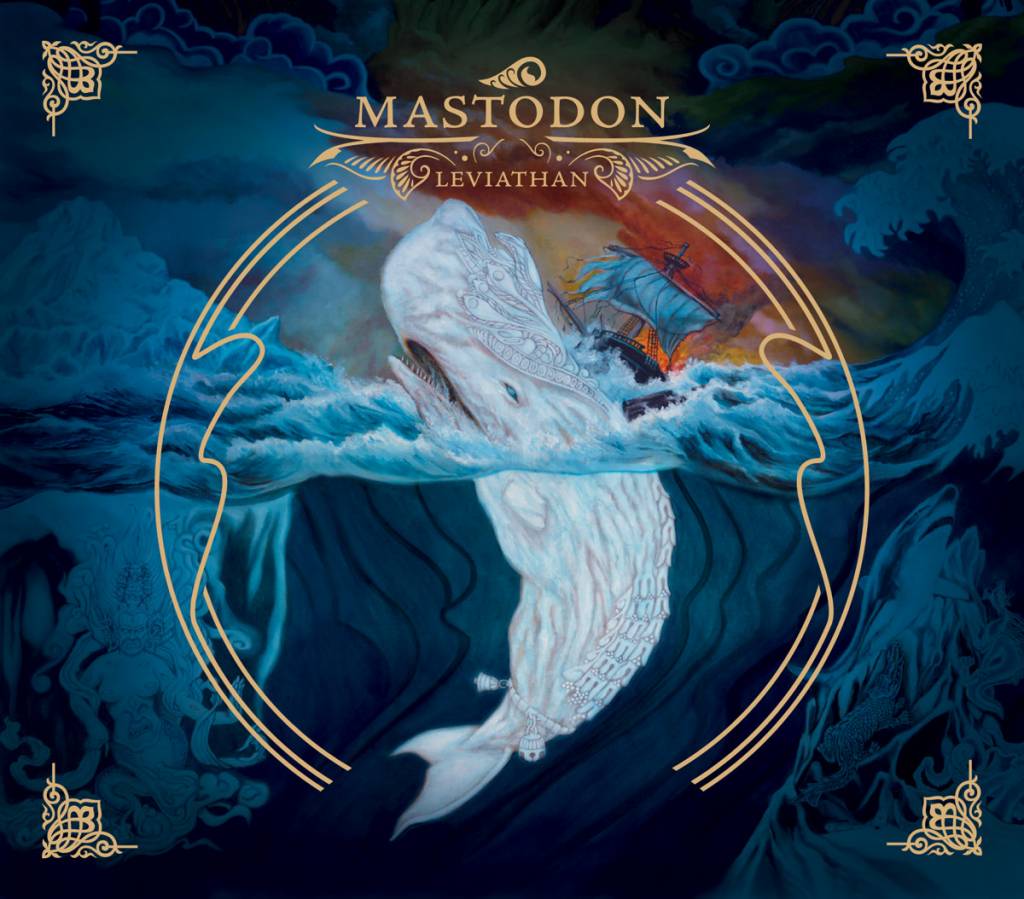
Mastodon Leviathan Album 2
This image reveals more of the complete picture of Mastodon’s Leviathan album that is a concept-album based on Melville’s Moby Dick


This “whooshing up,” D&K say, is when “[t]he most important things, the most real things in Homer’s world, well up and take us over, hold us for a while, and then finally, let us go” (200).  The name for this in Homeric times was the word physis which “was the name for the way the most real things in the world present themselves to us” (200).  D&K consider this whooshing up to be the sacred breaking into our world and shining for all to see and they explain that “[w]hen something whooshes up it focuses and organizes everything around it…” so that “everyone understands who they are and what they are to do immediately in relation to the sacred event that is occurring” (201).  Of course, the best that they can come up with as an example in our modern age is sporting events, when some player does something unimaginable during play… I guess I’ve just never been whooshed up when watching others play sports.  I have had such wooshing experiences at live rock shows in small clubs (when a crowd wide mosh pit erupts in unison or everyone’s face melts at a guitar solo that must be from the rock gods on high – though I’ve never had this moment at an arena or large festival show though – only small, shoulder to shoulder club shows, so I can kind of get what D&K are talking about in terms of responding in a way without thought to the physis overtaking the bystanders).

D&K’s focus seems to be on the wooshing that takes over a group of people as one individual in their midst is wooshed up by the gods.  They do not entertain the individual being struck by the sacred in a moment of isolation in nature (maybe floating in the middle of lake under the star lit sky) or while reading a book or watching a movie alone or laying on the floor listening to an album start to finish with headphones on and eyes closed – these are the times that I am overcome the most by a force outside myself that I could recognize to be sacred.  I don’t quite understand why their focus is on all things shining in crowds – apart from sports giving people a communal meaning their main wooshing up example was Martin Luther King Jr.’s “I have a Dream” speech on the National Mall.

This group response is where their evil really lies… because they have no absolute and objective standard of morality in their polytheistic endeavor.  D&K admit that there can be madness in the crowds, but they say we must be courageous and leap in to experience this polytheistic path. (220)  They understand that things can get turnt[3] “in new and more shining and meaningful ways” or maybe… “Sometimes, by contrast, one dances with the devil” (220).  Because we’re just getting wooshed up (overtaken by a force of the gods) in their paradigm of finding meaning, they explain that it is “[o]nly by having been taken over by the fanatical leader’s totalizing rhetoric, and [after having] experienced the dangerous and devastating consequences it has, does one learn to discriminate between leaders worth following and those upon whom one must turn one’s back” (220).

That final statement is brutally wicked.  Was Germany whooshed up by Hitler?  Um… Yeah.  But what if Germany had won the war?  Would Hitler then have been “the devil” when we know that the victor writes the history books?  Were many whooshed up into a violent frenzy during the multi-day LA Race Riots?  Um… Yeah.  Was the violence, arson, and looting justified?  Who gets to decide and why?  Were many whooshed up when they followed Jim Jones into his Kool-Aid suicide massacre?  Um… Yeah, and many realized they danced with the devil, but the doors were blocked by gunmen and it was too late to find a different partner to woosh them up into a new and shining dance.  Was Ishmael and the others whooshed up by Captain Ahab’s fanaticism to kill the beast?  Um… Yeah, but only Ishmael survived the whoosh!

The people who got whooshed in the examples I just provided were people who, according to D&K, hadn’t yet “acquired the skill” to let themselves “be overwhelmed” by the gods yet possess the “discrimination” to keep themselves from getting “drawn in by the rhetoric of the fanatical and dangerous demagogue” (221).   But remember, there is no way to “acquire this skill” until one has already “been taken over by the fanatical leader’s totalizing rhetoric, and experienced the dangerous and devastating consequence’s it has” (220).  An “evil art” indeed.

What D&K are selling is still essentially nihilism, which is what they are trying avoid, since they recognize nihilism fails to provide meaning in life.  They don’t et that their pitch is still nihilism.

By what standard is one to know if he is dancing with the devil or with the gods?  These whooshing forces were never all good in the Greek pantheon of the gods.  And since D&K aren’t really asking us to accept the Greek gods as being real, again I’ll ask the question but in a slightly different way, by what standard are we to judge what is good and what is evil?  The standard is one’s own opinion.  We can pick and choose what we follow..  In the end, this is still nihilism, a nihilism that has each man be his own god… because it’s truly each individual person who gets to say what whoosh is right and what whoosh is wrong, or if there is even a whoosh to be had at all.

What happens when there are two whooshing parties who come into direct contradiction with one another in terms of who they are and what they are to do and they each consider the other party to be whooshed by the devil?  Well here, we just landed back at what D&K want to avoid, sitting in the contemporary world with “no ground for choosing one course of action over any other” (15).   They offer that there are many gods that can whoosh us up and let us see the shiny good things as they really are, but we’re the final judges of what is shining or not.  Since we’re still the judges of what is right and wrong and what is sacred and shining in the D&K model of finding meaning in life, they’re still dealing the Nietzsche pill of being free to do what we whilt, which I prefer to label as Anton LaVey chose to name it – Satanism.  And in this label, we get the grandest understanding of how evil D&K’s book is – All Things Shining – because as Christians we know that Satan dances among us as an angel of light.  (2 Corinthians 11:14)

Satan deceives through telling lies, but his lies are tricky to recognize, because they’re steeped in truth.  In other words, his lies come to us in partial truths.  It is in this sense that I do try to approach all things as shining.  Every worldview and every culture and every religion and every zeitgeist has some elements of truth within them – I’m rather certain of this.  Christians would do good to point these truths out from time to time.  Since Christ’s claim is true that he is the way, the truth, and the life (John 14:6), then all truth is God’s truth, no matter where it is found.  Where truth is found, declare it, use it, put it in its full context of which it is fully and directly revealed from God in the Bible.  The Apostle Paul did this when he quoted the philosophers of the Athenians (Acts 17).  We can do this too, but we must realize that when we seek the shiny things in life in this manner, we must always cling to the truth of Christ so that we are not deceived into the lie that all is one, and one is all, and that all that glitters is gold.[4]

The nuggets of truth that I am referring to that permeate all of the world are reflections of the Creator within his Creation.  In the Christian account of everything the world is now fallen from its very good original state at creation, but that does not mean that all is now evil within it… there is much that is good and much to be enjoyed and praised and thankful for within God’s world.  Through man’s natural knowledge that there is a God, known from what he has created, from God’s law written on the hearts of all men, and from God’s love for all of his creation in which he showers both the righteous and the wicked with good gifts in this temporal realm, the sacred things of beauty and truth bubble up all around us.  It is in this sense that I highly appreciate D&K’s call for us all to develop the “skills for responding to the manifold senses of the sacred that still linger unappreciated at the margins of our disenchanted world” (222).  It is here in the margins that I have seen people tend to embrace and enjoy the full freedom of being who they want to be, being their own god creating their own little kingdoms, and with their creative juices unstifled by the restrictions and conformity of society they really do shine and stand out among the herd, and people are drawn to such whooshed up individuals and they find their identity and meaning in such communities.   From my Christian perspective, they are letting the image of God that they bare (as broken as it may be) shine as they show off their creative abilities and flair, as they reflect their Creator that they may not personally know in the slightest.

In this way, all things are shining for a time.  Apart from God, however, there is no light – only darkness.  And God’s patience is running out.


[1] All parenthetical numbers are references to the page numbers within All Things Shining by Dreyfus and Kelly that was published in 2011 by Free Press.

[2] A line I stole from the epic song, “Nantucket Sleighride” by Mountain.

[3] Slang for “get really wasted and have a ton of fun” according to Urban Dictionary, but I’ve heard it used by many in Gen Z to refer to something very akin to getting whooshed up in a communal sense (and it sounds so much more lit to get turnt than to get whooshed).

[4] “Stairway to Heaven” by Led Zeppelin lyric reference.