The Different and Contradictory Writings of the World’s Religions

There are many religions in the world, more than what I am going to list today in this blog post, but one of the main reasons that they all have different and contradictory teachings is because they have a different source for their doctrine.  In technical terms, the formal principle is the ultimate source and norm of one’s theology.  For Protestants, the formal principle is claimed to be Sola Scriptura, “Scripture Alone,” however, that isn’t always the case, as some Protestant denominations lean upon reason to fill in the gaps or erase paradoxes found within the Bible.

The following is a list of religions and cults with the writings from which their teachings are derived.  If we have a different source of theology, we’ll obviously have different theological conclusions on the nature of the divine, the universe, humanity, ethics, and the afterlife.

Add to this list in the comments section, please (I know I am missing Shinto, Jainism, Yoruba, Voddoo, and Baha’i.

The Different and Contradictory Writings of the World’s Religions:

Christianity – The Bible

Jehovah’s Witnesses – All current Watchtower publications, including the Bible (New World Translation only), Reasoning from the Scriptures, You Can Live Forever in Paradise on Earth, Watchtower and Awake! Magazines.

MormonismThe Book of Mormon, Doctrine and Covenants, Pearl of Great Price, plus the Bible (King James Version only or Smith’s “Inspired Version”) which is seen as less reliable.  Authoritative teachings of Mormon prophets and other LDS “general authorities.” Ensign and Liahona magazines.

Unification ChurchDivine Principles by Sun Myung Moon, considered the “Completed Testament.”  Outline of the Principle, Level 4, and the Bible.

Christian ScienceScience and Health with Key to the Scriptures, Miscellaneous Writings, Manual of the Mother Church, and other books by Mary Baker Eddy; The Bible, Christian Science Journal, Christian Science Sentinel,  and other official periodicals.

Unity School of ChristianityUnity magazine, Lessons in Truth, Metaphysical Bible Dictionary, and the Bible.

ScientologyDianetics: The Modern Science of Mental Health and other writings by Hubbard.  The Way to Happiness.

Wicca – No offical sacred text, however The Book of Shadows, first compiled by Gardner, is largely used by many Wiccans.

New Age – No officical sacred text, however, almost any religious text can be used, as well as texts on astrology, mysticism, and magic.

Islam – The Holy Qur’an and the Haddiths, sayings of the prophet Muhammad.

Nation of Islam – The Qur’an but Message to the Blackman in America, Our Savior Has Arrived, and other books guide the views of the Nation of Islam.

Judaism – The Tanakh and the Talmud.

Hinduism – The Vedas, The Upanishads, and the Bhagavad-Gita.

Hare Krishna – Swami Prahbuhpada’s translations and commentaries on Hindu scriptures, especially the Bhagavad-Gita. 

BuddhismThe Mahavastu, The Jataka Tales, and the Tripitaka.

The Church of SatanThe Satanic Bible by Anton LaVey.

Daoism – Tao Te Ching, Zhuangzi, and Daozang.

Confucianism – The Analects of Confucius.

Sikhism – The Sri Guru Granth Sahib (or Adi Granth).

What is Law and Gospel?

What is Law and Gospel?
In this blog post, I follow the order and outline of the chapter, “Law and Gospel” found in Called to Believe: A Brief Introduction to Christian Doctrine, published by Concordia Publishing House and edited by Steven P. Mueller. 

Maintaining a proper distinction between God’s Law and God’s Gospel is of utmost importance.  This proper distinction is maintained throughout all of Lutheran systematic theology and is at its heart connected to the doctrine of justification.  All of God’s word comes to us in one of these two ways, Law or Gospel.  Anytime, any passage of scripture is read, one should ask the questions, what is the law in this passage and what is the Gospel.

To define God’s Law, it is that which God commands and demands of us.   Exodus 20 with the issuance of the Ten Commandments immediately springs to mind when asking what does God commands of us.  In Luke 10:27, Jesus boiled the Law down to two essential commands, “Love the Lord your God with all your heart and with all your soul and with all your strength and with all your mind; and, ‘Love your neighbor as yourself.”  The Lord speaks the Law in even briefer terms in Leviticus 19:2 by saying, “Be Holy, because, I the Lord your God, am holy.”  James explains that if keep all of God’s law but stumble in just one area of the Law we are guilty of breaking all of God’s Law (James 2:10).  Throughout scripture, it is taught that if we obey God’s Law blessings will follow, but if we break God’s Law curses will follow.  From an honest look at what is demanded of us by God’s Law, it is evident that we have all broken it and the result of falling short of God’s Law is death, spiritual, physical, and eternal!

To define the Gospel, it is the work of God alone to save mankind.  The Gospel is not exhortation, it is declaration.  The Gospel is a gift which is freely given to us with no strings attached.  If there is any demand put upon us in our salvation, then it is no longer the Gospel being taught and shared.

Similarities and Differences

God’s Law and the Gospel are as different as night and day.  The Law brings death for all who break it.  The Gospel brings life.  The Law brings despair because who can fulfill God’s righteous requirements.  The Gospel on the other hand brings hope for all who receive it.  The Law judges and condemns us.  The Gospel sets us free!  The Law brings wrath and destruction upon sinners.  The Gospel brings love and restores the relationship of fallen mankind with the holy Lord.  The Law demands us to fulfill all God of commands.  The Gospel promises us life at Christ’s expense.

Despite being exact polar opposites in what they do and proclaim, the Law and Gospel share similarities.  Since they have both come from God, they are both good and holy (Romans 7:12).  Some make the error of saying that the Law is evil because it brings death to mankind, but that is a complete and utter lie.  Both of these apply to all people.  God’s Law is a standard placed upon all people, just as God’s Gospel is a gift given to all people in that Christ was an atoning sacrifice for the sins of the world (2 Corinthians 5:19 and 1 John 2:2).  It must also be said that God speaks both of these out of love.  He does not speak the Law out of hatred to us.  The Law is spoken out of love to us for our good that we might see our sinfulness and turn to him for our salvation.

3-D Law                 

When we read through the Bible we will see many different commands given.  Some of these were given to certain people in a certain time in history.  Should certain commands like animal sacrifices or laws about stoning certain sinners still apply to us today?  To fully understand how to interpret and apply all the laws present in scripture, a person must know and understand the three dimensions, or types of the law.  They are the civil-political dimension, ceremonial dimension, and moral dimension.

Civil-political law – These laws are the laws which are given to governments by God.  Romans 13:1-5 clearly teaches that all authority on earth has been given by God and we should thus obey the laws of the governments.  However, we should disobey these laws if the government’s laws directly contradict God’s moral law.  Does this mean that I should obey the laws of the Chinese government if I am in America?  No, but if I am in China I should obey the Chinese laws regardless of what country I am from.

Some of the laws we read in the Bible are laws given to the nation of Israel under the theocracy of God.  Since this nation no longer exists, we do not need to obey and follow these laws anymore today.  An example of this is the command to put to death homosexuals (Leviticus 18:22, 20:12).  This is no longer the law in America, where I live, so I shouldn’t put homosexuals to death, and if I did, I would actually be breaking my country’s laws, and thus breaking God’s law!

Ceremonial law – These laws mostly centered on the Jewish tabernacle, later to be replaced by Solomon’s temple.  These laws dealt with the manner of sacrifices, Sabbath observance, Jewish festivals, purity and cleanliness, and temple practices and activities.  What’s important to remember about these laws is that they pointed to Jesus Christ.  Read Leviticus 16 and the Day of Atonement for a great example of how these laws foreshadowed Christ.  Other verses that explain the purpose of these laws are Colossians 2:16-17, Acts 10:9-16, John 1:14, Hebrews 8:13, and John 2:12-22.  When we read Scripture we need to decipher if the commands we are reading are ceremonial.  Some ceremonial laws can still be of benefit to observe today, but some of the laws, such as the ones dealing with animal sacrifices should certainly not be practiced because Christ was the atoning sacrifice for sin once and for all.

Moral law – God’s moral law might best be summarized with the Ten Commandments, but even then questions arise about the manner and method of what is required with observing the Sabbath and keeping it holy in light of Christ.  Jesus’ two essential laws “Love the Lord your God” and “Love your neighbor as yourself” could serve as good summaries of the moral law.  This dimension, or type, of the law applies to all people throughout all time!

3 Uses of the Law

There are also three uses of the law, or functions of the law.  These can be considered as ways in which the dimensions of the law can be applied to our lives.  The three uses of the Law are as a curb, as a mirror, and as a rule.

1st use – Curb – Think of a street curb.  The purpose of a street curb is to prevent accidents and to keep cars on the correct path.  Likewise, God’s law functioning as a curb prevents and restricts evil in the world.  This use of the Law is given and applied to all people, whether they know it or not.  The laws of authorities and governments function as a curb by rewarding law-bearers and punishing law-breakers.  In addition to these laws, God has written his law upon the hearts of men as another way of curbing the external sinful actions of mankind.

2nd use – Mirror – When you look into a mirror, you must see your reflection, unless you are a vampire or you are on the wrong-side of a two-way mirror.  God’s law functioning as a mirror shows us our sin.  When we gaze into God’s perfect Law, we see our reflection – we’ve fallen short of God’s command and we deserve eternal punishment.  The second use of the law is necessary for us to know our need of a savior.  A good dose of the Law in this function leaves us in despair, but it is exactly what we need to drive us running to the cross of Calvary for our salvation.  This use of the law is for Christians and non-Christians alike.  Non-Christians need to hear that they are sinful before a just and holy God in order to come to repentance and Christians need to daily be reminded of their sinfulness, unless we become self-righteous or forget our utter dependence upon God for our salvation.

3rd use – Rule – Rule is the term commonly used to describe the 3rd use of the Law.  When the term rule is used, picture a ruler which gives a standard of measurement.  God’s Law likewise gives us a standard for which we can measure ourselves.  Sometimes, instead of using the word rule to describe this function, the word guide is employed.  Once a person has come to salvation, the Law no longer serves as an instrument to bring guilt and repentance, but as a guide for how God would have us live our lives.  This function of the Law only applies to Christians who are living under God’s grace, who follow the path the Lord has set before those who believe to follow in this life.  Interestingly enough, as soon as one starts to follow God’s Law – almost instantly, the 3rd use of the Law, the Rule, converts back into the 2nd use of the Law, the Mirror; again our sinfulness is made clear to us and we are again clinging to the Gospel.

The Good News

Gospel means good news.  After being dealt a crushing blow by the law which shows our sinfulness, we are in desperate need of a savior.  The Gospel shows us our savior – Jesus Christ.  The good news is that the condemnation which we deserve for breaking God’s Law has already been paid in full by Christ.  Christ who was sinless became sin and took the full wrath of God upon himself and suffered hell on the cross and died.  However, because of his faithfulness in fulfilling the Law and serving as a substitute for us to receive the punishment we deserve, God the Father had Christ raised from the dead by the Holy Spirit!

This entire process has been called the “Great Exchange.”  Our sins have been credited to Christ.  Christ’s righteousness has been credited to us.  This exchange occurs through faith in this good news!

John 3:16“For God so loved the world that he gave his one and only Son,that whoever believes in him shall not perish but have eternal life.”

Philippians 2:5-11 “Christ Jesus: Who, being in very natureGod, did not consider equality with God something to be grasped, but made himself nothing, taking the very natureof a servant,  being made in human likeness. And being found in appearance as a man, he humbled himself and became obedient to death— even death on a cross! Therefore God exalted him to the highest place and gave him the name that is above every name, that at the name of Jesus every knee should bow, in heaven and on earth and under the earth, and every tongue confess that Jesus Christ is Lord, to the glory of God the Father.”

Galatians 1:3-4 “Grace and peace to you from God our Father and the Lord Jesus Christ, who gave himself for our sins to rescue us from the present evil age, according to the will of our God and Father, 5to whom be glory forever and ever. Amen.”

Ephesians 2:4-9 “But because of his great love for us, God, who is rich in mercy, made us alive with Christ even when we were dead in transgressions—it is by grace you have been saved. And God raised us up with Christ and seated us with him in the heavenly realms in Christ Jesus, in order that in the coming ages he might show the incomparable riches of his grace, expressed in his kindness to us in Christ Jesus. For it is by grace you have been saved, through faith—and this not from yourselves, it is the gift of God— not by works, so that no one can boast.”

Distortion and Confusion Leads to Danger!

Properly administering Law and Gospel can be very difficult.  Sometimes it can become easy to distort Law and Gospel from their proper biblical sense and thus it becomes easier to apply these two concepts to our lives, but if we do so we are in grave danger of losing the Christian faith.  The following are possible examples of how Law and Gospel can be distorted or confused:

  1. Weaken the Law.  If we weaken the Law we turn God’s Law into a commandment that we can fulfill.  This is utterly wrong because it is impossible for us to live up to God’s perfect and holy standard.  If a person hears again and again a message that says that they can “do it” then he or she will literally start to think that they can.  Weakening the Law leads to self-righteousness in which one no longer needs Christ because righteousness has already been achieved by a person who thinks he has fulfilled the Law.  Or, in this weakened state of the Law, a person thinks the Law can be fulfilled by one’s own merit and that person will strive for perfection but will fall short of it again and again.
  2. Hear only Law.  If a person hears only the Law, that person is left in utter defeat because he or she will always fall short.  It’s Mission: Impossible.   It can’t be done.  However, many people go to church and only hear the Law.  The messages given are all Law-centered and speak only of what the Christian should be doing.  This might be ok for a while if the hearers do know the Gospel, but over a period of time, this will lead to guilt and depression and sense of inadequacy.  Often times, if the Law is only preached, then the Law is being viewed in its weakened state because it is being viewed as an obtainable standard, when it is not.
  3. Mixing Law and Gospel.  The Gospel is God’s work alone to save mankind.  However, sometimes there is the tendency to insert our work or a level of performance into the Gospel.  An example of this might be to say that if a person truly believes in God they wouldn’t sin in certain areas or to certain degrees.  Another example of doing this is setting a prerequisite to coming to faith.  I once heard a preacher say that you had to get the filth out of your life to come to God in a message that was directed towards non-Christians.  This of course is completely false.  If we had to get the filth out of our life to become Christians, no one would be a Christian.  Anytime the Law and the Gospel are mingled, salvation is in doubt because our works our involved and not just God’s.
  4. Hear only Gospel.  If a person hears only the Gospel, this can lead people to think they can do anything they want, because God loves them and will always forgive them.  It might even lead them to think that they can believe anything they want and worship anything they want because they’ll always be forgiven.  While, it’s true that God always forgives us on account of Christ’s work, but if our sin is left unchecked by only hearing the Gospel, our sin could grow to the point that we love our sin so much that we reject faith in God and replace him with the sin that we love so much.

S.O.S.

Both the Law and Gospel are needed.

Law S.O.S.Shows our sin.

Gospel S.O.S.Shows our Savior.

We need both of these.  Without the Law to show us our sin, we don’t need to know our savior.  Without the Gospel to show us our savior, we would constantly strive for the perfection that God’s Law demands of us and always fall short, or we would just give up and live in guilt until facing our coming judgment.  The two complement each other and go hand in hand.  Because of this Christians need to hear both Law and Gospel.  However, sometimes we need to hear one and not the other.  If a person feels the weight of his or her sin and is in a state of confession, dosing on more Law would be utterly wrong.  This person desperately needs to hear the good news of the Gospel.  If a person is unrepentant, sinning away and has no sorrow or contrition, then that person needs to hear the Law.

Anytime we read the Bible, we need to ask ourselves “What is the Law in this passage?” and “What is the Gospel in this passage?”  If we find that a passage only has Law, we should seek to find the Gospel in related passages, and conversely if a passage only contains Gospel we need to find Law in related passages.

We should always listen to every sermon carefully and recognize how the Law is used in it and if the Gospel is free of the Law.  If you ever come away from a church gathering, feeling guilty and questioning your salvation, check to see if the message preached only contained Law, and if so, run to the Bible and read clear Gospel proclamations!

Above all remember that out of love for us, God shows us our sin and out of that same love he graciously shows us our savior.


2,000-man Brawl at Chinese Apple Factory

In Taiyuan, China there was a massive brawl that broke out at a dormitory at a Chinese factory. 2000 employees were involved in the brawl, and 5000 police were sent to stop the violence.  I think such outbreaks of violence are in fact very common in China, and that we are just hearing about this outbreak because it happened at a factory making Apple iPhones, a popular commodity for us in America.

Such outbreaks can occur for numerous reasons… demanding more pay, not being paid at all, the long hours, and the living conditions can lend themselves to such outbursts.  This one seems strange, because it was amongst the employees.  The article I read from Beijing (AP), “Apple supplier halts China factory after violence,” doesn’t mention the reason for the violence, and it seems very odd that they would all be fighting amongst themselves.  I suspect this was a protest against the factory employers in some way, but I could be wrong.

Let me paint some of the scenario for you:

Many Chinese factory workers live at their factories.  They work long days, and sometimes everyday.  They rarely leave the factory site, they eat all their meals at the factory cafe, and then they sleep in a dormitory that has bunk beds with each dorm room housing 6-10 workers.  It’s a rough gig.  We have similar setups in America, such as the oil working towns in North Dakota, or the island canneries in Alaska.

An example of a Chinese factory dorm.

In China, such working scenarios are common in all cities and urban environments.  I saw it first hand leaving in Hangzhou, China, and it is very common for construction workers to live in the buildings as they are being constructed, or to have temporary dorms built on site.  Usually these workers are willing to do the work and put up with the conditions for the same reason that the oil workers and cannery workers do in America, the pay is great and the living expenses throughout the process is nil since they’re covered by the employers for the most part.  However, in China, the pay isn’t good, it’s just good for the people who have no other choice.  They are often migrant workers – China has their own cheap labor sector that due to their registered residency in poor provinces, or rural areas, were they can legally work, choose to migrate to more affluent cities and provinces to find work.  They essentially are illegal migrant workers, in their own country, working were they do not have a permit to work, but employers hire them for tough jobs at substandard rates, at least that is how I understand the situation for many Chinese factory workers from my time living in China.

Some people travel far from home for work, and then get injured on the job, lose their job, and don’t have insurance or the proper funds to fix the injury or even get home.  I have seen it and talked to people who have gone through such struggles.  If you put thousands of young, strong men in one place and treat them poorly, expect uprisings periodically.  As long as the cops can outnumber them like they did in Taiyuan just recently, the system can stay as it is, and the workers for the most part get paid better than would back home, bust their tails for a few years, and go back pretty wealthy.  The young ladies might choose prostitution since it pays way better  than factory work, and there is a ton of customers from all the migrant guys, but no one back home really asks or cares as long as the money comes back home.

I know a guy from Maylasia who was living in China who worked for a company that was having their product made in China at various factories.  At one of his factory visits, there was a protest, and he and his co-workers, and factory leaders, could not leave the site.  They were trapped in the factory overnight and couldn’t leave until many police arrived and made a path within the mob using riot shields to escort them all out.  His experience and other articles and stories I have heard from eyewitnesses makes me question that this outburst in Taiyuan was just employees fighting each other!  I could be wrong, but I think it was a protest against the factory, and I do think this happens all the time, and we only hear what the Xinhua, China’s central news agency, allows to hear.  All the info in the article from AP came from Xinhua.  So yea… I’d double all the numbers, and add a lot of fatalities, and throw in some major problems.  I investigated some Xinhua articles firsthand in China and I found that the numbers can’t be trusted, unless things have recently changed.

An example image of a Chinese factory being surrounded by protestors. This protest is in Zhejiang province, where I lived for three years.

Contradictory Views of Mankind’s Ultimate Problem

Views of Mankind’s Ultimate Problem

The root words for religion, re (again) and lig (connect), indicate that religions are about reconnecting with something that has been lost. But what has been lost? What is causing the separation? What are the ultimate effects of this separation? How can the separation be overcome? The answers vary and they can’t all be harmonized to all be true.
  • Judaism – Adam and Eve disobeyed God and thus, their rebellion has brought mankind under a curse that involves struggle between the sexes, painful labor (both in child-bearing and work), and ultimately death.  The prophet Isaiah recognizes that such lawlessness has cut mankind off from God as he warns Israel, “Your iniquities have separated you from your God;
    your sins have hidden his face from you, so that he will not hear” (Isaiah 59:2).
  • Christianity – Romans 3:23 states that “all have sinned and fallen short of the glory of God.”  Romans 6:23 teaches that the penalty of that shortcoming by stating, “the wages of sin is death.”
  • Islam – Allah knows all and sees all, nothing is hidden from him and a day is coming when Allah shall bring judgment to everyone. (Surah 69:18).  At that time, “neither one shall avail another, nor any ransom (compensation) shall be accepted from anyone, nor intercession shall benefit anyone, nor any help will be given” (Surah2:123).  Humanity’s problem is facing Allah’s judgment on the actions of their life and ensuring that the good of an individual’s life outweighs the evil, of which Allah can be the only judge.
  • Hinduism – “Who sees the many and not the ONE, wanders on from death to death.  Even by the mind this truth is to be learned: there are not many but only ONE.  Who sees variety and not the unity wanders on from death to death” (Katha Upanishad Part 4).Our minds are deceived by the illusion called Maya that keeps us from all seeing the oneness of all things, and this deception on our part causes us to live within a cycle of death and rebirth.  We must find the one path that leads to immortality and escape Samsara, the cycle of reincarnation, and of the paths there are many with karma dictating the position of one’s next life.
  • Buddhism – The reality of this life is found in the mind’s perception of what is real and what is lasting.  The world is always changing, always in flux, and our minds and bodies with their desires and cravings resist change.  If our minds can’t acknowledge and accept this constant impermanence, pain and suffering are the natural byproduct.  The origin, or cause, of this suffering is our desires for gratification and success.  The Buddha taught, “The mind is fickle and flighty, it flies after fancies wherever it likes: it is difficult indeed to restrain” (The Dhammapada 35).
  • Christian Science – Mankind’s ultimate problem is being deceived by the illusion of sin, suffering, and death.  To the question, “Is there sin,” the answer provided within Mary Baker Eddy’s Health and Science is, “All reality is in God and His creation, harmonious and eternal. That which He creates is good, and He makes all that is made. Therefore the only reality of sin, sickness, or death is the awful fact that unrealities seem real to human, erring belief, until God strips off their disguise. They are not true, because they are not of God. We learn in Christian Science that all inharmony of mortal mind or body is illusion, possessing neither reality nor identity though seeming to be real and identical” (Chapter 14:472-473).
  • Atheism – If you are reading this text, you are alive, but the greatest problem you, and everyone else who is alive, is always facing in the atheistic worldview is death.  At death, you no longer exist, and that is mankind’s ultimate problem, our mortality.  Rocker, writer, and speaker, Henry Rollins expresses the atheistic view as such, “I don’t believe in an afterlife; you step on a bug, it dies; I shoot you in the face, you die, and you don’t come back.  That’s my belief.  OK?  There are no ghosts; there’s no afterlife; I’m not a spiritual person; I’m kind of a cash and carry type of guy, wash and wear.”

Henry Rollins – Joe Cole Part 1
Henry Rollins – Joe Cole Part 2

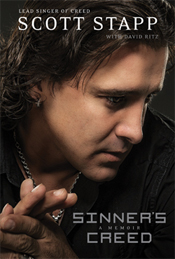
Scott Stapp – Singer of the band Creed writes Christian memoir – Sinner’s Creed.

Creed’s first album, My Own Prison.

Does anyone remember Scott Stapp?  Or the band Creed?  I think it’s a testimony to the impermanence of this world.  At one point in time, I couldn’t listen to the radio without hearing a song by the band Creed.  The band hit popularity as I was exiting high school.  I bought the band’s first album, because it was on a mega-sale, and I was interested in it for some reason.  A song on that album spoke about a courtroom judgment, and the singer’s sins were on trial, and how he cried out for help above and saw a vision of the cross.  The song’s chorus was “Should’ve been dead on a Sunday morning, banging my head, no time for mourning, ain’t got no time.”  There are also a lot of cryptic words and language in the song, which really made the meaning incomprehensible to me, but it certainly seemed influenced by Christ and his death and resurrection for the sins of the world!

The next time I heard Creed, it was the song, “Higher.”  Clearly this one was about heaven;

Creed’s second album, Human Clay.

it had to be.  But was this a Christian band?  It was too hard to tell.  I didn’t hear the name of Jesus in any of the songs, and God was never clearly defined.  I always sort of heard that they were a Christian band, but sometimes the actions of the lead singer that hit the news didn’t match what is typically considered Christian, especially for someone who is on such a public platform, especially the “sex tape” that came out that featured both Stapp and Kid Rock.  I never investigated the material in it or made much attention to it, but I’m pretty sure it emerged about the time the band broke up, and I always placed the video with the demise of the band.  I thought that maybe the other members of the band got fed up with Stapp’s actions, if they were all Christian.

Well from an article just published by Christianity Today, I discovered that Stapp was the only Christian in the band Creed!  And that the others in the band were the reason that the band wasn’t a “Christian” band, and maybe why Stapp wasn’t more vocal about his faith.  From the article, it seems that Stapp has come full circle, from alcoholism, physically abusing his wife, and overcoming and forgiving past abuse from his step-father.

He completely comes clean in a new memoir about his life.  As Christians, we might look at it as, why are you airing your dirty laundry, but many of us haven’t been in the public eye like Stapp – I mean, there was a time, when Creed might have been the most popular rock band releasing new albums, and for all intensive puposes, Stapp was the draw for the band.  His voice and lyrics led the direction of the band, for Creed it wasn’t as much the music that did the talking, but Stapp, especially since there was so much talk about the band being a “Christian” band.  I’m sure for Stapp, looking back at the drunkenness, sex tape scandal, and physical abuse to his wife, all of this really hurt not just his image, but the image of Christ!  And I think in this memoir, he’s really come clean and just saying, “Man I’m a sinner, like all of you, and all of us have a gracious savior, Jesus Christ.”

Stapp is now alcohol free for a little over a year, and Creed is back together.  It’s not the first time Stapp has been sober for this long.  In the Christianity Today article Stapp says:

A little over one year. I used to be very naïve about the fact that alcoholism is a disease, and that there are things I need to do proactively every day to manage that and prevent relapses. Prior to a relapse a year ago, it had been a year-and-a-half. And prior to that, it had been two years. It’s part of the disease, but all I know is that as long as I do what it takes every day and surrender myself to God, I’ll be OK.

Being involved in the program [for recovering alcoholics] has helped me rediscover my relationship with God, because in these programs, God is the center. Now they may call him a “higher power,” but I tell you, I needed a new foundation with God. I needed to throw everything out the window and start over. I’ve been humbled where I needed to be humbled. I was an egomaniac with an inferiority complex, and I needed to hit bottom.

Concerning the help, Stapp got from God in his battle with alcoholism, and I’m sure handling the fame he received from Creed, Stapp says:

God is the miracle heart surgeon, and he gives the best heart transplants in the world. There are no scars on the outside, and the scars on the inside just make us better Christians and help us help others. I really feel that I got the needed heart transplant, and now it’s just fresh and alive, full of love and grace and understanding.

Concerning his bandmates, Stapp shares:

Those guys have openly confessed their atheism and tried to distance themselves as far from God as possible. But I’m continuing to pray and believe in my heart that God put me with these guys for a reason. I hope my life and testimony will speak to them, that God is real. I’m praying for that.

Let’s pray that Creed can get back on top of the charts, that Stapp’s book helps people who don’t know Christ come to understand that Stapp though a Christian was just as broken as others and that God has forgiven him and restored him and has that in-store for all of us, and that Stapp’s life can show Christians that we’re not any better than the world apart from Christ in us, our hope and glory, and that we can mingle with non-Christians and still proclaim Christ and not be ashamed of sharing our faith, even when we are caught red-handed with our sins.  I think Stapp’s battle with alcoholism also shows our battle with sin in general, that we will fight, fight, fight, and win, win, win in the struggle, but then we’ll succumb, and we’ll have to repent, and it’s a vicious cycle that often continues for a very long time, and when one sin is finally put in the grave, God shows us the next sin in our lives that we had all the while we were struggling with the first sin, but we weren’t aware of it at the time.  God chips away at our sinful nature, one strike at a time, as he sculpts us into the image of his Son, Jesus Christ.

To read the article, “The Confessions of Scott Stapp,” click go here.