Many Different Contradict Stickers – Which is the best?

Contradict Movement was born through weekly evangelism outings at University California Irvine (UCI).  Our method of engaging in conversation was to setup a folding table with a few camping chairs at UCI’s Freedom of Speech Zone. We’d have some Starbuck coffee in a “traveler” with creams, sugar, cups, and stir sticks.  We would then use various signs and posters laying on the table or taped to the front of the table that were designed to spark conversation that would allow us to introduce the Gospel.  One night, Adam Stetson, suggested creating a poster that spelled Contradict using religious symbols.  That idea profoundly struck me as the best idea I had ever heard.  It’s a perfect conversation starter: “All religions can’t be true because they contradict each other in their teachings.  Logically, they could all be false, but how would we know that?”  We then could spring into why we believe Christianity to be true!

Upon returning home, I instantly searched for Contradict bumper sticker online.  The following are the two images that I found online:

Image #1: This Contradict image doesn’t strictly use religious symbols and it has no tagline of explanation.

Contradict Bumper Sticker
This was the first Contradict image that I found. And if my memory serves me correctly, this was the image that I used to print off a little sign to use on our coffee table evangelism outings at UCI.

Image #2: This Contradict image was also online at the time and being sold by someone who clearly wasn’t Christian.  The tagline really makes no sense!  I think the sticker is calling for us to go against all religions because all religions are just forms of social slavery.

Contradict Sticker
The other Contradict image that I found online around 2009-10 for use in evangelism. I believe I did print this one for evangelism, but I had to cut out the tagline.

After using these two as small printed pages on the top of the table, Adam had a friend paint an original Contradict design on a poster to tape to the front of the table.  Once we had that poster, Contradict became are constant (only) go to sign for kickstarting evangelism conversations.

After a couple of year at UCI, I wanted to write a book laying out the Contradict message I would share with someone from start to finish, if they gave me five hours of their time.  I also I wanted the book to serve as a tool to help spur others onto college campus and public spaces with a similar approach to evangelism.  To help raise awareness for the book, I wanted to create bumper stickers and a website.  If I was to sell bumper stickers and sell a Contradict design on the front cover a book, I’d need to own the copyright of the image, those I sat down and made a list of religious symbols I would use to spell Contradict and I hired a friend, Danny Martinez, to put it together for me.  I own the copyright and now I also own the trademark to the Contradict Movement logo:

Image #3: The Contradict Movement version of Contradict!

Contradict Sticker
You can order these stickers with a black background or a white background at http://www.contradictmovement.org. I also offer tracts and my book, Contradict – They Can’t All Be True, at the website.  Click the image to go to Contradict Movement.

At the time I launched Contradict Movement as a website, I saw that another Contradict image had emerged:

Image #4: That I could tell the person who made this image was Christian and had a Facebook page named Contradict, but no stickers of this image were being sold.  Later, Cross Examined, started to sell this image with the same tagline with their website url on it.  I don’t think Cross Examined sells this image anymore.
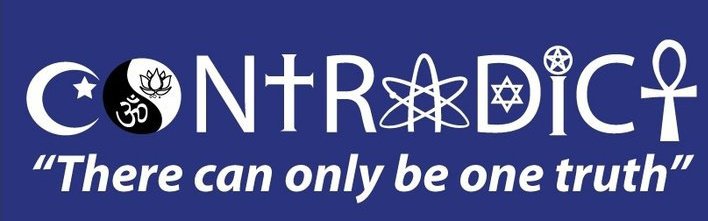
I don't like this tagline as well as mine, but I do really like the design.  I still prefer my design though, because all the letters in this one are not religious symbols.
I don’t like this tagline as well as mine, but I do really like the design. I still prefer my design though, because all the letters in this one are not religious symbols.

Recently, I checked online and I have seen that numerous other Contradict designs have been created and they are now being sold online as bumper stickers!   Here they are:

Image # 5: This was the first obviously Christian Contradict image I saw being sold online (besides the Cross Examined one I mentioned above that is now no longer being sold at the Cross Examined store, Impact Apologetics).  This one is being sold on Zazzle.

I really like this design!  The tagline is good too. It's a shout out to John 14:6, the same verse that I simply cited.
I really like this design! The tagline is good too. It’s a shout out to John 14:6, the same verse that I simply cited.

Image # 6: Here’s a variation of the one above that is also being sold on Zazzle.

I prefer the one with the bubble letters behind the symbols.

Image #7: This is the current Cross Examined Contradict image being sold through their Impact Apologetics online store.

I really like this design.  I think the R with Kokopelli is very creative.
I really like this design. I think the R with Kokopelli is very creative.

I suspect that the clearly Christian Contradict images created after I launched Contradict Movement were working off my Contradict image.  I suggest this because the common theme is the Shinto torri gate for the letter N, but I could be wrong!  They might not have seen my image first.

Two questions:

1.  Which Contradict tagline do you think is the best? 

“They Can’t All Be True – John 14:6”
“Only 1 is Truth, Life eternal, and the Way”
“Don’t be a Contradiction.  There can only be ONE Truth.” 

2.  Which sticker do you think would be the one best suited to go platinum, “Coexist status”, and why? 

If you think it should be mine, please, share http://www.contradictmovement.org with all your friends and family.  Order extra stickers and help distribute them.

Here’s why I think my sticker is best situated for sharing the Gospel!  It has the url to my website, big and clear for people to visit.  The home page has a video that details the message of Contradict by sharing the importance of Coexistence and Tolerance, while also sharing that Tolerance can’t be taken to mean that all religions are true.  I then share examples of religious contradictions and close by sharing the Gospel and why we can trust that Jesus is the Way, the Truth, and the Life.  From a stand alone point of view, the one with the tagline, “Only 1 is Truth, Life Eternal, and the Way” clearly shows a Christian message.  The Cross Examined tagline, “Don’t be a Contradiction, There can only be ONE Truth”, does not clearly demonstrate that it is a Christian bumper sticker, however, the name of their website’s url does indicate this.  When visiting their website though, you are not instantly greeted with the message of their Contradict sticker.  With my tagline, “They Can’t All Be True – John 14:6”, interested parties could be forced to go to a Bible and look up John 14:6 to know why all religions can’t be true.  If interested parties go to Contradict Movement, they will only find links to my blog, the Contradict Facebook page, my Youtube channel, and my book.  All of these sites are very much Contradict themed!

Every sticker I sell comes with a Contradict folding tract as well as a printed page of explanation.  The goal is that if anyone is interested in knowing more about the message of Contradict when seeing a person’s sticker, the Christian has something to hand interested parties on the spot.  It has been my experience that when people are caught starting at your Contradict sticker, they usually don’t want to talk long in the parking lot.

If you do appreciate my work with Contradict Movement, help share my image online and through print.  Right now, images to my page do not always display as prominently as these others, so people may not find my page.  Cross Examined is way more known and popular than Contradict Movement, my blog, or my book.  If their sticker takes off and becomes the one everyone sees and knows, that’s great, because they certainly proclaim the Gospel and do a great job defending it, but if you think the Contradict Movement platform is better due to more specialized focus, again, share Contradict Movement with everyone you know by selecting some key blog articles, Youtube videos, or Facebook posts that you find helpful for sharing the Good News of Jesus Christ.

Thanks so much!

Peace in Christ,
Andy Wrasman

The Blind Men and the Elephant – The Response!

The following is an excerpt from my book, Contradict – They Can’t All Be True (FYI – the spacing doesn’t always transfer correctly from my PDF file to the blog):

Drawing by my friend Danny Martinez.

A popular analogy that depicts an “all religions lead to God” form of pluralism is the story of several blind men touching various parts of an elephant and being unable to agree on a single description of the creature they’re touching. This story has connections to Jainism, Buddhism, Hinduism, and even Sufi Islam, a mystical branch of Islam. The story is found in the teachings of the Buddha within the Pali canon of Theravada Buddhism. One of the most popular versions comes from a nineteenth-century poet, John Godfrey Saxe, who rewrote the story in rhyme.

Though there are minor discrepancies among the versions, they all present the same basic scenario: since each blind man is touching a different part of the elephant, they disagree on what the elephant actually is. The one touching the tail might think the elephant is a broom; the one touching the side of the elephant might think the elephant is a wall; the one touching
the elephant’s trunk might think the elephant is a snake. Individually, they each know a part of the elephant accurately, but not the sum total of the animal. They fail to grasp what the elephant actually is because of their blindness. Their dispute is futile since they are all mistaken.

It is pretty clear how this story can be used within the framework of pluralistic relativism. Christians, Jews, Muslims, Hindus, Buddhists, and the like are all touching the same sacred elephant, God. But because all of humanity is spiritually blind, we are incapable of knowing God as he actually is. Any fighting among religious faiths is thus futile.

On the flip side, the good news within pluralism is that every religion is true based on what its adherents have experienced of the sacred reality. Since all religions have touched the sacred elephant, all religions lead to the same divine truth. Religious pluralists argue that if humanity could only come to “see” this predicament, all religious fighting could stop. We could recognize what each religion has learned about God and, by compiling the parts of the whole, come to a better understanding of who or what the nature and personhood of the sacred reality is.

The view of the divine expressed by the sacred elephant analogy is plausible and worth considering. Before considering the accuracy of its assertions, I want to stress the pluralistic uses of the story. Far from saying all religions are true, the story of the blind men and the elephant takes all religions and throws them under the bus, where they are left broken in their false perceptions of ultimate truth. As hopeful as this story can appear, in reality it just drops the bomb on absolute truth, at least absolute truth concerning God. The blind men show us that truth concerning God is unobtainable due to our limited faculties.

Skepticism toward God doesn’t invalidate this brand of pluralism. The problem lies within itself. Nestled within the story of the blind men and the elephant is a self-contradiction that makes the entire claim crumble in on itself. The pluralists claim that God is unknowable; every religion is wrong about its perceived understanding of the divine. However, in making this claim, the pluralists also implicitly declare they have an inside track on who God is. If no one is capable of knowing God due to our lack of sight in the realm of the divine, then what prescription glasses have enabled the pluralists to know the nature of God with such certainty? Pluralists are rejecting all exclusive truths concerning God, but making one themselves.

End of excerpt from Contradict – They Can’t All Be True.

In my book, I intentionally wrote with a non-Christian voice for the first six  chapters.  I first present what religious pluralism is and why its so dominant in our culture and society right now.  I then demonstrate how religious pluralism doesn’t actually work logically.  Responding to the elephant analogy was near the end of that section of the discussion before moving into presenting an evaluation of religious truth-claims and ultimately landing on the trustworthy nature of the person and work of Jesus of Nazareth to save us from sin and death and reconcile us into a right relationship with God!  Since I wasn’t ready to let it out of the bag that I was a Christian yet in that stage of the book writing process, I didn’t  respond to the elephant analogy the way I typically would.  The following is a more complete Christian response to this popular analogy:

A critique of this parable would contain the following points:

  1. This parable is actually claiming that all religions are false.
  2. This parable makes all aspects of life subjective.  There is no absolute, objective reality that we can be certain we are experiencing correctly.  If absolutes don’t exist in a way that we can comprehend them, morals and ethics also become subjective.  There would no longer be such a thing as right and wrong.
  3. Any exclusive religion, such as Christianity, Judaism, and Islam are forced to give up their claims to exclusivity to fit into the inclusive, pluralism which this parable projects.
  4. With Christianity’s exclusive claim that Jesus is the only way to salvation, all other religions would have to be false if Christianity is true, or Christianity could be false and other religions true.  This does not fit with the elephant analogy at all.
  5. The original telling of this legend has a king who sees the blind men groping at the elephant arguing about what they are touching.  The king reveals to them in laughter that they are all foolish men that they are all touching the same reality, the elephant!  This is very interesting that the original legend has a word from above revealing the truth to the blind men.  This indicates that the truth is actually discernible – we might just need some help from someone up above.
  6. The original ending of this parable lends itself very well to Christianity.  Christianity teaches that help did come from above.  That God has revealed himself to mankind through what he has created as well as through special revelation from the Scriptures and in particular through the second person of the Trinity, Jesus, taking on flesh and walking amongst us, revealing the truth to us, healing the blind and helping them see.  This revelatory claim of Christianity isn’t even considered or introduced in pluralistic uses of this parable.

Conclusion: Declare truth where truth is found!

It seems clear that all religions cannot be fully and equally true.  There are direct contradictions within the teachings of the world’s religions, such as Jesus is God (Christianity) and Jesus is not God (Islam), which eliminate the possibility that all religions are true.

This however doesn’t mean that aspects of the truth cannot be found within various religions.  Christians would do good to point these truths out from time to time.  If Christ’s claim is true that he is the way, the truth, and the life (John 14:6), then all truth would be God’s truth, no matter where it is found.  Where truth is found, declare it, use it, put it in its full context of which it is fully and directly revealed from God in the Bible.  The Apostle Paul did when he quoted the philosophers of the Athenians (Acts 17).  We can do it too!

Overview of Contradict – They Can’t All Be True

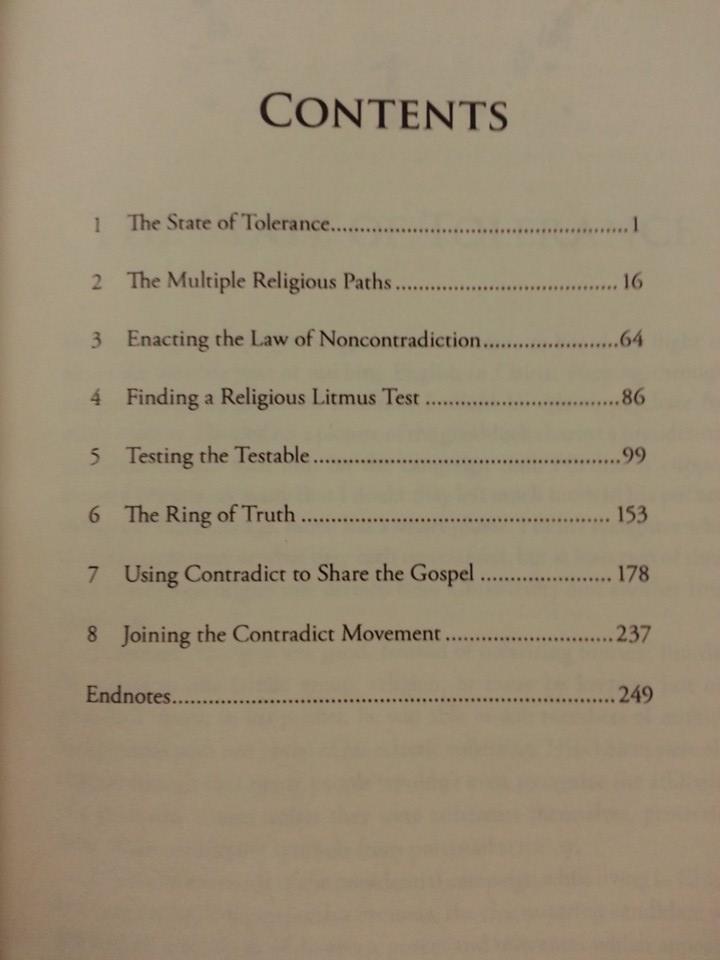
table of contents2My first published book is entitled, Contradict – They Can’t All Be True.  In case you have been wondering what’s inside the book before taking the plunge to order your copy, I have provided a brief overview of the book in this blog post:


Ch. 1 – The State of Pluralism

America’s state of religious pluralism stems from Hindu influence that crept in via the transcendental movement and came full force in the 60s counter-culture movement. The New Age Movement has direct parallels to Hindu beliefs, both of which lead to forms of religious pluralism. I share that the heart behind the movement is love, but that truth and love is lost in pluralism.

Ch. 2 – The Multiple Religious Paths

Many believe religious pluralism is true because Americans are religiously ignorant. Many of us don’t even know Christianity. So I give a 20 word glossary for Hinduism, Buddhism, Judaism, Christianity, and Islam.   If you know these 20 terms for each, you will know the basic history, teachings, and practices of the world’s five major religions.

Ch. 3 – Enacting the Law of Non-Contradiction

I then take direct quotes from the authoritative texts of each of those 5 religions and other minor religions and cults and put them under various doctrinal topics such as who God is, who man is, what mankind’s ultimate problem is, what the solution is to that problem to show the contradictions.

Ch. 4 – Finding a Religious Litmus Test

I present the historiographical tests for evaluating claims of the past and that Christianity offers a historical claim to prove or disprove the Christian faith – the resurrection.

Ch. 5 – Testing the Testable

I apply those tests to the Gospels. I present it in a way that I haven’t seen done yet in another book – so I think I’m contributing something new to the vast works that are already out there.

Ch. 6 – The Ring of Truth

I share what I call the ring of truth. The ring of truth can be found in the Bible’s details, its one unified message, its accuracy in predicting future events, and its uniqueness amongst the world’s religions.  I close this chapter by quoting Peter from Acts 2 and Jesus from Mark 16, “Repent and be baptized for the forgiveness of your sins.”

All of the book so far was in a non-Christian voice. I want anyone reading to not know where I am coming from – what I actually believe. I have not identified myself as Christian until the end of this chapter. It’s all fact based presentations. It turns me off reading most books of this nature because I don’t think my non-Christian friend would get past the first few pages in most cases the way they are written. The bias comes through too strongly in most of the books I have read making a case for the Christian faith.

Ch. 7 – Using Contradict to Share the Gospel

The Christian voice is out. This chapter focuses on sharing the Gospel using Contradict. It explains how I have used Contradict as a witnessing tool on college campuses and I explain the whole process if someone else wants to use it. I then give the 20 most asked questions after the initial conversational starter sharing that all religions can’t be true because they contradict each other, but that I believe Christianity is true and that Jesus is the son of God who died for the sins of all of mankind. Every question has several types of responses that should be utilized in the response. Validation responses show why it’s a good question and how you understand why it is being asked. Socratic method responses are questions that lead the person to the answer based on what they already know. Answer responses give multiple ways to respond to answer the question directly. Scripture responses show the verses that support the answer from God’s Word. Back the Gospel responses must always be used at the end of every answer. The Gospel saves, not our apologetics, so the answers must always be used to get back to the Gospel and often times the Gospel answers the question!

Ch. 8 – Join the Movement.

Why did I call Contradict a movement? The Holy Spirit moves each of us to action as he desires. There isn’t only one way, or method, to present the exclusive claims of Christ to be our only all-sufficient Savior. The Spirit might move some to share the Gospel exactly as I have using Contradict, but others might get other ideas on how to initiate the conversation. We might not all be led to success by the Spirit either. We might be led to persecution. Our role is simply to resign ourselves to will of God as the Spirit moves us to make disciples of all nations.

You can order my book here!

Contradict Bumper Sticker Explanation

With every Contradict bumper sticker shipment, a double-sided page of explanation is also shipped.  The goal with Contradict Movement is to have as many Contradict stickers on cars, or laptops, as there are Co-exist stickers.  Beyond the sheer numbers, the goal is to also have the Contradict stickers represented by Christians who know and can share the information contained in the page of explanation.  This page of explanations is downloadable at http://www.contradictmovement.org for printing and sharing and Contradict stickers may be ordered at the site too.  Here is the basic explanation of Contradict, and please note that it supports religious freedom and calls for a certain type of tolerance and respect:

What does this Contradict sticker mean?

Tolerance and co-existence are both great! In fact, they are necessary.    If we are to live together in peace without hating each other, or worse physically harming each other, over differences in race, culture, sexual orientation, political views, and even religious beliefs, we all must have tolerance for one another.  However, we must recognize that every belief can’t be equally valid.   If two beliefs directly contradict each other, both of them cannot be true, no matter how tolerant we become.   This means it is false to say that every religion is true, or that every religion leads to God.  If people make such claims they are showing that they have not taken the time to study the world’s religions, because a brief reading of the sacred texts of only a handful of religions quickly reveals contradictions on fundamental levels.

Religious Contradictions

Reincarnation (Hinduism and Buddhism) contradicts the belief that this life is the only life before eternity (Christianity, Judaism, and Islam).

Pantheism (Hinduism) contradicts the belief that there is only one transcendent God (Christianity, Judaism, and Islam), and both of these beliefs contradict the belief that there is no God (Theravada Buddhism and Atheism).

Salvation from sin (Christianity) contradicts the belief that there is no sin to be saved from but simply pain that can be escaped through enlightenment (Buddhism).

Jesus is the incarnate, Son of God (Christianity), contradicts the teaching that he is just a prophet (Islam) or that he was a false prophet (Judaism).

Jesus died as an atoning sacrifice for the sins of the world and rose from the grave contradicts the belief that Jesus ascended into heaven while never dying on a cross, or facing death of any kind (Islam).

All religions that suggest that the merits of an individual can free a person from humanities ultimate problem of death contradict Christianity’s teaching that “we are saved by grace through faith in Christ, which is a gift, so that no one may boast” (Ephesians 2:8).

In light of these contradictions, all religions can’t be true.  They could all potentially be false, but they can’t all be true.

How can one know which religion is true, if any?

To discern if a belief is true, it needs to be testable.  The scientific method can’t test most of the claims found in the world’s religions, but science is not our only means of verifying the legitimacy of truth claims.  In the case of judging religious truth claims, historical-forensic evidence needs to be utilized. No other religion than Christianity has at its center, a historical event that can be evaluated in such a manner to prove or disprove the religious truth claims.  Paul says in 1 Corinthians 15 that if Christ did not rise from the grave that his faith is futile and his testimony about Jesus would be a lie.  If someone could prove that Jesus did not rise from the grave, then the resurrection would be considered a false claim and the Christian faith should be rejected.  On the flip side, if Jesus rose from the grave, it confirms that Jesus’ claim to be “the way, the truth, and the life, the only way to Father” (John 14:6) is true!  If he did not rise from the grave, then Jesus was a liar and Christians ought to be pitied above all men.

www.contradictmovement.org
Videos, Stickers, Blog, and Facebook

Is there evidence that Jesus rose from the grave?

The good news for Christians and all of humanity is that the New Testament is the best attested ancient manuscript in terms of the number of copies it has, the dates of the copies to their original writings, and the accuracy of the copies.  In addition to this, the original Gospels were written by eyewitnesses, or written by people who wrote using eyewitness testimony.  This also means the authors were writing too close to the death and resurrection of Jesus for myths to have crept into the accounts.  Other witnesses, both friend and foe, would have known if the Gospel writers were telling lies and they would have revealed the Gospels to be false.  However, we have no such competing accounts from contemporaries.  We do on the other hand have non-Christian authors writing in the first and second centuries who affirm the claims of the Gospels, and no one in the first century was ever able to produce the bones of Jesus to disprove the empty tomb one Sunday morning.  The Jewish and Roman leaders and authorities had the motif and the means to disprove the resurrection, but they could not.  The best they could do was to persecute Christians as an attempt to stop the spread of the Gospel of Jesus Christ.  The apostolic circle in which the claim of Jesus’ resurrection originated never recanted their testimony in the face of martyrdom as they continued to proclaim the risen Christ all the way to their deaths.

Exclusive Claims and Teachings Concerning Salvation within the Bible

Mark 16:16 “Whoever believes and is baptized will be saved, but whoever does not believe will be condemned.”

John 3:36 “Whoever believes in the Son has eternal life, but whoever rejects the Son will not see life, for God’s wrath remains on him.”

John 14:6 “Jesus answered, “I am the way, the truth, and the life.  No one comes to the Father except through me.”

Acts 4:12 “Salvation is found in no one else, for there is no other name under heaven given to men by which we must be saved.”

Ephesians 2:8-10 “For it is by grace you have been saved through faith – and this not from yourselves, it is the gift of God – not by works, so that no one can boast.  For we are God’s workmanship, created in Christ Jesus to do good works, which God prepared in advance for us to do.”

John 3:16 “For God so loved the world that he gave his one and only Son, that whoever believes in him shall not perish but have eternal life.”

Acts 2:37-39 “When the people heard this, they were cut to the heart and said to Peter and the other apostles, “Brothers what shall we do?”  Peter replied, “Repent and be baptized, every one of you, in the name of Jesus for the forgiveness of your sins.  And you will receive the gift of the Holy Spirit.  The promise is for you and your children and for all who are far off – for all whom the Lord our God will call.”

Jesus is the Savior of all people.  He is the Savior of the Buddhist, the Hindu, The Muslim, the Jew, the Satanist, the Atheist, the homosexual, the heterosexual, the republican, and the democrat – all people.  To all who have received him, to all who have called upon his name, he has given the right to be called children of God! (John 1:12)  Repent and be baptized in the name of the Father, and of the Son, and of the Holy Spirit for the forgiveness of sins. (Matt. 28:19 and Acts 2:38)

www.contradictmovement.org
Videos, Stickers, Blog, and Facebook

Contradict #11 – What Does “Co-exist” mean?

The “Co-exist” bumper sticker is pretty vague in its meaning.  It could mean that all religious fanatics who actively stir up hate and dissension and cause violence in the world due to different religious beliefs should stop, and learn to co-exist!  It’s possible to co-exist and still maintain stark differences, even contradictions, that’s why it’s called co-existence, and tolerance, and not just existence!

Some people have argued that the “Contradict” bumper sticker goes against “Co-Exist.”  It does, and it doesn’t.  It depends on how you define “Co-Exist.”  I have heard from people that “Contradict” is hateful, arrogant, superior, and not loving or peaceful.  I wonder if they actually watched the first Contradict Movement video, which is on the homepage of the Contradict Movement site?  The opening to the video says plainly, we need “Co-existence” if we are to live as humans without hating each other, or worse harming each other physically, spiritually, or emotionally.

However, “Co-existence” has other meanings.  It also means that everyone is right, that no one is wrong, unless of course, your belief happens to disagree by saying it is the only absolute truth and other beliefs are wrong!  The people that claim “Contradict” is hateful, superior, and not loving fall into the “Co-existence” camp that believes religious pluralism.  I have had some people deny this, saying that “Co-exist” in no way means or implies religious pluralism.

Here is a video that explains otherwise, setting the record straight on what “Co-exist” actually is and what it means:

Order a Contradict Sticker