Charles Colson – Against the Night #1 – The Ideas that Brought the New Dark Ages

I started reading the late Charles Colson‘s book Against the Night: Living in the New Dark Ages.  This book was written in 1989, and I’m sure Colson would have far more to say if it were written today.  He writes about the setting sunset and our entrance into the “new dark ages.”  What makes our times dark?  It’s moral decay!  We’ve lost the fundamental truths upon which absolute morality is established.  The age of relativism is bringing down Western society as we know it.

In the first chapter of my soon to be published book, Contradict – They Can’t All Be True, I address this same problem, but my focus is on religious pluralism more so than moral relativism, but the two go hand in hand.  I trace the origin of this “new dark age” in the West from its religious origins of Hinduism’s influence on Western culture from the transcendentalist movement that began in 19th century through authors such as Whitman, Emerson, and Thoreau. Colson begins earlier in 1610 with the French philosopher Rene Descartes.  Descartes came to the conclusion that the one thing he knew was certain was the fact that he doubted.  He could not doubt that he doubted, which led to his classic statement, “I think, therefore I am.”

Colson sees this teaching as the root of our current age of moral decline and loss of truth:

Descartes’s now-famous postulate led to a whole new premise for philosophic thought: man, rather than God, became the fixed point around which everything else revolved; human reason became the foundation upon which a structure of knowledge could be built; and doubt became the highest intellectual virtue. … Men and women could not order their lives according to what they could see for themselves through reason, and the fetters of faith and tradition fell away.  … For centuries people had established their moral standards according to the discerned will of God or by appealing to Aristotelian concepts of virtue.  Now Enlightened thinkers sought to root morality not within a transcendent authority or classical conceptions of virtue, but within the mind and heart of man.  Moral judgments would be measured by what men and women could know or feel for themselves.

René Descartes
René Descartes – Is this the man we can blame for our current state of moral decay and loss of the belief absolute truth within our culture?

I find it interesting that Colson traces the problem back to a philosophy that ultimately strips God from the picture and makes Man the end all, be all of determining reality, and I traced the problem back to a religion that says everything is divine and thus each of us is God!  The two go hand in hand.  One reached the mind through philosophy and the other spoke to the heart through an Eastern religion that is experiential.  The one, two punch combo that has knocked us down.  Are we going to get up?  Are you we going to fight back?  We must reclaim absolute truth, not for ourselves, but for all of mankind who needs a saving relationship with God.

2 Peter 3:9 – “The Lord is not slow in keeping his promises.  He is patient!  He desires that no one perishes, but that everyone comes to eternal life through repentance and faith in Jesus Christ.”

Reza Aslan’s Interview on Fox and his new book Zealot!

An interview on Fox News of Reza Aslan and his new book Zealot has received numerous social media posts recently.  Here is a copy of the interview that currently has over 2 million views:

The interviewer is slammed for asking him again and again why he is writing this book as a Muslim.  I think Reza’s answers could have been much better, but the interviewer just keeps asking the same question again and again and it gets nowhere and we don’t get to learn much of what Reza actually believes concerning the life of Jesus.

What stood out the most to me in the interview is that Reza states that it is a fundamental truth that everyone agrees that Jesus was crucified, but that’s not the Muslim belief and teaching of Islam as he also states! Reza must mean that every historian believes Jesus was crucified.

Why do Muslims believe Jesus wasn’t crucified?  Sura 4:157-158 clearly states that he wasn’t.  These two verses read:

“That they said (in boast), “We killed Christ Jesus the son of Mary, the Messenger of Allah”;- but they killed him not, nor crucified him, but so it was made to appear to them, and those who differ therein are full of doubts, with no (certain) knowledge, but only conjecture to follow, for of a surety they killed him not -Nay, Allah raised him up unto Himself; and Allah is Exalted in Power, Wise.”

This leads me to believe that Reza is a very liberal Muslim.  It even makes me think that he isn’t Muslim at all to so openly deny a teaching of the Qur’an like this.  However, I was told that there were different Muslim interpretations on this passage.  I however don’t think that Jesus actually being crucified was one of them.  Some Muslim scholars believe that Jesus never died and others believe that he died of natural causes, but which Muslim scholar besides Reza believes that Jesus was crucified.

Before Reza I have only read Muslim teachers and Muslims I have spoken with to hold to the interpretation that Jesus did not die, at all! According to Adil Salahi who wrote on this topic on Muslim.org says that there are two views within Islam. He writes:

“The first, which is held by a majority of scholars, is that Jesus Christ did not die but was raised by Allah and that he will make a second coming at a time determined by Allah, when he will be preaching the message of Islam. The other view is that Jesus Christ died a natural death after Allah had saved him from his enemies. Both groups of scholars agree that Jesus Christ was neither killed nor crucified. Needless to say, those who subscribe to the second view do not speak of a second coming of Jesus Christ.” (http://www.muslim.org/islam/deathjarab.htm)

It appears as if Reza has an interpretation which does not fit with the interpretations of mainstream Muslim scholars on the teachings of the Qur’an and the Hadiths, so I’m very interested to read his book to see where else he skews not only on orthodox Islam but also Christianity. I wish the interviewer allowed him to get into such things, but it would have been nice if he had answered her question in a better fashion by just saying, “As a Muslim, I’m very deeply concerned with and interested in the person and history of Jesus (peace be upon him) because there is more in the Qur’an about Jesus (peace be upon him) than Muhammad (peace be upon him) and since the teachings of Christianity contradict the teachings in the Qur’an I have every right and interest as a religious scholar, Muslim, or any person interested in seeking religious and historical truth to research the life of Jesus.” I think if he had answered in such a way it would have shut down her stupid string of questions. She clearly is very ignorant on the subject of religious studies and the desire that any religious adherent should have in researching the claims of religions other than their own.

If Reza and other Muslim scholars are beginning to say that Jesus was crucified then it seems like a direct leave from the direct statements of Sura 4:157-158. I see where there is room for Jesus to have died a natural death in that passage, but there is clearly no room given for him to have died by crucifixion. I have never met a Muslim who has read the Qur’an to say that Jesus died of natural causes, much less that he was crucified, and these were leaders of Muslim unions on college campuses and teachers from whyislam.org who I invited to my world religions class to speak. You can check out their website and they very clearly state that Jesus did not die! (http://www.whyislam.org/submission/prophethood-in-islam/jesus-peace-be-upon-him/jesus/) They leave no room for any other interpretation. I’m afraid to say that Reza doesn’t seem very reliable as a Muslim theologian.

What about those born into other religions? Isn’t God playing favorites?

What about those born into other religions?  Isn’t God playing favorites?

English: Richard Dawkins giving a lecture base...
English: Richard Dawkins giving a lecture based on his book, The God Delusion, in Reykjavik (Photo credit: Wikipedia)


This is a common argument that comes up quite a lot by people who reject the Christian faith because of exclusivity of salvation as being by grace through faith in Jesus Christ.  Usually, the argument is thrown out to people who grew up in predominantly Christian regions of the world.  Outspoken Atheist, Richard Dawkins refers to this situation as the result of “childhood indoctrination.”  In the Preface of his best-selling book, The God Delusion, Dawkins writes:

If you feel trapped in the religion of your upbringing, it would be worth asking yourself how this came about.  The answer is usually some form of childhood indoctrination.  If you are religious at all it is overwhelmingly probable that your religion is that of your parents.  If you were born in Arkansas and you think Christianity is true and Islam false, knowing full well that you would think the opposite if you had been born in Afghanistan, you are the victim of childhood indoctrination.

Sadly, Dawkins is likely correct for many religious adherents.  Many people would attest that their faith is the result of their upbringing and they don’t have any answers to share to back up their faith besides pointing to the claims of their religious texts (Christians – the Bible is true because it says it is true) or their subjective experience during prayer (Mormons – just pray and you’ll feel the burning in your bosom that Mormonism is true).  I know my faith is a product of my upbringing, and I don’t deny it.  However, I and many other Christians point outside of our experience to observable evidence such as the fine-tuning of the universe for life on earth for the existence of God and we then point to the historical evidence of the person of Jesus Christ.  The Christian faith is grounded in history and the authors of the New Testament pain-mistakenly made efforts to ensure their accounts portray this fact.  You can sift through this blog more to find answers to back-up the validity of the Christian faith via historical examination, but I want to address this question from a different angle.  Since “child indoctrination” doesn’t apply to everyone who is a Christian, or follower of another faith, I think the complaint of Dawkins can be boiled down to fairness.  If God is real and a correct understanding and truth about him and trust in him are key components of salvation, it’s not fair that some are born in positions where they likely will become adherents of the WRONG religion.  Since this doesn’t seem fair, then God must not exist, because God must be fair.

As I have answered previous questions from time to time, here I go again with a statement of validation, Socratic style answering, a straight answer, and Scripture to back up the answer.

Validation:

I know what you’re thinking.  You’re thinking that I’m a Christian, because I grew up in a Christian family, a Christian culture, that if I grew up in Turkey, I’d likely be a Muslim, or that if I grew up in India, I’d probably be a Hindu.  I’d agree with you; it’s not always the case, but more often than not we are often a product of our environment.  The apple doesn’t fall far from the tree as the saying goes.  It seems as if God is playing favorites, since some people are born into lives that appear to be more fertile to having a relationship with him.

Socratic Method:

“How is it playing favorites, if Jesus died to take away the sins of all people?”

“Is it really playing favorites, if we are all sinful and deserving of condemnation?  For God to remain just and not overlook lawlessness, he had to send his one and only Son, Jesus Christ to die as a substitutionary sacrifice.  Does God have to go through such pain and suffering, considering we are all guilty of sin?  Shouldn’t we be fortunate that he has paved a way for us to have salvation?”

“Where do you stand in the so-called “favorites” ranking?  Have you heard the Good News of salvation through Jesus Christ?”

Answer:

The Bible is very clear that God does not show favoritism. He is the savior of all men.  Jesus’ last words to his disciples before ascending to heaven were commands that they should make disciples of all nations.  (Matthew 28:18-20)  He even promised that it would happen and that the disciples would receive power through the Holy Spirit to accomplish that feat.  (Acts 1:7-8)  It is clear in Scripture that people from all races, nations, and tongues will have salvation and be with God in heaven.  This is already evident now if you look on a map of the spread of religions.  Christianity is the only religion that is diverse enough to have spread across the globe, breaking through all sorts of barriers of language, culture, ethnicity, and lines of nationality.  Jesus even promised that the end would not come until the Gospel has been preached to all nations.  (Matthew 24:14)  It is clear that Jesus does not show favorites due to place of birth.

Scripture:

Galatians 3:26-29 – “You are all sons of God through faith in Christ Jesus, for all of you who were baptized into Christ have clothed yourselves with Christ. There is neither Jew nor Greek, slave nor free, male nor female, for you are all one in Christ Jesus. If you belong to Christ, then you are Abraham’s seed, and heirs according to the promise.”

Revelation 7:9 – “After this I looked and there before me was a great multitude that no one could count, from every nation, tribe, people and language, standing before the throne and in front of the Lamb.”

Acts 10:34 – “Then Peter began to speak: “I now realize how true it is that God does not show favoritism but accepts men from every nation who fear him and do what is right.”

Key Points of Chapter 20 of Without a Doubt Part 1

I apologize for any spacing, numbering, and alignment errors that occurred from copying from Word into WordPress for this blog post, but here is the first part of an outline of Kenneth Samples’ book, Without a Doubt:

Key Points from Chapter 7 Part 1: Historical Reliability of The Gospels

The Christian faith depends on the historical nature and accuracy of the unique claims, character, and credentials of Jesus Christ! – Page 91

Read 1 Corinthians 15:12-18. Christianity hinges on the resurrection of Christ.

Support for the Historical Reliability of the Gospels

  1. 1.       The New Testament documents are the best attested documents of antiquity in terms of total number of manuscripts. 


  • Check out this website: http://www.leaderu.com/orgs/probe/docs/bib-docu.html
  • 5,000 individual Greek Manuscripts
  • 8,000 copies of the Latin vulgate
  • Without these there are still thousands of manuscripts from commentaries and sermons that can be used to piece together the entire New Testament and these are from the early church fathers in the second to fifth centuries. – Page 92
  • Textual criticism exists because of the Bible.


  1. 2.       The interval of time between the date of the original authorship and the date of the earliest New Testament manuscript copies is extremely short.
  2. 3.       The historic statements made about Jesus by ancient non-Christian authors for the most part matches well with the Gospel record.
  • He was a provocative teacher, a wise and virtuous man from the region of Judea.
  • He reportedly performed miracles and made prophetic claims.
  • The Jewish leaders condemned him for acts of sorcery and apostasy.
  • He was crucified by Pontius Pilate at the time of the Jewish Passover, and during the reign of the Emperor Tiberius.
  • Jesus’ followers reported that he had risen from the dead.
  • The Christian faith spread to Rome were the Christians were persecuted and tried for crimes.
  • First-century Christians worshiped Jesus Christ as God and celebrated the Eucharist in their services.
  • Even though these Romans ridiculed the Christians as being morally weak, they were often times known for their courage and virtue.
  1. 4.       The authors of the four Gospels were eyewitnesses of Jesus’ life themselves, or were closely associated with the eyewitnesses. 

John 19:1-4
1 John 1:1-2
Luke 1:1-4
Galatians 1:11-12
2 Peter 1:16

  1. 5.       The Gospel writers intended to convey factual and historical information and the writings of their historical content have been confirmed to a significant degree.
  2. 6.       The apostles’ testimony becomes more credible when it is considered that they had nothing to gain from it and everything to lose. 
  • They received no monetary reward or power from their message.
  • They received only beatings, imprisonment, and death.
  • Adversaries could have exposed their message as a lie, but they couldn’t.
  • We can trust their message because they had no motif to lie or deceive.
  • If they did lie and deceive they violated everything Jesus taught about honesty and truth.

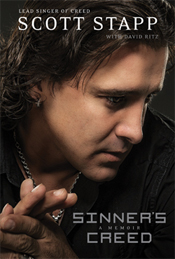
Scott Stapp – Singer of the band Creed writes Christian memoir – Sinner’s Creed.

Creed’s first album, My Own Prison.

Does anyone remember Scott Stapp?  Or the band Creed?  I think it’s a testimony to the impermanence of this world.  At one point in time, I couldn’t listen to the radio without hearing a song by the band Creed.  The band hit popularity as I was exiting high school.  I bought the band’s first album, because it was on a mega-sale, and I was interested in it for some reason.  A song on that album spoke about a courtroom judgment, and the singer’s sins were on trial, and how he cried out for help above and saw a vision of the cross.  The song’s chorus was “Should’ve been dead on a Sunday morning, banging my head, no time for mourning, ain’t got no time.”  There are also a lot of cryptic words and language in the song, which really made the meaning incomprehensible to me, but it certainly seemed influenced by Christ and his death and resurrection for the sins of the world!

The next time I heard Creed, it was the song, “Higher.”  Clearly this one was about heaven;

Creed’s second album, Human Clay.

it had to be.  But was this a Christian band?  It was too hard to tell.  I didn’t hear the name of Jesus in any of the songs, and God was never clearly defined.  I always sort of heard that they were a Christian band, but sometimes the actions of the lead singer that hit the news didn’t match what is typically considered Christian, especially for someone who is on such a public platform, especially the “sex tape” that came out that featured both Stapp and Kid Rock.  I never investigated the material in it or made much attention to it, but I’m pretty sure it emerged about the time the band broke up, and I always placed the video with the demise of the band.  I thought that maybe the other members of the band got fed up with Stapp’s actions, if they were all Christian.

Well from an article just published by Christianity Today, I discovered that Stapp was the only Christian in the band Creed!  And that the others in the band were the reason that the band wasn’t a “Christian” band, and maybe why Stapp wasn’t more vocal about his faith.  From the article, it seems that Stapp has come full circle, from alcoholism, physically abusing his wife, and overcoming and forgiving past abuse from his step-father.

He completely comes clean in a new memoir about his life.  As Christians, we might look at it as, why are you airing your dirty laundry, but many of us haven’t been in the public eye like Stapp – I mean, there was a time, when Creed might have been the most popular rock band releasing new albums, and for all intensive puposes, Stapp was the draw for the band.  His voice and lyrics led the direction of the band, for Creed it wasn’t as much the music that did the talking, but Stapp, especially since there was so much talk about the band being a “Christian” band.  I’m sure for Stapp, looking back at the drunkenness, sex tape scandal, and physical abuse to his wife, all of this really hurt not just his image, but the image of Christ!  And I think in this memoir, he’s really come clean and just saying, “Man I’m a sinner, like all of you, and all of us have a gracious savior, Jesus Christ.”

Stapp is now alcohol free for a little over a year, and Creed is back together.  It’s not the first time Stapp has been sober for this long.  In the Christianity Today article Stapp says:

A little over one year. I used to be very naïve about the fact that alcoholism is a disease, and that there are things I need to do proactively every day to manage that and prevent relapses. Prior to a relapse a year ago, it had been a year-and-a-half. And prior to that, it had been two years. It’s part of the disease, but all I know is that as long as I do what it takes every day and surrender myself to God, I’ll be OK.

Being involved in the program [for recovering alcoholics] has helped me rediscover my relationship with God, because in these programs, God is the center. Now they may call him a “higher power,” but I tell you, I needed a new foundation with God. I needed to throw everything out the window and start over. I’ve been humbled where I needed to be humbled. I was an egomaniac with an inferiority complex, and I needed to hit bottom.

Concerning the help, Stapp got from God in his battle with alcoholism, and I’m sure handling the fame he received from Creed, Stapp says:

God is the miracle heart surgeon, and he gives the best heart transplants in the world. There are no scars on the outside, and the scars on the inside just make us better Christians and help us help others. I really feel that I got the needed heart transplant, and now it’s just fresh and alive, full of love and grace and understanding.

Concerning his bandmates, Stapp shares:

Those guys have openly confessed their atheism and tried to distance themselves as far from God as possible. But I’m continuing to pray and believe in my heart that God put me with these guys for a reason. I hope my life and testimony will speak to them, that God is real. I’m praying for that.

Let’s pray that Creed can get back on top of the charts, that Stapp’s book helps people who don’t know Christ come to understand that Stapp though a Christian was just as broken as others and that God has forgiven him and restored him and has that in-store for all of us, and that Stapp’s life can show Christians that we’re not any better than the world apart from Christ in us, our hope and glory, and that we can mingle with non-Christians and still proclaim Christ and not be ashamed of sharing our faith, even when we are caught red-handed with our sins.  I think Stapp’s battle with alcoholism also shows our battle with sin in general, that we will fight, fight, fight, and win, win, win in the struggle, but then we’ll succumb, and we’ll have to repent, and it’s a vicious cycle that often continues for a very long time, and when one sin is finally put in the grave, God shows us the next sin in our lives that we had all the while we were struggling with the first sin, but we weren’t aware of it at the time.  God chips away at our sinful nature, one strike at a time, as he sculpts us into the image of his Son, Jesus Christ.

To read the article, “The Confessions of Scott Stapp,” click go here.