77. Seeing Christ in Your Christmas

>> Click Here to Listen to the Episode! <<
(Right click and “save as” to download the file)

Or listen in iTunes.

charlie-brown-christmas

In the first segment, Andy shares his article, “Seeing Christ In Your Christmas,” and in the second segment, John Campbell discusses why Christians shouldn’t worry about celebrating Christmas out of fear that they are somehow endorsing paganism!  

“Seeing Christ in Your Christmas” by Andy Wrasman

There are many simple ways to see Christ in Christmas.  One way to accomplish this goal is by drawing Biblical parallels with the traditional Christmas tree décor.   As long as Christians are not glorifying pagan beliefs and practices, or bowing at the altar of gluttonous consumerism through our American Christmas tree traditions, then there is freedom in Christ to take what has become a hallmark of the secular world at the time we celebrate the birth of our Lord, and point it all back to Jesus being the reason for the season.  With no plea to reject Black Friday shopping as the day to get your Christmas season started off on the right foot, and with no “Bah Humbug” towards the secular spirit of Christmas, here’s a list to check twice to see Christ this Christmas.

The Christmas tree is an evergreen tree, because it doesn’t lose its needles through the winter.  Using this type of tree points to the eternal life that Jesus Christ offers to the world.  Jesus is the one who was, and is, and is to come! (Revelation 4:8).  The Christmas tree also harkens us back to the tree upon which Christ was slain, the tree by which eternal life has been given to the world. (Galatians 3:13)

The traditional tree toppers – a bow, an angel, or a star – all point to the Christmas tree representing Jesus.  Bows adorn gifts, and the coming of Christ into the world is a reminder that the Father gave Jesus as a gift out of his great love for us. (John 3:16) At Jesus’ birth, Luke records a great multitude of angels proclaiming the Good News of his arrival to shepherds who watched over their flock at night.  (Luke 2:8-18)  Matthew tells of wise men traveling from the east, following a star to the birth place of the awaited Messiah (Hebrew for Christ).  (Micah 5:2, Matthew 2:1-12)

The wise men from the east, who followed the star of Christ, brought gifts of gold, frankincense, and myrrh, valuable gifts that were common to give to a king.  If the Christmas tree is seen to represent Christ, the gifts at the foot of the tree draw us back to the gifts the wise men laid before baby Jesus as they worshiped him.  (Matthew 2:11)  Our gift giving at Christmas should serve to remind us that as we give to others who are in need, we are giving to Jesus.  (Matthew 25:34-40)  And if the gifts at the tree are seen to have come from Santa Claus, an all-knowing, all-loving, apparently all-powerful, and never dying father-figure who cares for children, it should point us to the true gift-giver, God our heavenly Father.  (James 1:17)

The lights that are held up by being draped across the Christmas tree’s branches are a final touch that point back to Christians, the Church.  John begins his Gospel biography of Christ by saying that in Jesus “was life, and the life was the light of men” (John 1:4, ESV).  The light of Jesus shines in the darkness of this sin cursed world.  (John 1:5)  The light of Jesus enlightens men as to who God is.  (John 1:9) Later in his Gospel, John directly quotes Jesus as having said, “I am the light of the world.  Whoever follows me will not walk in darkness, but will have the light of life” (John 8:12).  As Christians know the Lord through Jesus, and possess eternal life and the light of Christ, we become just what Jesus calls us in his Sermon on the Mount, “the light of the world” (Matthew 5:14).

When we look at the Christmas tree, we are reminded that Jesus became flesh and dwelt among us.  The Light of the World has revealed himself, lighting the path to eternal life.  As Christians are connected to Christ, we shine the light of Christ into a fallen world.  The Church that is spread out across the world, and is still growing, shines as many dispersed beacons of hope in a fallen and depraved world.  Jesus came, died for our sins, rose for our salvation, and is patiently waiting for more to come to know of his love and grace.

This Christmas, remember that Jesus came once with angels and with a star as the ultimate gift of God to this world, and Jesus will come again; this time with the entire heavenly host with the falling of all the stars as he returns for his chosen and holy people.  Let’s help the world see Christ this December, as we hold out the Good News of Jesus Christ in all that we say and all that we do in our Christmas celebration.

Show Links:

Life In His Hands Christian Newspaper Issue 8 (Andy’s article is on page 3)

Andy’s book, Contradict – They Can’t All Be True
 

76. To Sing or Not To Sing?

>> Click Here to Listen to the Episode! <<
(Right click and “Save as” to download the file)

Or Listen in iTunes.

reconnect-episode-76

Should some Christian worship songs and hymns not be song in corporate, public worship?  Are some songs good or at least OK songs, for personal worship in your car driving to work, but not for congregational singing?

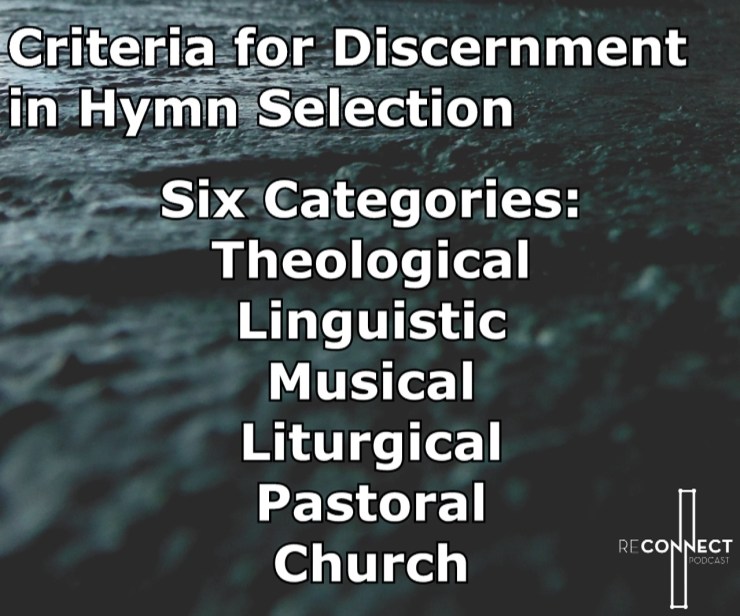
Jonathan Pratt says, “Yes!”  He has compiled and edited a list of criteria for discernment in hymn selection.  If you have never asked yourself, “What types of songs are sung in your church’s services and gatherings and why?” this episode of Reconnect is a must listen for you.  If you are a pastor or worship leader in charge of selecting your congregation’s music and you can’t explain why each and every song was picked for the service, and if you do have the answers, but your answers don’t contain theological reasons, you should definitely listen to this episode!

Jonathan Pratt lays out six categories of criteria for song selection in congregational singing while Tyler Dawson and David Pratt critique or confirm Jonathan’s list.  Andy Wrasman for the most part just moderates and asks questions for this episode.

“Criteria for Discernment in Hymn Selection” as compiled and edited by Jonathan Pratt

Theology

Christ-Centered
Biblically Grounded
Proper Distinction Between Law and Gospel
Theology of the Cross

Linguistic

Doctrinal Precision
Poetic Integrity
Corporate Nature of the Text

Musical

Music Serving the Text
Proper Union of Text and Tune
Musical Integrity of Tune and Setting
Churchly Character of the Tune

Liturgical

Church Year and Lectionary Appropriate
Sacramental Focus
Supportive of Daily Devotional Life
Ability of Text and Tune to Withstand Repeated Usage

Pastoral

Catechetical Use
Cultivating Faith and Piety
Provides Comfort to the Believer

Church

Historic Catholicity
Ethnic Catholicity

Show Links

“Criteria for Discernment in Hymn Selection” Compiled and Edited by Jonathan Pratt

To Whom It May Concern – Tyler Dawson’s Website and Podcast

Episode 55: David Pratt on Apologetics

Episode 30: Who is Serving in your Service?

Episode 28: Jesus is my Girlfriend Songs

Table Talk Radio

75. A Different Kind of Baptism

>> Click here to listen to the episode <<
(Right click and “save as” to download)

Click here to listen in iTunes!

holy-spiritScripture mentions John’s baptism, Jesus’ baptism, baptism of water, baptism in the name of the Father, the Son, and the Holy Spirit, baptism by fire, and baptism of the Holy Spirit.

Some of these descriptions are just different ways of describing the same type of baptism, and certainly most Christians would agree with this.

One particular denomination, the Assemblies of God, hold specific teachings about Baptism in the Holy Spirit.  Their denomination confesses that Baptism in the Holy Spirit is distinct and separate for water baptism and the new birth of a believer.  This baptism is the bestwoal of the Holy Spirit upon a believer that gives the believer certain spiritual gifts and a boldness to share the Gospel and an overflowing joy, or sense of the Spirit’s presence.  This baptism according to the Assemblies of God is recognized by the physical sign of speaking in tongues.  So if you haven’t spoken in tongues, it would mean you haven’t been baptized in the Holy Spirit.

Andy lays out what he thinks is the proper Scriptural understanding of Baptism in the Holy Spirit to Jonathan Bennett and Jonathan Pratt.  This is a type of baptism that many Christians circles typically associate with water baptism (washing in the name of the Triune Lord) or the moment a person’s conversion.  Andy however sees something entirely different from the Assemblies of God and most other Christian groups!

To present his understanding of what he calls, Spirit-Baptism, for short, Andy answers the following two questions:

1.  Is there a difference between having the Holy Spirit and the filling of the Holy Spirit?

2.  Is there a difference between having been baptized in the name of the Father and of the Son and of the Holy Spirit and having been baptized in the Holy Spirit?

Check the Scriptures used in this episode and see what you think.  Is Andy properly interpreting Scripture?

Show Links:

Spirit-Baptism by Andy Wrasman

Contradict – They Can’t All Be True by Andy Wrasman

74. A Different Kind of Election

>> Click Here to Listen to the Episode! <<
(Right click and “save as” to download the file)

Or Listen in iTunes!

doctrine-of-election-button-300x292

The presidential election for 2016 is over!

So it’s time to talk about a different kind of election, the election of sinners by God to salvation. Andy shares the five points of Calvinism and Arminianism, the two common theological systems that are debated and compared when discussing God’s role in salvation.  But then the curveball comes, the Lutheran position on election is presented, a position which rarely discussed in the predestination debate among Christians.  The Lutheran understanding of single-predestination is by far a different election from Calvin’s double-predestination.

Some show notes:

Five Points of Calvinism

T – otal Depravity
U – nconditional Election
L – imited Atonement
I – irresistible Grace
P – reservation of the Saints

Five Points of Arminianism

  1. Free-will, human-ability
  2. Conditional Election (Election is Foreknowledge)
  3. General Atonement (Objective Justification)
  4. The Holy Spirit can be resisted.
  5. Falling from Grace

Lutherans hold to 1.5 points of Calvinism and 3 Points of Arminianism

Total Depravity and Predestination for Salvation
General Atonement, Grace is Resistible, and Falling from Faith

We are saved by grace through faith.  

John 3:16
Ephesians 2:8-9
Romans 4:5

Faith is not our work but the work of the Holy Spirit.

Titus 3:5

1 Corinthians 12:3
John 1:13
Ephesians 2:8-9
Ephesians 2:5 “God makes us alive.”
Romans 9:16
John 6:29

We are incapable of deciding to have faith.

1 Corinthians 12:3
Ephesians 2:1 “We are dead in our sins and trespasses.”
John 1:13
John 6:441 Corinthians 2:14 “The man without the Spirit does not accept the things that come from the Spirit of God, for they are foolishness to him, and he cannot understand them because they are spiritually discerned.”

Any verse about being born again indicates this also, for what role do we play in our natural birth?  None!

Since faith is purely a gift of God and we play no role in our conversion, then it could be assumed that God then chooses who will be saved, and also chooses who will not be saved.

Here’s what Scripture says on the matter:

God elects/predestines to salvation!

Ephesians 1:3-13, 4:3-5
John 1:13
Ephesians 2:4-5 “God made us alive (spiritually).
Romans 8:29-30
2 Timothy 1:8-9

It is the will of God that no man should perish!

1 Timothy 1:3-4
2 Peter 3:8-9


You can Serve God and Your Neighbor in the Military.

veterans-day

Whenever, Veterans’ Day rolls around, I am reminded of vocations (callings in our lives) and how God works through all vocations.  Vocations are not just jobs.  They are callings in our lives that can be relational callings, such as that of a friend, sibling, parent, or spouse.  They can be callings in various stages of life, such as being called to be  a student, devoting time to learning a particular skill or knowledge that you will later be able to use to serve your neighbor.  These vocations are given by God and designed by him as the ways in which he works through individuals to meet our physical, emotional, and spiritual needs.

For instance, God works through doctors to heal people.  He works through police officers to keep law and order in society.  He works through farmers to produce the food we need to live, which means he also works through the factory workers who manufacture and package the farmer’s food, the engineers and scientists who have helped hone this practice to be most efficient, the truck drivers who deliver the packaged food to our local grocery stores, and the many employees at your local grocery to manage, stock, and sell that food in a clean and safe manner.  Many people have worked through their vocations (callings by God) to serve you, every single meal, even if you cooked the food yourself.

Not all relationships and jobs however are vocations (callings), because God does not call us to sin.  A person can’t be a drug dealer to the glory of God for instance, unless he or she is a pharmacist.

A proper understanding of vocations helps remind me of how God works through the military of our country to do his work in the world, as well as other country’s militaries.   I know that some Christians oppose Christian involvement in any military service.  I think they lack a proper understanding of vocations.  God works through soldiers and the governments that send them to war to ensure justice in the world and safety and freedom.

As an apologetic for the military being a vocation (calling) from God, and how Christians can faithfully serve in a military vocation, I have some quotes from Martin Luther on vocation.  They were taken from: http://trinitypartners.org/2010/07/04/luther-on-vocation/

“A cobbler, a smith, a farmer, each has the work and office of his trade, and yet they are all alike consecrated priests and bishops, and every one by means of his own work or office must benefit and serve every other, that in this way many kinds of work may be done for the bodily and spiritual welfare of the community, even as all the members of the body serve one another…”
 
“What you do in your house is worth as much as if you did it up in heaven for our Lord God…We should accustom ourselves to think of our position and work as sacred and well-pleasing to God, not on account of the position and work, but on account of the word and faith from which the obedience and the work flow”

“Monastic vows rest on the false assumption that there is a special calling, a vocation, to which superior Christians are invited to observe the counsels of perfection while ordinary Christians fulfill only the commands; but there simply is no special religious vocation since the call of God comes to each at the common tasks.”

“The idea that the service to God should have only to do with a church altar, singing, reading, sacrifice, and the like is without doubt but the worst trick of the devil. How could the devil have led us more effectively astray than by the narrow conception that service to God takes place only in a church and by the works done therein…The whole world could abound with the services to the Lord, Gottesdienste – not only in churches but also in the home, kitchen, workshop, field”

And could it not also be on the battlefields?

God bless you Veterans!