Justification, Sanctification, and Conversion

I received the following question: “What are the main and general differences between justification, conversion, and sanctification?”

Sanctification may not always be such an upward slope.  I believe we will have dips in our walk with the Lord.
Sanctification may not always be such an upward slope. I believe we will have dips in our walk with the Lord.

Justification is being declared holy.
Sanctification is being made holy.

When we are declared holy it doesn’t mean that we actually are holy.  In god’s sight, through faith in Christ and his saving work, we are seen to be holy even though we still sin!  This is justification.

Justification is instaneous.  The moment a person has faith in Christ is the exact moment they are saved – seen to be holy in God’s sight.

At the exact same moment a person is justified he is converted.  He has gone from life to death, from a child of Satan to a child of God.  Just as justification is instantaneous, conversion is instaneous.

Through the life of the believer, he grows in holiness.  He becomes more like Christ.  Sin lessens and good works abound.  However, in this life, we will never become perfect. We will always still have sin.  So though we are becoming holy in sanctication, the process is never complete this side of heaven.

In summary:

Justification and conversion happen at the exact same moment and the effects are ongoing.
Justification and conversion are both instaneous.
Sanctiication is a process.
Do Christians and Muslims worship the same God?

Alan Shlemon writes a monthly letter for Stand to Reason.  This month’s letter addresses the person and nature of God within Christianity by asking the question:

Do Christians worship the same God as Muslims? (Click to read the article)

Alan opens the letter by saying that most Muslims would say yes.  That’s not my experience… I have yet to meet a Muslim who has said yes.  They have always told me that Christians worship three gods, not one!  I also don’t agree with part of his conclusion in the letter.  I think if Jesus were to show up on the streets of Detroit today, every Muslim would fall in worship – they’d have no choice at Christ’s second coming – Every knee shall bow and every tongue confess that Jesus Christ is Lord!  Philippians 2 says this.  But I get Alan’s point.  If Jesus were to somehow return a second time in his state of humiliation and not his exaltation, Muslims wouldn’t bow and worship him, unless they converted to Trinitarian worship.

With that said however, Alan does a great job in my opinion of showing how Muslims believe in a God that is one person, one essence.  Christians believe in a god that is three persons, one essence.  Big distinction!

I like to say, “Jesus is God or Jesus is just a man.”  Clearly, we’re not worshiping the same God.  But from my experience, many Christians simply don’t fathom this.  I have seen classrooms filled with mostly Christians divided on this question, just like Alan said.

Why?  Why are Christians divided on this issue?

TruthXchange – Only 2 Religions

only 2 religions
Click the image to be taken to the truthXchange website to order this book.

A wonderful lady, Mary, who works at truthXchange was cut off driving on the freeway over a year ago.  The person had one of those Coexist stickers on the back of his car… but then she noticed that it said something different – Contradict. She found my website and shared her ministry with me.  TruthXchange was new to me.  I had never heard of its founder, Dr. Jones before either.  Mary sent me a copy of Only Two Religions.  It’s a user’s guide to the truthXchange Evangelism Tool.  She asked if I could read it and give some feedback.  I finally finished reading it in Dec. 2013, long after receiving it, and I’m just now getting to write something about it.

The premise is simple.  There are only two religions – One and Two, termed as One-ism or Two-ism.  The truthXchange, pocket-sized evangelism tool, explains it very simply:

One-ism, all is one. We worship and serve creation as divine.  All distinctions must be eliminated.  Through enlightenment, we discover that we also are divine.

Two-ism, all is two.  We worship and serve the eternal personal Creator of all things.  God alone is divine and is distinct from His creation, yet through His Son, Jesus, He is in loving communion with it.

The book addresses the topics of humanity, religions, our problem as humans, and the solution to that problem from both a one-ist view of the world and a two-ist view of the world.  Each section is designed to be read as a group with assignments to do during the week – pretty cool stuff, like looking for one-ist articles and movies to share with the group at the next meeting.

This framework comes from Romans 1:18-25.  This section of scripture states very plainly that all of creation knows there is a God from what has been created, yet men, have exchanged the truth of God for a lie, and have instead worshiped and served created things, rather than the Creator – who is forever praised.  When the Creator God is denied, men still worship.  The Created becomes the object of worship – creation, nature, is now One, not Two.  When the Creator is not exchanged for a lie, there are Two – Creator and His creation.  This means there are only two religions – worshiping the Creator or worshiping creation.

Dr. Peter Jones explains that “One-ism can be either atheistic (God is nothing and nowhere), or pantheistic (God is everything and everywhere)” (page 9).  From either form of One-ism, mankind’s ultimate problem is that we don’t recognize this all pervasive oneness.  One-ism says that our solution is to turn inward to ourselves – to become enlightened, that together, not separate, we can solve all of our problems.  Either way – atheistic or pantheistic, this is humanism, mankind is now divine.

This is a good starting point for discussing the uniqueness of the Christian truth-claims amongst the world’s religions. Christianity after all is the turning from one’s self (one-ism) and turning to Christ for salvation (two-ism).

I personally struggle with labeling this one-ism and two-ism distinction as justifying that there are only two religions, because I think that Jews and Muslims would be Two-ist in the sense that they recognize that there is a Creator, that God is transcendent and separate from what he has created.  I must not be the only one to have raised this objection or had this question because Appendix 2 in Only 2 Religions is entitled, “Are Judaism and Islam Two-ist?”  The answer seems to lie in the “personal” nature of the Two-ist Creator God.  According to Dr. Jones:

Is the Jewish God personal?  Well, yes it would seem so.  The Old Testament speaks often of God’s love, His compassion and His grace.  Such attributes are indeed personal.  And yet, the same Old Testament Scriptures give hints that God is triune.  The first verses of the Old Testament include the hovering of the Spirit, the power of the Word, and the intentions of God the Creator.  (See also Genesis 1:26 and other plural references for God, Psalms 110 and other passages that clearly speak of the coming Messiah).  We also see that the Messiah must be God himself.  (Isaiah 58).

Essentially, I understand Dr. Jones to be staying that sense the Jews have rejected the God revealed in the Tanakh (the Old Testament) they have rejected the Creator and are now “functioning as One-ist (page 58).  The same explanation also applies to Muslims with their view of Allah, who though He is viewed as transcendent and the Creator of all, “is made out to be so transcendent that no one can actually know anything about him” (page 59).

In conclusion on this question of framing Christianity as the only Two-ist religion, Dr. Jones writes:

Traditional Judaism and Islam claim to be Two-ist, yet both are functionally One-ist and the god they worship lacks both true transcendence and true immanence.  If God is remote, untouchable, impersonal, impotent and silent, there is no hope for any of us!  If He has not come down Himself to rescue us and to restore communion with us, we would have no way of knowing and loving Him. (Page 59)

two religions
This is the inside of the unfolded truthXchange “Only 2 Religions” evangelism tool. Note, they don’t call it a tract.

Because of this hiccup on Judaism and Islam essentially claiming to be Two-ist, I personally don’t like this One-ist and Two-ist framework to say that there are only two religions.  That doesn’t mean I don’t like this framework though.  I was able to use this framework to explain patterns of religions with a man on plane a ride this past winter.  I pulled out the truthXchange “Only 2 Religions” evangelism tool to show the difference between religious pluralism/pantheism/New Age/Hindu thought and practice compared to Christianity.  We went through each of the topics listed in the tool from the “All is One” perspective and the “All is Two” perspective. Having the tool in my pocket was very useful and gave a good visual to our discussion. I then was able to share Romans 1:18-25 to clarify that we all know there is a God from what he has made and that we all worship, we just don’t all worship the one true and living God.  I stressed that we all know there is a God even if we have exchanged that truth for a lie, and that it is through the person of Jesus Christ that the one true God has been personally revealed to us, that Jesus is the invisible image of God made visible to us!

I then explained the way I like to classify religions – There are only 2 religions, either “paid” or “not paid.”  I then quoted Romans 4:4-5 to the man, which in paraphrase says that when we work our wages are due to us, but when we don’t work, but trust God who justifies the wicked, we have salvation.  Essentially, all religions besides Christianity require men to work to attain some end goal.  We have been given a bill, a debt if you will, and we must either do yoga as in Hinduism, meditate as in Buddhism, adhere to the Law as in Judaism, follow the Five Pillars as in Islam, or adhere to other practices and rules according to other religions to pay this debt, to earn our way to the highest goal of mankind.  And in the end, no one from any of these religions has any certainty that they have paid the bill in full.  They are left to die in despair.  Or we can turn to Jesus who has paid the bill for us!   Through his life, death, and resurrection, he has paid all of our debts!  In the Christian worldview, our works our worthless.  If we want to trust in them and demand to be paid what we are due, we get and deserve eternal death.  When we turn from our sins, our unrighteous works, and turn to Christ and his righteousness for our hope and glory, we receive an inheritance that comes from the Lord. Death becomes sweet.  To live is Christ, and to die is gain.  Christanity alone stands apart as the only saved by grace, saved by divine redemption, religion.  In this sense there are only two religions “paid” and “not paid.”

I also like to classify religions as either, “from man” or “from God.”  All religions besides Christianity were founded by men, who claimed to be men.  They were either heroes, sages, prophets, or the like, but only in Christianity do we get a religion that is founded by a man who claimed to be God in the flesh.  This is why it should be no surprise that Christianity is the only religion that is “paid” for us by God.

So please, whatever way you want to share it – “One-ism vs. Two-ism” or “Paid vs. Not Paid” or “From Man vs. From God” or through none of these categorical tools- proclaim the Good News that salvation has come to us through the person and work of Jesus Christ.  Do not be ashamed – Romans 1:16.

In conclusion on Dr. Jones’ helpful Only 2 Religions evangelism tool and user’s guide, I think this framework does a great job of explaining why so many in our day and age are turning to homosexuality, religious pluralism, and humanism.  The explanation for the rise of homosexuality in our culture was most helpful to me – and a brand new idea that I hadn’t read from anyone else.  I’ll close by quoting that section:

A One-ist believes that God is no different than creation… which means that he is the one who decides what to worship and usually ends up worshiping himself!  A One-ist will naturally seek to suppress the distinctions God has placed in the world and may be tempted to embody his One-ist tendencies in a One-ist sexuality, such as homosexuality, transgenderism or lesbianism. … A Two-ist recognizes the distinctions God put in the world as a reflection of the distinction between the Creator and the creation.  Sexuality is one of those distinctions, as so a Two-ist rejoices in the sexual differences between men and women and enjoys normal, created sexual relations within the marriage and family structure ordered by the Creator.  … If you believe in a God who is “other,” then you will worship something “other” and will be in human sexual relationship with someone who is “other” (male or female). (pages 33-34)

Watch this following video to get the One-ism vs. Two-ism distinctions directly from truthXchange:

Click here for Only 2 Religions.

Click here to get my book, Contradict – They Can’t All Be True.

Is Atheism a religion?

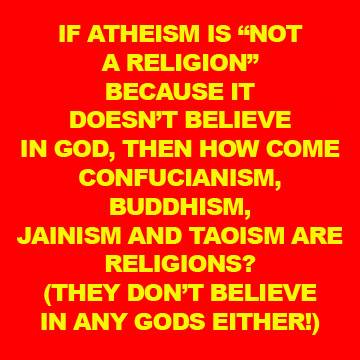
atheism is not a religionI think the person who made this image is trying to make the case that Atheism should be considered a religion.  I disagree…

There are other elements that need to be considered when defining something as a religion or not in addition to the belief of a God. Any belief system that is labeled a religion usually has a belief about the afterlife and they provide a way to attaining the best possible afterlife, they usually have a moral code, they have rituals, they provide a sense of community, they have a central myth (or story), they tend to recognize something as being sacred, they tend to recognize a universal problem for mankind, and they provide a way to overcome that problem.

Atheism falls flat of possessing many of these traits… do atheists have rituals, yes, but are they accepted amongst a community of atheists who practice them together? Do atheists recognize any afterlife? Nope. Does Buddhism? Yes. Does Taoism? Not so much, but some branches do recognize that people can become immortal or gain supernatural powers, and some Taoist even believe in spirit beings and gods. Jains believe in reincarnation! I could go on….

I could go on and on.

Watch this video to learn more about what makes a religion a religion.

http://www.youtube.com/watch?v=k1Wv0FHfzD8…

Overview of Contradict – They Can’t All Be True

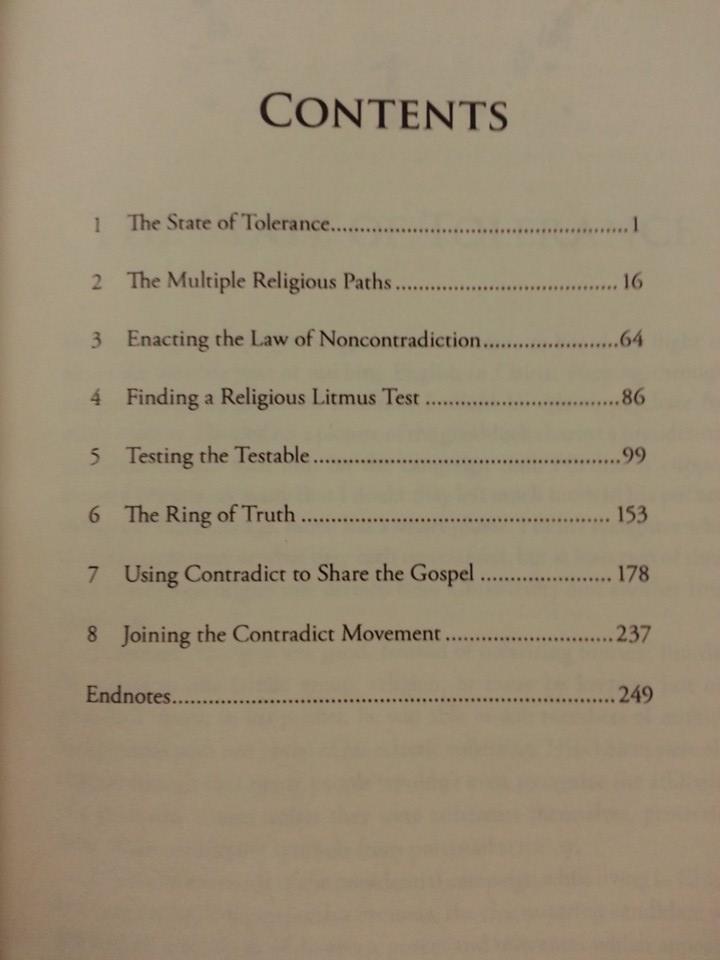
table of contents2My first published book is entitled, Contradict – They Can’t All Be True.  In case you have been wondering what’s inside the book before taking the plunge to order your copy, I have provided a brief overview of the book in this blog post:


Ch. 1 – The State of Pluralism

America’s state of religious pluralism stems from Hindu influence that crept in via the transcendental movement and came full force in the 60s counter-culture movement. The New Age Movement has direct parallels to Hindu beliefs, both of which lead to forms of religious pluralism. I share that the heart behind the movement is love, but that truth and love is lost in pluralism.

Ch. 2 – The Multiple Religious Paths

Many believe religious pluralism is true because Americans are religiously ignorant. Many of us don’t even know Christianity. So I give a 20 word glossary for Hinduism, Buddhism, Judaism, Christianity, and Islam.   If you know these 20 terms for each, you will know the basic history, teachings, and practices of the world’s five major religions.

Ch. 3 – Enacting the Law of Non-Contradiction

I then take direct quotes from the authoritative texts of each of those 5 religions and other minor religions and cults and put them under various doctrinal topics such as who God is, who man is, what mankind’s ultimate problem is, what the solution is to that problem to show the contradictions.

Ch. 4 – Finding a Religious Litmus Test

I present the historiographical tests for evaluating claims of the past and that Christianity offers a historical claim to prove or disprove the Christian faith – the resurrection.

Ch. 5 – Testing the Testable

I apply those tests to the Gospels. I present it in a way that I haven’t seen done yet in another book – so I think I’m contributing something new to the vast works that are already out there.

Ch. 6 – The Ring of Truth

I share what I call the ring of truth. The ring of truth can be found in the Bible’s details, its one unified message, its accuracy in predicting future events, and its uniqueness amongst the world’s religions.  I close this chapter by quoting Peter from Acts 2 and Jesus from Mark 16, “Repent and be baptized for the forgiveness of your sins.”

All of the book so far was in a non-Christian voice. I want anyone reading to not know where I am coming from – what I actually believe. I have not identified myself as Christian until the end of this chapter. It’s all fact based presentations. It turns me off reading most books of this nature because I don’t think my non-Christian friend would get past the first few pages in most cases the way they are written. The bias comes through too strongly in most of the books I have read making a case for the Christian faith.

Ch. 7 – Using Contradict to Share the Gospel

The Christian voice is out. This chapter focuses on sharing the Gospel using Contradict. It explains how I have used Contradict as a witnessing tool on college campuses and I explain the whole process if someone else wants to use it. I then give the 20 most asked questions after the initial conversational starter sharing that all religions can’t be true because they contradict each other, but that I believe Christianity is true and that Jesus is the son of God who died for the sins of all of mankind. Every question has several types of responses that should be utilized in the response. Validation responses show why it’s a good question and how you understand why it is being asked. Socratic method responses are questions that lead the person to the answer based on what they already know. Answer responses give multiple ways to respond to answer the question directly. Scripture responses show the verses that support the answer from God’s Word. Back the Gospel responses must always be used at the end of every answer. The Gospel saves, not our apologetics, so the answers must always be used to get back to the Gospel and often times the Gospel answers the question!

Ch. 8 – Join the Movement.

Why did I call Contradict a movement? The Holy Spirit moves each of us to action as he desires. There isn’t only one way, or method, to present the exclusive claims of Christ to be our only all-sufficient Savior. The Spirit might move some to share the Gospel exactly as I have using Contradict, but others might get other ideas on how to initiate the conversation. We might not all be led to success by the Spirit either. We might be led to persecution. Our role is simply to resign ourselves to will of God as the Spirit moves us to make disciples of all nations.

You can order my book here!