Norman Geisler – Science and Scripture? Nooooooooooooo!!!!

Norman Geisler – this bright, strong advocate for the Christian faith.  One of the greatest apologists, defenders of Scripture, in our age.  I just saw an article posted on his website… entitled, “Does Believing in Inerrancy Require One to Believe in Young Earth Creationism.”

In this article, he claims numerous times that it is possible to have gaps between the days of the Genesis accounts of creation (Alternating Day-Age Theory).  He claims it is possible to have a HUGE gap between Genesis 1:1 and Genesis 1:2 (Gap-Theory).  He claims it is possible that each day is lengthy epochs of time (Day Age Theory).  All of this is true.  Anything is possible.  He then rips all the arguments of a 24-Hour Day interpretation of Genesis 1.  He then provides arguments for all of the other theories.  He concludes by saying that the age of the earth doesn’t matter – it’s not important to salvation – it’s never been an essential doctrine or creed in church history – UNTIL NOW, of course.

What Geisler doesn’t do a great job of mentioning is that all of the views besides the “Young Earth” view have death reigning in the world before the fall of man into sin!  He also fails to mention that these other views (as of today) are arising not from Scripture Alone, but from the process of inserting prior beliefs into the reading of Scripture and performing interpretative gymnastics to pull out of Scripture the beliefs that were inserted into the text.

Please, read the article linked above, and then read my response.

I think we should note his hermeneutic – his formal principle. Norman Geisler writes near the end of this article, “If the Young Earth view is true, then so be it. Let the biblical and scientific evidence be mustered to demonstrate it.” This is not Reformation sola scriptura at work! That is my biggest complaint against the Old Earth crew. Members of this growing elite, such as Hugh Ross, claim that God has given us two books! Ross actually says “two books.” By this he means natural knowledge (general revelation) and revealed knowledge (special revelation). Since when does God’s revelation of himself through what he has created become on par with Scripture? I think that the Old Earth Creationists are starting with their conclusion that the world is very old based on their interpretation of what they see in the physical world and then interpreting Scripture in light of that presupposition.

From strictly reading the Bible, why would we suspect that there are gaps between the days in Genesis or that there is a gap between Genesis 1:1 and 1:2? From strictly reading the Bible, why would I suspect that there were millions of years of death in the animal kingdom with entire species being wiped off the face of the planet before the creation of Adam and Eve and before their fall into sin?

I agree with Geisler that one does not have to believe the earth is a certain age to be a follower of Christ – to trust in the salvation that comes through Christ’s work alone, but using “science” to interpret scripture is a bad hermeneutic and teaching death before the fall does not sit well with a very good world created by God. Many of the leading Christian apologists today are making claims that death in the animal kingdom was in the world before the fall of man and that there is where the huge problem lies! Death without sin is not Scriptural. God did not create a world of death. Teaching this as the Old Earth Creationists teach can very easily lead people away from Scripture and therefore away from God.
Go to www.contradictmovement.org to find links to my book, other merchandise, my Facebook page, and my Youtube Channel.

Discerning Law and Gospel when Interpretting Scripture

How do you interpret the Bible?  Most people ask questions such as:

1. Who wrote this text?
2. Who was first receiving this text?
3. What was the intent and goal of the author in writing to his audience?

These two questions can make a big difference in understanding the text.  Matthew for instance was writing to a Jewish audience trying to to show them how Jesus was the Messiah.  That’s why Matthew, of all the Gospels, quotes from the Old Testament Scriptures the most – showing how Jesus fulfilled them!

4.  What is the historical context?
5.  What is the cultural context?

These things do matter!  A whole other post is needed to address these.

6.  What is the context within the book?
7. What is the context within the rest of Scripture?

Context matters.  Have you ever been quoted out of context?  Did it completely change the meaning of what you said?  Yea.  Sound-bites kill context and meaning.  We should do our best to keep verses in their proper context.

8.  Greek and Hebrew?
9. Grammar?  Active vs. Passive verbs?  Singular vs. Plural nouns?  Who is the subject or object?  Etc.
10.  How else are these words used in Scripture?

You’ve heard that things are lost in translation.  Sometimes, going to the Greek and Hebrew can help.  A common example is that the word Love in English is only Love and can mean almost anything.  In Greek there are three words for love (agape, phileo, and eros – bet you can guess the meaning of the last one) and they all three have a different meanings, yet all three are translated into the same English word, love.

Answering all of these types of questions can help you understand the text as the original audience would have received and understood its meaning – it’s actually meaning.  The meaning doesn’t change.  The application, however, might change as the meaning is passed on to different cultures and historical settings.  Agree or disagree?  Leave a comment.

Now – to the topic of this post.  When you interpret a Scriptural passage do you ask yourself:

11. What is the Law in this passage?
12. What is the Gospel in this passage?

Law is what God tells you to do, what God expects of you.  Law shows you your sin and the consequences of those sins.

Gospel shows you your savior.  It is the work and actions of God alone to save you from your sins.  It is Good News!  Don’t take that to mean the Law is Bad News.  The Law is good too!  It just shows us our sin and our need of a savior.

Law statements might be implied or directly stated in a text.  The same for Gospel statements – implied or directly stated.

As we see these Law and Gospel statements we want to then apply them to our current culture, historical setting, and life.  When we are finished, we should be able to make an application of the Scripture to ourselves knowing what God wants us to do after hearing his Word and what he is doing for us to save us and bring us through this life to the finish line – i.e. Christ and eternal life with him in heaven.

I should probably write many blogs on this process and will likely do so.  For now, watch this video!  It gives examples of looking at verses and showing Law and Gospel statements that can be drawn from them.  Granted, I just look at one verse and show the Law and Gospel in it alone, not the full context of the passage that contains the verse – sort of breaking my interpretation rules – huh?

Drop me a line and let me know what you think.

Christ’s States of Humiliation and Exaltation!

I heard a message at my school’s chapel this week that covered the great Philippians 2 creed, the one that says, “Christ, who being in very nature God, did not consider equality with God something to be grasped, but made himself NOTHING, taking on the nature of a servant, being made in human likeness, in which he was obedient to the Father, unto death, DEATH ON A CROSS, and on account of his obedience, the Father had him raised and exalted him to the highest place, that at the name of Jesus EVERY knee shall bow and EVERY tongue confess that JESUS IS LORD!”  My paraphrase off the top of my head.  An awesome passage.  It details what is doctrinally called Christ’s states of humiliation and exaltation.  His state of humiliation commenced from the moment he assumed a human nature (his conception) until his death, at which point he entered into his state of exaltation.  Want more info…. watch this video!  Peace in Christ, Andy.

Contradict Evangelism Table

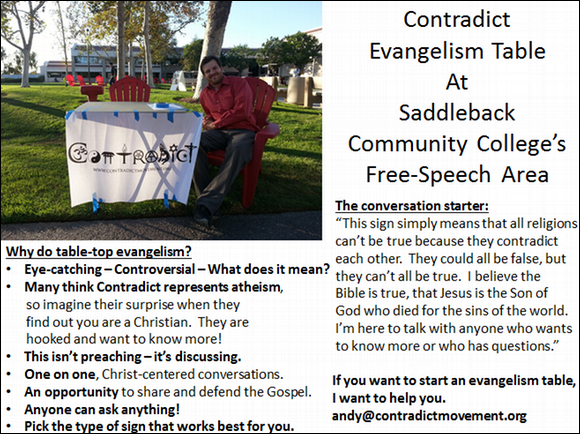
table evangelismAs many of you know if you have followed my blog, the Contradict logo was birthed from evangelism at University of California Irvine.  From many trial and error attempts at initiating Christ-centered conversations on the campus, I found that the best method for my personality is to set-up a table and draw people in to talk with a catchy poster on a table.  My first attempt was a Led Zeppelin poster with a sign saying free bootleg CDs.  I actually had purchased some bootleg CDs and was raffling them off, but, to enter the raffle the person had to take my “Stairway to Heaven” Gospel tract that I had written.  They also got an invitation to a Bible study on UCI’s campus.  I got a few emails this way so I could keep in contact – spamming people, if you will, about events I was hosting on campus.  I never got anyone to show to those events – :(.

Then I met a lady that was a full-time missionary at University California Los Angeles.  She told me what worked best for her was hosting a “Blessing of the Brains” night every mid-term and finals week.  She said students were up late studying and that she would offer them coffee and the opportunity to have their brains blessed with prayer!  She would pray for them right then and there if they wanted, or just collect prayer requests in a prayer box.  I did that method twice!  Both times – very successful.

All of these attempts were when I was as an undergraduate student at Concordia University Irvine during the 2004-2005 and 2005-2006 school years.  After a Masters degree and three years teaching in China, I was back in Orange County in the summer of 2009 and asked if I would kickstart evangelism for a congregation at UCI.  I wanted to set-up another table with a poster that would draw people in to talk and I wanted to also offer coffee.  Sort of a combination of the two best options I had done before.  I had many other attempts along the way that I won’t mention.  From UCLA pastor, Mark Jasa, I learned of a cool sign approach to evangelism. He set-up a table with a poster that read, “Religion is for the Weak.”  His approach was that people would see this and not know what he believed!  People usually think he is an atheist, and then get caught off guard and are intrigued to hear more when they find out he is actually a Christian.  He presents that everyone is going to die and religion offers a solution to the problem, yet there are really only two religions – Free and Not Free.  Christianity is the only Free religion – saved by grace through faith in Christ.  Then the discussion begins!

Adam Stetson also saw a presentation from Pastor Jasa on his “Religion is for the Weak” method of starting an evangelism conversation. Together we bought a table and went to UCI’s Freedom of Speech Area.  We started with small print-out pages that said “Religion is for the Weak” and other slogans we came up with. The only one I still remember is the one that I made up which was “Christianity is not a way of life.”  If someone asked what it meant I’d share, “Christianity is life given to you for free by the work of Jesus.  It’s not a list of rules you must obey to be saved.  Therefore it is not a way of life, it is life.”  We also had a big poster board that said, “Got Prayer?”  We did a lot of stuff like that.  It was a smorgasbord of little flyers taped to everything on the table.  People would get coffee and as they shook their sugar into their cup, they’d ask what the message meant on the sugar container.  It was quite comical.

One week, Adam said, he wanted to make a Contradict sign to counter Co-exist.  I thought it was great!  I found a few designs already made online and we started to use them on the table too.  It became my go to every time someone asked why were out there giving out free coffee.  Adam and the others with us began to always gravitate towards it too.  Eventually Adam had a Contradict poster made!  And then we ditched everything else and just used a Contradict poster exclusively, taped to the front of the table.  “Religion is for the Weak” didn’t work so great for me for some reason.  Before launching the site http://www.contradictmovement.org, I designed my own Contradict logo with my friend Danny Martinez.

I love the Contradict conversation starter.  It’s simple.  Someone asks what does this mean and I get to simply say, “It means that all religions contradict each other and they can’t all be true.  They could all be false, but they can’t all be true.  I personally believe Christianity is true, that Jesus is God and died for your sins and I am here to share that good news and answer any of your questions about what I believe from the Bible.”  I have presented the central truth-claim of Christianity, and now the ball is in that person’s court!  Often times, they might be shocked that I am Christian. For example, I once let an atheist talk a long time about his views on religion.  He thought I was an atheist too, so he was just laying it really thick against all religions and religious people, and when I told him what I believed he was stunned.  And his mouth was open, and he asked, “Wait, you’re a Christian?”  He thought by Contradict, I somehow meant they were all wrong!  No.  It means they can’t all be true, not that they’re all wrong – which is what many people first think the sign means.

Anyways, it’s a great conversation starter!  I encourage you to give it a try somewhere, at a park, a campus, a store front, a fair, a street corner with a lot of foot traffic.  There are handouts at http://www.contradictmovement.org that you can download and print for free.

If you are really into this idea, I encourage you to check out my book, Contradict – They Can’t All Be True.  It details the entire message I’d share with someone if they gave me 3-4 hours of their time.  And believe it or not, sometimes, people actually give that much time!  Many people I have talked to are very intrigued.  They are craving God (although they don’t know that’s what they’re missing and needing as they are lost in their sins) and few Christians have given them the straight up truth from Scripture.  And few Christians have sat there to listen to their questions and answer them.  A big portion of my book is to help equip you to know what questions are most often asked from the Contradict conversation starter.

Here’s a video for more info on how to get started. God bless you.

Please, let me know if you give this a try.  And you might find that something else besides Contradict works best for you.