True for You, But Not True for Me (Or is it?)


Truth is not opinion

When speaking with famous atheist, Richard Dawkins, on his Fox News program, The O’Reilley Factor, Bill O’Reilley told Dawkins, “I can’t prove to you that Jesus is God, so that truth is mine and mine alone. But you can’t prove to me that Jesus is not God, so you have to stay in your little belief system.” O’Reilley’s statement fits into a view of truth called relativism. It is common to hear relativistic expressions within and without the Christian community. Relativism holds that truth is relative to each person’s experiences, culture, and needs. Since such guideposts for truth are not universal, truth is subjected to individual determination.  Approaching all truth claims from a relativistic approach fails in three specific ways: failure to distinguish between subjective and objective claims, denies basic laws of logic, and is an inherently self-contradictory worldview.

First, relativism fails to distinguish between objective and subjective truth claims. Subjective truth claims are relative to each individual, because these claims deal in preference and personal opinion, often based on experience and feelings. For example, the best seats at a movie theater are the front rows. There are less people there to bother you, you don’t have anyone sitting in front of you to block your view, you always have a middle seat, and the screen encompasses the totality of your vision. I think the majority of the population would disagree with my claim, judging from my experiences of sitting by my lonesome in the front few rows of movie theaters. Others claim that the middle rows are the best. Others assert the back rows are superior. “The front rows are the best” is a true statement for me, but it might not be true for you, because determining the best row in a movie theater is based on subjective values.

Objective claims on the other hand lie outside of one’s individual partiality and experience for determining their truthfulness. They are unbiased claims that are determined to be true based on external realities that can be verified or tested.   Objective claims pertain to facts, not opinions. Sticking with movie examples, the Best Picture of 2013 according to the Academy Awards was 12 Years a Slave. That is an objective claim. It can be factually verified to be true or false. If it were simply stated that 12 Years a Slave was the best movie of 2013, it would be a subjective claim, because everyone has a different opinion on the matter, but the specific Oscar winner of the 2013 Best Picture award is not a matter of opinion. A movie either won or did not win the Oscars for Best Picture. Relativism fails to realize this distinction by handling objective claims as if they were subjective, which is what Bill O’Reilly failed to do, when saying that “Jesus is God” is his truth, but not Richard Dawkins’ truth.

A second failure of relativism is its denial of basic laws of logic. When relativists state that all religions are true, they reject the Law of Non-Contradiction. The Law of Non-Contradiction states that “A” cannot equal “Non-A”. This means a statement cannot be true and not true at the same time in the same respect. Plugging statements into this equation, “Jesus is God” (Christianity) cannot equal “Jesus is not God” (Judaism and Islam). Already, the Law of Non-Contradiction has disproven the notion that all religions can be true, however the Law of Excluded Middle and the Law of Identity further demonstrate relativism’s denial of reason. The Law of Excluded Middle states that “A” is either “A” or “Non-A”. This means an objective claim is either true or not true.  Jesus is either God or he is Not-God. Finally, the Law of Identity dictates that “A” is “A”; a thing is what it is. Therefore, if “Jesus is God” is a true statement, Jesus must be God.

A third failure of relativism is that it is a self-contradictory worldview. Relativists declare, “All truth is relative.” Yet, in their rejection of the existence of absolute truth, relativists are making an absolute truth claim themselves. If a relativist says, “There are no absolutes,” ask him, “Are you absolutely certain?” If a relativist says, “All truth is relative,” ask him, “Is that relative?” Such simple questions in response to relativism reveal the self-contradictions within such a worldview.

To answer this question directly, objective truth is not a matter of opinion. Jesus is God or Jesus is not God. We cannot have it both ways.   The truthfulness of these two positions is not contingent upon our subjective experiences. This means that it is intolerant to claim that all religions are true, because it would require the erasure, or change, of all exclusive teachings within all of the world’s diverse religious faiths to make them one. If relativism is not intolerance in action, then it must be ignorance that fails to distinguish between subjective and objective claims, denies basic laws of logic, and embraces an inherently self-contradicting worldview.

Consider ordering my book Contradict – They Can’t All Be True! 


My Lutheran Heritage and Study

In response to a recent post on Baptism, I was asked how old is my Lutheran heritage or study?  Here was my reply, in case any of you are interested in this same topic and find this blog post:

My grandparents on my mother’s side were both Lutheran from NC.  I have no idea how far back it goes on my granddad’s side of the family.  My understanding is that my grandmother was the first believer in her family.  She went to church on her own since she was 5 or 6 years old and always did until she was married to my granddad.

They then raised my mom in a Lutheran Church.  My mom married a Roman Catholic and so my dad’s whole side of the family was Roman Catholic, and now they are splintering into other denominations, but the bulk is still Catholic.

I initially was brought up going to Roman Catholic masses until second grade when we went to a Presbyterian Church, then we landed Lutheran when I was in 7th grade.  I had a horrid confirmation and I didn’t learn what Lutherans actually believe.  I grew up in TN so I was heavily Baptist influenced and from my background I didn’t think it mattered what denomination you went to.  I thought the differences was mostly in the worship styles at services.  In high school I visited other churches on Wednesdays and I quickly found that there were plenty of differences doctrinally, and it wasn’t until after high school when I was hounded by a group to be baptized because  my first baptism didn’t count because I was an infant and because I continued to actively deny the command to be baptized I wasn’t saved or a Christian, that I really dug in with my pastor and learned what the Scriptures said and finally claimed Lutheran as the denomination that was right (not the one I preferred, which to be honest based on my experiences, it wasn’t the one I preferred).

I went to Concordia Irvine when I was 21 and it was there that I discovered that I wasn’t actually a Lutheran.  I agreed with the sacraments, but I didn’t know anything about the doctrine of election.  I had essentially been taught Arminian (Decision Theology) my whole life.  After a lot of wrestling with God and professors, I came full swing  I can say that I am in agreement with Lutheran theology. My heart actually aches for those who confess Christ as Lord, speak of his salvation for us, but still live under the yoke of the law.  I pray that the Lord sees them as believing, but needing help from him with their unbelief.

Why do you have to evangelize?

I was on a radio show recently called Engaging Truth.  The episode I was on was hosted by Ken Chitwood.  There was an option for people to call in with questions or to text questions.  A few questions were received but not able to be addressed on the show.  Here is one of those questions:

Why do you have to ‘evangelize?’ Couldn’t you just help people appreciate religious differences, teach them about religion, and lead others into more peaceful co-existence… recognizing we aren’t all the same? Why do you have to shove your faith down someone else’s throat? 


My answer:

I agree with you that the Christian faith shouldn’t be forced upon someone. Jesus taught that we should make disciples through sharing his teachings, not at gunpoint with an ultimatum to convert or die. The example of Jesus and the early church is that the spreading of the gospel needs to be done through service to the community, coupled with dialogue, storytelling, Scripture proclamations, and reasoned arguments communicated in love. Submission holds with tap-out conversions aren’t part of God’s plan of proselytizing, and if you have experienced Christians sharing God’s Word in an unloving manner, I apologize.

When I share my Christian faith in public, I share my beliefs with anyone who wants to listen to them and engage in dialogue with me. I offer coffee and a chair to create a relaxed, enjoyable environment for religious conversation, usually on public campuses. If you don’t want to stay and discuss the person and work of Jesus Christ with me, and how he stands out among the other religious founders by being the only one to die for the sins of the world and rise from the grave, then I don’t want to force you to listen.  I wish you well and I say silent prayer for you as you move on down the line.

The reason I “evangelize” is because I am convinced that Jesus is God and that he died to take away the sins of the world.  “Evangelize” means to share good news. Gospel means “good news” and the good news is that God has demonstrated his love for us through his Son Jesus Christ, forgiving our sins through Jesus’ life, death, and resurrection. I’m sure that you have heard this message before, if you are living in America. I have strong convictions that the gospel is true, so much so that I take time to share the gospel of Jesus Christ at the risk of potentially offending someone and bringing harassment upon myself in the process. I hope you understand that because I believe the life, death, and resurrection of Jesus is good news for the entire world, I must tell people. If I were to keep silent and not share what I believe to be the best news anyone could ever receive, that would mean I really hate you. If you have any questions about the Christian faith or why I believe it to be true, it’d be my pleasure to answer them to the best of my ability.

Some questions I would ask back to you:

Can you think of any examples where it could be right to force your beliefs on others even if they don’t want any part of what you confess to be true? Would it be okay if you were convinced that sharing your beliefs was a matter of life and death, the type of truth that could save someone’s life or make society as a whole better?

What if your belief system involved a command to share your beliefs with others? Would you disobey the exhortation to share what you believe to be true?

Here is a well-known atheist who understands why Christian share their faith:

http://www.youtube.com/watch?v=Ol8_cdn-N_k


G220 Radio – Contradict: They Can’t All Be True

I was just on a padcast show called G220 Radio.  The name comes from Galatians 2:20.  You should look that verse up, here. The show is hosted by Ricky Gantz.  He has followed the Contradict – They Can’t All Be True Facebook page for quite awhile.  He recently launched this podcast and he has a lot of great topics that I think anyone who likes this blog would be interested in hearing discussed.  The show before the Contradict episode was on Jehovah’s Witnesses and the show that will be aired next week is on interracial relationships and marriages – you know from the Bible.  I hope they address the insane idea that dark skinned people came from the descendents of Ham, because Ham was cursed to have children born to slavery.  If you want to see where people get that idea, go to Genesis 9.

For the G220 Radio episode I was on as the guest, I love that Ricky focused on Chapter 2 of Contradict – They Can’t All Be True.  Chapter 2 teaches the basic history, beliefs, and practices of the world’s five major religions via 20 key terms for each.  So 100 terms in total.  Ricky went through each of the five religions and asked me to speak on some of those terms for each religion.  I like that he did this because I took it upon myself to compare and contrast the teachings with what the Bible teaches us.  I also was able to give some good points for where the Gospel could be interjected into the teachings of other religions – in other words points at which adherents of these other religions would find the Gospel to be truly Good News for them!

Ricky also got to share some experiences he has had using Contradict in evangelism.

Give it a listen and share it far and wide.  G220 Radio: Contradict They Can’t All Be True!

G220

Overview of Contradict – They Can’t All Be True

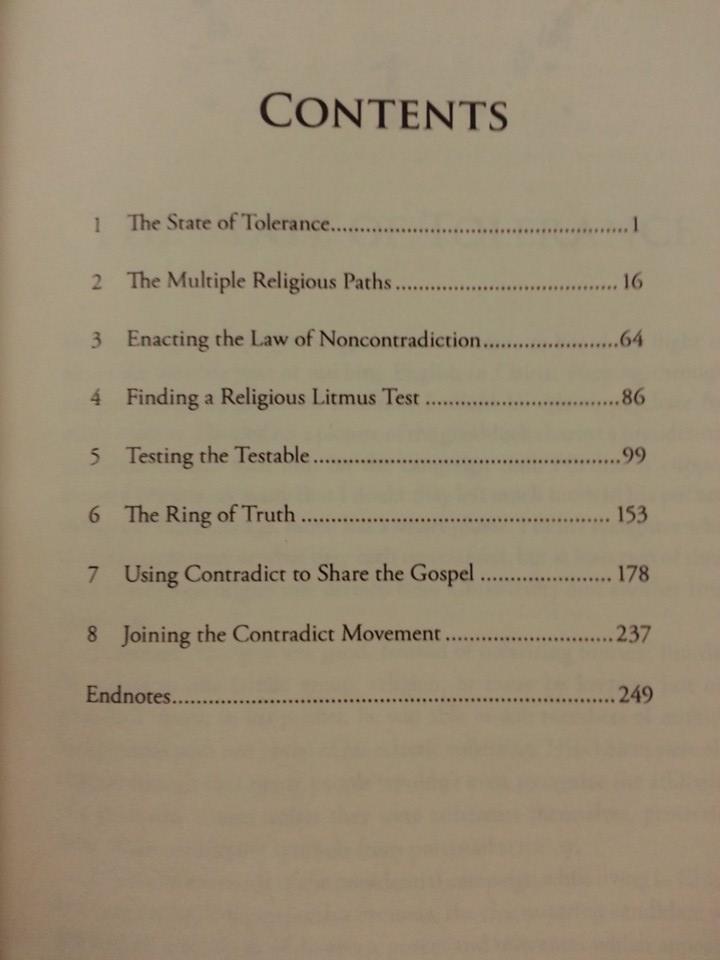
table of contents2My first published book is entitled, Contradict – They Can’t All Be True.  In case you have been wondering what’s inside the book before taking the plunge to order your copy, I have provided a brief overview of the book in this blog post:


Ch. 1 – The State of Pluralism

America’s state of religious pluralism stems from Hindu influence that crept in via the transcendental movement and came full force in the 60s counter-culture movement. The New Age Movement has direct parallels to Hindu beliefs, both of which lead to forms of religious pluralism. I share that the heart behind the movement is love, but that truth and love is lost in pluralism.

Ch. 2 – The Multiple Religious Paths

Many believe religious pluralism is true because Americans are religiously ignorant. Many of us don’t even know Christianity. So I give a 20 word glossary for Hinduism, Buddhism, Judaism, Christianity, and Islam.   If you know these 20 terms for each, you will know the basic history, teachings, and practices of the world’s five major religions.

Ch. 3 – Enacting the Law of Non-Contradiction

I then take direct quotes from the authoritative texts of each of those 5 religions and other minor religions and cults and put them under various doctrinal topics such as who God is, who man is, what mankind’s ultimate problem is, what the solution is to that problem to show the contradictions.

Ch. 4 – Finding a Religious Litmus Test

I present the historiographical tests for evaluating claims of the past and that Christianity offers a historical claim to prove or disprove the Christian faith – the resurrection.

Ch. 5 – Testing the Testable

I apply those tests to the Gospels. I present it in a way that I haven’t seen done yet in another book – so I think I’m contributing something new to the vast works that are already out there.

Ch. 6 – The Ring of Truth

I share what I call the ring of truth. The ring of truth can be found in the Bible’s details, its one unified message, its accuracy in predicting future events, and its uniqueness amongst the world’s religions.  I close this chapter by quoting Peter from Acts 2 and Jesus from Mark 16, “Repent and be baptized for the forgiveness of your sins.”

All of the book so far was in a non-Christian voice. I want anyone reading to not know where I am coming from – what I actually believe. I have not identified myself as Christian until the end of this chapter. It’s all fact based presentations. It turns me off reading most books of this nature because I don’t think my non-Christian friend would get past the first few pages in most cases the way they are written. The bias comes through too strongly in most of the books I have read making a case for the Christian faith.

Ch. 7 – Using Contradict to Share the Gospel

The Christian voice is out. This chapter focuses on sharing the Gospel using Contradict. It explains how I have used Contradict as a witnessing tool on college campuses and I explain the whole process if someone else wants to use it. I then give the 20 most asked questions after the initial conversational starter sharing that all religions can’t be true because they contradict each other, but that I believe Christianity is true and that Jesus is the son of God who died for the sins of all of mankind. Every question has several types of responses that should be utilized in the response. Validation responses show why it’s a good question and how you understand why it is being asked. Socratic method responses are questions that lead the person to the answer based on what they already know. Answer responses give multiple ways to respond to answer the question directly. Scripture responses show the verses that support the answer from God’s Word. Back the Gospel responses must always be used at the end of every answer. The Gospel saves, not our apologetics, so the answers must always be used to get back to the Gospel and often times the Gospel answers the question!

Ch. 8 – Join the Movement.

Why did I call Contradict a movement? The Holy Spirit moves each of us to action as he desires. There isn’t only one way, or method, to present the exclusive claims of Christ to be our only all-sufficient Savior. The Spirit might move some to share the Gospel exactly as I have using Contradict, but others might get other ideas on how to initiate the conversation. We might not all be led to success by the Spirit either. We might be led to persecution. Our role is simply to resign ourselves to will of God as the Spirit moves us to make disciples of all nations.

You can order my book here!